


The NFL’s first regular-season game in France was supposed to be a celebration.
But before the Pittsburgh Steelers and New Orleans Saints even kicked off, one word in France’s national anthem ignited a controversy that quickly traveled far beyond the Stade de France.
French-Canadian singer Nina Tonji performed “La Marseillaise” before Sunday’s game in Paris.
She did not sing it exactly as written.
Tonji appeared to change the famous line “Qu’un sang impur abreuve nos sillons” to “Qu’un sang uni abreuve nos sillons.”
That is a one-word change.
It is also a completely different message.
Nina Tonji performs the national anthem of France live from @StadeFrance@NFLFrance
PITvsNO on NFL Network
Stream on @NFLPlus pic.twitter.com/1JBfVCNsfz
— NFL (@NFL) October 25, 2026
The traditional word “impur” means “impure.” The word Tonji sang, “uni,” means “united.”
The original lyric is commonly rendered in English as a call for “impure blood” to water France’s fields or furrows. It comes from the violent revolutionary setting in which “La Marseillaise” was written in 1792, with the enemies of the revolution cast as the threat.
Tonji’s version replaced that image with “united blood.”
In practical terms, the altered line shifted the anthem away from excluding a foreign enemy and toward a message of unity that includes foreigners and immigrants.
French viewers heard the difference immediately.
OutKick reported that Tonji received warm applause inside the stadium, but the online reaction changed once French viewers isolated the altered line. Large French media accounts including Cerfia, RMC Sport and France TV Sport circulated the performance to millions of followers and drew attention to the substitution.
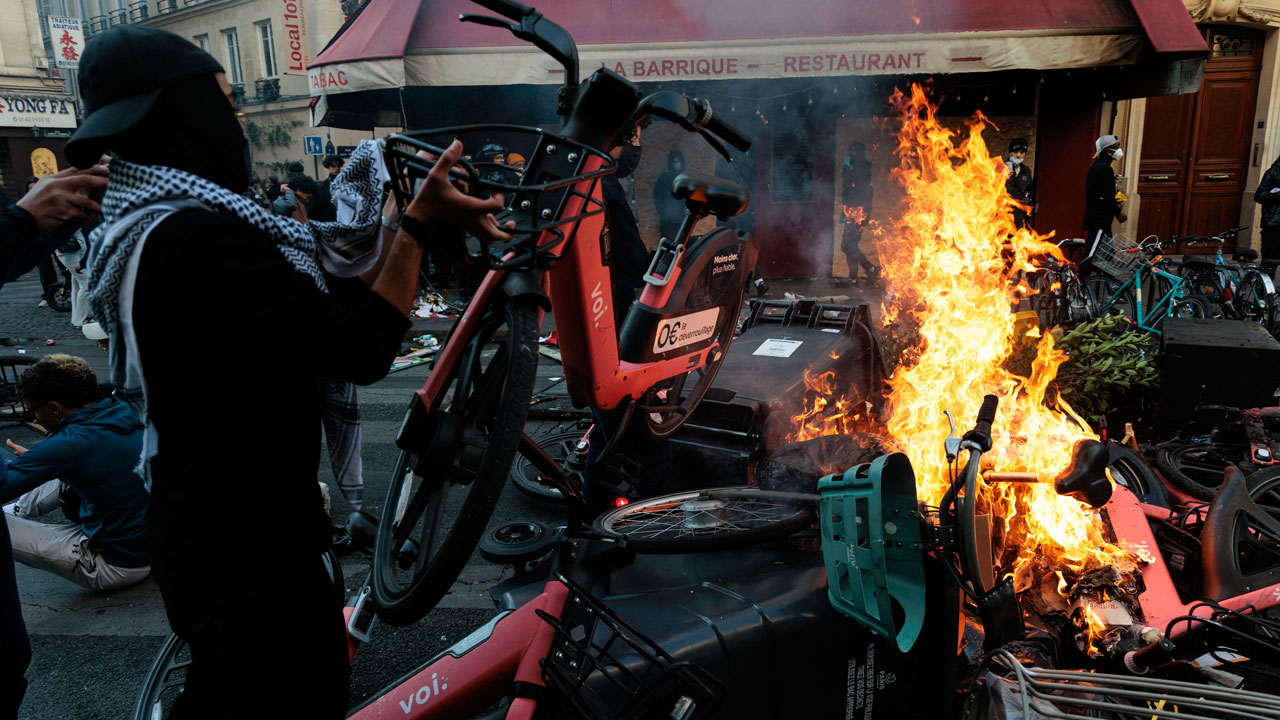
The report placed the moment in a much larger argument already consuming France. The country had endured two weeks of civil unrest, some of it involving immigrant protesters and anti-Israel demonstrations, while public anxiety about immigration and national identity remained high.
A changed word in “La Marseillaise” was therefore never going to be treated as an ordinary vocal flourish.
OutKick also reported that no public explanation from Tonji had emerged by Monday. That point matters.
The pro-immigrant effect of the rewritten line can be heard and translated directly, but her precise motive has not been independently confirmed. The evidence establishes what she sang and how it changed the meaning—not what she was privately thinking when she sang it.
French critics were not interested in giving her the benefit of the doubt.
Journalist Yves Bourdillon argued that “impure” referred to enemies and traitors in the anthem’s historical setting, not to a racial category. He also wondered how a Canadian performer would react if someone rewrote Canada’s national anthem on a major stage.
Commentator Mathieu Bock-Côté was even more direct.
He said the performer should respect the spirit and traditional delivery of “La Marseillaise” and should not treat the national anthem as though its words belonged to her to rewrite.
The reaction gets to the heart of the issue.
A national anthem is not an ordinary song selected from a performer’s catalog. It belongs to the country and carries words that generations have treated as fixed, even when those words come from a bloody and distant era.
An artist can change the key, the tempo or the vocal arrangement.
Changing the words is different.
That turns interpretation into revision.
The Gateway Pundit focused on the pro-immigrant meaning created by the substitution and the French backlash that followed. Its account traced the original “impure blood” language to the enemies and traitors of revolutionary France, then contrasted it with the “united blood” wording heard during Tonji’s performance.
The report also gathered criticism from prominent French voices who said the alteration inserted politics into a national ceremony. Bourdillon challenged the idea that the historical word carried a racial meaning, while Bock-Côté argued that a guest performer does not own the words of the anthem and should not rewrite them.
All of this unfolded during a major NFL milestone. The league has spent years expanding its international footprint, and taking a regular-season game to France for the first time was a centerpiece of that strategy.
Pittsburgh ultimately defeated New Orleans 16-10, but the altered anthem ensured the score was not the only thing people remembered.
One altered word transformed a pregame performance into a debate over immigration, patriotism and whether an invited singer has the right to rewrite a country’s anthem in front of a global audience.
The league may now face a straightforward question before its next international showcase.
Should performers be required to sing national anthems as written?
Because when the words are changed, the ceremony is no longer merely honoring the host country.
It is being used to tell that country what its anthem ought to mean.
Continue reading...
[ H/T WLT Report ]