



Sex, Spies, And The FOMC: How Beijing Turned A Senior Fed Economist Into Its "Inside Man"
For years, conspiracy theorists have insisted that the Federal Reserve is run for the benefit of a foreign power. It turns out they were - at worst - only half wrong: it's just that the foreign power in question wasn't getting the FOMC minutes through the front door, but via a lovesick Fed economist, an online dating site, a set of silk scarves, and a gym-obsessed "Ph.D. student" who, according to US officials, was actually a Chinese intelligence officer.
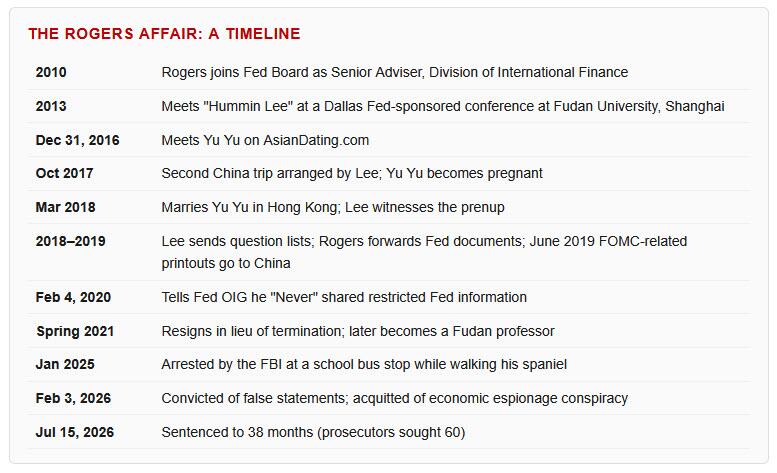
Readers may recall the name John Harold Rogers, the former senior adviser in the Fed Board's Division of International Finance whose arrest we first reported back on Feb 1, 2025, and whose case we then revisited in May 2025 under the only headline the facts allowed: "Teaching Or Treason?" In February a DC jury gave its answer (sort of): guilty of lying to investigators, not guilty of conspiracy to commit economic espionage. And in July, as we reported on July 16, Judge Dabney Friedrich sentenced him to 38 months in federal prison.
That, it seemed, was that. But now a lengthy CNBC investigation, built on text messages, investigator audio recordings, trial exhibits and copies of the Fed documents in question, fills in the gaps. And the gaps, it turns out, were where all the good stuff was hiding.
The story begins in 2013 at a conference in Shanghai, sponsored by, of all things, the Federal Reserve Bank of Dallas, on the campus of Fudan University. During a session break, a tall, broad-shouldered young man introduced himself to Rogers as Hummin Lee, a Ph.D. student. US authorities believe his real name is Jin Chuan, and that he is a Chinese spy.

A photo of Hummin Lee flexing his muscles that Lee sent to John Rogers in a text message on Aug. 4, 2018; Source: Department of Justice
What followed was textbook slow-burn cultivation. Lee sent birthday wishes and Christmas presents (including, in a detail no novelist would dare invent, a copy of Sun Tzu's The Art of War), invited Rogers to lecture in China, and kept tabs via a Facebook account featuring shirtless gym photos and, in total, six friends. After Trump won in 2016, the gift of a traditional Chinese painting arrived with a question attached: would Trump label China a currency manipulator? Rogers, to his credit, dodged.
Then came New Year's Eve 2016. Rogers, a divorced father of four grown children who later said he "kind of felt like a loser" that night, logged on to AsianDating.com and met Yu Liu, known as Yu Yu, a young woman in Shanghai 24 years his junior. Her messages were beautifully written in English. Only later did Rogers learn she didn't speak English at all.

Yu Liu and John Rogers are seen at a restaurant in a photo from a text message Rogers sent to Hummin Lee on Nov. 20, 2017; Source: Department of Justice
Retired 35-year CIA veteran Ralph Goff, who had no role in the case, told CNBC what everyone reading this is thinking:
CNBC notes it is unclear whether Yu Yu has any links to Beijing; she did not respond to questions. What is clear is that from that moment on, Rogers suddenly very much wanted to travel to China, and his generous friend Lee was only too happy to arrange it. "Your related expenses in China will all be covered by us," Lee wrote.
Lee didn't just book flights. He planned itineraries and arranged lectures. When Yu Yu needed cash, Lee wired her 5,000 "of my own money. Don't worry." When her then-husband demanded 80,000 yuan to sign divorce papers, Lee told Rogers to "go to sleep and take a good rest man," and seven hours later texted a photo of a freshly issued divorce certificate. When Rogers married Yu Yu in Hong Kong in March 2018 (she became pregnant on his second trip to China), Lee organized the logistics and witnessed the prenup. When the baby arrived that summer, Lee met Rogers at the airport and went with the couple to the hospital.
Rogers described him to Fed investigators as a "super nice guy but so nice it was a little bit spooky." Which is a useful working definition of a case officer.
Lee also introduced his "boss," a "Professor Cui," who pressed Rogers for Fed rumors and gossip and, per Rogers, offered him packets of cash (which Rogers said he declined). When the FBI searched Rogers' home years later, agents found $55,000 in cash, including some in a white plastic grocery bag at the bottom of a closet under a pile of women's clothing. Investigators could not establish where it came from.
With Rogers now thoroughly in his debt, Lee's curiosity about the Fed grew. The "classes" Rogers taught in China increasingly took place in hotel rooms with a handful of attendees. At one point Lee sent over a typed list of questions, among them:
"I'm wondering if you could help us collect answers from your colleagues or documents and teach us when we meet," Lee added, helpfully. Rogers testified these were "bread-and-butter" textbook questions. Which, to be fair, they mostly are; it's the "from your colleagues or documents" part that is less textbook.
Rogers then emailed Fed colleagues asking for material, remarking with remarkable self-awareness: "Part of it, I think, is that they want me to reveal some kind of Fed secrets they believe exist." One document he received was marked "Nonconfidential/Internal FR." According to a federal agent's testimony, Rogers changed the heading to "Nonconfidential/External" and forwarded it to Lee. On another occasion he asked a colleague for Fed thinking on trade policy uncertainty, adding: "If there is something in writing that is not allowed to be shared, please send that just for me to catch up." He received a document on washing machine tariffs, forwarded it to his personal Gmail, and from there to Lee.
Then, in June 2019, Rogers printed two documents: one from a category generally covering the staff forecasts prepared for the FOMC and open market operations (per the indictment, "Class II" FOMC information), and a set of bullet points for a briefing to Fed governors ahead of an FOMC meeting. The next day he flew to China. Three days later, he photographed a "class" in a Beijing hotel room: Lee, another man and a woman, posing by a big video monitor. Prosecutors later said both men worked for Chinese security and intelligence services.
How valuable was any of this? That was the heart of the trial. The defense argued Rogers passed nothing of value and was "a naive academic." Prosecutors argued, in their sentencing memo, that the restricted information "could allow [Beijing] to make untold sums of money by trading with its roughly $1.5 trillion in U.S. Treasury securities and related instruments." The jury, notably, was not persuaded on the espionage count. Then again, as one might note, you don't need a Fed briefing book to front-run the Fed; you just need to read Jerome Powell's press conference... or a Nick Timiraos article (well, during the Powell years at least... it appears he isn't on Warsh's Christmas Card list, or Bessent's for that matter).
Ironically, it wasn't China's MSS that brought Rogers down, but garden-variety sextortion scammers. After his marriage imploded (the Vienna, Virginia police were called after a physical fight between Yu Yu and a masseuse Rogers had invited to live in the house; "I swear to God we're just friends," Rogers told officers), he went back online.
On Instagram he traded nude photos with accounts showing attractive women, photos taken with his Fed-issued phone, sometimes in the gym at Fed headquarters.
The people behind the accounts then demanded money, and threatened to send the photos to then-Fed Vice Chair Richard Clarida. They also threatened to kidnap his 18-month-old daughter. On Super Bowl Sunday 2020, Rogers told his superiors, who referred him to the Inspector General, where the Fed's cyber team was already uneasy about his China trips and his friendship with Lee.
In a 2.5-hour recorded interview, OIG agent Alan Hershkowitz asked if he had ever taken a nude photo of himself. "No," said Rogers. Pressed, he conceded: "I can't rule it out." Asked whether he had ever shared restricted Fed information outside the Board, he answered: "Never." Prosecutors proved he had sent such a document to a co-author at Fudan. That single word is what cost him three years.
Perhaps the most damning detail, though, is about the Fed itself: Rogers was quietly allowed to resign in 2021, the circumstances were never made public, and he promptly went to teach at, yes, Fudan University, where according to prosecutors he earned at least $900,000 in salary and grants between February 2022 and his arrest. It then took more than three years for the FBI to show up at the bus stop.
If the Rogers case were an isolated incident, one could shrug it off as a lonely man getting played. But the Fed's own watchdog suggests otherwise:
So: a Fed that can't catalog its own critical assets, can't stop a retiree from USB-sticking FOMC files out the door ahead of a trip to a restricted country, and is targeted by Chinese hackers from the outside and (allegedly) cultivated insiders from the inside. Asked by CNBC whether China is still trying to penetrate the Fed, Goff's answer was one word: "Absolutely." The Fed and its IG declined to comment.
We leave the last word to Rogers himself. Asked at trial who he believed Lee really was, he replied: "A spy." And how did that make him feel?
"Duped. He was my friend."
Which, come to think of it, is also how most savers feel about the Fed.
Tyler Durden Wed, 09/30/2026 - 12:00
Continue reading...
[ H/T ZeroHedge ]
For years, conspiracy theorists have insisted that the Federal Reserve is run for the benefit of a foreign power. It turns out they were - at worst - only half wrong: it's just that the foreign power in question wasn't getting the FOMC minutes through the front door, but via a lovesick Fed economist, an online dating site, a set of silk scarves, and a gym-obsessed "Ph.D. student" who, according to US officials, was actually a Chinese intelligence officer.
Readers may recall the name John Harold Rogers, the former senior adviser in the Fed Board's Division of International Finance whose arrest we first reported back on Feb 1, 2025, and whose case we then revisited in May 2025 under the only headline the facts allowed: "Teaching Or Treason?" In February a DC jury gave its answer (sort of): guilty of lying to investigators, not guilty of conspiracy to commit economic espionage. And in July, as we reported on July 16, Judge Dabney Friedrich sentenced him to 38 months in federal prison.
That, it seemed, was that. But now a lengthy CNBC investigation, built on text messages, investigator audio recordings, trial exhibits and copies of the Fed documents in question, fills in the gaps. And the gaps, it turns out, were where all the good stuff was hiding.
Meet "Hummin Lee"
The story begins in 2013 at a conference in Shanghai, sponsored by, of all things, the Federal Reserve Bank of Dallas, on the campus of Fudan University. During a session break, a tall, broad-shouldered young man introduced himself to Rogers as Hummin Lee, a Ph.D. student. US authorities believe his real name is Jin Chuan, and that he is a Chinese spy.
A photo of Hummin Lee flexing his muscles that Lee sent to John Rogers in a text message on Aug. 4, 2018; Source: Department of Justice
What followed was textbook slow-burn cultivation. Lee sent birthday wishes and Christmas presents (including, in a detail no novelist would dare invent, a copy of Sun Tzu's The Art of War), invited Rogers to lecture in China, and kept tabs via a Facebook account featuring shirtless gym photos and, in total, six friends. After Trump won in 2016, the gift of a traditional Chinese painting arrived with a question attached: would Trump label China a currency manipulator? Rogers, to his credit, dodged.
Then came New Year's Eve 2016. Rogers, a divorced father of four grown children who later said he "kind of felt like a loser" that night, logged on to AsianDating.com and met Yu Liu, known as Yu Yu, a young woman in Shanghai 24 years his junior. Her messages were beautifully written in English. Only later did Rogers learn she didn't speak English at all.
Yu Liu and John Rogers are seen at a restaurant in a photo from a text message Rogers sent to Hummin Lee on Nov. 20, 2017; Source: Department of Justice
Retired 35-year CIA veteran Ralph Goff, who had no role in the case, told CNBC what everyone reading this is thinking:
CNBC notes it is unclear whether Yu Yu has any links to Beijing; she did not respond to questions. What is clear is that from that moment on, Rogers suddenly very much wanted to travel to China, and his generous friend Lee was only too happy to arrange it. "Your related expenses in China will all be covered by us," Lee wrote.
The full-service handler
Lee didn't just book flights. He planned itineraries and arranged lectures. When Yu Yu needed cash, Lee wired her 5,000 "of my own money. Don't worry." When her then-husband demanded 80,000 yuan to sign divorce papers, Lee told Rogers to "go to sleep and take a good rest man," and seven hours later texted a photo of a freshly issued divorce certificate. When Rogers married Yu Yu in Hong Kong in March 2018 (she became pregnant on his second trip to China), Lee organized the logistics and witnessed the prenup. When the baby arrived that summer, Lee met Rogers at the airport and went with the couple to the hospital.
Rogers described him to Fed investigators as a "super nice guy but so nice it was a little bit spooky." Which is a useful working definition of a case officer.
Lee also introduced his "boss," a "Professor Cui," who pressed Rogers for Fed rumors and gossip and, per Rogers, offered him packets of cash (which Rogers said he declined). When the FBI searched Rogers' home years later, agents found $55,000 in cash, including some in a white plastic grocery bag at the bottom of a closet under a pile of women's clothing. Investigators could not establish where it came from.
The "questions"
With Rogers now thoroughly in his debt, Lee's curiosity about the Fed grew. The "classes" Rogers taught in China increasingly took place in hotel rooms with a handful of attendees. At one point Lee sent over a typed list of questions, among them:
- Why the dollar wasn't appreciating much despite repeated Fed hikes;
- How the Fed evaluated China's financial liberalization;
- And, our favorite: "How does the Fed evaluate the trade war with China proposed by Trump? Will the Fed adjust monetary policy to cooperate with the trade war? What specific measures will the Fed take?"
"I'm wondering if you could help us collect answers from your colleagues or documents and teach us when we meet," Lee added, helpfully. Rogers testified these were "bread-and-butter" textbook questions. Which, to be fair, they mostly are; it's the "from your colleagues or documents" part that is less textbook.
Rogers then emailed Fed colleagues asking for material, remarking with remarkable self-awareness: "Part of it, I think, is that they want me to reveal some kind of Fed secrets they believe exist." One document he received was marked "Nonconfidential/Internal FR." According to a federal agent's testimony, Rogers changed the heading to "Nonconfidential/External" and forwarded it to Lee. On another occasion he asked a colleague for Fed thinking on trade policy uncertainty, adding: "If there is something in writing that is not allowed to be shared, please send that just for me to catch up." He received a document on washing machine tariffs, forwarded it to his personal Gmail, and from there to Lee.
Then, in June 2019, Rogers printed two documents: one from a category generally covering the staff forecasts prepared for the FOMC and open market operations (per the indictment, "Class II" FOMC information), and a set of bullet points for a briefing to Fed governors ahead of an FOMC meeting. The next day he flew to China. Three days later, he photographed a "class" in a Beijing hotel room: Lee, another man and a woman, posing by a big video monitor. Prosecutors later said both men worked for Chinese security and intelligence services.
How valuable was any of this? That was the heart of the trial. The defense argued Rogers passed nothing of value and was "a naive academic." Prosecutors argued, in their sentencing memo, that the restricted information "could allow [Beijing] to make untold sums of money by trading with its roughly $1.5 trillion in U.S. Treasury securities and related instruments." The jury, notably, was not persuaded on the espionage count. Then again, as one might note, you don't need a Fed briefing book to front-run the Fed; you just need to read Jerome Powell's press conference... or a Nick Timiraos article (well, during the Powell years at least... it appears he isn't on Warsh's Christmas Card list, or Bessent's for that matter).
Undone by... Instagram
Ironically, it wasn't China's MSS that brought Rogers down, but garden-variety sextortion scammers. After his marriage imploded (the Vienna, Virginia police were called after a physical fight between Yu Yu and a masseuse Rogers had invited to live in the house; "I swear to God we're just friends," Rogers told officers), he went back online.
On Instagram he traded nude photos with accounts showing attractive women, photos taken with his Fed-issued phone, sometimes in the gym at Fed headquarters.
The people behind the accounts then demanded money, and threatened to send the photos to then-Fed Vice Chair Richard Clarida. They also threatened to kidnap his 18-month-old daughter. On Super Bowl Sunday 2020, Rogers told his superiors, who referred him to the Inspector General, where the Fed's cyber team was already uneasy about his China trips and his friendship with Lee.
In a 2.5-hour recorded interview, OIG agent Alan Hershkowitz asked if he had ever taken a nude photo of himself. "No," said Rogers. Pressed, he conceded: "I can't rule it out." Asked whether he had ever shared restricted Fed information outside the Board, he answered: "Never." Prosecutors proved he had sent such a document to a co-author at Fudan. That single word is what cost him three years.
Perhaps the most damning detail, though, is about the Fed itself: Rogers was quietly allowed to resign in 2021, the circumstances were never made public, and he promptly went to teach at, yes, Fudan University, where according to prosecutors he earned at least $900,000 in salary and grants between February 2022 and his arrest. It then took more than three years for the FBI to show up at the bus stop.
Is the Fed a sieve?
If the Rogers case were an isolated incident, one could shrug it off as a lonely man getting played. But the Fed's own watchdog suggests otherwise:
- On the same day Rogers was sentenced, the Fed's OIG reported that the central bank lacked "a process to identify its critical assets" and needed a program to manage insider risk, warning that the Board's proprietary economic information "is of great interest to foreign adversaries."
- Then, in a report published last week, the OIG revealed that another Division of International Finance employee (same division as Rogers!) retiring in July 2024 potentially walked out with FOMC-classified information after generating 279 data-loss alerts in the final 90 days, 139 of them involving potentially sensitive FOMC material. The same employee had a history of copying FOMC files to unencrypted USB drives and emailing them to a personal address, and had traveled to a Fed-designated restricted country in June 2024. The Fed only found out a year later, and never opened a formal misconduct probe. The OIG blamed "a collective lack of action across multiple divisions."
- And in August, as we reported on Aug 26, the DOJ and FBI announced the takedown of platforms used by QTFY, a PRC state-sponsored hacking group whose targets included NASA, the DOJ, the Senate... and the Federal Reserve.
So: a Fed that can't catalog its own critical assets, can't stop a retiree from USB-sticking FOMC files out the door ahead of a trip to a restricted country, and is targeted by Chinese hackers from the outside and (allegedly) cultivated insiders from the inside. Asked by CNBC whether China is still trying to penetrate the Fed, Goff's answer was one word: "Absolutely." The Fed and its IG declined to comment.
We leave the last word to Rogers himself. Asked at trial who he believed Lee really was, he replied: "A spy." And how did that make him feel?
"Duped. He was my friend."
Which, come to think of it, is also how most savers feel about the Fed.
Tyler Durden Wed, 09/30/2026 - 12:00
Continue reading...
[ H/T ZeroHedge ]