







"Where Is The Onshoring?" UBS Questions White House Investment Boom As Foreign Money Flows Into Takeovers
President Trump recently said that over $20 trillion in foreign investment has flowed into the US so far in his second term.
“We have more money being spent from outside countries and companies. Over $20 trillion. That’s five, six, seven times higher than any country. Not just here, any country ever,” Trump said, adding that the total could climb to $25 trillion by the end of his term.
Yet UBS economist Arend Kapteyn wrote in a new note on Thursday that new foreign direct investment totaled $232 billion in 2025, roughly $30 billion below its 10-year average. He said that, adjusted for inflation, investment that year was below every pre-pandemic year.
“One way to assess whether manufacturing is being ‘onshored’ to the US is through foreign direct investment (FDI) data,” Kapteyn said.
Kapteyn’s findings clash with the White House’s narrative of the early innings of a durable manufacturing revival. The latest White House tracker lists trillions of dollars in announced US and foreign investments, with commitments from the United Arab Emirates, Qatar, Japan, Saudi Arabia, India and South Korea alone exceeding $5 trillion.
Kapteyn continued:
Yet little of this is visible in the BEA's New Foreign Direct Investment data (chart below).
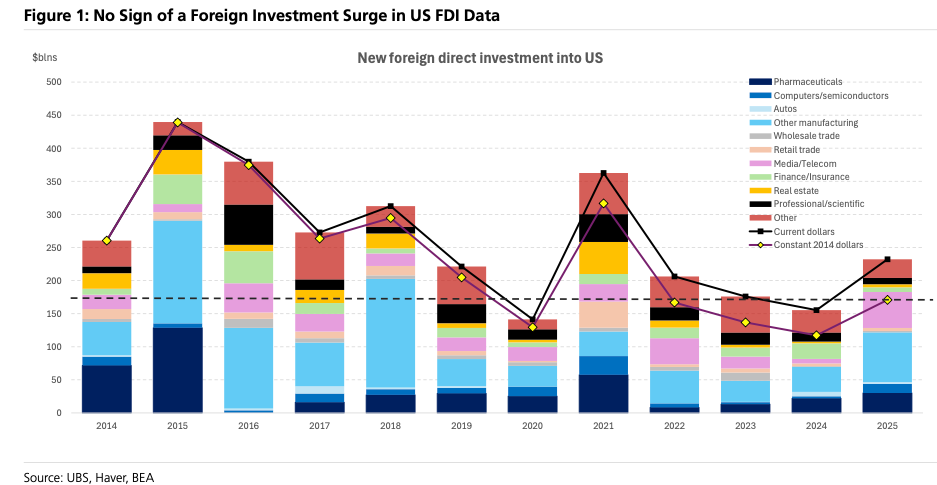
New FDI totaled just $232bn in 2025, around $30bn below its 10-year average and, in real terms, lower than in any pre- pandemic year. There was a modest pickup relative to 2022-24, driven mainly by media/ telecoms and primary metals (within 'other manufacturing), but no broad-based investment surge.
Also note that, 94% of new foreign investment took the form of acquisitions of existing US firms. Only 2% reflected the creation of new businesses and 4% the expansion of existing foreign-owned operations, suggesting that foreign capital is largely changing ownership rather than adding new productive capacity.
The gap between the data Kapteyn analyzed and the White House's announcements may partly reflect the lag between investment pledges and actual spending. The bigger question is how much of that money will ultimately finance new US production capacity, rather than acquisitions of existing businesses.
Tyler Durden Sat, 10/03/2026 - 09:55
Continue reading...
[ H/T ZeroHedge ]
President Trump recently said that over $20 trillion in foreign investment has flowed into the US so far in his second term.
“We have more money being spent from outside countries and companies. Over $20 trillion. That’s five, six, seven times higher than any country. Not just here, any country ever,” Trump said, adding that the total could climb to $25 trillion by the end of his term.
President Trump stuns the World by saying our Manufacturing is higher than ever and $20 Trillion dollars is being invested into America
"No country in HISTORY has ever been close”
THIS IS EXACTLY WHAT I VOTED FOR
Follow @mr_pool001 pic.twitter.com/qPr4i4INN2
— Mr pool (@mr_pool001) October 1, 2026
Yet UBS economist Arend Kapteyn wrote in a new note on Thursday that new foreign direct investment totaled $232 billion in 2025, roughly $30 billion below its 10-year average. He said that, adjusted for inflation, investment that year was below every pre-pandemic year.
“One way to assess whether manufacturing is being ‘onshored’ to the US is through foreign direct investment (FDI) data,” Kapteyn said.
Kapteyn’s findings clash with the White House’s narrative of the early innings of a durable manufacturing revival. The latest White House tracker lists trillions of dollars in announced US and foreign investments, with commitments from the United Arab Emirates, Qatar, Japan, Saudi Arabia, India and South Korea alone exceeding $5 trillion.
Kapteyn continued:
Yet little of this is visible in the BEA's New Foreign Direct Investment data (chart below).
New FDI totaled just $232bn in 2025, around $30bn below its 10-year average and, in real terms, lower than in any pre- pandemic year. There was a modest pickup relative to 2022-24, driven mainly by media/ telecoms and primary metals (within 'other manufacturing), but no broad-based investment surge.
Also note that, 94% of new foreign investment took the form of acquisitions of existing US firms. Only 2% reflected the creation of new businesses and 4% the expansion of existing foreign-owned operations, suggesting that foreign capital is largely changing ownership rather than adding new productive capacity.
The gap between the data Kapteyn analyzed and the White House's announcements may partly reflect the lag between investment pledges and actual spending. The bigger question is how much of that money will ultimately finance new US production capacity, rather than acquisitions of existing businesses.
Tyler Durden Sat, 10/03/2026 - 09:55
Continue reading...
[ H/T ZeroHedge ]