






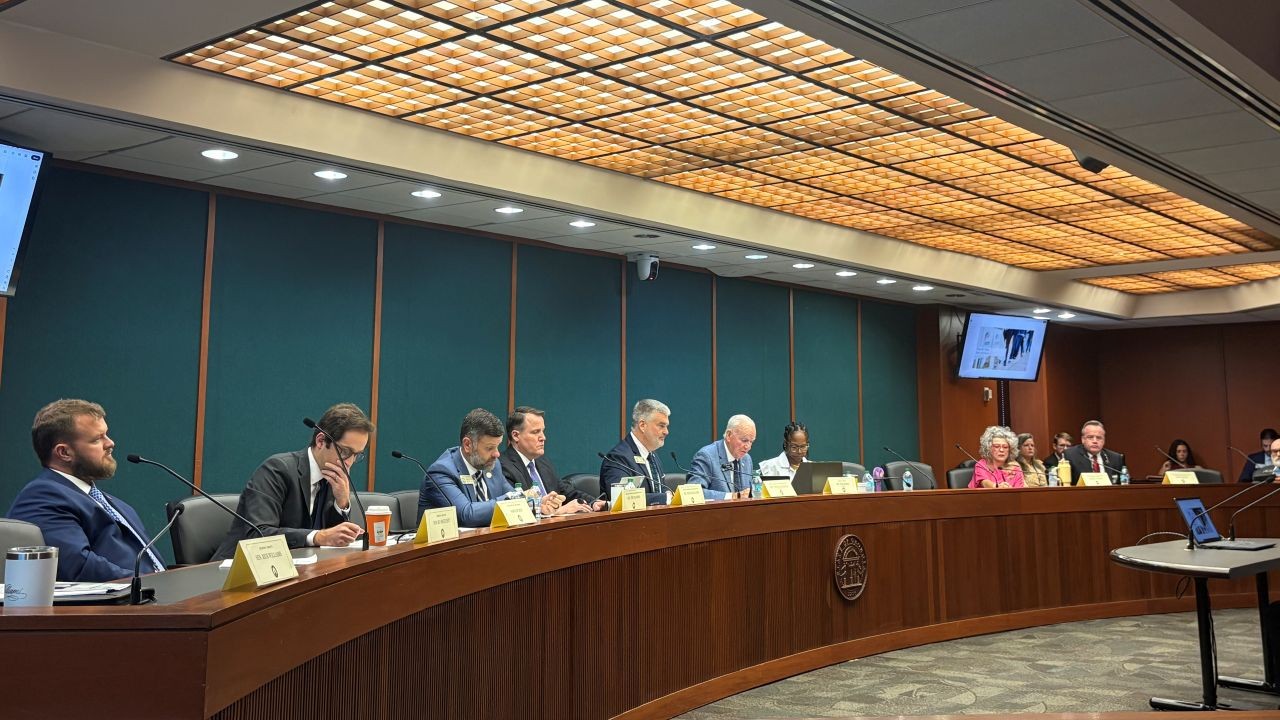
ATLANTA—On Thursday, the Joint Election Equipment Specifications and Standards Committee held its fourth meeting at the Georgia Statehouse to hear from vendors about what sets their systems and machines apart from others.
This all comes as part of a large-scale effort to create specifications and standards for the state’s next election system.
The committee is co-chaired by state Sen. Max Burns, R-Sylvania, and state Rep. Victor Anderson, R-Cornelia.
Hart InterCivic Showcases Its Security Measures
The first vendor to present was Hart InterCivic, and Sam Derheimer, director of government affairs, spoke. “We were the first in the country to certify a full election system to the VVSG 2.0 federal standard,” he said. “Hart … advise[d] [the Department of] Homeland Security on election administration and election security.”
Derheimer added that, “We do not tabulate votes from barcodes or QR codes.”
This comes after the state’s push to ban QR codes for tabulation after July 1, 2026, based on legislation instituted in 2024.
Derheimer continued, “Our BMDs [ballot-marking devices] and our scanners use optical character recognition to read and record the words on the ballot, the same words your eyes can read, to tabulate your vote selections.”
Shawn Phillips, a sales engineer for the company, said, “It’s important that that system is completely offline, it’s certified, [and] it can never be connected to any sort of outside network.”
Referring to two-factor authentication, Phillips said, “What it means is [that] no one can access these devices, no one can open polls, close polls, or get into any menu other than what is voter-facing without having a physical card. … And they have to know the passcode.”
“If anyone is trying to do something to the [voting] machine that they shouldn’t, it’s going to alarm, that alarm will not be silenced until someone who has the proper credentials comes in [and] investigates,” Phillips added.
Deidre Holden, a Paulding County elections and voter registration director and committee member, asked the presenters about updates and the protocol for implementing them to the voting machines.
Phillips replied, “We already have the first update to the Verity Vanguard system; we will be in constant communication with our customers, including the state of Georgia, to what these updates are. You are then able to decide whether you want that update or not, if it’s pertinent to your needs here in the state.”
State Rep. Scott Holcomb, D-Atlanta, asked the representatives about the lifespan of the voting machine systems. One of the representatives from the company, Dwayne Broxton, the company’s director of sales, said, “With technology moving forward as fast as it does, you’re looking at at least a decade of use in a system.”
What Sets Runbeck Apart
The next vendor to present was Runbeck Election Services, and Kabir Chopra, the national director of sales for the organization, spoke, highlighting the company’s “Sentio ballot print-on-demand.”
He described the Ballot Guard security paper the company offers, which includes “five layers of security.” It features five different components so “you know every single ballot that was casted by your voters is secure. If anyone was trying to duplicate or replicate a ballot, they would have to have all five layers of that security built in.”
Anthony Paiz, chief product officer for the company, spoke next, discussing what differentiates the company from other vendors. He noted that the company is “vendor agnostic,” meaning that the “existing tabulation system would interface exactly as it does with [the company’s] ballot-on-demand system.”
However, he did add that, “There is no certification for ballot-on-demand currently at a federal level.”
Following the Q-and-A session with the presenters and the committee members, Burns said, “[Runbeck is] going to be the direction that we feel that the state will likely choose to adopt.”
Election Systems and Software Offers Solutions
Tucker Omel, director of sales engineering for Election Systems and Software (ES&S), said, “You [the committee] are keenly interested in ballot-on-demand. We have a ballot-on-demand solution as well. It is fully integrated with any pollbook vendor that you’d like to use, including our own poll book.”
He added, “Just know, everything is paperbacked. ES&S is, on record, supportive of paper ballots.”
He also explained the company’s audit procedure, saying, “That ballot is now made unique, anonymously unique. … You can see exactly, hold that ballot in your hand and see exactly how it was tabulated by the machine.”
Additionally, the company’s slideshow presentation said, “No barcodes or QR codes are used to count votes.”
However, Jeb Cameron, a senior executive for the company, said that the systems “are currently in testing today for 2.0 certification.” As it stands today, the system “has been certified to the 1.0 standards.”
Holden said to the ES&S representatives, “I think that it’s very important that we have [a] relationship with whatever vendor we have, not just to sell us a product, but to be there with us through the roughest times we go through.”
Burns said to the presenters, “We’re [the committee is] leaning in the direction of ballot on-demand printing.”
Following the discussion, the vendors showcased their systems and machines, and public comment was heard. Burns closed the committee meeting by announcing the next meeting, which will take place on Oct. 15 at the Statehouse.
Continue reading...
[ H/T The Daily Signal ]