





Futures Slide As Market Runs Out Of AI Patience, Oil Jumps On Saudi Attacks
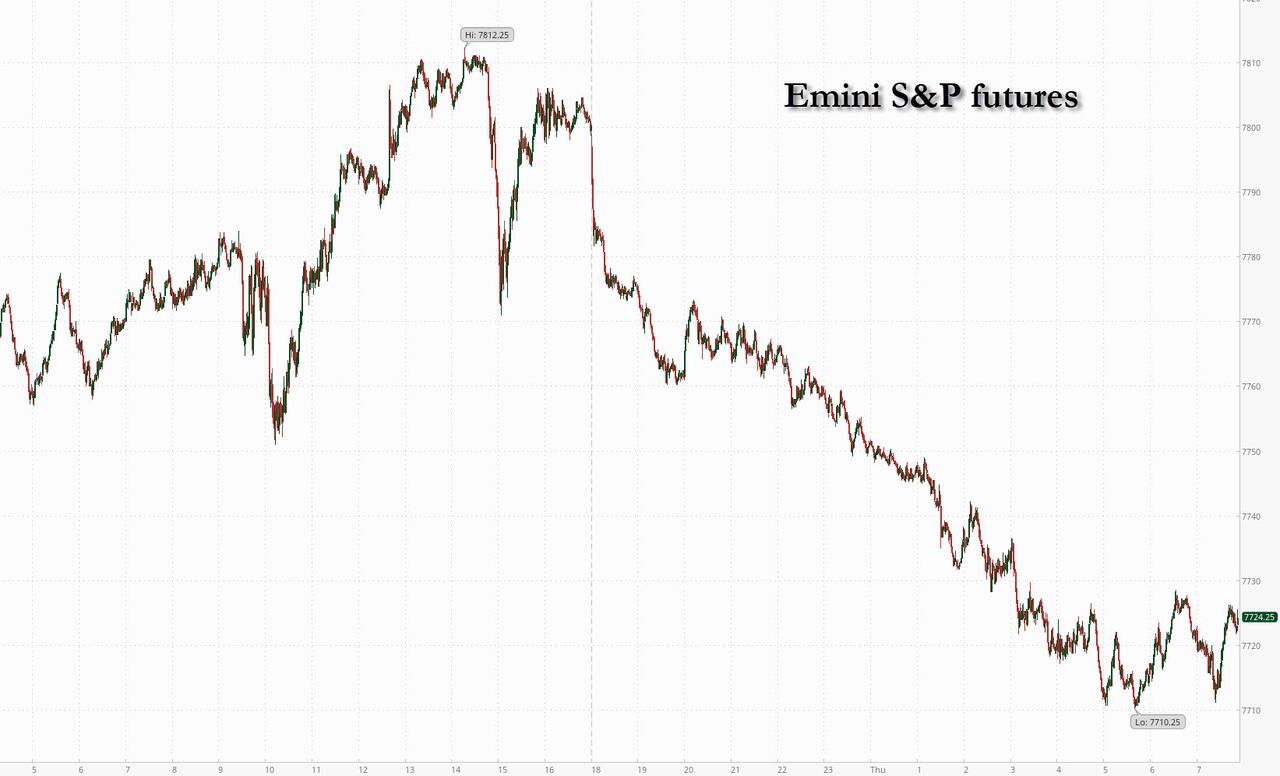
US futures are lower as the AI trade discovered that there is no right answer on capex: Meta spent more, Tesla spent less, and the market slammed both (after an initial kneejerk bounce), while a fresh wave of deadly attacks on Saudi Arabia, a US-ordered departure of diplomats from the kingdom and an NYT report that the US and Israel have drawn up plans for renewed strikes on Iran after the midterms sent Brent back above $112; as a result the flight to quality is back on, with 10Y yields sliding 9bps to 5.03% even as oil jumps and French bond yields soar. As of 8:00am ET, S&P futures are 1.0% lower at 7,720.75 while Nasdaq futures are down 1.7% at 29,507.50 and Dow futures are 0.6% lower. Wednesday's session closed near its highs, with the S&P rising 0.6% to 7,757 for a third straight gain and closing within 1% of its record high, as the SpaceX blowout revived the AI trade. In premarket trading, all Mag 7 names are red led by Tesla, which drops 4.4% after cutting its 2026 capex target to about $20 billion from more than $25 billion, while Meta reversed an after-hours gain of as much as 5% to trade down about 1.5% as investors focused on its hedged 2027 spending commentary (as we noted last night, the stock erased most of its gains after the CFO warned "significant investment" will raise serving costs); Lam Research tumbles 8% on a soft forecast, dragging chipmakers including AMD, Broadcom and Intel. The day's driver is oil (again): Brent rose as much as 3.3% to $112.43 and WTI briefly topped $100 after two attacks on an Aramco oil field and an airport in Saudi Arabia's Eastern Province killed at least three people, Aramco told staff to evacuate its Dhahran headquarters, and the IRGC Navy warned US bases could be targeted if Washington keeps "encouraging" ships through the Strait of Hormuz. Treasuries are bid across the curve in a bull steepener as AI doubts and another spike in French yields drive a haven bid; the OAT-Bund spread blew out by as much as 18bps to 177bps, the widest since 2011. The yen and Swiss franc lead G10 FX, with EUR/JPY at the lowest in almost a year, while the Bloomberg dollar index is little changed. Gold is down 1.3% near $4,085 and silver is down more than 3%, refusing to play haven, copper slides with the AI trade, and Bitcoin slipped below $82,000. US economic data slate includes weekly initial jobless claims (8:30am), the September leading index (10am) and the October Kansas City Fed manufacturing index (11am), and Treasury auctions resume with a $26 billion 5-year TIPS new issue (1pm). The Fed is in its blackout period ahead of next Wednesday's decision.
In premarket trading, all Mag 7 names are lower: Tesla (TSLA) drops 4.4% after the electric-car maker cut its spending plans, following capital investment that trailed expectations last quarter (Nvidia (NVDA) -2%, Alphabet (GOOGL) -2%, Amazon (AMZN) -2%, Meta Platforms (META) -2%, Microsoft (MSFT) -0.9%, Apple (AAPL) -0.2%)
In other corporate news, Meta did its best to change the subject from capex, announcing a one-time dividend of non-voting Class C shares that effectively amounts to a 2-for-1 split and, per Bloomberg, gives Mark Zuckerberg shares he can sell without giving up control as a proposed California wealth tax looms; Tesla CEO Elon Musk wants to combine Tesla and SpaceX in a $3.7 trillion deal and is rushing to get it done before Trump leaves office, according to Bloomberg; the US signed a deal with Lockheed Martin for a minimum of 850 F-35 jets; Comcast reported 3Q adjusted EPS of $1.07 vs an estimate of 98c; Blackstone's 3Q distributable income of $1.32 a share beat the $1.26 estimate; American Airlines sees a 4Q adjusted loss of 50c to $1.10 a share, vs an estimated loss of 49c; Spotify sees 4Q MAUs of 818 million, a hair below the 819.08 million estimate; Barclays is cutting 5,000 jobs, about 5% of headcount, as it adopts AI across the bank; EQT's bid for Qiagen is now firm at €46.50 a share in cash; and Chinese AI startup DeepSeek raised about 100 billion yuan ($15 billion) in its latest fundraising round.
Bloomberg sums up the overnight mood succinctly: "AI nerves are back." The bar for an AI beat has moved from ambition to monetization, and the market is no longer giving credit for spending plans alone: Meta lifted the bottom of its 2026 capex range to $135 billion from $130 billion and guided above consensus, Tesla cut its capex target after third-quarter spending came in at $4.73 billion vs $7.95 billion expected, and both stocks are lower. Spend more or spend less, the market frowned either way. IBM swung from a 5% gain to a 4.6% loss in late trading even after saying slipped infrastructure deals had come back, a reminder that software is no safe corner of the AI trade either. All of this comes as hyperscaler credit spreads sit at record wides (as we noted in last night's wrap) and as Ken Griffin calls AI "almost certainly" a bubble.
“Markets are basically telling us we are moving on from trading AI vibes and narrative to now requiring a pretty high bar for what an earnings beat looks like,” said Kaanhari Singh, APAC head of equity derivatives sales at Barclays, on Bloomberg TV. “That’s both in terms of capex forward guidance, but also for the path of monetization.”
Tesla and Lam results put “the AI confidence back in the air again, dragging a few other semi names lower,” said Anna Wu, an investment strategist and founder of Floodlines Research.
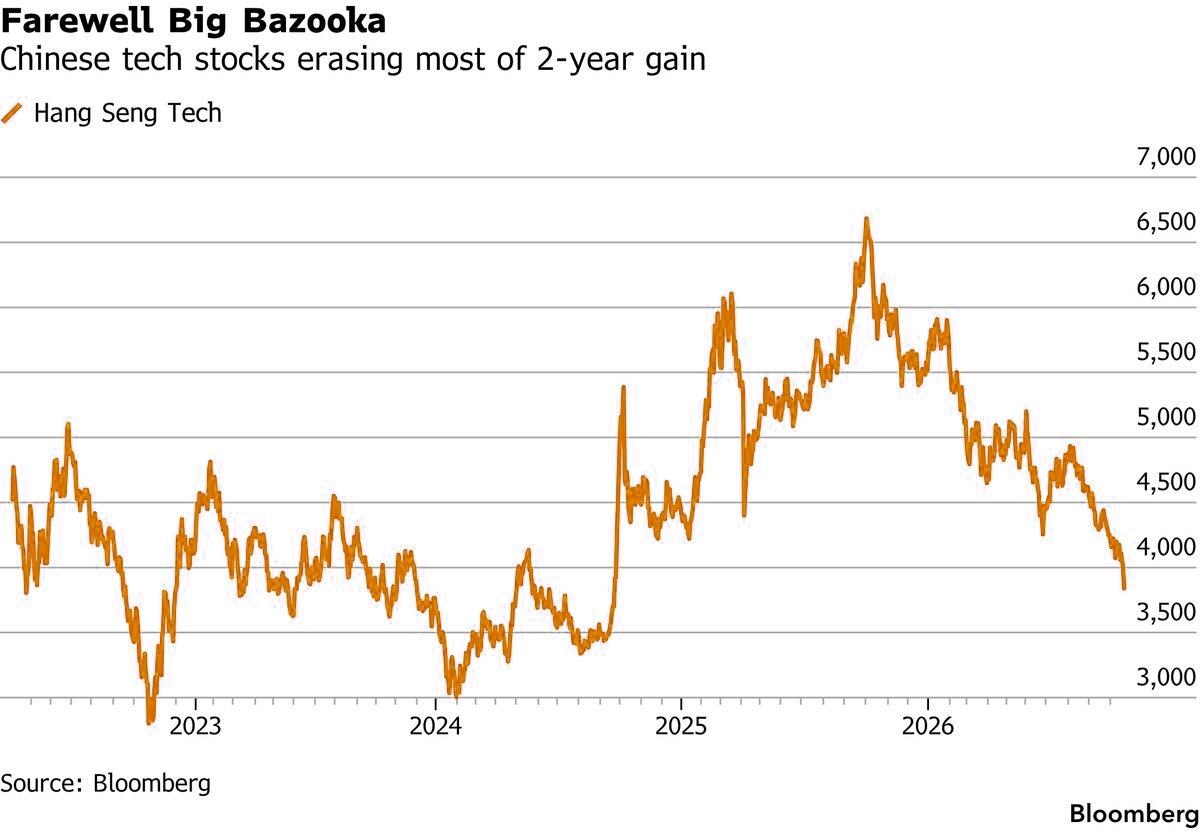
The pain was most acute in Asia, where the CSI 300 briefly entered a bear market, down 20% from its June highs, and Chinese e-commerce names including Alibaba slumped after the market regulator urged platforms to tighten product quality controls. Chinese tech stocks are now erasing most of their 2-year gain.
JPM's Market Intel desk calls it a "narrative shift overnight amid geopolitics concerns": Wednesday's session closed near its highs with AI/Tech and Momentum leading, but that tone reversed overnight. Beyond the NYT Iran headline, the desk says underlying price action and trading desk feedback point to "the still fragile narrative around AI financing concerns and the lack of conviction / re-grossing from the recent tech reversal." The team stays Tactically Bullish, favoring cyclicals outside tech while selectively buying tech weakness in semis and memory. JPM specialist Mark Schilsky called Meta's quarter in line, with a Q4 revenue guide that is "decidedly better than expected," but noted the 2027 commentary "will leave some investors wanting" and that the new Class C shares likely mean an equity raise is coming, just not until early 2027: "The overhang lives on!" Meanwhile, JPM credit trader William Jarvis notes the bank's HY AI basket is trading at all-time wides, 97bps wider than its July peak, mostly led by CoreWeave, with Oracle widening far more than the rest of IG (as Barclays warned, the AI credit flush won't be the last).
Over at Goldman, Rich Privorotsky flagged the capex whiplash: "Tesla actually cut FY capex guidance from >$25bn to ~$20bn, completely out of sync with what SpaceX was telling us earlier this week. Could be sequencing, but the market doesn't like capex going backwards." He also notes the NYT report means "we've now effectively stapled another potential escalation event to the calendar" right after the midterms, and that prime data shows one of the most pronounced net tech reductions in recent memory. The GS desk adds that hedge funds have heavily net sold global equities in October, with short sales outpacing long buys about 5 to 1, and short leverage at the 99th percentile; with positioning this defensive, the derivatives desk sees right-tail hedges as historically cheap. In Asia, Goldman's prime book shows L/S managers down 1.5% intraday and 8.6% month to date.
In Europe, the French bond rout that has carried out London macro traders deepened: France's 10Y yield hit 5.14% and its risk premium over bunds widened to 177bps, the most since 2011, as the government prepares to deploy soldiers to free up police for Saturday's protests and Paris luxury boutiques brace for more unrest. Goldman has built a fragmentation alarm to gauge how close Europe is to another "whatever it takes" moment; M&G is not worried just yet.
“We don’t believe that France needs to be bailed out. There’s no concern about this,” said M&G Asset Management CEO Joseph Pinto on Bloomberg TV. “We believe it’s a sound and solid country. It just needs to act on its budget and provide something that reassures markets.”
In Europe, the Stoxx 600 is down 0.9% at 638.75, with 445 members down and 146 up, as mixed results from US tech revive concerns about the AI trade. Miners and banks are the worst performing sectors, while telecoms, food and beverage and health care are the only gainers; JPM notes semis and electrification baskets are among the top underperformers, with only defensives and rate-sensitive baskets in the green as beta and momentum are sold. Hermès slumps after its Asia-Pacific sales disappointed, while UCB soars after raising guidance. Here are the biggest European movers:
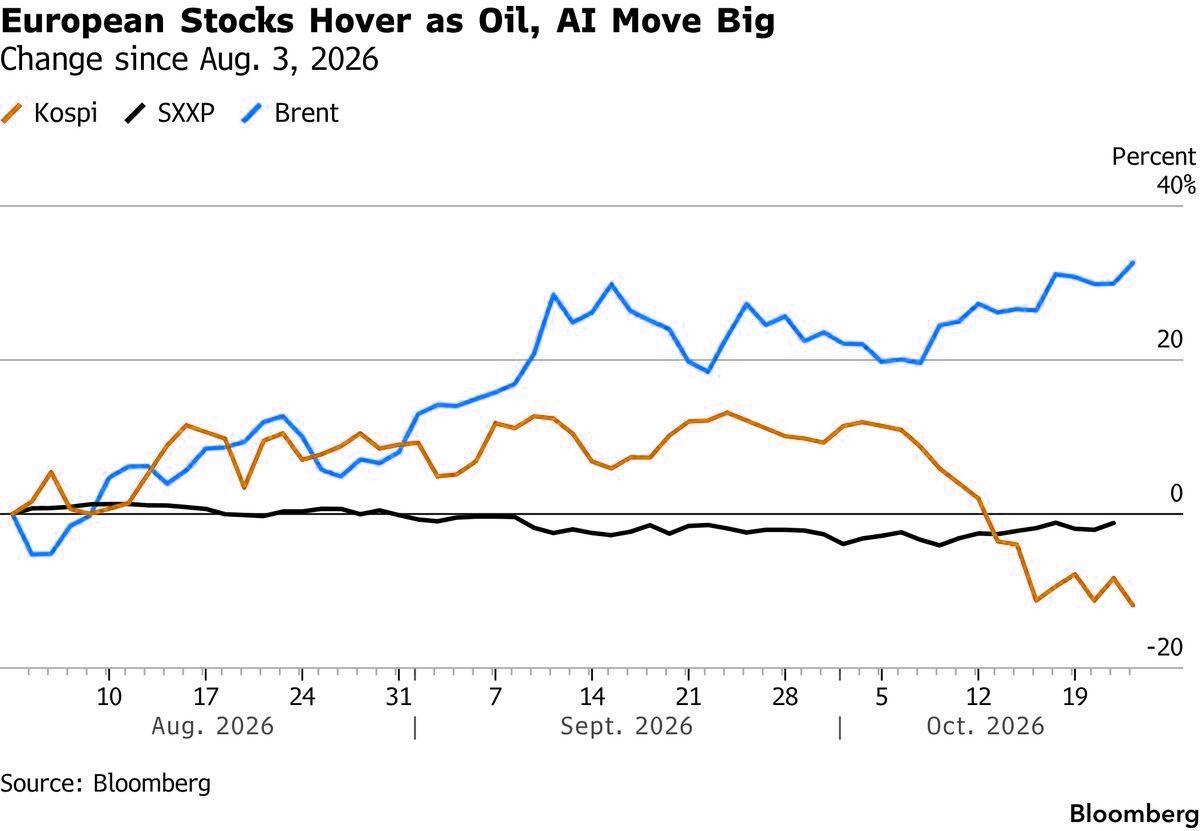
Europe's Wednesday gains now look like borrowed strength: the Stoxx 600 has gone nowhere since early August while Brent and the Kospi have moved big.
Asian stocks fell sharply, with the MSCI Asia Pacific Index dropping more than 1.5% to head for its lowest close since July 30, as underwhelming US tech earnings and higher oil broadened the AI selloff across the region. According to Goldman's regional wrap, South Korea's Kospi sank 3.5% with SK Hynix down 5.5% and Samsung down 4%, the Hang Seng fell 3%, its biggest drop since March, with the Hang Seng Tech index down about 5% as Alibaba and Lenovo slumped, and the Nikkei 225 dropped 2.7% to break below 64,000 as Advantest, Tokyo Electron (-7%) and SoftBank (-6.9%) accounted for about 62% of the index's losses. China's CSI 300 fell 1.8% and is now 20% off its June high, Taiwan's Taiex lost 1.8% and Australia's ASX 200 slipped 0.4%, while Indonesia was the regional outlier, rising 1.1% as the sovereign wealth fund said it was buying local stocks. The Bank of Korea held rates at 3% but said growth would be "considerably higher" than projected, signaling more tightening to come.
In FX, the Bloomberg Dollar Spot Index is little changed and the DXY trades in a 101.44-101.73 range, pressured by lower yields. The yen is the standout, rising to its strongest against the euro in almost a year, with EUR/JPY falling as much as 1.1% to 175.64, its biggest drop in seven weeks, and USD/JPY dropping as much as 0.9% to 156.77, down for a third day; real money funds have been buying the yen, traders say, while the Swiss franc rose to its strongest against the euro since early July. Bloomberg's Vassilis Karamanis notes the dollar now trades "almost as a clean function of Treasuries: once 10-year yields slipped below 5.10%, the dollar was sold further." The kiwi lags after cooler-than-expected New Zealand CPI, the Egyptian pound hit a record low, and Turkey's central bank cut its one-week repo rate by 100bps to 36%, its first cut since the start of the Iran war and in line with estimates.
Declines in Japanese equities are fueling risk-off sentiment, while recent stability in the Japanese government bond market is also supporting the yen, Hirofumi Suzuki, chief FX strategist at Sumitomo Mitsui Banking Corp., told Bloomberg.
In rates, Treasury futures extend gains in early US trading with the 10-year yield down 9bps near 5.03%, outperforming global peers, as haven demand from the AI stock jitters and deepening French bond stress overwhelms higher energy prices. Yields are 6-10bps lower across the curve with intermediate tenors outperforming, richening the 2s5s30s fly by around 4bp, while the 5s30s spread is steeper by about 4bp and the 30-year yield touched its lowest since Sept. 23. The haven bid is coming from the AI selloff rather than the oil spike, and the long end is the one place investors are still finding shelter (gold and Bitcoin clearly aren't). Bunds and gilts are also bid, with the German 10-year yield down 7bps at 3.35% and long gilts outperforming, but France is the stress point: OATs fell more than a point at worst, lifting the 10-year yield to 5.14% and the spread over bunds to 177bps, the widest since 2011, while Italian and Spanish spreads also widened Wednesday. Money markets still price about 25bps of Fed hikes by year-end ahead of next Wednesday's decision, after another poor, tailing 20Y auction on Wednesday. Treasury auctions resume at 1pm with a $26 billion 5-year TIPS new issue, while the IG dollar issuance slate includes one name so far after just over $8 billion priced on Wednesday, with at least two borrowers that stood down planning to look again today.
In commodities, WTI briefly topped $100 and trades in a $97.72-$100.09 range while Brent trades between $109.81 and $112.68, still contained within Tuesday's broad range, after the IRGC Navy said four vessels transferring oil cargoes were struck in the Persian Gulf and three more hit sea mines west of the Strait of Hormuz. Iran's Major General Rezaei said Iran will neither reopen the strait nor resume negotiations until seven new conditions are met. Saudi Arabia is in talks to give Aramco access to foreign strategic storage, while Morgan Stanley estimates Middle East crude exports, including non-Hormuz routes, at about 17m b/d last week, roughly 94% of prewar levels. In Libya, a pipeline from the Hamada and Al-Tahara fields was shut. Spot gold sits at the bottom of its $4,067-$4,146 range as the oil spike raises inflation risks ahead of the Fed, and LME copper slid toward the bottom of its $14,090-$14,370 range on the AI selloff.
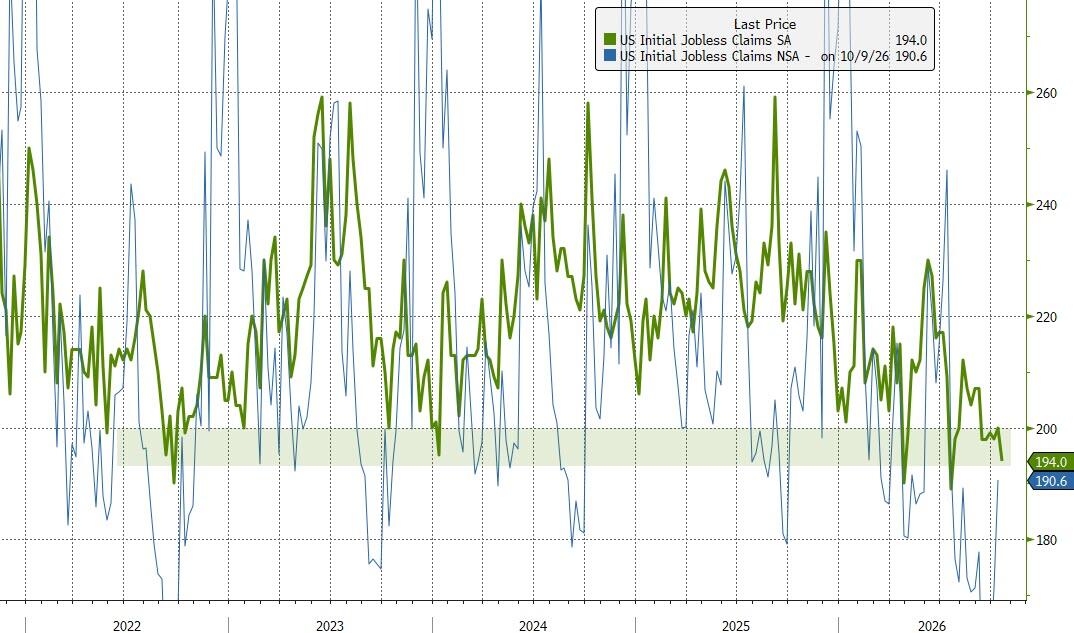
US economic data slate includes initial jobless claims (8:30am, est. 200k) and continuing claims (8:30am), the September leading index (10am), EIA natural gas storage (10:30am), the October Kansas City Fed manufacturing index (11am) and a $26 billion 5-year TIPS auction (1pm). The Fed is in its blackout period. Companies reporting before the open include Procter & Gamble, Blackstone, Union Pacific, Lockheed Martin, Honeywell, Comcast, American Airlines, Valero and Nasdaq; Valero and Bloom Energy also headline today's slate.
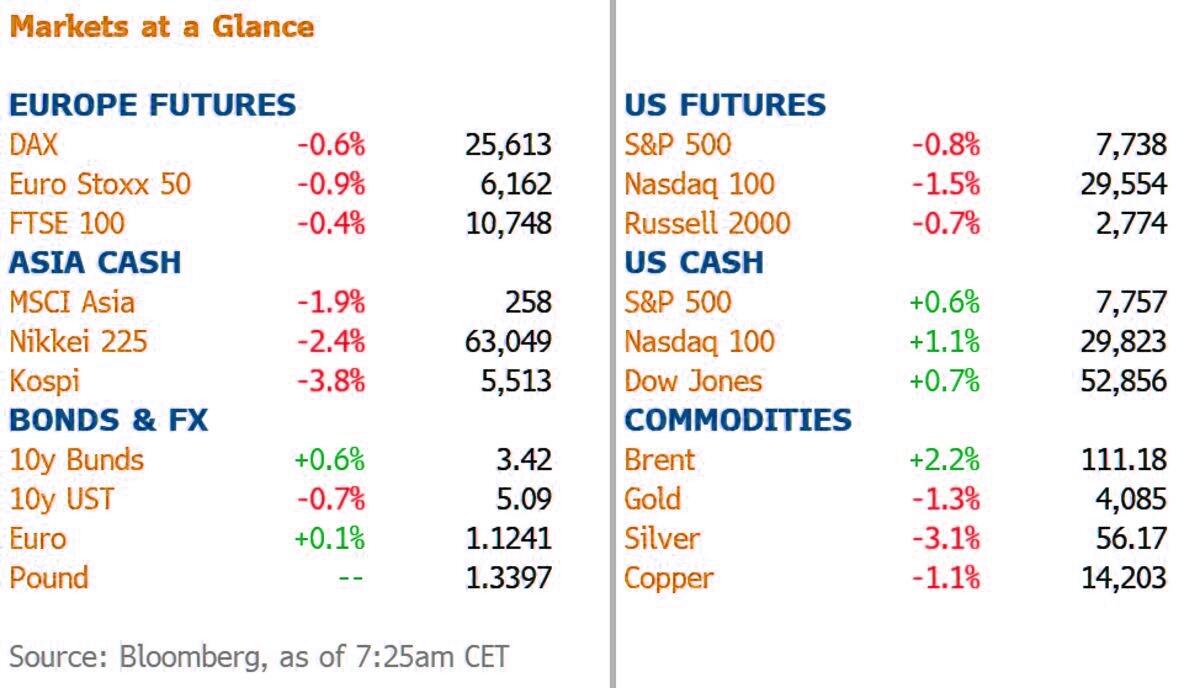
Market Snapshot
Top Overnight News
A more detailed look at global markets courtesy of Newsquawk
APAC stocks were pressured and extended on losses throughout the session despite the positive lead from Wall Street, as AI and semiconductor names were sold after Tesla cut capex guidance, Lam Research fell after-hours, and Meta's results stoked concerns over the financial strain of heavy AI investment. Middle East tensions also remained in focus, with the US preparing ordered departures at embassies across the Gulf and reports of renewed attacks on Saudi Arabia. ASX 200 was lower, with energy and retail stocks leading the declines as Nick Scali slumped after its profit warning and weighed on fellow retailers, although the index pared some of its earlier losses. Nikkei 225 extended on losses, with AI and semiconductor names such as Tokyo Electron, SoftBank Group, Ibiden and Fujikura pressured. KOSPI underperformed as concerns over investment in the AI value chain sparked a selloff in chip stocks, with Samsung Electronics and SK Hynix both pressured, while Samsung Electro-Mechanics reversed the opening gains it saw on its NVIDIA tie-up. The BoK held rates unanimously, as expected, while Governor Shin said the recent stock market correction weighs on consumption. Hang Seng led the declines in the region with Lenovo and Hua Hong Semiconductor each down around 7% and CATL extending its losing streak to a seventh day, while the Shanghai Comp declined amid uncertainty over the Middle East, with semiconductor names sold.
Top Asian News
European bourses are under pressure this morning, following on from the weakness seen in Asia. In Hong Kong, the likes of Alibaba (-6.1%) and PDD (-3.6%) slipped after China’s CMRC urged e-commerce platforms to strengthen product quality controls and consumer protection. Sectors highlight the negative bias. Telecoms, Food, Beverages & Tobacco and Health Care are the sector gainers. The underperformer is Basic Resources, followed by Banks and Tech. Key earnings include: SAP -0.9%, despite Q3 metric beats and sees FY26 cloud revenue at the upper end of its guided range; Nestle +1.6%, Q3 sales beat and reaffirms its FY26 sales growth target; Roche -0.5%, despite Q3 sales topping estimates and reaffirms FY outlook; Nokia -5.3%, despite Q3 profit beating expectations and expects supply chain constraints to continue in 2027. US equity futures follow the broader space lower, with underperformance in the NQ, pressured by Tesla (-4.5% pre-market) after reporting slower deliveries growth. Meta (-1.2% pre-market) follows sentiment lower, despite reporting strong Q3 results, but with potential focus on the Co. being ordered to pay a USD 25bln penalty to New Mexico.
FX
Central Banks
Fixed Income
Commodities
Trade/Tariffs
Geopolitics: Middle East
Geopolitics: Ukraine
Crypto
US Event Calendar
Central Bank Speakers
DB's Jim Reid concludes the overnight wrap
It’s been another difficult 24 hours for markets, as investors grapple with AI growth concerns, higher oil prices, and ongoing fiscal stress. Admittedly, yesterday saw the S&P 500 (+0.58%) post a third consecutive gain, closing back within 1% of its record high. But as we go to press this morning, all those risks have resurfaced. First, the latest earnings after the US close failed to reassure investors, with futures on the NASDAQ 100 (-1.32%) pointing to fresh declines. Second, geopolitical tensions in the Middle East have seen oil prices bounce back this morning, with Brent crude (+1.73%) currently around a five-month high of $110.70/bbl. And third, France’s fiscal position has remained in the spotlight, with the country’s 10yr yield (+8.3bps) closing above 5% yesterday for the first time since 2002. Indeed, that risk-off move has also pushed the 30yr Treasury yield (-3.1bps) down to 5.38% this morning, which would be its lowest closing level in the last month. So the overnight backdrop has clearly turned more negative since yesterday’s session.
We’ll start with the oil moves, as several geopolitical headlines came through overnight that led to mounting concerns about a fresh escalation in the conflict. Among others, the New York Times reported that the US and Israel had drawn up plans for renewed strikes against Iran after the midterm elections, with the report saying targets would likely include Iran’s energy infrastructure. Moreover, the strikes on Saudi Arabia continued, with two people killed in an attack on the Shaybah oil field in Saudi Arabia, whilst another was killed in a strike on the King Fahd International Airport. In the meantime, the US State Department issued an ordered departure for non-emergency government employees and family members in Saudi Arabia.
All those headlines have come amidst little sign of progress towards a deal. Indeed, Iran’s foreign minister Abbas Araghchi wrote in an FT op-ed yesterday that “we have no trust whatsoever in the sincerity of the US administration’s professed desire for peace with Iran.” And he also said “there is little reason to expect progress now”. So that dampened hopes for a near-term resolution, and oil prices have continued to rise over the last 24 hours. So Brent crude is currently up +1.73% this morning at $110.70/bbl, and investors are also pricing a longer period of high oil prices extending well into 2027. For instance, the 12-month Brent future (+0.75%) is also up to $88.39/bbl this morning.
The other big development after the US close were the earnings releases from Meta and Tesla, with tech stocks struggling to gain traction since. For Meta, its shares rose by more than +2% in after-hours trading, as it beat on Q3 revenue ($64.6bn vs $63.3bn est.) and delivered Q4 guidance towards the upper end of expectations ($73-76bn vs $73.6bn est.). The company also slightly boosted its 2026 capex plan from a $130bn-145bn range to $135bn-145bn. However, Tesla fell by -3% after-hours after it cut its 2026 capex target from $25bn to $20bn. So that raised questions about the speed of its transition into AI and robotics, while current revenue and earnings were close to expectations.
In aggregate, those results took some of the shine off the tech mood overnight, which had been a bit more optimistic yesterday. So this morning, futures on the S&P 500 (-0.66%) and the NASDAQ 100 (-1.32%) are both pointing lower. Moreover, we’ve seen that echoed across Asian equity markets this morning, with all the major indices falling back. That includes sharp losses for the KOSPI (-3.26%), the Hang Seng (-2.87%) and the Nikkei (-2.00%), whilst there have been relatively smaller declines for the CSI 300 (-1.26%) and the Shanghai Comp (-0.89%). Earlier in the session, the CSI 300 had even entered bear market territory, having fallen more than -20% since its closing peak in June, although it’s pared back those losses since and is now slightly above that level.
Before those earnings, US markets had actually put in a decent session yesterday, with tech stocks leading the way. That was partly thanks to the earnings report from SpaceX after the previous day’s close, which helped to reassure investors that the tech rally was still durable, and we saw some of the most AI-exposed names do particularly well yesterday. For instance, the Philly semiconductor index (+1.97%) continued to recover, whilst the NASDAQ (+1.05%) also put in a strong session. So that helped to lift US equities more broadly, with the S&P 500 ultimately up +0.58%, closing within 1% of its record high. And over in Europe, there were even bigger gains, with the STOXX 600 (+0.92%) and other indices all posting a solid performance, with tech leading the way there too.
But even as equities saw growing optimism, the fiscal concerns were still present around Europe, with France’s 10yr yield (+8.3bps) closing at a post-2002 high of 5.01%. And with the 10yr bund yield only up +2.1bps to 3.42%, that pushed the Franco-German 10yr spread up to 159bps, its highest closing level since 2011. Now admittedly, the spread remains some way beneath its Euro crisis peak, when it closed at 189bps in November 2011, but the continued rise has seen other sovereigns come under pressure too. Among others, the Italian 10yr spread over bunds widened +3.8bps to 116bps, whilst Spain’s widened +3.1bps to 66bps, marking its widest level since June 2025.
For Europe, matters weren’t helped by the latest rise in energy prices, which added to concerns on the inflation side. For instance, European natural gas futures (+2.78%) were back up to €87.43/MWh. And even though Brent crude was little changed in yesterday’s session, the 1yr Euro inflation swap (+3.5bps) still rose to 3.82%, its highest level since May. And with more inflation priced in, investors priced in more ECB rate hikes too, with the amount priced by the June 2027 meeting up +2.0bps on the day to 64bps.
Over in the US, Treasury yields saw a smaller increase than their European counterparts, with the 10yr yield (+1.1bps) only rising to 5.12%. However, that’s pulled back given the risk-off tone overnight, with the 10yr yield (-3.5bps) falling back to 5.08%.
Elsewhere overnight, the Bank of Korea left their policy rate at 3%, in line with expectations. But they also said growth this year and next would be “considerably higher” than their August projections, and Governor Shin said they needed to maintain a tightening policy stance. Meanwhile in New Zealand, inflation fell more than expected in Q3, falling to +3.7% on a year-on-year basis (vs. +3.8% expected).
Finally, the other inflation release yesterday came from the UK CPI print, which rose more than expected to +3.5% in September (vs. +3.4% expected). That was the highest level for headline CPI in nearly a year, whilst the core CPI print also hit a 6-month high of +2.8%, although that was in line with expectations. So collectively, that helped to cement investor expectations for a BoE rate hike in November, particularly after the strong labour market data the previous day. In fact by the close yesterday, markets were pricing in a 98% chance of a November rate hike.
Looking at the day ahead now, data releases include the US weekly initial jobless claims, and the European Commission’s preliminary consumer confidence indicator for the Euro Area in October. Otherwise from central banks, we’ll hear from the ECB’s Kocher, Panetta, Pereira and Escriva.
Tyler Durden Thu, 10/22/2026 - 08:25
Continue reading...
[ H/T ZeroHedge ]
US futures are lower as the AI trade discovered that there is no right answer on capex: Meta spent more, Tesla spent less, and the market slammed both (after an initial kneejerk bounce), while a fresh wave of deadly attacks on Saudi Arabia, a US-ordered departure of diplomats from the kingdom and an NYT report that the US and Israel have drawn up plans for renewed strikes on Iran after the midterms sent Brent back above $112; as a result the flight to quality is back on, with 10Y yields sliding 9bps to 5.03% even as oil jumps and French bond yields soar. As of 8:00am ET, S&P futures are 1.0% lower at 7,720.75 while Nasdaq futures are down 1.7% at 29,507.50 and Dow futures are 0.6% lower. Wednesday's session closed near its highs, with the S&P rising 0.6% to 7,757 for a third straight gain and closing within 1% of its record high, as the SpaceX blowout revived the AI trade. In premarket trading, all Mag 7 names are red led by Tesla, which drops 4.4% after cutting its 2026 capex target to about $20 billion from more than $25 billion, while Meta reversed an after-hours gain of as much as 5% to trade down about 1.5% as investors focused on its hedged 2027 spending commentary (as we noted last night, the stock erased most of its gains after the CFO warned "significant investment" will raise serving costs); Lam Research tumbles 8% on a soft forecast, dragging chipmakers including AMD, Broadcom and Intel. The day's driver is oil (again): Brent rose as much as 3.3% to $112.43 and WTI briefly topped $100 after two attacks on an Aramco oil field and an airport in Saudi Arabia's Eastern Province killed at least three people, Aramco told staff to evacuate its Dhahran headquarters, and the IRGC Navy warned US bases could be targeted if Washington keeps "encouraging" ships through the Strait of Hormuz. Treasuries are bid across the curve in a bull steepener as AI doubts and another spike in French yields drive a haven bid; the OAT-Bund spread blew out by as much as 18bps to 177bps, the widest since 2011. The yen and Swiss franc lead G10 FX, with EUR/JPY at the lowest in almost a year, while the Bloomberg dollar index is little changed. Gold is down 1.3% near $4,085 and silver is down more than 3%, refusing to play haven, copper slides with the AI trade, and Bitcoin slipped below $82,000. US economic data slate includes weekly initial jobless claims (8:30am), the September leading index (10am) and the October Kansas City Fed manufacturing index (11am), and Treasury auctions resume with a $26 billion 5-year TIPS new issue (1pm). The Fed is in its blackout period ahead of next Wednesday's decision.
In premarket trading, all Mag 7 names are lower: Tesla (TSLA) drops 4.4% after the electric-car maker cut its spending plans, following capital investment that trailed expectations last quarter (Nvidia (NVDA) -2%, Alphabet (GOOGL) -2%, Amazon (AMZN) -2%, Meta Platforms (META) -2%, Microsoft (MSFT) -0.9%, Apple (AAPL) -0.2%)
- Chipmakers and other AI-related firms slide after reports from Tesla, Lam Research and IBM underwhelmed. Decliners include AMD (AMD) -4%, Broadcom (AVGO) -3%, Intel (INTC) -4%. The mood is weighing on other growth sectors and pushing crypto names lower
- American Airlines (AAL) slumps 4% after issuing a broad range for its fourth-quarter loss prediction, highlighting how the industry is struggling to map out its performance amid persistently high fuel prices.
- Biohaven (BHVN) soars 53% after the FDA said company’s new drug application resubmission for Vyglxia has been accepted for review.
- CSX (CSX) inches 2% higher after the railroad reported earnings per share for the third quarter that beat the average analyst estimate.
- The company is benefiting as trucking gets more expensive, pushing shippers to use its intermodal offering instead of having goods carried entirely by truck.
- Gentherm (THRM) falls 6% after the the automotive supplier reported adjusted earnings per share below analyst expectations in the third quarter.
- International Business Machines (IBM) falls 5% after posting third quarter results.
- Kinder Morgan (KMI) gains 2% after formally committing to building a $4.2 billion pipeline that will haul fuel across West Texas and the Panhandle to help power a data center complex.
- Lam Research (LRCX) falls 7% after the semiconductor capital equipment company gave a forecast for adjusted second-quarter earnings that was slightly weaker than expected at the midpoint of the range.
- Lockheed Martin (LMT) rises 4% after lifting its full-year outlook as the company’s missile systems portfolio was buoyed by rising global defense spending.
- Pool Corp. (POOL) gains 4% after third quarter results topped expectations.
- Procter & Gamble (PG) gains 3% after sales and profits beat Wall Street expectations, showing the Tide-owner’s limited price hikes that are successfully drawing constrained customers have not come at the expense of earnings.
In other corporate news, Meta did its best to change the subject from capex, announcing a one-time dividend of non-voting Class C shares that effectively amounts to a 2-for-1 split and, per Bloomberg, gives Mark Zuckerberg shares he can sell without giving up control as a proposed California wealth tax looms; Tesla CEO Elon Musk wants to combine Tesla and SpaceX in a $3.7 trillion deal and is rushing to get it done before Trump leaves office, according to Bloomberg; the US signed a deal with Lockheed Martin for a minimum of 850 F-35 jets; Comcast reported 3Q adjusted EPS of $1.07 vs an estimate of 98c; Blackstone's 3Q distributable income of $1.32 a share beat the $1.26 estimate; American Airlines sees a 4Q adjusted loss of 50c to $1.10 a share, vs an estimated loss of 49c; Spotify sees 4Q MAUs of 818 million, a hair below the 819.08 million estimate; Barclays is cutting 5,000 jobs, about 5% of headcount, as it adopts AI across the bank; EQT's bid for Qiagen is now firm at €46.50 a share in cash; and Chinese AI startup DeepSeek raised about 100 billion yuan ($15 billion) in its latest fundraising round.
Bloomberg sums up the overnight mood succinctly: "AI nerves are back." The bar for an AI beat has moved from ambition to monetization, and the market is no longer giving credit for spending plans alone: Meta lifted the bottom of its 2026 capex range to $135 billion from $130 billion and guided above consensus, Tesla cut its capex target after third-quarter spending came in at $4.73 billion vs $7.95 billion expected, and both stocks are lower. Spend more or spend less, the market frowned either way. IBM swung from a 5% gain to a 4.6% loss in late trading even after saying slipped infrastructure deals had come back, a reminder that software is no safe corner of the AI trade either. All of this comes as hyperscaler credit spreads sit at record wides (as we noted in last night's wrap) and as Ken Griffin calls AI "almost certainly" a bubble.
“Markets are basically telling us we are moving on from trading AI vibes and narrative to now requiring a pretty high bar for what an earnings beat looks like,” said Kaanhari Singh, APAC head of equity derivatives sales at Barclays, on Bloomberg TV. “That’s both in terms of capex forward guidance, but also for the path of monetization.”
Tesla and Lam results put “the AI confidence back in the air again, dragging a few other semi names lower,” said Anna Wu, an investment strategist and founder of Floodlines Research.
The pain was most acute in Asia, where the CSI 300 briefly entered a bear market, down 20% from its June highs, and Chinese e-commerce names including Alibaba slumped after the market regulator urged platforms to tighten product quality controls. Chinese tech stocks are now erasing most of their 2-year gain.
JPM's Market Intel desk calls it a "narrative shift overnight amid geopolitics concerns": Wednesday's session closed near its highs with AI/Tech and Momentum leading, but that tone reversed overnight. Beyond the NYT Iran headline, the desk says underlying price action and trading desk feedback point to "the still fragile narrative around AI financing concerns and the lack of conviction / re-grossing from the recent tech reversal." The team stays Tactically Bullish, favoring cyclicals outside tech while selectively buying tech weakness in semis and memory. JPM specialist Mark Schilsky called Meta's quarter in line, with a Q4 revenue guide that is "decidedly better than expected," but noted the 2027 commentary "will leave some investors wanting" and that the new Class C shares likely mean an equity raise is coming, just not until early 2027: "The overhang lives on!" Meanwhile, JPM credit trader William Jarvis notes the bank's HY AI basket is trading at all-time wides, 97bps wider than its July peak, mostly led by CoreWeave, with Oracle widening far more than the rest of IG (as Barclays warned, the AI credit flush won't be the last).
Over at Goldman, Rich Privorotsky flagged the capex whiplash: "Tesla actually cut FY capex guidance from >$25bn to ~$20bn, completely out of sync with what SpaceX was telling us earlier this week. Could be sequencing, but the market doesn't like capex going backwards." He also notes the NYT report means "we've now effectively stapled another potential escalation event to the calendar" right after the midterms, and that prime data shows one of the most pronounced net tech reductions in recent memory. The GS desk adds that hedge funds have heavily net sold global equities in October, with short sales outpacing long buys about 5 to 1, and short leverage at the 99th percentile; with positioning this defensive, the derivatives desk sees right-tail hedges as historically cheap. In Asia, Goldman's prime book shows L/S managers down 1.5% intraday and 8.6% month to date.
In Europe, the French bond rout that has carried out London macro traders deepened: France's 10Y yield hit 5.14% and its risk premium over bunds widened to 177bps, the most since 2011, as the government prepares to deploy soldiers to free up police for Saturday's protests and Paris luxury boutiques brace for more unrest. Goldman has built a fragmentation alarm to gauge how close Europe is to another "whatever it takes" moment; M&G is not worried just yet.
“We don’t believe that France needs to be bailed out. There’s no concern about this,” said M&G Asset Management CEO Joseph Pinto on Bloomberg TV. “We believe it’s a sound and solid country. It just needs to act on its budget and provide something that reassures markets.”
In Europe, the Stoxx 600 is down 0.9% at 638.75, with 445 members down and 146 up, as mixed results from US tech revive concerns about the AI trade. Miners and banks are the worst performing sectors, while telecoms, food and beverage and health care are the only gainers; JPM notes semis and electrification baskets are among the top underperformers, with only defensives and rate-sensitive baskets in the green as beta and momentum are sold. Hermès slumps after its Asia-Pacific sales disappointed, while UCB soars after raising guidance. Here are the biggest European movers:
- Nestle gains as much as 2.7% after the company reported real internal growth for the nine month period of +1.9%, which was welcomed by analysts who noted “broad-based” improvement in RIG across different divisions and regions of the business.
- UCB shares rally as much as 16% after the biopharma company raised its guidance, with analysts expecting material upgrades to consensus estimates.
- Verisure shares rise as much as 17% in Stockholm after the Financial Times reported that CVC is exploring a bid to take the security group private.
- Moncler shares rise as much as 2.8% after the Italian luxury company reported third-quarter revenue that beat consensus estimates.
- Rentokil shares rise as much as 9.5% after the British facility management company reported revenue for the third quarter of $1.89 billion.
- Hermès shares fall 9% after the Birkin bag maker’s third-quarter revenue fell short of analyst estimates.
- Besi shares drop 4.3% after reporting 3Q orders that beat consensus estimates and pushing back on concerns that ASML would be a competitive threat to its flagship hybrid bonding technology.
- Roche shares slip as much as 1.5% after the pharmaceutical firm reported third-quarter results. Analysts note the sales beat reflects a benefit from the integration of its Enterprise Resource Planning IT system.
- SEB shared declined as much as 5.2% after the lender reported earnings that analysts say are weak and announced a pause in buybacks after Sweden’s financial regulator temporarily raised its capital requirements.
- Yara shares fall as much as 4.7% after the fertilizer producer reported adjusted Ebitda for the third quarter that missed the average analyst estimate.
- Sainsbury shares fall as much as 4.4% after the British supermarket reported earnings for the first half, including revenue which fell short of expectations.
- Digital Network falls as much as 18% after the founder sold a nearly 20% stake in Polish advertising-services company through an accelerated bookbuild at a 19% discount to the previous close, upsizing the deal from an initially planned 12%.
- Inchcape shares fall as much as 12% after the vehicle dealership group cut its margin guidance for the year due to continued underperformance of its business in Australia.
- Nokia shares fall as much as 3%. The firm gave bullish guidance for revenues exposed to data center buildout in 2027, seeing 25% to 30% growth in optical and IP networks businesses, adding to evidence that its networking gear is seeing strong demand due to AI adoption.
Europe's Wednesday gains now look like borrowed strength: the Stoxx 600 has gone nowhere since early August while Brent and the Kospi have moved big.
Asian stocks fell sharply, with the MSCI Asia Pacific Index dropping more than 1.5% to head for its lowest close since July 30, as underwhelming US tech earnings and higher oil broadened the AI selloff across the region. According to Goldman's regional wrap, South Korea's Kospi sank 3.5% with SK Hynix down 5.5% and Samsung down 4%, the Hang Seng fell 3%, its biggest drop since March, with the Hang Seng Tech index down about 5% as Alibaba and Lenovo slumped, and the Nikkei 225 dropped 2.7% to break below 64,000 as Advantest, Tokyo Electron (-7%) and SoftBank (-6.9%) accounted for about 62% of the index's losses. China's CSI 300 fell 1.8% and is now 20% off its June high, Taiwan's Taiex lost 1.8% and Australia's ASX 200 slipped 0.4%, while Indonesia was the regional outlier, rising 1.1% as the sovereign wealth fund said it was buying local stocks. The Bank of Korea held rates at 3% but said growth would be "considerably higher" than projected, signaling more tightening to come.
In FX, the Bloomberg Dollar Spot Index is little changed and the DXY trades in a 101.44-101.73 range, pressured by lower yields. The yen is the standout, rising to its strongest against the euro in almost a year, with EUR/JPY falling as much as 1.1% to 175.64, its biggest drop in seven weeks, and USD/JPY dropping as much as 0.9% to 156.77, down for a third day; real money funds have been buying the yen, traders say, while the Swiss franc rose to its strongest against the euro since early July. Bloomberg's Vassilis Karamanis notes the dollar now trades "almost as a clean function of Treasuries: once 10-year yields slipped below 5.10%, the dollar was sold further." The kiwi lags after cooler-than-expected New Zealand CPI, the Egyptian pound hit a record low, and Turkey's central bank cut its one-week repo rate by 100bps to 36%, its first cut since the start of the Iran war and in line with estimates.
Declines in Japanese equities are fueling risk-off sentiment, while recent stability in the Japanese government bond market is also supporting the yen, Hirofumi Suzuki, chief FX strategist at Sumitomo Mitsui Banking Corp., told Bloomberg.
In rates, Treasury futures extend gains in early US trading with the 10-year yield down 9bps near 5.03%, outperforming global peers, as haven demand from the AI stock jitters and deepening French bond stress overwhelms higher energy prices. Yields are 6-10bps lower across the curve with intermediate tenors outperforming, richening the 2s5s30s fly by around 4bp, while the 5s30s spread is steeper by about 4bp and the 30-year yield touched its lowest since Sept. 23. The haven bid is coming from the AI selloff rather than the oil spike, and the long end is the one place investors are still finding shelter (gold and Bitcoin clearly aren't). Bunds and gilts are also bid, with the German 10-year yield down 7bps at 3.35% and long gilts outperforming, but France is the stress point: OATs fell more than a point at worst, lifting the 10-year yield to 5.14% and the spread over bunds to 177bps, the widest since 2011, while Italian and Spanish spreads also widened Wednesday. Money markets still price about 25bps of Fed hikes by year-end ahead of next Wednesday's decision, after another poor, tailing 20Y auction on Wednesday. Treasury auctions resume at 1pm with a $26 billion 5-year TIPS new issue, while the IG dollar issuance slate includes one name so far after just over $8 billion priced on Wednesday, with at least two borrowers that stood down planning to look again today.
In commodities, WTI briefly topped $100 and trades in a $97.72-$100.09 range while Brent trades between $109.81 and $112.68, still contained within Tuesday's broad range, after the IRGC Navy said four vessels transferring oil cargoes were struck in the Persian Gulf and three more hit sea mines west of the Strait of Hormuz. Iran's Major General Rezaei said Iran will neither reopen the strait nor resume negotiations until seven new conditions are met. Saudi Arabia is in talks to give Aramco access to foreign strategic storage, while Morgan Stanley estimates Middle East crude exports, including non-Hormuz routes, at about 17m b/d last week, roughly 94% of prewar levels. In Libya, a pipeline from the Hamada and Al-Tahara fields was shut. Spot gold sits at the bottom of its $4,067-$4,146 range as the oil spike raises inflation risks ahead of the Fed, and LME copper slid toward the bottom of its $14,090-$14,370 range on the AI selloff.
US economic data slate includes initial jobless claims (8:30am, est. 200k) and continuing claims (8:30am), the September leading index (10am), EIA natural gas storage (10:30am), the October Kansas City Fed manufacturing index (11am) and a $26 billion 5-year TIPS auction (1pm). The Fed is in its blackout period. Companies reporting before the open include Procter & Gamble, Blackstone, Union Pacific, Lockheed Martin, Honeywell, Comcast, American Airlines, Valero and Nasdaq; Valero and Bloom Energy also headline today's slate.
Market Snapshot
Top Overnight News
- For most of the war, Iran had an invaluable cushion: dozens of oil tankers holding millions of barrels of crude sitting safely in waters in Asia. Tehran steadily sold the oil to China, bringing in billions of much-needed cash. Now, that floating storage is gone. By mid-October, the reserves were fully depleted, according to analysts at Kpler, as a U.S. naval blockade prevented Iran from replacing the crude it normally sells to Chinese refineries. WSJ
- The US ordered some diplomats and their families to leave Saudi Arabia because of the threat from Houthi militants, as the Iran-backed group carried out more strikes from Yemen; four people were killed in two attacks on an Aramco oil field and an airport in Saudi Arabia's Eastern Province. BBG
- The US and Israel have drawn up plans for renewed strikes on Iran after the midterm elections, with targets likely to include Iran's energy infrastructure, nuclear facilities and missile and drone arsenals. NYT
- Aramco told staff to leave its headquarters in Dhahran and work remotely. RTRS
- Iran's IRGC threatened US bases in the region if Washington keeps escorting ships through what it calls an “illegal” Hormuz route. BBG
- Saudi Arabia is in talks with foreign governments to give state-owned Aramco access to their strategic oil storage, as the kingdom seeks to make its supplies to customers more resilient during disruptions, Chief Executive Officer Amin Nasser said. BBG
- The risk-off mood boosted havens, with Treasuries, the yen and Swiss franc gaining. The 30-year US yield touched its lowest since Sept. 23, but there was no relief for embattled French bonds which led a slide in European peers. BBG
- France's 10-year bond risk premium over Germany widened as much as 18bps to 177bps, the widest since 2011. BBG
- Over the past two weeks, HFs aggressively net sold global Info Tech stocks at the fastest pace in the past decade (-3.3 SDs), driven by long-and-short sales. Net allocation to Global AI stocks now sits in the 38th percentile while aggregate long/short ratio is in the 6th percentile vs. the past year. GSPB
- Apple shares have become investors’ preferred Big Tech hedge against AI volatility as the company largely sits out the infrastructure spending boom. BBG
- DeepSeek raised about $15 billion from investors including CATL and Tencent. BBG
- JPM's HY AI credit basket is trading at all-time wides, 97bps wider than its widest level in July, with most of the move led by CoreWeave; Oracle has widened far more than the rest of the IG hyperscalers. JPM
- Japan’s largest labor union group is seeking another year of wage increases big enough to anchor pay growth against persistent inflation. WSJ
- Japanese monetary policy: the BOJ will keep rates unchanged at its meeting next week according to a report this morning in the Nikkei (this is consistent w/market expectations). Nikkei
- The Philippine central bank surprised markets with a bigger-than-expected interest rate hike as it seeks to keep inflation in check during one of the worst energy crisis in decades and looming weather-driven shocks. WSJ
- Turkey's central bank cut its one-week repo rate by 100bps to 36%, its first cut since the start of the Iran war, in line with estimates. BBG
- The EU reached a provisional deal to overhaul securitization market rules that would unleash billions of euros to finance initiatives in key areas such as defense and climate resilience. BBG
- Barclays said it’s cutting 5,000 jobs, or about 5% of total headcount, as part of a “technology-enabled” effort to reduce costs as it adopts artificial intelligence across the bank. BBG
- The US signed a deal with Lockheed Martin for a minimum of 850 F-35 jets. BBG
- A federal judge barred the DHS from knocking on doors to check on people’s immigration status in nine states through election day, saying the practice likely violates the Voting Rights Act. BBG
- BofA Total Card Spending (week to October 17th) +4.9% Y/Y (prev. +5.1%); lower-income spending growth has consistently outpaced higher-income spending growth over the past several weeks. Newsquawk
- Some US banks are reportedly detecting unauthorised AI agents operating within accounts: Axios. The report added that the banks affected include Morgan Stanley (MS), Bank of America (BAC), JPMorgan (JPM), Wells Fargo (WFC).
A more detailed look at global markets courtesy of Newsquawk
APAC stocks were pressured and extended on losses throughout the session despite the positive lead from Wall Street, as AI and semiconductor names were sold after Tesla cut capex guidance, Lam Research fell after-hours, and Meta's results stoked concerns over the financial strain of heavy AI investment. Middle East tensions also remained in focus, with the US preparing ordered departures at embassies across the Gulf and reports of renewed attacks on Saudi Arabia. ASX 200 was lower, with energy and retail stocks leading the declines as Nick Scali slumped after its profit warning and weighed on fellow retailers, although the index pared some of its earlier losses. Nikkei 225 extended on losses, with AI and semiconductor names such as Tokyo Electron, SoftBank Group, Ibiden and Fujikura pressured. KOSPI underperformed as concerns over investment in the AI value chain sparked a selloff in chip stocks, with Samsung Electronics and SK Hynix both pressured, while Samsung Electro-Mechanics reversed the opening gains it saw on its NVIDIA tie-up. The BoK held rates unanimously, as expected, while Governor Shin said the recent stock market correction weighs on consumption. Hang Seng led the declines in the region with Lenovo and Hua Hong Semiconductor each down around 7% and CATL extending its losing streak to a seventh day, while the Shanghai Comp declined amid uncertainty over the Middle East, with semiconductor names sold.
Top Asian News
- BoJ's October lending survey: Corporate loan demand DI rose to +3 (prev. -1), led by small firms (+5), while banks' lending stance DI for large firms remained unchanged at +3 and corporate loan margins continued to narrow.
- Japan's RENGO set 2027 wage negotiation target centred on a 6% pay increase, while maintaining a minimum benchmark of at least 5%, aiming to sustain wage growth momentum following three consecutive years of average pay rises exceeding 5%.
- Japan is reportedly considering broadening the definition of defence-related spending to include AI, satellites, R&D and infrastructure such as ports and railways, amid US pressure to increase defence outlays and domestic fiscal constraints, according to sources.
European bourses are under pressure this morning, following on from the weakness seen in Asia. In Hong Kong, the likes of Alibaba (-6.1%) and PDD (-3.6%) slipped after China’s CMRC urged e-commerce platforms to strengthen product quality controls and consumer protection. Sectors highlight the negative bias. Telecoms, Food, Beverages & Tobacco and Health Care are the sector gainers. The underperformer is Basic Resources, followed by Banks and Tech. Key earnings include: SAP -0.9%, despite Q3 metric beats and sees FY26 cloud revenue at the upper end of its guided range; Nestle +1.6%, Q3 sales beat and reaffirms its FY26 sales growth target; Roche -0.5%, despite Q3 sales topping estimates and reaffirms FY outlook; Nokia -5.3%, despite Q3 profit beating expectations and expects supply chain constraints to continue in 2027. US equity futures follow the broader space lower, with underperformance in the NQ, pressured by Tesla (-4.5% pre-market) after reporting slower deliveries growth. Meta (-1.2% pre-market) follows sentiment lower, despite reporting strong Q3 results, but with potential focus on the Co. being ordered to pay a USD 25bln penalty to New Mexico.
FX
- G10s are mixed against the USD. JPY is the clear outperformer, joined closely by the CHF, benefiting from haven flows. On the flip side, the Antipodeans have been hampered by the risk tone, whilst the Kiwi digests cooler-than-expected CPI.
- DXY is on the back foot this morning, pressured by lower yields, which comes despite elevated energy prices. The index currently holds at the upper end of a 101.44 to 101.73 range; price action today will likely be dictated by cross-asset relationships, given that the data docket remains light today. Some of the pressure today may also be facilitated by poor results from Tesla.
- The JPY is the outperformer this morning, benefiting from its safe haven status. USD/JPY currently holds at the bottom end of a 156.76 to 158.25 range, a move which will no doubt be welcomed by Japanese officials. Focus for geopolitics was on an IRGC warning to US bases, that they may be a target if the US continues to allow ships to pass through the Strait of Hormuz. Aside from geopolitics, the JPY is digesting reports that Japan is considering the resumption of energy subsidies. Whilst this does reduce the inflationary implications of recent energy price rises, the overarching question is how Japan intends to finance this; of course, options include a supplementary budget, which could involve bond issuance, further fuelling fiscal woes. Elsewhere in Japan, the RENGO union is reportedly seeking a 6% wage increase for 2027, an increase from the 2026 figure of 5.01%; for reference, the union had demanded 5.94% in 2026.
- The Antipodeans are the slight laggards this morning, given the subdued risk tone. The Kiwi mildly underperforms vs the Aussie following a cooler-than-expected CPI report, but still remains at elevated levels. Therefore, money markets still expect the RBNZ to hike rates at next week’s meeting; Westpac sees rates to be hiked by 25bps.
Central Banks
- BoK left its rate unchanged at 3.0% as expected. BoK said today's rate decision was unanimous, while the timing and pace of further rate hikes will depend on inflation, economic conditions and financial stability. It is essential to assess domestic and external risks and the impact of the previous two rate hikes. Expects inflation to remain above its target for an extended period. Stock price volatility has increased amid concerns over slowing semiconductor sector profitability and investment. Financial imbalances related to the housing market and household debt require continued attention. Expects exports and investment to sustain strong growth.
- SNB Minutes (Sept): The rise in inflation since the beginning of the year has been largely attributable to the increase in oil product prices, but there are still no signs of second-round effects, and core inflation has risen only slightly. At the same time, medium-term inflationary pressure is only slightly higher, and the new conditional inflation forecast shows that inflation is within the range consistent with price stability over the entire forecast horizon. On FX, the Minutes state that the SNB is also willing to be active in the foreign exchange market as necessary to ensure appropriate monetary conditions, but that the increased willingness to intervene is no longer necessary in the current environment.
Fixed Income
- In brief, a haven bid is seen across most core fixed income, as the geopolitical situation escalates and yields prove somewhat resilient to the energy upside, as much of that is priced by this stage, with focus instead increasingly on the growth side of the equation.
- USTs just off a 105-19+ peak, firmer by 16 ticks at best. The docket ahead is relatively light, but the focus is firmly on geopolitics after the activity seen in APAC hours and the continued dissemination of punchy rhetoric in the European morning.
- Bunds also bid, and in-fitting with USTs for the most part. At a 121.90 high, firmer by 50 ticks. As above, specifics are relatively light and the focus is firmly on geopolitical developments for core counterparts.
- In brief, while the focus for core debt is increasingly on the growth implications of the ongoing Middle East situation, this is not to a degree that is likely to dissuade policymakers from tightening in the weeks ahead, with the BoE for instance expected to start its tightening cycle; though, it is expected to be brief.
- Continuing with the UK, Gilts opened with modest gains, given the above haven allure factoring initially, before then being briefly unwound/offset by energy’s influence. However, Gilts broadly conform to peers, with gains of around 15 ticks currently, some 10 off the 84.73 peak.
- More pertinently, those under significant fiscal scrutiny are seeing a selloff as the growth-hit and inflationary angle combine to further knock the fiscal backdrop. A point that is particularly evident in France, with OATs down by over a point at most, lifting the 10yr yield to a 5.14% high, and widening the OAT-Bund spread to 1.73%, the highest since January 2011.
- The UK sells GBP 1bln 0.125% 2031 I/L Gilt: b/c 3.99x (prev. 4.26x), real yield 1.141% (prev. 0.933%).
Commodities
- Crude benchmarks have climbed throughout the APAC session and continue as Europe steps in. Iran’s IRGC Navy said four vessels transferring oil cargoes were struck in the Persian Gulf, while three other vessels hit sea mines yesterday west of the Strait of Hormuz, warning that US efforts to encourage passage could result in strikes on US bases. With repeated airing of these comments, it has continued to support the energy complex. WTI briefly topped USD 100/bbl, but currently holds at the upper end of its USD 97.72-100.09/bbl range, while Brent trades in a USD 109.81-112.68/bbl range. All being said, the crude complex remains contained within Tuesday’s broad range.
- Elsewhere, the NYT reported that the US and Israeli militaries have developed plans for renewed strikes on Iran after the US midterm elections, targeting energy infrastructure, nuclear facilities and missile and drone arsenals, while Israeli press cited US official comments that there has apparently been a change in the American position in favour of a pre-emptive strike on Iran.
- Spot gold has come under pressure in the European morning, as it resides at the lower end of its USD 4067-4146/oz range. Zooming out to the range formed over the past month, the yellow metal sits at the bottom of that range (USD 4066-4228/oz). The precious metal has not been favoured by usual risk-off flows or a weaker dollar, but instead found headwinds from escalating Middle East hostilities, which have raised inflation risks ahead of the Fed decision next week.
- 3M LME Copper slid overnight and currently holds at the bottom end of its USD 14.09k-14.37k/t range. The red metal is tracking the losses in the equity space, over continued worries of the AI trade. Copper has benefited recently due to its use in data centres and power infrastructure.
- US waived Russian diesel tax record requirements for buyers.
- Russia's Novatek is to redistribute its LNG globally when the ban on its imports into Europe comes into effect, RIA reported.
- Iraq is looking to charter tankers to ship fuel oil outside of the Strait of Hormuz.
- Saudi Aramco CEO expects oil demand to increase by 3mln BPD once the Middle East conflict ends. The CEO added that oil could have been higher during the crisis; one factor that offset it was the east-west pipeline.
- Libya's NOC said unidentified people have entered the crude-receiving station near the Zawiya refinery (120k BPD) and closed the pipeline valves.
Trade/Tariffs
- China's MOFCOM said it is to improve its trade friction response mechanism.
Geopolitics: Middle East
- Iran's IRGC Navy said four vessels transferring oil cargoes were struck in the Persian Gulf, while three other vessels hit sea mines yesterday west of the Strait of Hormuz, warning that US efforts to encourage passage could result in strikes on US bases. Furthermore, Fars reported similar commentary by the IRGC Navy, stating that confrontation could extend to US bases if Washington continues “encouraging” vessels to use an “illegal” route in the Strait of Hormuz.
- Iran's Major General Rezaei said if diplomacy can create this understanding, Iran prefers diplomacy but warned that continuing the current situation will have strategic consequences, including that energy markets will not calm down for the next three years.
- Iran's Major General Rezaei said Iran has presented seven new conditions through mediators and will neither reopen the Strait of Hormuz nor resume negotiations until they are met.
- Israeli PM Netanyahu said 90% of the mission has been accomplished in Iran and that striking Iranian nuclear facilities is not enough as long as the regime remains in power, Channel 12 reported. Additionally, Israeli PM Netanyahu said he will inform US President Trump of Israel's plans regarding Iran but will not seek his approval for any strikes, according to Al Arabiya.
- US and Israeli militaries have reportedly developed plans for renewed strikes on Iran after the US midterm elections, targeting energy infrastructure, nuclear facilities and missile and drone arsenals, NYT reported, citing sources.
- US military is reducing troop presence at bases across the Middle East, while the State Department is ordering further staff reductions at diplomatic posts amid regional threats and potential US military action against Iran, NBC News reported.
- "The likelihood of a renewed war with Iran is increasing", Israeli Walla reported citing a security official.
- Explosions were reportedly heard in Iran's port city of Sirik, with claims that US forces struck an anti-ship missile launcher targeting vessels in the Strait of Hormuz, Israel's Channel 12 reported.
- Saudi Civil Aviation said King Fahd Airport in Dammam was attacked on Wednesday evening, Al Arabiya reported.
- Saudi Arabia's Eastern Province was reportedly targeted by four drones, Naya for Iraq reported.
- An Aramco facility in Saudi Arabia was on fire, Sabereen News reported.
- Saudi Aramco has reportedly instructed staff to evacuate its Dhahran headquarters and work from home, according to sources.
Geopolitics: Ukraine
- Russian Kremlin said there are no current plans for a conversation between President Putin and US President Trump, but it could be organised quickly if required.
- A drone struck energy infrastructure in Ukraine's Poltava region near Kremenchuk, according to a local official.
Crypto
- Bitcoin slips below USD 82k, from an earlier peak of USD 84.3k as the downside coincides with the renewed pressure on risk assets.
US Event Calendar
- 08:30: Oct. Initial Jobless Claims, est. 200k, prior 199k
- 08:30: Oct. Continuing Claims, est. 1710k, prior 1710k
- 10:00: Sept. Leading Index, est. -0.1%, prior -0.1%
- 10:30: EIA weekly natural gas storage
- 11:00: Oct. Kansas City Fed Manf. Activity, est. 12, prior 14
- 13:00: $26bn 5-year TIPS auction (new issue)
Central Bank Speakers
- None: the Fed is in its pre-meeting blackout period ahead of the Oct. 28 FOMC decision
DB's Jim Reid concludes the overnight wrap
It’s been another difficult 24 hours for markets, as investors grapple with AI growth concerns, higher oil prices, and ongoing fiscal stress. Admittedly, yesterday saw the S&P 500 (+0.58%) post a third consecutive gain, closing back within 1% of its record high. But as we go to press this morning, all those risks have resurfaced. First, the latest earnings after the US close failed to reassure investors, with futures on the NASDAQ 100 (-1.32%) pointing to fresh declines. Second, geopolitical tensions in the Middle East have seen oil prices bounce back this morning, with Brent crude (+1.73%) currently around a five-month high of $110.70/bbl. And third, France’s fiscal position has remained in the spotlight, with the country’s 10yr yield (+8.3bps) closing above 5% yesterday for the first time since 2002. Indeed, that risk-off move has also pushed the 30yr Treasury yield (-3.1bps) down to 5.38% this morning, which would be its lowest closing level in the last month. So the overnight backdrop has clearly turned more negative since yesterday’s session.
We’ll start with the oil moves, as several geopolitical headlines came through overnight that led to mounting concerns about a fresh escalation in the conflict. Among others, the New York Times reported that the US and Israel had drawn up plans for renewed strikes against Iran after the midterm elections, with the report saying targets would likely include Iran’s energy infrastructure. Moreover, the strikes on Saudi Arabia continued, with two people killed in an attack on the Shaybah oil field in Saudi Arabia, whilst another was killed in a strike on the King Fahd International Airport. In the meantime, the US State Department issued an ordered departure for non-emergency government employees and family members in Saudi Arabia.
All those headlines have come amidst little sign of progress towards a deal. Indeed, Iran’s foreign minister Abbas Araghchi wrote in an FT op-ed yesterday that “we have no trust whatsoever in the sincerity of the US administration’s professed desire for peace with Iran.” And he also said “there is little reason to expect progress now”. So that dampened hopes for a near-term resolution, and oil prices have continued to rise over the last 24 hours. So Brent crude is currently up +1.73% this morning at $110.70/bbl, and investors are also pricing a longer period of high oil prices extending well into 2027. For instance, the 12-month Brent future (+0.75%) is also up to $88.39/bbl this morning.
The other big development after the US close were the earnings releases from Meta and Tesla, with tech stocks struggling to gain traction since. For Meta, its shares rose by more than +2% in after-hours trading, as it beat on Q3 revenue ($64.6bn vs $63.3bn est.) and delivered Q4 guidance towards the upper end of expectations ($73-76bn vs $73.6bn est.). The company also slightly boosted its 2026 capex plan from a $130bn-145bn range to $135bn-145bn. However, Tesla fell by -3% after-hours after it cut its 2026 capex target from $25bn to $20bn. So that raised questions about the speed of its transition into AI and robotics, while current revenue and earnings were close to expectations.
In aggregate, those results took some of the shine off the tech mood overnight, which had been a bit more optimistic yesterday. So this morning, futures on the S&P 500 (-0.66%) and the NASDAQ 100 (-1.32%) are both pointing lower. Moreover, we’ve seen that echoed across Asian equity markets this morning, with all the major indices falling back. That includes sharp losses for the KOSPI (-3.26%), the Hang Seng (-2.87%) and the Nikkei (-2.00%), whilst there have been relatively smaller declines for the CSI 300 (-1.26%) and the Shanghai Comp (-0.89%). Earlier in the session, the CSI 300 had even entered bear market territory, having fallen more than -20% since its closing peak in June, although it’s pared back those losses since and is now slightly above that level.
Before those earnings, US markets had actually put in a decent session yesterday, with tech stocks leading the way. That was partly thanks to the earnings report from SpaceX after the previous day’s close, which helped to reassure investors that the tech rally was still durable, and we saw some of the most AI-exposed names do particularly well yesterday. For instance, the Philly semiconductor index (+1.97%) continued to recover, whilst the NASDAQ (+1.05%) also put in a strong session. So that helped to lift US equities more broadly, with the S&P 500 ultimately up +0.58%, closing within 1% of its record high. And over in Europe, there were even bigger gains, with the STOXX 600 (+0.92%) and other indices all posting a solid performance, with tech leading the way there too.
But even as equities saw growing optimism, the fiscal concerns were still present around Europe, with France’s 10yr yield (+8.3bps) closing at a post-2002 high of 5.01%. And with the 10yr bund yield only up +2.1bps to 3.42%, that pushed the Franco-German 10yr spread up to 159bps, its highest closing level since 2011. Now admittedly, the spread remains some way beneath its Euro crisis peak, when it closed at 189bps in November 2011, but the continued rise has seen other sovereigns come under pressure too. Among others, the Italian 10yr spread over bunds widened +3.8bps to 116bps, whilst Spain’s widened +3.1bps to 66bps, marking its widest level since June 2025.
For Europe, matters weren’t helped by the latest rise in energy prices, which added to concerns on the inflation side. For instance, European natural gas futures (+2.78%) were back up to €87.43/MWh. And even though Brent crude was little changed in yesterday’s session, the 1yr Euro inflation swap (+3.5bps) still rose to 3.82%, its highest level since May. And with more inflation priced in, investors priced in more ECB rate hikes too, with the amount priced by the June 2027 meeting up +2.0bps on the day to 64bps.
Over in the US, Treasury yields saw a smaller increase than their European counterparts, with the 10yr yield (+1.1bps) only rising to 5.12%. However, that’s pulled back given the risk-off tone overnight, with the 10yr yield (-3.5bps) falling back to 5.08%.
Elsewhere overnight, the Bank of Korea left their policy rate at 3%, in line with expectations. But they also said growth this year and next would be “considerably higher” than their August projections, and Governor Shin said they needed to maintain a tightening policy stance. Meanwhile in New Zealand, inflation fell more than expected in Q3, falling to +3.7% on a year-on-year basis (vs. +3.8% expected).
Finally, the other inflation release yesterday came from the UK CPI print, which rose more than expected to +3.5% in September (vs. +3.4% expected). That was the highest level for headline CPI in nearly a year, whilst the core CPI print also hit a 6-month high of +2.8%, although that was in line with expectations. So collectively, that helped to cement investor expectations for a BoE rate hike in November, particularly after the strong labour market data the previous day. In fact by the close yesterday, markets were pricing in a 98% chance of a November rate hike.
Looking at the day ahead now, data releases include the US weekly initial jobless claims, and the European Commission’s preliminary consumer confidence indicator for the Euro Area in October. Otherwise from central banks, we’ll hear from the ECB’s Kocher, Panetta, Pereira and Escriva.
Tyler Durden Thu, 10/22/2026 - 08:25
Continue reading...
[ H/T ZeroHedge ]