





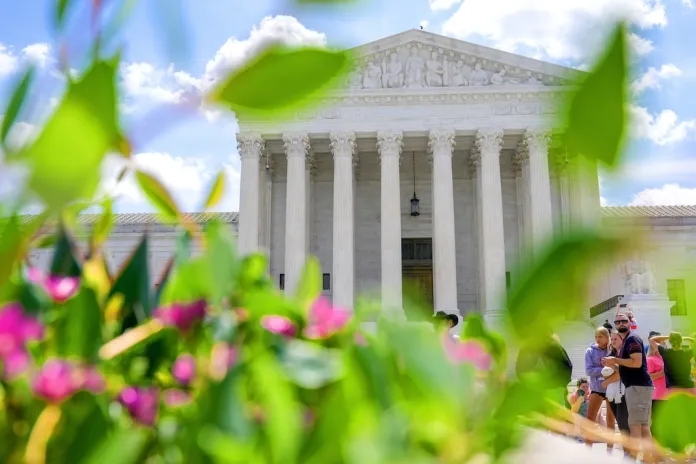
The Supreme Court will take up another case involving parental rights in its upcoming term, as states craft laws aimed at usurping parental authority, especially via LGBT policies, and courts hand down a patchwork of rulings about where parents’ right to dictate their child’s upbringing ends.
The high court will hear arguments in International Partners for Ethical Care, Inc. v. Ferguson next term, weighing whether parents may sue Washington state over its law that “deliberately displaces their decisionmaking role as to ‘gender transitions’ of their children, and in so doing creates present and likely future impediments to their ability to parent their children as they deem best for them.” The law itself allows runaway minors to get transgender surgeries without parental permission, in addition to exempting the state from a requirement to inform the parents of their child’s location and condition, by making genital and chest surgeries a “protected health care service.”
The case continues a trend of parental rights cases at the Supreme Court, which started with the 2025 ruling in Mahmoud v. Taylor, in which the high court affirmed the right of parents to opt their children out of LGBT books in school, and the March 2026 emergency docket ruling in Mirabelli v. Bonta, which halted a California public school policy that required school officials to actively hide a student’s use of a different name, pronouns, and bathroom facilities from his or her parents. The Mirabelli ruling pointed back to the Mahmoud ruling by affirming that parents have a constitutional right to control their child’s upbringing.
With the Ferguson case, the coalition of parents who brought the case, backed by America First Legal, is asking the high court to allow their case to proceed in court. AFL senior counsel Ian Prior told the Washington Examiner that with this case, the Supreme Court has the chance to “solidify the ability of parents to effectively exercise their parental rights through litigation” by allowing the case against Washington’s law to continue.
“In order to effectively exercise those rights, it’s important that the Supreme Court further clarifies, as it did in the Mirabelli v. Bonta case, that parents that are the object of the policy have standing, not that they have to wait for something to actually happen to their child before exercising their rights,” Prior said.
He pointed to the “roadblocks in cases throughout the country” where parents have been barred from suing over policies that aim to give local and state governments more authority over children than the parents, as some courts have ruled they do not have standing to file lawsuits until their rights have already been violated.
“Unfortunately, when you’re dealing with parental rights and you’re dealing with a very limited time horizon, No. 1, where you were a parent and you were raising your child, and No. 2, if you deny parents the ability to step in and challenge these these laws, these regulations, these policies until something happens, at that point the damage is already done,” Prior said.
A persistent problem
The case of parents looking to sue over the Washington law comes as the issue of parental rights, particularly at the intersection of LGBT issues, including transgender surgeries for minors and a child’s use of adopted pronouns or names, appears to be a persistent problem for the justices to solve.
The high court has been clear in its affirmation of parents’ constitutional right to dictate their children’s upbringing, but the cases involving parental rights are still moving through lower courts.
Tom Jipping, a senior legal fellow at the conservative Advancing American Freedom, told the Washington Examiner that as long as states such as Washington, California, and Maryland pursue a “gender agenda” seeking to shut parents out of key decisions about their child’s upbringing, this issue will continue to make its way before the justices.
“This gender agenda is one that I think shocks a lot of people in terms of how just aggressive and forceful it is to the exclusion of anything else,” Jipping said. “I don’t understand why states are that determined to dictate what people say, dictate what kids learn, how they should be treated in schools, that this gender idea is so potent that it overrides everything else.”
“I don’t understand that, but as long as that’s what some states are going to continue doing, this issue of the fundamental right of parents to direct their children’s upbringing is going to be back in the courts, back at the Supreme Court. They’re going to say it over and over and over again,” he added, noting the high court has been “crystal clear” about parents’ fundamental right to dictate their children’s upbringing in all contexts.
Many of the laws at issue in the cases making their way through the federal courts not only hide information from parents, but in some cases, like in Mirabelli, require teachers to actively mislead parents on what is going on with their children’s name or gender identity at schools.
“They’re going to actively, deliberately lie and deceive parents, so that this really critical part of children’s lives is under their control. That’s just monstrous, in my opinion. But they’re so determined to do that,” Jipping said, referring to policies like one at issue in Mirabelli.
“But that’s why we have courts,” he added. “That’s why we have the Constitution to protect fundamental rights. That’s why we have litigators, who have been bringing these cases. That’s why we have the system that we have, and thankfully, the Supreme Court isn’t blinded by this agenda, they’re staying focused on the Constitution, which does protect parents’ rights.”
The Supreme Court did not offer an explanation for why it decided to take up International Partners for Ethical Care, Inc. v. Ferguson for arguments in its June 29 orders list, in keeping with typical court processes, but Prior said he believes the high court “is certainly trying to send a message by taking” the case. He noted that some justices have previously discussed their concern over courts throwing out parental rights cases without hearing them by alleging a lack of standing. The standing question is at the center of the Ferguson case.
Jipping noted that while there are usually a variety of reasons for why the Supreme Court may decide to take up a case, such as a split between different federal judicial circuits on an issue, with this case, it seems the justices may have wanted to reaffirm their previous parental rights holding and send a message with a case where the violation appears “blatant.”
“It’s like a majority of the justices are saying, ‘Look, we gotta show that we mean it, we gotta show that this is real, what we’ve said about parents’ rights,'” Jipping said. “And so they’re gonna take a few of these cases that are probably fairly easily decided, hoping that people respect the Constitution.”
With the upcoming arguments in the Ferguson case, the stakes are high for parental rights advocates. While the Supreme Court has repeatedly sided with parents’ rights activists in earlier cases, a ruling favoring Washington would be dire, Prior noted, because of the confusion it would cause and the issues it would create for future lawsuits over similar laws.
‘ASSAULT WEAPONS’ BANS ARE ON THEIR WAY TO THE SUPREME COURT
“It [would take] away the ability for parents to prevent that harm from occurring in the first place, which is an incredibly dangerous place to be, and it’s an egregious violation of their constitutional rights,” Prior said.
The Supreme Court has not announced when it will hold oral arguments in the Ferguson case, but it will likely be sometime between December 2026 and the end of April 2027. A ruling in the case is expected by the end of June 2027.
Continue reading...
[ H/T Washington Examiner ]