






The Palestinians want to be occupied, but not by Israel. Rather, they want to be governed by people of their own ethnicity and religion.
For decades, Palestinian nationalism has been presented as a struggle for freedom. Give Palestinians sovereignty over Gaza, East Jerusalem, and the West Bank — the proper appellation for this territory is Judea and Samaria — and they will supposedly achieve the “freedom” and “self-determination” they have long sought.
This claim confuses national independence with individual liberty. Resistance to Israeli rule does not necessarily produce freedom under a Palestinian government. What many Palestinians call “freedom” appears to mean government that is not run by Jews, but instead is controlled by members of their own ethnic and religious group.
The meaning of freedom
Freedom is the condition of not being subject to another person’s arbitrary control or to constraints that prevent one from acting according to one’s own will.
Politically, freedom means the absence of government force or arbitrary control over citizens, apart from compulsory taxation. It includes freedom of speech, freedom of the press, freedom of assembly, religious liberty, protection of individual rights and property, and a democratic process capable of defending those liberties.
Palestinian nationalists have generally defined freedom as the end of Israel’s “occupation,” or have used vague expressions such as national “self-determination.” But freedom from Israeli rule is not the same thing as individual freedom under a Palestinian government. The authoritarian records of Hamas and the Palestinian Authority show why Palestinian statehood, by itself, would not produce a free Palestinian society.
Other than demanding that Israel cease to exist — or return to the borders of 1967 — Palestinian leaders have offered little concrete vision of what a “free” Palestinian state would look like. Chants such as “from the river to the sea, Palestine will be free” are memorable, but they do not explain what the word “free” means.
Freedom from Israel’s alleged “occupation of Palestinian land” identifies only the ethnicity and religion of the people Palestinians want to govern them. It gives no indication of whether a future Palestinian state would protect dissent, private property, religious minorities, journalists, political opponents, or individual rights.
The Palestinian Authority
The Palestinian Authority’s Basic Law serves as its interim constitution and governs PA governance in the West Bank. It supposedly guarantees freedom of opinion, freedom of the press, and the right to form political parties. Yet these freedoms are largely absent from life in the West Bank.
Mahmoud Abbas was elected president of the Palestinian Authority in January 2005. His four-year term has now extended into its third decade — no presidential election has been held since 2005. A presidential election has been announced for 2027, while the legislature has been dissolved, leaving Abbas to govern largely by decree.
The PA’s treatment of critics further illustrates the gap between constitutional promises and actual conduct. The 2017 Cybercrime Law criminalized online criticism of the leadership. In 2021, activist Nizar Banat was beaten to death by PA security forces after posting videos attacking corruption. The officers charged in his death have still not been tried.
The Palestinian National Charter of 1968 also fails to provide a serious account of political liberty. It mentions one specific freedom, freedom of worship, but does not explain what other freedoms Palestinians would enjoy under a sovereign Palestinian state. The PLO was supposed to draft a new charter after 1996, but never did.
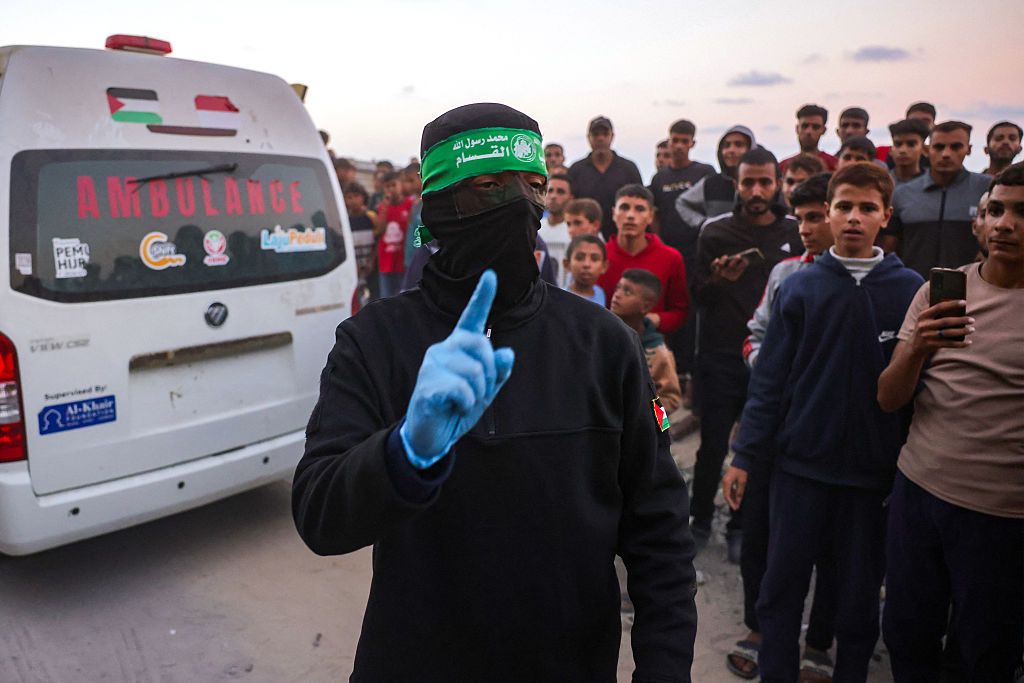
The Hamas charters provide even less reason for optimism. Neither the original charter nor the 2017 document proposes a liberal democratic order. Hamas seeks an Islamic political system extending over the entirety of Israel.
Existing Palestinian rule
The clearest evidence of what a “free” Palestine might look like comes from the governments that already exist.
Freedom House classifies the Palestinian Authority in the West Bank as “not free.” It describes the PA as authoritarian and says that it represses journalists and activists who criticize its rule. The organization similarly describes Hamas in Gaza as governing “in an authoritarian manner” and suppressing criticism.
Public opinion also shows substantial support for these movements. A July 2023 poll found that 57% of Palestinians in Gaza had a very or somewhat positive view of Hamas, while 68% of West Bank Palestinians had a very or somewhat positive view of Fatah.
In a December 2023 poll, 72% of Palestinians said that Hamas had made the correct decision in launching the Oct. 7 attack, while 60% preferred Hamas to control Gaza after the war.
Support later declined, but did not disappear. A May 2025 poll found that half of respondents still considered the Oct. 7 attack correct. A PCPSR poll conducted in August 2026 found Hamas and Fatah each receiving 24% support.
The problem is not that every Palestinian supports Hamas or the PA. The problem is that Palestinian nationalism has generally mobilized people against Israel rather than against the Palestinian rulers who deny them political rights.
Israel and Arab freedom
Living under a Jewish-majority state is not incompatible with individual freedom for Arabs or Muslims. Israel has political imperfections, but it has been rated “free” by Freedom House.
Arab citizens of Israel serve as professors, politicians, police officers, soldiers, doctors, lawyers, and engineers. A May 2026 survey found that 53% of Arab citizens described their overall sense of belonging as strong. A November 2023 survey found that 33% identified Israeli citizenship as the most important component of their identity, while only 8% selected “Palestinian.”
The ethnic or religious identity of a government does not determine whether its citizens are free. Institutions, laws, political competition, and respect for individual rights matter more.
ISRAEL WILL NOT SURRENDER ITS FUTURE TO HAMAS. ITS UN AMBASSADOR JUST REMINDED THE WORLD WHY
A genuinely free Palestine would require enforceable protections for speech, religious liberty, journalists, minorities, political opposition, property, and the rule of law. Until those freedoms become central to Palestinian political demands, describing Palestinian nationalism as a movement for freedom is misleading.
The Palestinians’ conception of freedom, as expressed through their political institutions and dominant movements, is not freedom in the ordinary political sense. It is the desire to be occupied, more oppressively, by people of their own ethnicity and religion rather than to live imperfectly under a Jewish democracy.
James Delmore is an independent writer. Walter E. Block, Ph.D., is the Harold E. Wirth eminent scholar endowed chair and professor of economics at Loyola University New Orleans.
Continue reading...
[ H/T Washington Examiner ]