



Submitted by Mary Christine
Guest Post by Ed Dowd

Nvidia’s stock is breaking down, and the headlines are busy with personal revelations about Jensen Huang. The more damaging revelations revolve around espionage and smuggling of chips to China. The timing is interesting, especially with reports last night circulating that he is out of a job. However, the predominant reason for the price action is simpler and more durable: the AI bubble has already popped because growth fundamentals are slowing for reasons I have laid out in previous articles.
Credit markets have been the canary. Private credit flows for data-center buildout are going the wrong way and that source of funds is effectively paused in the near term. Neocloud bond spreads are blowing out and access to funding is becoming expensive and problematic. Additionally hyperscalers are reassessing the pace of their current capital expenditure as well. When the second derivative of spending turns down because the ultimate ROI is being questioned, the pick-and-shovel supplier stocks feel it first. Semiconductor cycles do not care about narratives. Power and grid constraints have become the binding limit rather than pure chip supply. Circular financing arrangements that propped up reported demand are now under scrutiny. Estimates for the industry are too high and that is the core of the semiconductor stocks problem.
Nvidia Chart
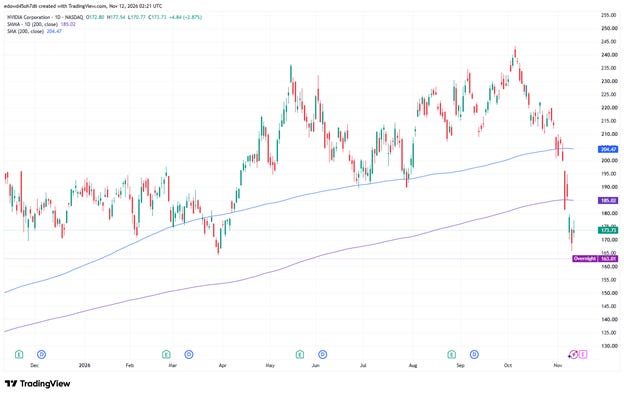
Potential Nvidia Expectations Reset
The recent revelations about affairs and alleged Chinese intelligence and smuggling links arrive against this deteriorating fundamental backdrop. Reports that Jensen is gone, if accurate, change the incentive structure immediately for the remaining C-suite and the board. As I noted on X last night: “Let’s war-game the daisy-chain effects. He has been the architect of much of the circular financing that helped pump chip demand. There were likely grey (I’m being generous) accounting practices. Growth fundamentals are clearly slowing. Those remaining in the C-suite and the board now have a strong incentive to kitchen-sink everything, reset expectations while blaming Jensen.” Simply put, growth was already decelerating so a new CEO can accelerate the recognition of that reality while cleaning the books. Markets price the reset faster than the story of any single executive.
On the subject of potential accounting issues this is not without precedent. Jensen and Nvidia have faced accounting questions before. In the crypto mining era, the company settled with the SEC in 2022 over inadequate disclosures regarding the growth of processors sold into the gaming segment that were actually going to miners thus understating the scale of that demand channel. Earlier periods around the early 2000s post-bubble environment also saw scrutiny of revenue recognition and related practices common in the semiconductor and technology space at the time. The pattern was one of aggressive channel and end-market accounting when growth was the dominant narrative. Fast forward to today with the circular deals, vendor financing-style arrangements, and optimistic useful-life assumptions on rapidly obsolescing hardware, it all rhymes with prior cycles. When the growth narrative cracks, the accounting tends to get reexamined.
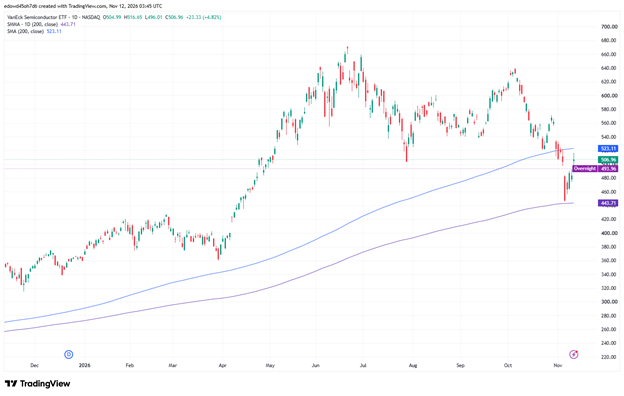
Semiconductor Industry Stock Prices Peaked In June
Last week on X I pointed out that IMHO the AI bubble had technically burst according to the semiconductor industry chart. The industry was down roughly 32 percent from its parabolic peak in June and took out the July low with authority. Semiconductors are the pick-and-shovel suppliers to the AI buildout and the tip of the spear. The Financial reflexivity that propelled valuations and revenues higher is now in reverse. Financial reflexivity is the theory that there is a two-way feedback loop in which investor perceptions and expectations influence market prices and fundamentals, which in turn shape those same perceptions thus creating self-reinforcing booms or busts. Credit markets signaled it first. There will be rallies and hope trades; that is normal in the unwind. But the longer-term technical trend has flipped IMHO, and it is a process driven by fundamentals, not a one-day headline.
SMH Chart (Semiconductor ETF)
Bottom Line
The Chinese linked revelations and the surrounding narrative have convenient timing. After the midterms and a shift in political power, forces inside government appear to have flipped the switch and are leaking this information with mainstream media amplification. Much of what is emerging was known for some time by authorities including allegations of smuggling. Why now? Expect the framing to move toward national security, export-control enforcement, and ultimately calls to regulate or restrict open-source competition. That serves certain institutional interests. It does not change the fact that the bubble was already bursting on slowing capex second derivatives, private-credit stress, ROI skepticism, power constraints and the classic semiconductor cycle dynamics of double-ordering and demand destruction. Nvidia has a top-line problem because the underlying growth assumptions embedded in current estimates are being invalidated by these forces. The Chinese espionage and smuggling allegations should not be diminished here should they turn out to be true and a sizable chunk of Nvidia’s revenues, rather investors should understand that cyclical growth deceleration is the primary cause of the stock decline and any subsequent rallies will be met with additional fundamentally driven selling as the cycle continues to unwind.
The stock is reflecting the recognition that growth was never going to stay parabolic once the funding, power, and end-demand realities asserted themselves. The personal and geopolitical stories are the cherry on top. The fundamentals were already being written into the charts since the semiconductor industry peak in June.
“Woe to him who builds his house by unrighteousness, and his upper rooms by injustice.” Jeremiah 22:13
Tweet
Continue reading...
[ H/T The Burning Platform ]
Guest Post by Ed Dowd
Fundamentals cracked first. The Chinese revelations arrived right on schedule.
Nvidia’s stock is breaking down, and the headlines are busy with personal revelations about Jensen Huang. The more damaging revelations revolve around espionage and smuggling of chips to China. The timing is interesting, especially with reports last night circulating that he is out of a job. However, the predominant reason for the price action is simpler and more durable: the AI bubble has already popped because growth fundamentals are slowing for reasons I have laid out in previous articles.
Credit markets have been the canary. Private credit flows for data-center buildout are going the wrong way and that source of funds is effectively paused in the near term. Neocloud bond spreads are blowing out and access to funding is becoming expensive and problematic. Additionally hyperscalers are reassessing the pace of their current capital expenditure as well. When the second derivative of spending turns down because the ultimate ROI is being questioned, the pick-and-shovel supplier stocks feel it first. Semiconductor cycles do not care about narratives. Power and grid constraints have become the binding limit rather than pure chip supply. Circular financing arrangements that propped up reported demand are now under scrutiny. Estimates for the industry are too high and that is the core of the semiconductor stocks problem.
Nvidia Chart
Potential Nvidia Expectations Reset
The recent revelations about affairs and alleged Chinese intelligence and smuggling links arrive against this deteriorating fundamental backdrop. Reports that Jensen is gone, if accurate, change the incentive structure immediately for the remaining C-suite and the board. As I noted on X last night: “Let’s war-game the daisy-chain effects. He has been the architect of much of the circular financing that helped pump chip demand. There were likely grey (I’m being generous) accounting practices. Growth fundamentals are clearly slowing. Those remaining in the C-suite and the board now have a strong incentive to kitchen-sink everything, reset expectations while blaming Jensen.” Simply put, growth was already decelerating so a new CEO can accelerate the recognition of that reality while cleaning the books. Markets price the reset faster than the story of any single executive.
On the subject of potential accounting issues this is not without precedent. Jensen and Nvidia have faced accounting questions before. In the crypto mining era, the company settled with the SEC in 2022 over inadequate disclosures regarding the growth of processors sold into the gaming segment that were actually going to miners thus understating the scale of that demand channel. Earlier periods around the early 2000s post-bubble environment also saw scrutiny of revenue recognition and related practices common in the semiconductor and technology space at the time. The pattern was one of aggressive channel and end-market accounting when growth was the dominant narrative. Fast forward to today with the circular deals, vendor financing-style arrangements, and optimistic useful-life assumptions on rapidly obsolescing hardware, it all rhymes with prior cycles. When the growth narrative cracks, the accounting tends to get reexamined.
Semiconductor Industry Stock Prices Peaked In June
Last week on X I pointed out that IMHO the AI bubble had technically burst according to the semiconductor industry chart. The industry was down roughly 32 percent from its parabolic peak in June and took out the July low with authority. Semiconductors are the pick-and-shovel suppliers to the AI buildout and the tip of the spear. The Financial reflexivity that propelled valuations and revenues higher is now in reverse. Financial reflexivity is the theory that there is a two-way feedback loop in which investor perceptions and expectations influence market prices and fundamentals, which in turn shape those same perceptions thus creating self-reinforcing booms or busts. Credit markets signaled it first. There will be rallies and hope trades; that is normal in the unwind. But the longer-term technical trend has flipped IMHO, and it is a process driven by fundamentals, not a one-day headline.
SMH Chart (Semiconductor ETF)
Bottom Line
The Chinese linked revelations and the surrounding narrative have convenient timing. After the midterms and a shift in political power, forces inside government appear to have flipped the switch and are leaking this information with mainstream media amplification. Much of what is emerging was known for some time by authorities including allegations of smuggling. Why now? Expect the framing to move toward national security, export-control enforcement, and ultimately calls to regulate or restrict open-source competition. That serves certain institutional interests. It does not change the fact that the bubble was already bursting on slowing capex second derivatives, private-credit stress, ROI skepticism, power constraints and the classic semiconductor cycle dynamics of double-ordering and demand destruction. Nvidia has a top-line problem because the underlying growth assumptions embedded in current estimates are being invalidated by these forces. The Chinese espionage and smuggling allegations should not be diminished here should they turn out to be true and a sizable chunk of Nvidia’s revenues, rather investors should understand that cyclical growth deceleration is the primary cause of the stock decline and any subsequent rallies will be met with additional fundamentally driven selling as the cycle continues to unwind.
The stock is reflecting the recognition that growth was never going to stay parabolic once the funding, power, and end-demand realities asserted themselves. The personal and geopolitical stories are the cherry on top. The fundamentals were already being written into the charts since the semiconductor industry peak in June.
“Woe to him who builds his house by unrighteousness, and his upper rooms by injustice.” Jeremiah 22:13
Tweet
Continue reading...
[ H/T The Burning Platform ]