





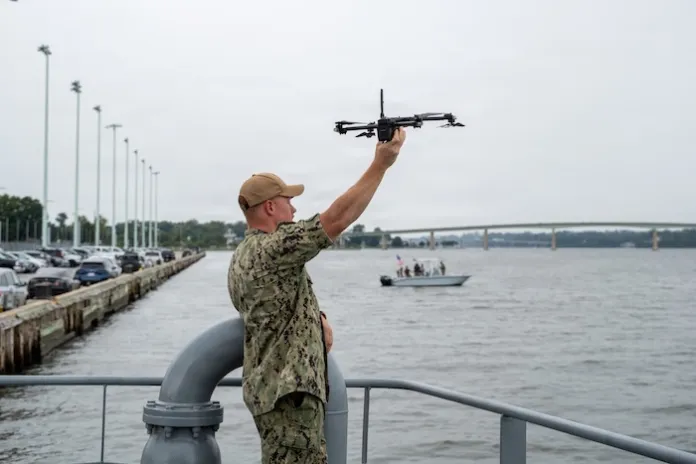
The Navy announced on Thursday the formation of a new center dedicated to robotic and autonomous systems that will be headquartered at Joint Expeditionary Base Little Creek-Fort Story in Virginia.
The Robotic and Autonomous Systems Warfighting Development Center will operate under U.S. Fleet Forces Command.
“To maintain our decisive maritime advantage, we must rapidly integrate robotic and autonomous systems into how we operate, train, and deploy,” Adm. Daryl Caudle, the Chief of Naval Operations, said. “The establishment of RASWDC ensures our Sailors are equipped with the tactical edge, advanced training, and specialized doctrine required to win the high-end fight.”
Caudle designated Rear Adm. Melvin Smith as the inaugural commander of RAWSDC, and Smith has been tasked with developing phased near-, mid-, and long-term implementation plans on command structure, mission relationships, resource requirements, and more.
“This is just day one,” said Smith. “Our purpose here is to consolidate the Navy’s autonomous efforts across air, surface, and undersea domains, and give them a single home here at Little Creek. Our mandate is straightforward: educate our warfighters, equip the Fleet with tools that actually survive the environment, and develop the combined tactics to employ them decisively. We are here to make sure our forces don’t just field unmanned systems, but dominate with them.”
Thursday’s news comes about a month and a half after acting Secretary of the Navy Hung Cao announced the establishment of a Direct Reporting Portfolio Manager for Robotics and Autonomous Systems.
Christopher Miller serves as the acting DRPM RAS and reports to the acting undersecretary of the Navy, William Toti.
“RASWDC is the critical bridge between capability development and operational employment,” Caudle added. “By forging a direct feedback loop, we are accelerating the delivery of unmanned capabilities from the foundry directly to the Fleet, ensuring our forces are postured to meet any challenge.”
The Navy has begun using autonomous systems already. In the Middle East, the navy deployed a Corsair drone boat to aid in the search and rescue for two Army Apache helicopter pilots who had to make an emergency landing in the Arabian Sea in June, and they later used that same platform as a kamikaze drone to hit and destroy a submarine and ship maintenance facility at the port at Bandar Abbas Naval Base.
UNDERSTANDING THE ARMY’S DRONE STRATEGY: NECESSARY ‘ACROSS EVERY WARFIGHTING FUNCTION
“On June 8th of this year, after a U.S. Army Apache AH-64 went down near the coast of Oman, U.S. CENTCOM launched a rapid, responsive joint search and rescue effort to recover the crew,” Gen. Dan Caine, the chairman of the Joint Chiefs of Staff, said last week. “That response drew on the totality of the joint force, and ultimately was required to use enabled unmanned vessels to participate in the rescue of downed U.S. service members for the first time ever.”
“That capacity did not appear overnight. It came from the men and women of Task Force 59, CENTCOM’s forward-leaning unmanned joint maritime unit, who spent the last several years testing, integrating, and operationalizing unmanned systems and AI in one of the most demanding and kinetic environments on Earth right now,” Caine said during the Air and Space Conference in Maryland last week.
Continue reading...
[ H/T Washington Examiner ]