


NANO's Laser Partner Finally Files For IPO: LIS Technologies Wants $17 Million To Fix America's Enrichment Problem
We have been previewing this one since January. On Monday morning, it finally arrived.
LIS Technologies (LIST), the Oak Ridge laser enrichment startup in which NANO Nuclear (NNE) is a shareholder, strategic partner, landlord and, through chairman Jay Yu, something close to a sibling, filed its S-1 for a Nasdaq IPO under the ticker "LIS." The terms: 2,833,334 shares at $5 to $7, or about $17 million at the $6 midpoint, with Titan Partners as lead bookrunner. The public filing follows a confidential DRS submitted on July 20 and amended on September 10, so the company has been quietly working on this all summer, right around the time it was buying buildings, shipping uranium and clearing NRC security reviews (all of which we covered as they happened).
At the midpoint, LIS would have a market cap of roughly $447 million on 74.4 million post-IPO shares, and closer to $620 million fully diluted by our math once you count the ~29 million options, RSUs and warrants outstanding. For context, NANO Nuclear itself was valued at $643 million this morning, with the stock at $12.04, a fresh 52-week low and 76% below its $49.50 high, marking the nadir of unprecedented anti-nuclear sentiment pervasive in the market at a time when nuclear fundamentals have never been stronger. The pre-revenue laser startup is asking to be valued at about the same as its own (also pre-revenue, but $580 million-liquidity-holding) partner.
Regular readers know why we have been fixated on this name since the day it announced its $1.38 billion plant: as we put it on January 16, it was "bullish for LIST partner NNE."
So what does the S-1 actually tell us about LIS, about NANO, and about America's nuclear fuel pipeline? Quite a lot, as it turns out, and not all of it will make it into the roadshow deck.
The basics first. LIS is offering 2,833,334 shares on a firm-commitment basis, plus a 30-day option on another 425,000. The underwriting discount is 6.5%, plus a 0.5% expense allowance, and Titan gets warrants on 7% of the deal struck at 115% of the IPO price. Net proceeds come to about $15.1 million at the midpoint ($17.5 million if the shoe is exercised). Officers and directors are locked up for 180 days, and both CEO Jay Yu and president Christo Liebenberg have indicated interest in buying up to $250,000 of stock each in the deal.
Where does the money go? About 67.5% to R&D, site work on LIST Island and testing, 20% to working capital... and 12.5%, or roughly $1.9 million, to "marketing and promotion, and business development activities." Every nuclear renaissance needs a marketing budget, apparently.
The underwriter choice is worth flagging too. Titan Partners was the sole placement agent on NANO's own $400 million at-the-market private placement in October 2025, and NANO itself went public in May 2024 with a tiny $10.25 million IPO at $4 a share. Same chairman, same micro-IPO-then-raise-big template. Given that NNE trades 3x above its IPO price even after a 76% drawdown, maybe LIS insiders can be forgiven for running it back.
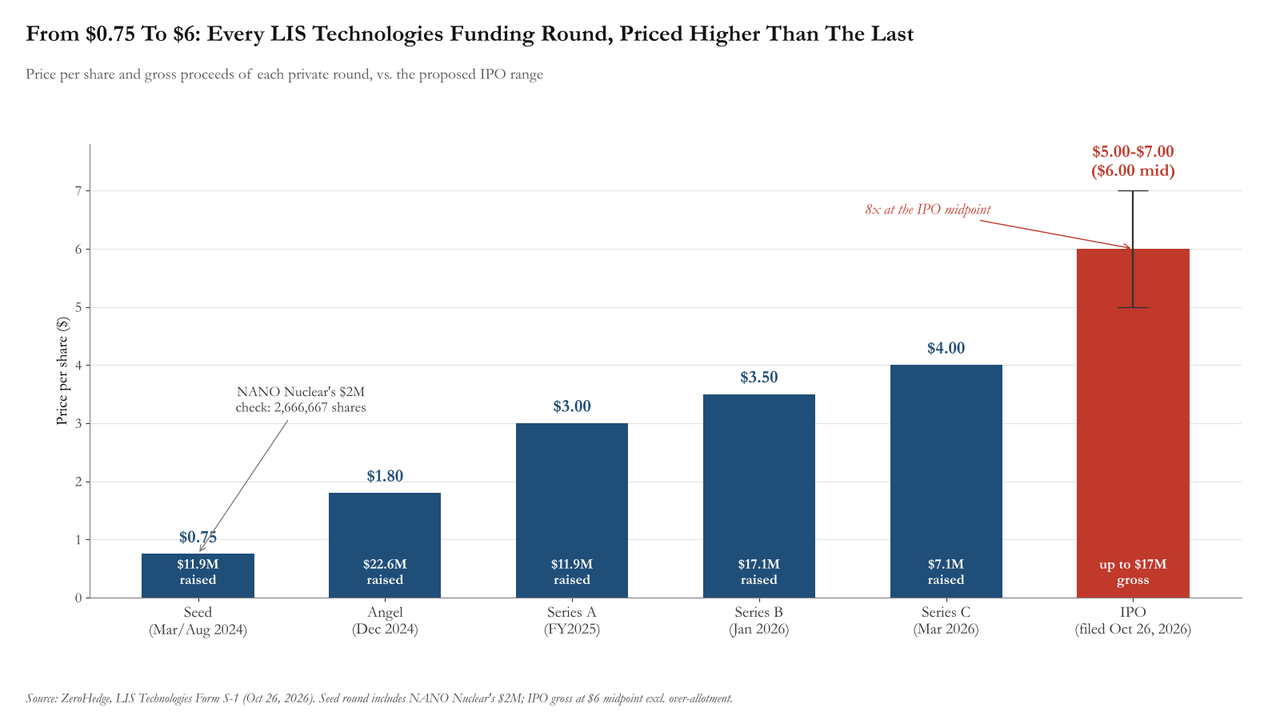
And the insiders have done very well already. The S-1 lays out every private round, and each one priced above the last: $0.75 in the 2024 seed round (where NANO wrote its $2 million check), $1.80 in the December 2024 angel round, $3.00 in Series A, $3.50 in January's $17.1 million Series B and $4.00 in a $7.1 million March round. All told, LIS has raised about $70.6 million privately; the IPO midpoint is 8x where NANO got in.
Strip away the related-party plumbing and the pitch is simple: the US can't enrich enough uranium to fuel its own reactors, and Washington just set a hard deadline to stop buying the stuff from Russia.
The S-1 cites UxC's Q1 2026 Enrichment Market report: projected US requirements run from about 11 million SWU (Separative Work Units) in 2045 in the low case to about 39 million SWU if nuclear capacity triples, against current US domestic enrichment capacity of "less than 5 million SWU per year." That leaves, in the company's words, "a projected supply gap of approximately 6 million to 35 million SWU per year." Here is the UxC chart straight out of the filing:
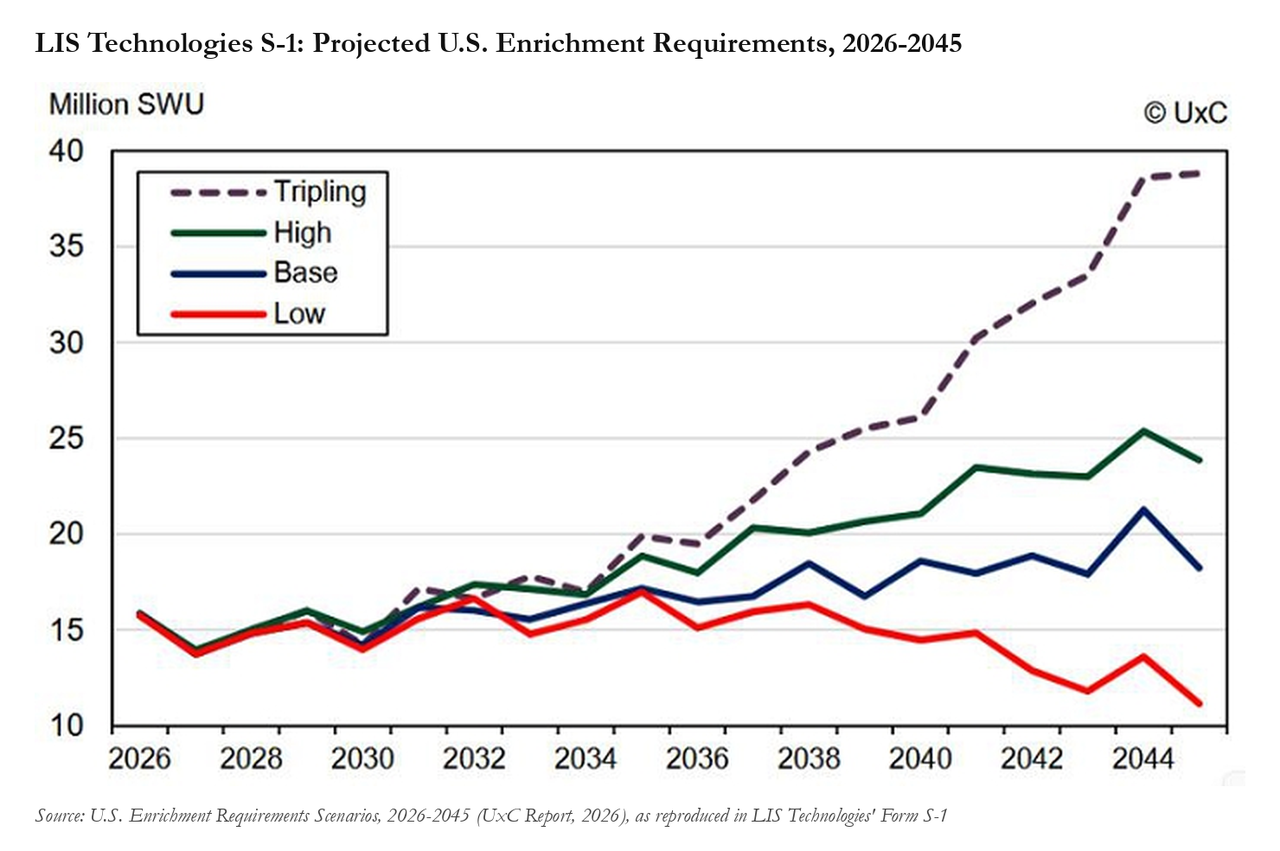
Note the starting point, which the S-1 skips over: UxC has US requirements at roughly 16 million SWU today. In other words, even UxC's bear case for 2045 needs twice the enrichment America can currently produce, and the gap is already here. It's filled with imports from Urenco's European plants, Orano and, until January 2028, Russia. As Bloomberg reported in July, citing EIA data, Russia supplied almost 26% of US reactor operators' enrichment purchases in 2025, or about 3.28 million SWU. The DOE's waiver authority under the 2024 import ban expires no later than January 2028, and DOE officials have said there are no plans to extend it (as we discussed last month).
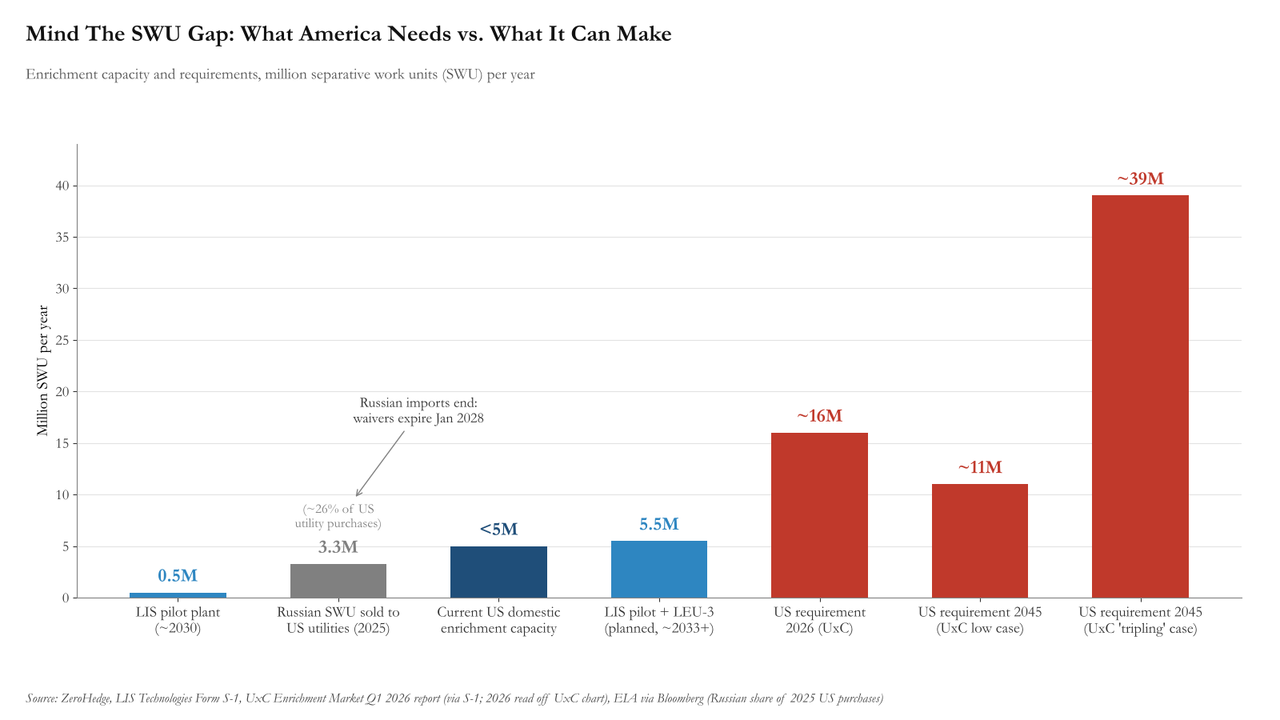
Put LIS's own plans in that context. The pilot plant is designed for about 0.5 million SWU around 2030, and the full LEU-3 facility for 5 million SWU around 2033, for a combined ~5.5 million SWU, or roughly a third of what US reactors consume today. Ambitious for a company whose test facility is a 14,000 square foot former K-25 badging office; still nowhere near enough for the country on its own.
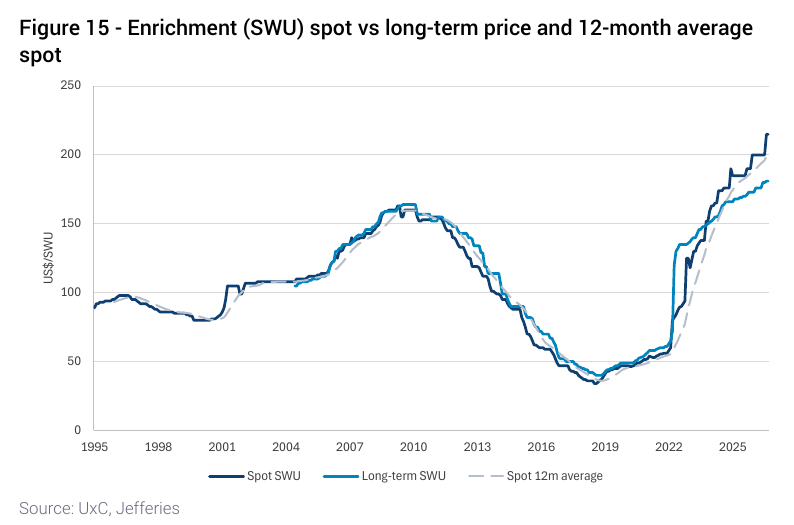
The market is already pricing the scarcity. As Jefferies' uranium team noted in its latest Uranium Market Update (available to pro subs), spot enrichment hit a series high of $215/SWU in August and held there in September, against $181/SWU long term, with the bank noting that "spot SWU prices the scarcity of enrichment services available sooner."
Washington, as usual, has responded by writing checks. In January the DOE handed $900 million each to Centrus' American Centrifuge Operating, General Matter and Orano, plus $28 million to Global Laser Enrichment. LIS is one of six companies on the DOE's ten-year LEU acquisition IDIQ contract, but the S-1 is refreshingly candid about what that's worth: the contract "does not fund the construction or operation of any enrichment facility," and LIS "does not currently rely on this program for funding." Total government money received to date, by our count: a $181,042 DOE task order and a $74,866 Air Force SBIR award. About a quarter of a million dollars, or roughly 0.01% of what the incumbents got in January.
The competitive landscape in the filing reads like a who's who of better-funded rivals: Centrus (licensed, Piketon), Urenco (licensed, Eunice), Orano (NRC review of its Oak Ridge centrifuge plant expected April 2027), Silex and Cameco's Global Laser Enrichment (laser, Paducah, NRC review expected January 2027) and the Thiel-backed General Matter. Even the incumbent is finding the buildout hard: BofA cut its Centrus (LEU) price objective by 10%, the only uranium name in its coverage to get a cut, "to reflect the rising complexity of its substantial U.S. enrichment capacity build-out" (in the bank's "We like copper and uranium" note, also available to pro subs). And LIS isn't the only laser story heading for public markets either: Goldman's Brian Lee hosted ASP Isotopes' soon-to-be-spun-off Quantum Leap Energy on October 8, focused on "the broader opportunity to address growing bottlenecks across the Western nuclear fuel cycle" (note available here for pro subs).
LIS's pitch against all of them: it is, "based on our public research," "the only company with a U.S.-origin and patented laser uranium enrichment technology." In a fuel market being rebuilt explicitly around national security, that's probably the single most valuable sentence in the filing.
For NNE holders, the S-1 is the most detailed look yet at what NANO actually owns, and the answer is: less than most people assume.
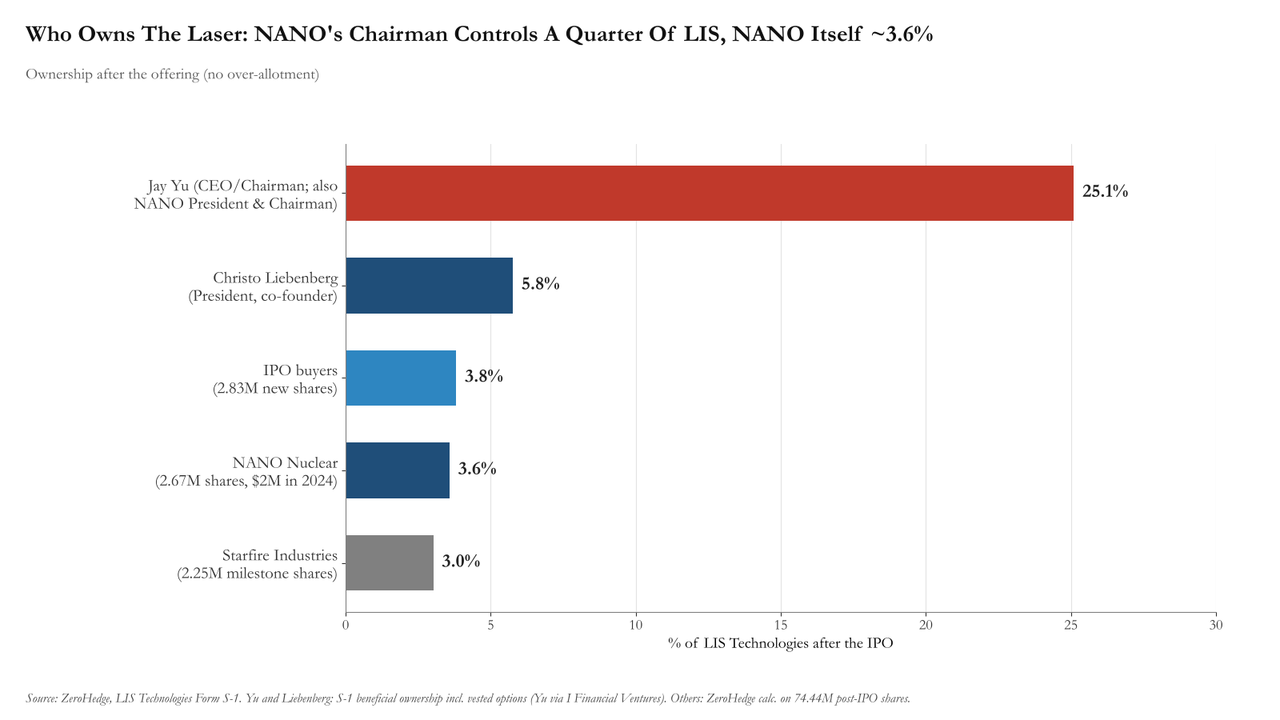
NANO holds 2,666,667 LIS shares, bought on August 8, 2024 at $0.75 for $2 million. That works out to about 3.6% of LIS after the IPO, which is below the 5% threshold, so NANO doesn't even appear in the principal stockholders table. At the $6 midpoint the stake is worth ~$16 million, a tidy 8x, but also just ~2.5% of NNE's current market cap. If you were buying NNE for "exposure to laser enrichment," the S-1 suggests you were mostly buying exposure to... Jay Yu.
Because the person who really owns LIS is NANO's chairman. Yu beneficially owns 21.8 million shares, or 25.1% after the offering, most of it through his wholly owned I Financial Ventures, including 12.4 million vested options. Those options are a story in themselves: 7.4 million of them were granted in May 2024 at $0.75 with a 20-year expiry (most of the other grants run four to six years), and all of his option grants vested on the day they were granted. At the midpoint his stake is worth roughly $131 million before exercise costs. Not bad for a company he runs part-time... and we mean that literally. Per the risk factors, Yu "is expected to continue to serve" as NANO's President, Secretary, Treasurer and Chairman and "devote no less than 40 hours per week to the business affairs of NANO Nuclear," while at LIS he is required to devote only "such of his business time and attention" as needed.
The commercial relationship is equally loose. The joint collaboration agreement, first signed on November 4, 2024 and amended and restated on September 8, 2026 (i.e., seven weeks before the S-1), sketches a closed loop: i) NANO "will work towards developing the necessary uranium conversion facilities" to supply UF6 feedstock, ii) LIS provides enriched and deconverted fuel back to NANO, iii) each gets reciprocal "preferred customer" status, and iv) the two share costs and jointly developed IP. But read the fine print:
In other words, the "LIST supplies NANO enriched UF6 at no cost in exchange for a share of profits" structure that both companies have been touting since 2024 is still an intention, two years later. Meanwhile the plumbing that does exist is mostly real estate: LIS leases its 7,000 sq ft Oak Ridge headquarters from NANO on a 10-year lease at $7,000 a month, and the two share a Project Management Office. As we said when the first uranium showed up in October, the related-party questions aren't going away, and a public listing just put a quarterly 10-Q spotlight on them.
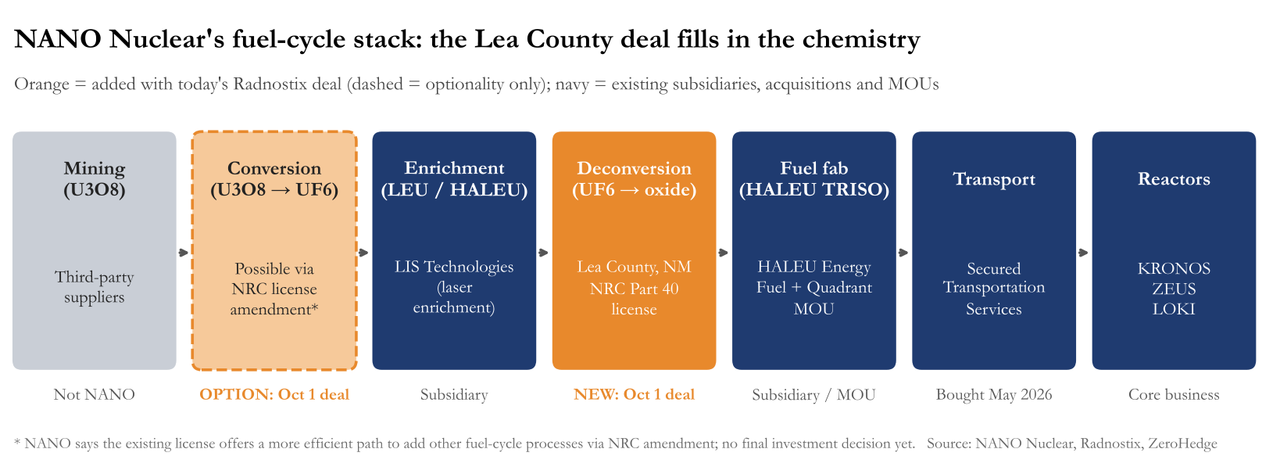
To be fair, the logic of the pairing remains intact. NANO has been methodically buying the boxes on either side of enrichment: transport (Secured Transportation Services in May), deconversion (the NRC-licensed Lea County site on October 1), and the reactors themselves. Here is the map we drew at the time; LIS is the box in the middle that NANO doesn't actually control:
And as we noted when the NRC signed off on LIS's security plan two weeks ago, the market has been unimpressed with all of it:
NNE was at $12.58 that day with short interest near a record ~40% of float. It's at $12.04 this morning, and touched a new 52-week low of $11.74 right as the S-1 hit. The IPO does at least give NNE holders a mark-to-market on a stake that until today was carried at whatever you wanted to believe; whether the shorts read the S-1 as a catalyst or as confirmation is the next fun question.
Now for the part of the S-1 that tends to get skipped. LIS is pre-revenue and has accumulated $65.4 million of losses since inception. The net loss for the nine months to July 31 was $29.7 million, up from $18.2 million a year earlier, and G&A ($15.8 million) still exceeds R&D ($11.4 million), helped by $10.5 million of equity compensation. Cash used in operations more than doubled to $14.8 million, and capex jumped to $24.9 million as the company bought and renovated property in Oak Ridge.
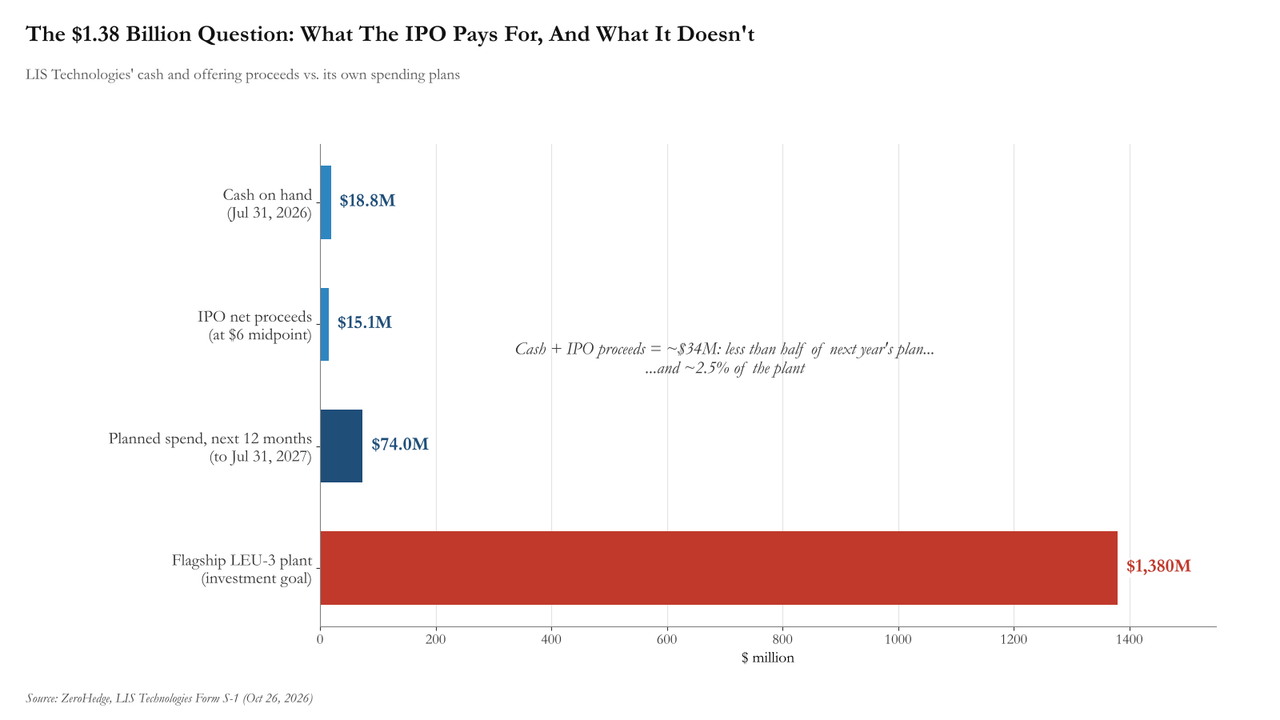
The result: cash fell from $33.2 million last October to $18.8 million at the end of July. Add the $15.1 million of IPO proceeds and LIS will have, generously, around $34 million (less whatever it spent in August through October). Against that, the S-1 says the company plans to spend about $74 million over the next twelve months: $18 million on opex, $28 million on CRISLA lab work, $4 million on "other proprietary processes" and $24 million on scaled facility development. And then there's the small matter of the $1.38 billion LEU-3 plant.
The going-concern language is a small masterpiece of the genre. Under the current plan, LIS says, existing cash "is expected to fund operations only into the first quarter of fiscal 2027," which starts next week (LIS's fiscal year ends October 31). That, the company concedes, raises "substantial doubt about our ability to continue as a going concern." But:
Translation: if we can't raise money, we'll stop doing the enrichment work, and then we'll be fine. Which is technically true. The filing also flags a Tennessee incentive package with "an estimated aggregate potential value of more than $200 million," of which nothing has been received yet. So, to state the obvious, this $17 million IPO is a down payment on many more raises to come, and anyone buying it should price in the dilution that funds the next $1.3 billion.
The other quiet change is the timeline. When LIS unveiled its $1.38 billion project in January, it was "targeting initial commercial operations before 2030." The S-1 now lays out four overlapping phases: re-demonstrate and optimize CRISLA through 2027; build industrial-scale equipment through 2028; license and build a 0.5 million SWU pilot plant "in or around 2030"; and then the commercial LEU-3 facility, "in or around 2033," starting at 3 million SWU and expanding to 5 million. You could argue the pilot plant counts as "initial operations." You'd probably have to argue it with a straight face.
Then there's the technology itself. CRISLA is a "U.S.-origin laser-based isotope enrichment process initially demonstrated in the early 1990s" by its inventor, Dr. Jeff Eerkens, and the immediate goal over the next twelve months is to "re-demonstrate and optimize enrichment results" his team achieved in 1993. LIS plans to initially use "the same proven legacy lasers used in 1987-1993 demonstrations," which it says were restored to "fully operational condition" as of May 30, 2026, while it develops its own laser systems with Starfire Industries (which, for what it's worth, holds 2.25 million LIS shares that vest only if milestones are hit). The S-1 is upfront that "there can be no assurance" the SEIT work "will successfully replicate those prior results." Lasers have broken plenty of hearts in enrichment before: ask anyone who worked on AVLIS, shelved in 1999 after billions in spending, or Global Laser Enrichment (the Silex/Cameco venture formerly run by GE-Hitachi), still not commercial after nearly two decades.
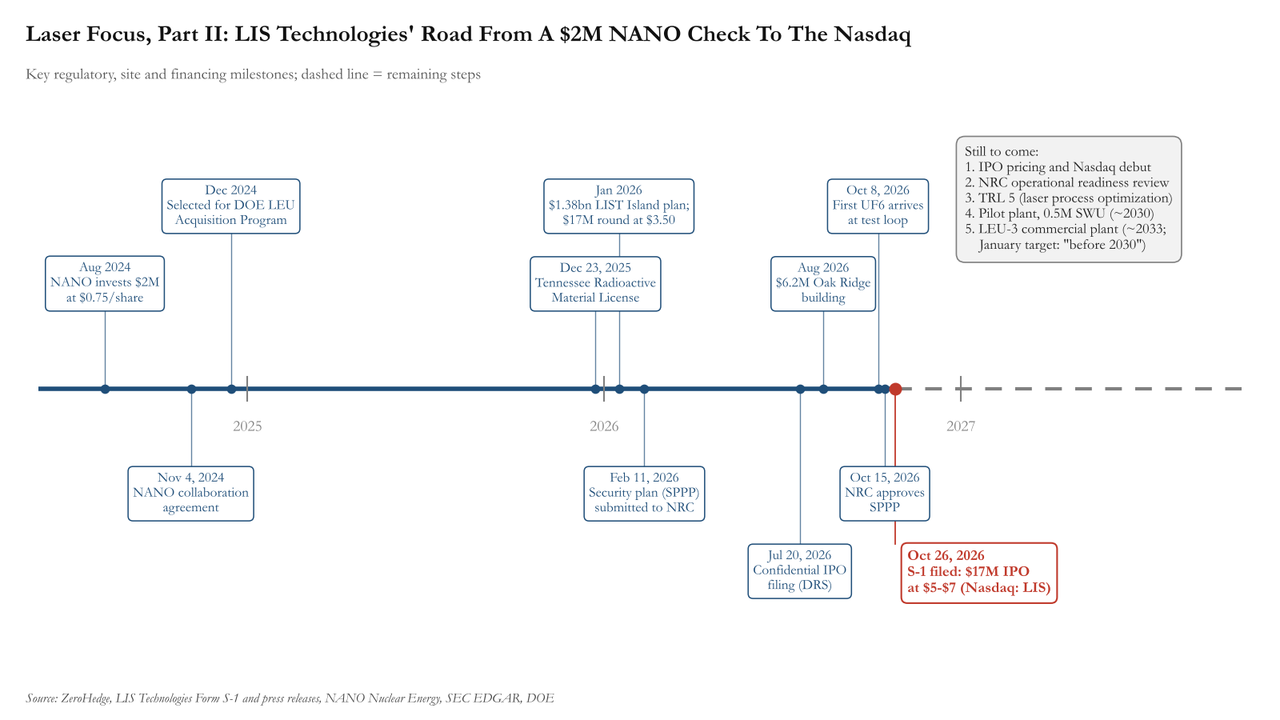
On the other hand, the regulatory boxes are getting ticked at a pace the nuclear industry usually doesn't recognize: a Tennessee radioactive materials license in December, the first UF6 delivery on October 8, and NRC approval of its security plan a week later. Here is our updated timeline:
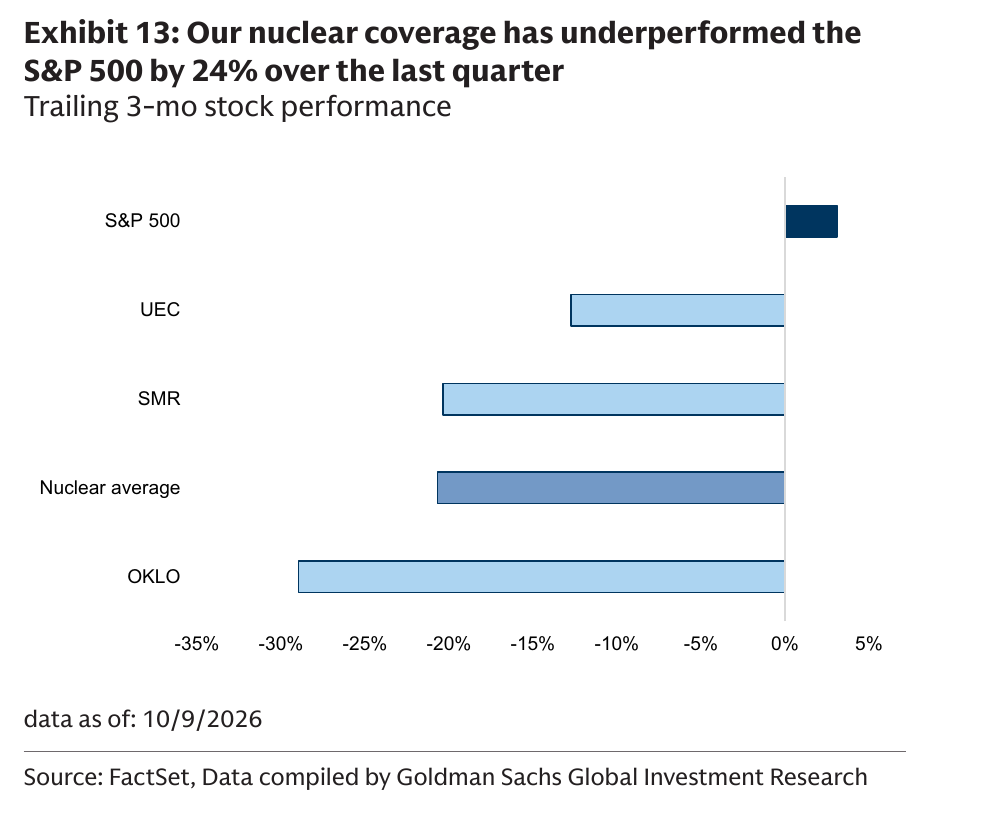
Finally, the timing. LIS is walking into one of the worst nuclear IPO windows in recent memory. In September Holtec postponed its $900 million IPO, citing deteriorating investor sentiment. As we detailed earlier today in "Everyone Wants Nuclear Power, Nobody Wants Nuclear Stocks," X-energy just signed its second Amazon-backed project with the stock 71% below its high, and Goldman's Brian Lee calculates in his latest Nuclear Nuggets that the bank's nuclear coverage returned -21% over the past three months versus +3% for the S&P (also available to pro subs).
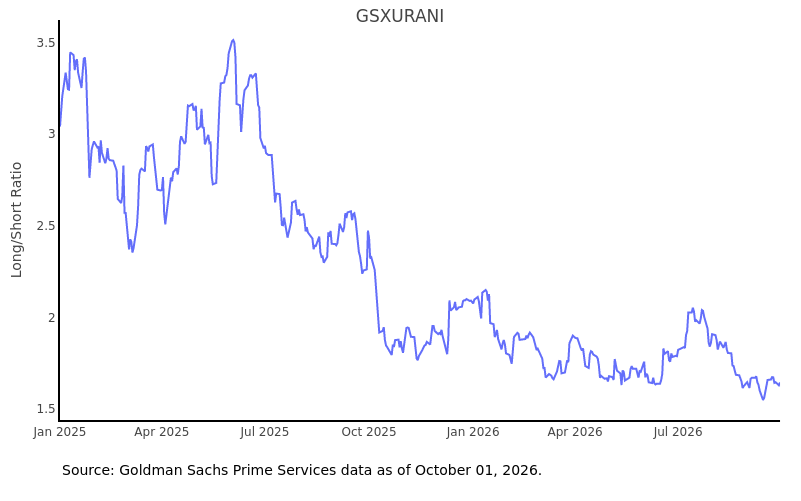
Positioning tells the same story. Goldman's derivatives desk put it bluntly in its "Nuclear Disconnect" Marquee note: "Nuclear investment continues to accelerate, but investor positioning remains subdued," with long/short ratios in the bank's uranium basket near the low end of recent ranges. The fundamentals keep improving and the money keeps leaving, as we discussed earlier in "Everyone Wants Nuclear Power, Nobody Wants Nuclear Stocks: Inside The Great Uprate Rush."
Which brings us to the obvious question: is a $17 million laser enrichment IPO a sign of froth, or a contrarian entry point? We lean toward the latter for the theme and stay more skeptical of the vehicle. The enrichment bottleneck is about as real as anything in the nuclear trade: spot SWU is at a record, Russian supply legally ends in 14 months, and even UxC's low case needs twice the capacity the US has today. If any slice of nuclear should collect rent in the 2030s, it's whoever controls the fuel, a point we've been making since January. And as Goldman's own data shows, the trade is about as unloved as it gets.
But LIS shareholders will be buying an option on a 1993 experiment, with less than half of next year's budget in the bank and a $1.38 billion plant still to finance. The IPO is the cheapest money LIS will ever raise as a public company... or the most expensive, depending on whether those decades-old lasers do what the patent says. We'll know a lot more when TRL 5 data comes in, probably sometime next year. Until then, for NNE holders at least, the gas station finally has a price tag, even if it still has no cars.
Much more in the full LIS Technologies S-1, plus Jefferies' "Uranium Market Update," BofA's "We like copper and uranium," and Goldman's "Nuclear Nuggets" and "Quantum Leap Energy" notes, all available to pro subs.
Tyler Durden Mon, 10/26/2026 - 12:15
Continue reading...
[ H/T ZeroHedge ]
We have been previewing this one since January. On Monday morning, it finally arrived.
LIS Technologies (LIST), the Oak Ridge laser enrichment startup in which NANO Nuclear (NNE) is a shareholder, strategic partner, landlord and, through chairman Jay Yu, something close to a sibling, filed its S-1 for a Nasdaq IPO under the ticker "LIS." The terms: 2,833,334 shares at $5 to $7, or about $17 million at the $6 midpoint, with Titan Partners as lead bookrunner. The public filing follows a confidential DRS submitted on July 20 and amended on September 10, so the company has been quietly working on this all summer, right around the time it was buying buildings, shipping uranium and clearing NRC security reviews (all of which we covered as they happened).
At the midpoint, LIS would have a market cap of roughly $447 million on 74.4 million post-IPO shares, and closer to $620 million fully diluted by our math once you count the ~29 million options, RSUs and warrants outstanding. For context, NANO Nuclear itself was valued at $643 million this morning, with the stock at $12.04, a fresh 52-week low and 76% below its $49.50 high, marking the nadir of unprecedented anti-nuclear sentiment pervasive in the market at a time when nuclear fundamentals have never been stronger. The pre-revenue laser startup is asking to be valued at about the same as its own (also pre-revenue, but $580 million-liquidity-holding) partner.
Regular readers know why we have been fixated on this name since the day it announced its $1.38 billion plant: as we put it on January 16, it was "bullish for LIST partner NNE."
So what does the S-1 actually tell us about LIS, about NANO, and about America's nuclear fuel pipeline? Quite a lot, as it turns out, and not all of it will make it into the roadshow deck.
The Terms: $17 Million, Titan Partners And A Very Familiar Playbook
The basics first. LIS is offering 2,833,334 shares on a firm-commitment basis, plus a 30-day option on another 425,000. The underwriting discount is 6.5%, plus a 0.5% expense allowance, and Titan gets warrants on 7% of the deal struck at 115% of the IPO price. Net proceeds come to about $15.1 million at the midpoint ($17.5 million if the shoe is exercised). Officers and directors are locked up for 180 days, and both CEO Jay Yu and president Christo Liebenberg have indicated interest in buying up to $250,000 of stock each in the deal.
Where does the money go? About 67.5% to R&D, site work on LIST Island and testing, 20% to working capital... and 12.5%, or roughly $1.9 million, to "marketing and promotion, and business development activities." Every nuclear renaissance needs a marketing budget, apparently.
The underwriter choice is worth flagging too. Titan Partners was the sole placement agent on NANO's own $400 million at-the-market private placement in October 2025, and NANO itself went public in May 2024 with a tiny $10.25 million IPO at $4 a share. Same chairman, same micro-IPO-then-raise-big template. Given that NNE trades 3x above its IPO price even after a 76% drawdown, maybe LIS insiders can be forgiven for running it back.
And the insiders have done very well already. The S-1 lays out every private round, and each one priced above the last: $0.75 in the 2024 seed round (where NANO wrote its $2 million check), $1.80 in the December 2024 angel round, $3.00 in Series A, $3.50 in January's $17.1 million Series B and $4.00 in a $7.1 million March round. All told, LIS has raised about $70.6 million privately; the IPO midpoint is 8x where NANO got in.
Why It Matters: America Burns More Than Three Times The SWU It Can Make
Strip away the related-party plumbing and the pitch is simple: the US can't enrich enough uranium to fuel its own reactors, and Washington just set a hard deadline to stop buying the stuff from Russia.
The S-1 cites UxC's Q1 2026 Enrichment Market report: projected US requirements run from about 11 million SWU (Separative Work Units) in 2045 in the low case to about 39 million SWU if nuclear capacity triples, against current US domestic enrichment capacity of "less than 5 million SWU per year." That leaves, in the company's words, "a projected supply gap of approximately 6 million to 35 million SWU per year." Here is the UxC chart straight out of the filing:
Note the starting point, which the S-1 skips over: UxC has US requirements at roughly 16 million SWU today. In other words, even UxC's bear case for 2045 needs twice the enrichment America can currently produce, and the gap is already here. It's filled with imports from Urenco's European plants, Orano and, until January 2028, Russia. As Bloomberg reported in July, citing EIA data, Russia supplied almost 26% of US reactor operators' enrichment purchases in 2025, or about 3.28 million SWU. The DOE's waiver authority under the 2024 import ban expires no later than January 2028, and DOE officials have said there are no plans to extend it (as we discussed last month).
Put LIS's own plans in that context. The pilot plant is designed for about 0.5 million SWU around 2030, and the full LEU-3 facility for 5 million SWU around 2033, for a combined ~5.5 million SWU, or roughly a third of what US reactors consume today. Ambitious for a company whose test facility is a 14,000 square foot former K-25 badging office; still nowhere near enough for the country on its own.
The market is already pricing the scarcity. As Jefferies' uranium team noted in its latest Uranium Market Update (available to pro subs), spot enrichment hit a series high of $215/SWU in August and held there in September, against $181/SWU long term, with the bank noting that "spot SWU prices the scarcity of enrichment services available sooner."
Washington, as usual, has responded by writing checks. In January the DOE handed $900 million each to Centrus' American Centrifuge Operating, General Matter and Orano, plus $28 million to Global Laser Enrichment. LIS is one of six companies on the DOE's ten-year LEU acquisition IDIQ contract, but the S-1 is refreshingly candid about what that's worth: the contract "does not fund the construction or operation of any enrichment facility," and LIS "does not currently rely on this program for funding." Total government money received to date, by our count: a $181,042 DOE task order and a $74,866 Air Force SBIR award. About a quarter of a million dollars, or roughly 0.01% of what the incumbents got in January.
The competitive landscape in the filing reads like a who's who of better-funded rivals: Centrus (licensed, Piketon), Urenco (licensed, Eunice), Orano (NRC review of its Oak Ridge centrifuge plant expected April 2027), Silex and Cameco's Global Laser Enrichment (laser, Paducah, NRC review expected January 2027) and the Thiel-backed General Matter. Even the incumbent is finding the buildout hard: BofA cut its Centrus (LEU) price objective by 10%, the only uranium name in its coverage to get a cut, "to reflect the rising complexity of its substantial U.S. enrichment capacity build-out" (in the bank's "We like copper and uranium" note, also available to pro subs). And LIS isn't the only laser story heading for public markets either: Goldman's Brian Lee hosted ASP Isotopes' soon-to-be-spun-off Quantum Leap Energy on October 8, focused on "the broader opportunity to address growing bottlenecks across the Western nuclear fuel cycle" (note available here for pro subs).
LIS's pitch against all of them: it is, "based on our public research," "the only company with a U.S.-origin and patented laser uranium enrichment technology." In a fuel market being rebuilt explicitly around national security, that's probably the single most valuable sentence in the filing.
The NANO Connection: One Chairman, Two Companies
For NNE holders, the S-1 is the most detailed look yet at what NANO actually owns, and the answer is: less than most people assume.
NANO holds 2,666,667 LIS shares, bought on August 8, 2024 at $0.75 for $2 million. That works out to about 3.6% of LIS after the IPO, which is below the 5% threshold, so NANO doesn't even appear in the principal stockholders table. At the $6 midpoint the stake is worth ~$16 million, a tidy 8x, but also just ~2.5% of NNE's current market cap. If you were buying NNE for "exposure to laser enrichment," the S-1 suggests you were mostly buying exposure to... Jay Yu.
Because the person who really owns LIS is NANO's chairman. Yu beneficially owns 21.8 million shares, or 25.1% after the offering, most of it through his wholly owned I Financial Ventures, including 12.4 million vested options. Those options are a story in themselves: 7.4 million of them were granted in May 2024 at $0.75 with a 20-year expiry (most of the other grants run four to six years), and all of his option grants vested on the day they were granted. At the midpoint his stake is worth roughly $131 million before exercise costs. Not bad for a company he runs part-time... and we mean that literally. Per the risk factors, Yu "is expected to continue to serve" as NANO's President, Secretary, Treasurer and Chairman and "devote no less than 40 hours per week to the business affairs of NANO Nuclear," while at LIS he is required to devote only "such of his business time and attention" as needed.
The commercial relationship is equally loose. The joint collaboration agreement, first signed on November 4, 2024 and amended and restated on September 8, 2026 (i.e., seven weeks before the S-1), sketches a closed loop: i) NANO "will work towards developing the necessary uranium conversion facilities" to supply UF6 feedstock, ii) LIS provides enriched and deconverted fuel back to NANO, iii) each gets reciprocal "preferred customer" status, and iv) the two share costs and jointly developed IP. But read the fine print:
In other words, the "LIST supplies NANO enriched UF6 at no cost in exchange for a share of profits" structure that both companies have been touting since 2024 is still an intention, two years later. Meanwhile the plumbing that does exist is mostly real estate: LIS leases its 7,000 sq ft Oak Ridge headquarters from NANO on a 10-year lease at $7,000 a month, and the two share a Project Management Office. As we said when the first uranium showed up in October, the related-party questions aren't going away, and a public listing just put a quarterly 10-Q spotlight on them.
To be fair, the logic of the pairing remains intact. NANO has been methodically buying the boxes on either side of enrichment: transport (Secured Transportation Services in May), deconversion (the NRC-licensed Lea County site on October 1), and the reactors themselves. Here is the map we drew at the time; LIS is the box in the middle that NANO doesn't actually control:
And as we noted when the NRC signed off on LIS's security plan two weeks ago, the market has been unimpressed with all of it:
NNE was at $12.58 that day with short interest near a record ~40% of float. It's at $12.04 this morning, and touched a new 52-week low of $11.74 right as the S-1 hit. The IPO does at least give NNE holders a mark-to-market on a stake that until today was carried at whatever you wanted to believe; whether the shorts read the S-1 as a catalyst or as confirmation is the next fun question.
Show Me The Money: $34 Million In Hand, $74 Million Planned, $1.38 Billion Needed
Now for the part of the S-1 that tends to get skipped. LIS is pre-revenue and has accumulated $65.4 million of losses since inception. The net loss for the nine months to July 31 was $29.7 million, up from $18.2 million a year earlier, and G&A ($15.8 million) still exceeds R&D ($11.4 million), helped by $10.5 million of equity compensation. Cash used in operations more than doubled to $14.8 million, and capex jumped to $24.9 million as the company bought and renovated property in Oak Ridge.
The result: cash fell from $33.2 million last October to $18.8 million at the end of July. Add the $15.1 million of IPO proceeds and LIS will have, generously, around $34 million (less whatever it spent in August through October). Against that, the S-1 says the company plans to spend about $74 million over the next twelve months: $18 million on opex, $28 million on CRISLA lab work, $4 million on "other proprietary processes" and $24 million on scaled facility development. And then there's the small matter of the $1.38 billion LEU-3 plant.
The going-concern language is a small masterpiece of the genre. Under the current plan, LIS says, existing cash "is expected to fund operations only into the first quarter of fiscal 2027," which starts next week (LIS's fiscal year ends October 31). That, the company concedes, raises "substantial doubt about our ability to continue as a going concern." But:
Translation: if we can't raise money, we'll stop doing the enrichment work, and then we'll be fine. Which is technically true. The filing also flags a Tennessee incentive package with "an estimated aggregate potential value of more than $200 million," of which nothing has been received yet. So, to state the obvious, this $17 million IPO is a down payment on many more raises to come, and anyone buying it should price in the dilution that funds the next $1.3 billion.
The Clock: "Before 2030" Becomes "Around 2033"
The other quiet change is the timeline. When LIS unveiled its $1.38 billion project in January, it was "targeting initial commercial operations before 2030." The S-1 now lays out four overlapping phases: re-demonstrate and optimize CRISLA through 2027; build industrial-scale equipment through 2028; license and build a 0.5 million SWU pilot plant "in or around 2030"; and then the commercial LEU-3 facility, "in or around 2033," starting at 3 million SWU and expanding to 5 million. You could argue the pilot plant counts as "initial operations." You'd probably have to argue it with a straight face.
Then there's the technology itself. CRISLA is a "U.S.-origin laser-based isotope enrichment process initially demonstrated in the early 1990s" by its inventor, Dr. Jeff Eerkens, and the immediate goal over the next twelve months is to "re-demonstrate and optimize enrichment results" his team achieved in 1993. LIS plans to initially use "the same proven legacy lasers used in 1987-1993 demonstrations," which it says were restored to "fully operational condition" as of May 30, 2026, while it develops its own laser systems with Starfire Industries (which, for what it's worth, holds 2.25 million LIS shares that vest only if milestones are hit). The S-1 is upfront that "there can be no assurance" the SEIT work "will successfully replicate those prior results." Lasers have broken plenty of hearts in enrichment before: ask anyone who worked on AVLIS, shelved in 1999 after billions in spending, or Global Laser Enrichment (the Silex/Cameco venture formerly run by GE-Hitachi), still not commercial after nearly two decades.
On the other hand, the regulatory boxes are getting ticked at a pace the nuclear industry usually doesn't recognize: a Tennessee radioactive materials license in December, the first UF6 delivery on October 8, and NRC approval of its security plan a week later. Here is our updated timeline:
Buying The Gas Station Before The Cars Show Up
Finally, the timing. LIS is walking into one of the worst nuclear IPO windows in recent memory. In September Holtec postponed its $900 million IPO, citing deteriorating investor sentiment. As we detailed earlier today in "Everyone Wants Nuclear Power, Nobody Wants Nuclear Stocks," X-energy just signed its second Amazon-backed project with the stock 71% below its high, and Goldman's Brian Lee calculates in his latest Nuclear Nuggets that the bank's nuclear coverage returned -21% over the past three months versus +3% for the S&P (also available to pro subs).
Positioning tells the same story. Goldman's derivatives desk put it bluntly in its "Nuclear Disconnect" Marquee note: "Nuclear investment continues to accelerate, but investor positioning remains subdued," with long/short ratios in the bank's uranium basket near the low end of recent ranges. The fundamentals keep improving and the money keeps leaving, as we discussed earlier in "Everyone Wants Nuclear Power, Nobody Wants Nuclear Stocks: Inside The Great Uprate Rush."
Which brings us to the obvious question: is a $17 million laser enrichment IPO a sign of froth, or a contrarian entry point? We lean toward the latter for the theme and stay more skeptical of the vehicle. The enrichment bottleneck is about as real as anything in the nuclear trade: spot SWU is at a record, Russian supply legally ends in 14 months, and even UxC's low case needs twice the capacity the US has today. If any slice of nuclear should collect rent in the 2030s, it's whoever controls the fuel, a point we've been making since January. And as Goldman's own data shows, the trade is about as unloved as it gets.
But LIS shareholders will be buying an option on a 1993 experiment, with less than half of next year's budget in the bank and a $1.38 billion plant still to finance. The IPO is the cheapest money LIS will ever raise as a public company... or the most expensive, depending on whether those decades-old lasers do what the patent says. We'll know a lot more when TRL 5 data comes in, probably sometime next year. Until then, for NNE holders at least, the gas station finally has a price tag, even if it still has no cars.
Much more in the full LIS Technologies S-1, plus Jefferies' "Uranium Market Update," BofA's "We like copper and uranium," and Goldman's "Nuclear Nuggets" and "Quantum Leap Energy" notes, all available to pro subs.
Tyler Durden Mon, 10/26/2026 - 12:15
Continue reading...
[ H/T ZeroHedge ]