







"Memory Remains The Epicenter": Micron Tumbles Below $1,000 As Kospi Catches-Down And CXMT Shrinks The DRAM Cell
Micron just delivered the kind of quarter that would have sent the stock into orbit in June. Instead, it is tumbling and about to lose the $1,000 handle.
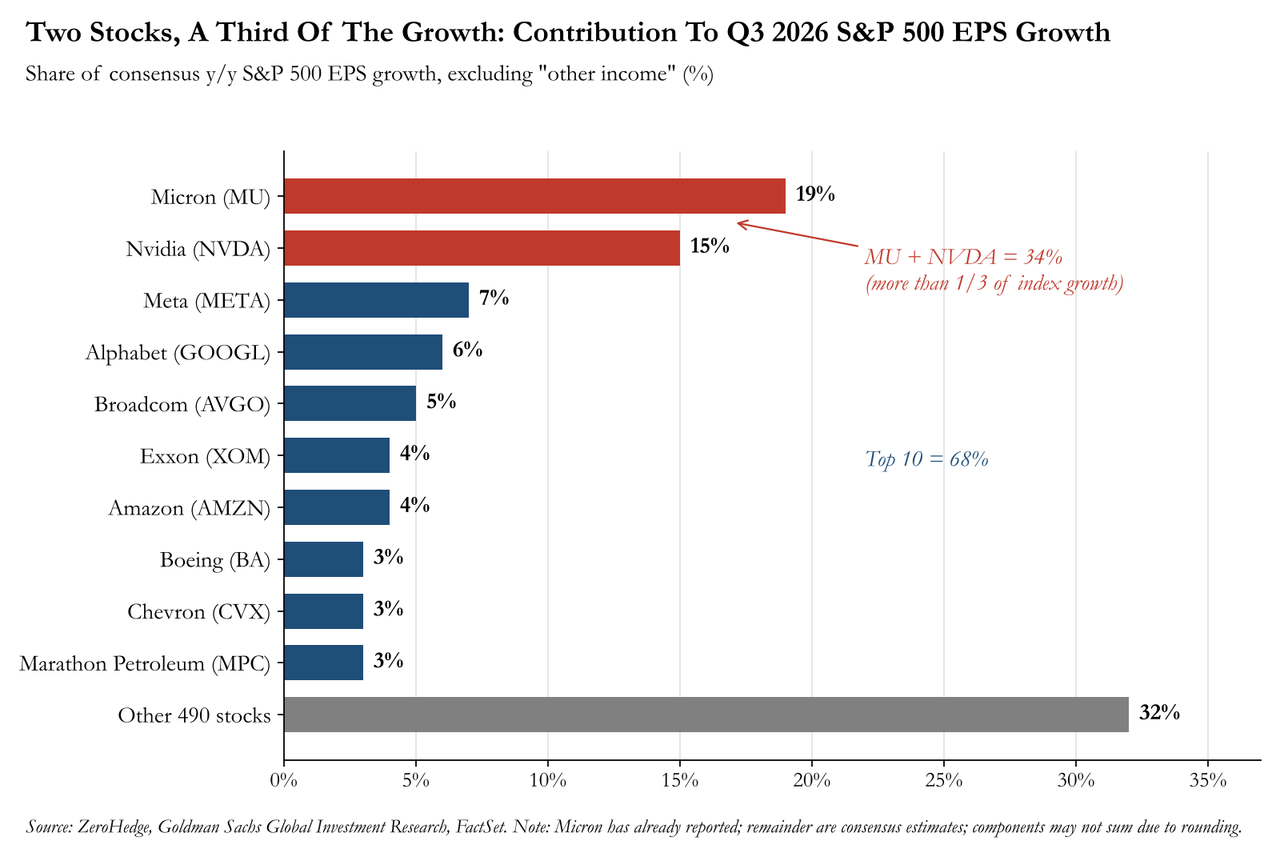
Barely two weeks after Micron (MU) guided to $60-$63 billion in fiscal Q1 revenue, crushing the $56.8 billion consensus, and a week after Goldman calculated that Micron alone would deliver 19% of the entire S&P 500's Q3 earnings growth...
Source
... the memory giant has slumped below $1000, down almost 5%, the lowest price in over 3 weeks.
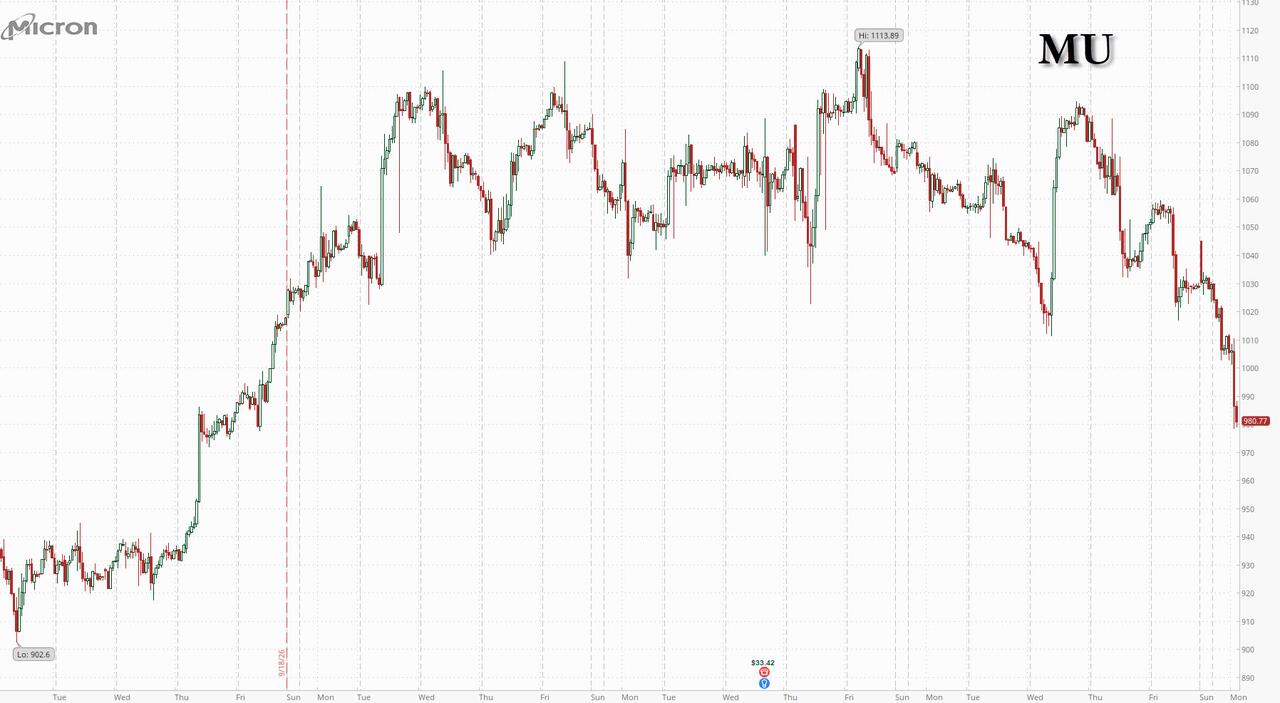
Sandisk was down even more, tumbling 7%, and according to Goldman's TMT desk, both names are now lower in 6 of their last 7 sessions. Micron is about to enter a bear market, down almost 20% from its June record close, and a stock where sentiment was "11/10" back in June is now trading like nobody wants to be the last one holding it.
The reason for the latest selloff is coming from the other side of the Pacific, where three things collided overnight: i) a Korean market reopening after Friday's Hangul Day holiday and catching up to two days of US chip selling, ii) the end of the record Samsung/SK Hynix buyback that we warned last week was the only thing propping up the Kospi, and iii) a weekend announcement out of Shanghai that China's DRAM champion CXMT has made "key progress" on the next-generation memory cell that Samsung and Hynix are still years away from mass producing.
Goldman's EMEA head of one-delta trading Rich Privorotsky summed it up in four words this morning (available to pro subs):
In other words, the fundamentals have never been better, and that is precisely the problem: they are all priced in.
Let's take a closer look at the latest Korean carnage, the CXMT news, and why the bull case (record margins, sold-out 2027) is now running into the one thing markets fear more than a shortage: the end of one.
The Kospi tumbled 3.65% to 6,384.2 in what Goldman's Seoul trading desk called "a one-way move from the open," closing right on top of its 200-day moving average at 6,376 (available to pro subs). The tech-heavy Kosdaq did even worse, sliding 4.8%. Here's how the desk described the session:
The semi index KRXSEMI dropped 5.2%, while SK Hynix (000660 KS) and Samsung (005930 KS) each lost about 4.5% as they played catch-down to "SOX's two-day weakness on reopening." That two-day weakness came on Thursday, when Goldman's US desk saw "a heavy wave of selling in Semis / AI complex around OpenAI revenue headlines that continued through Friday despite the clarification update." Foreigners dumped $782 million of Hynix and $415 million of Samsung, while retail (+$710 million in Samsung) once again caught the falling knives.
Here is how the past week looked in real time, as we posted this morning:
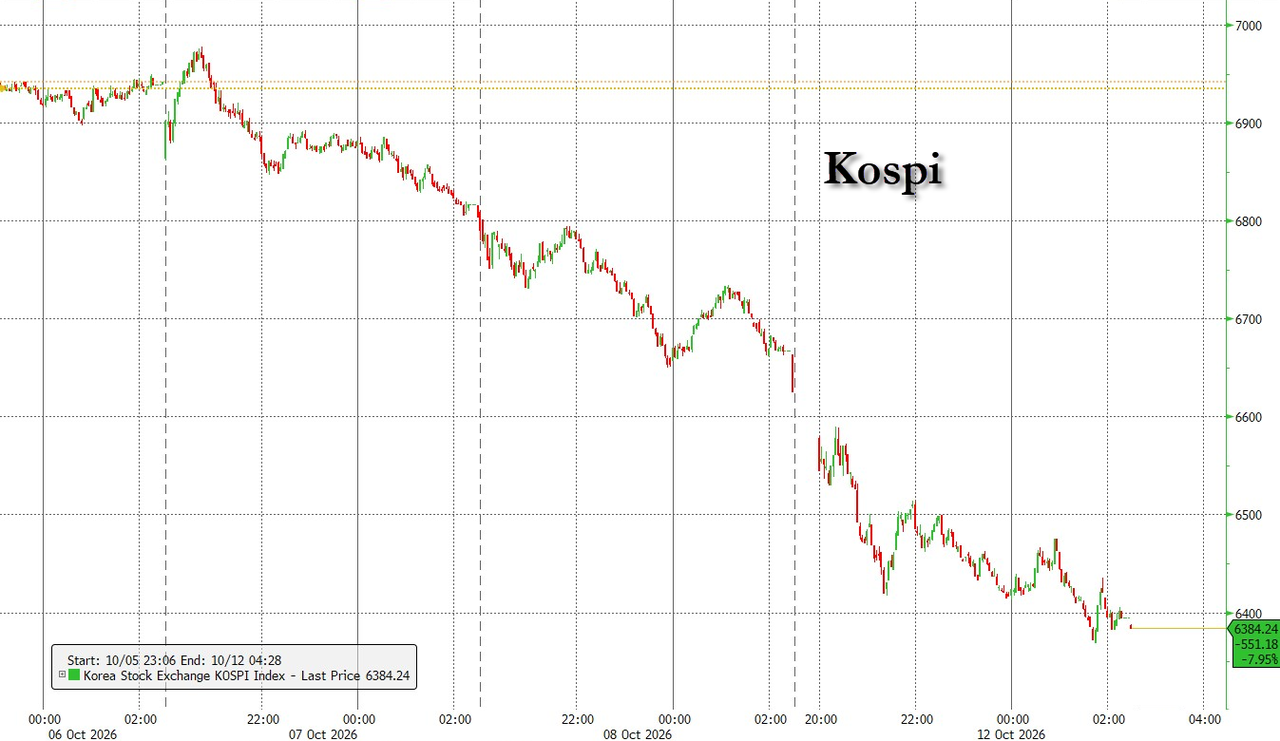
That is an 8% drop in the three sessions since Samsung's buyback program ran out, and the Kospi is now 30% below its June 22 record close. Korea's market, the poster child of the AI trade in the first half, has become the worst performer in the second, and as Bloomberg noted in a piece we ran last night, turnover has collapsed 70% from its late-May peak while foreigners have pulled $131 billion from Korean stocks this year, the most of any major Asian market.
Regular readers will recall that on Sept 3 we warned that only record buybacks were preventing a Kospi crash, and last Wednesday that the W55 trillion ($40 billion) Samsung/Hynix repurchase program, the largest in Korean history, was ending weeks ahead of schedule. As we put it at the time:
Samsung's program effectively ended on Oct 6, and Hynix's has a handful of sessions left at most at which point the biggest buyer in Korea will be gone. The math since then is not pretty: the Kospi has dropped in every session since, and today's flow data show exactly the hole we flagged. With the corporate bid gone, the only remaining buyer is Korean retail, and even there Goldman notes the "size of net-buying [is] on a decreasing trend." Bloomberg's numbers paint the same picture: margin loans are down from a June peak of 38.6 trillion won to about 33 trillion, and investor deposits have fallen to roughly 100 trillion won from nearly 140 trillion.
Translation: Korea's retail army already got carted out once in July, and it is in no hurry to volunteer for round two.
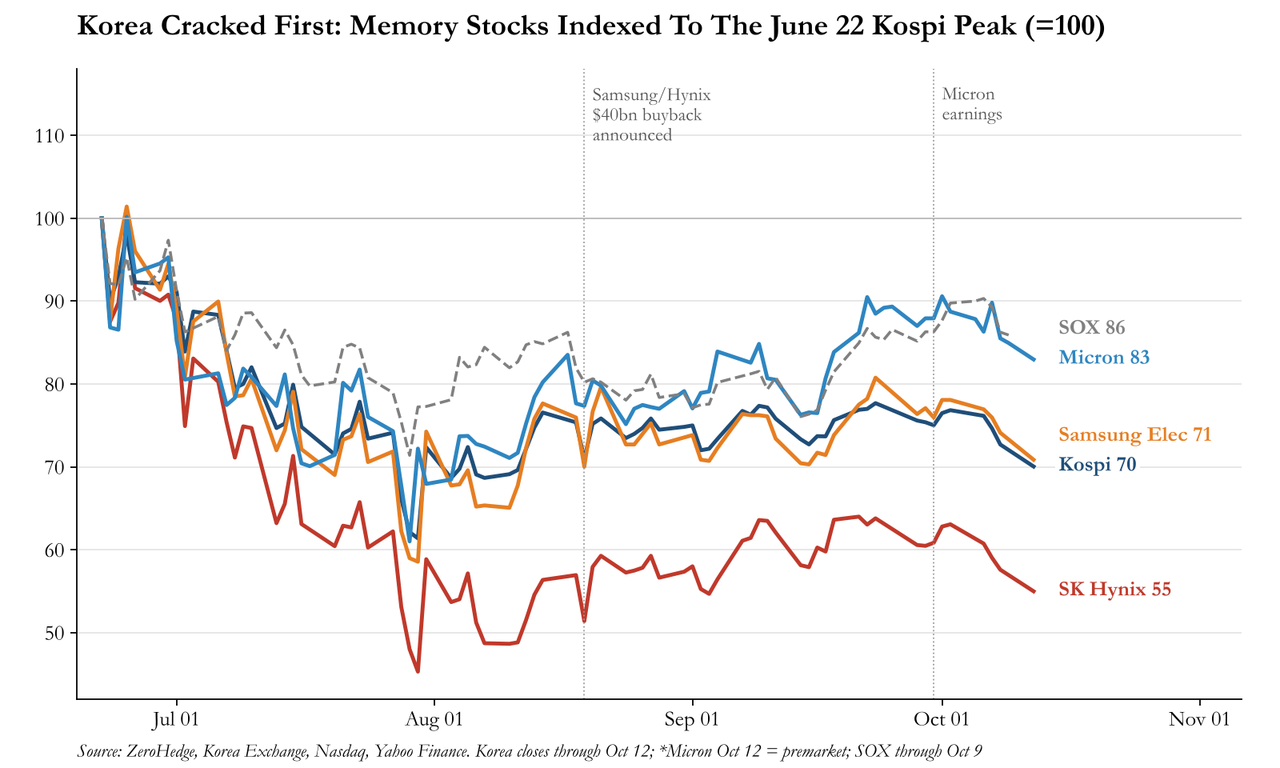
The ZH chart below shows just how far Korea has decoupled from the US memory complex since the June top. SK Hynix is down 45% from its June 22 close; the Kospi and Samsung are down roughly 30%. Micron and the SOX, which held up on the back of blowout US earnings, are only now starting to catch the Korean cold.
And then there's China.
On Saturday, ChangXin Memory Technologies (CXMT) president Cao Kanyu told an industry event in Shanghai that the company has made "key progress" on a new DRAM cell structure and plans to roll out a server-memory product based on it by the end of 2026, according to the South China Morning Post.
The technology is the so-called "4F²" (four square F) design, where each memory cell occupies an area of 4F², with F being the minimum line width of the chip. Today's mainstream commercial DRAM uses a 6F² cell. CXMT says the core of its design is a proprietary Vertical Surrounding Gate (VSG) transistor that uses a vertical gate to curb current leakage while shrinking the cell footprint.
Some quick math: shrinking each cell from 6F² to 4F² cuts its area by a third, which means up to ~50% more cells on the same die at the same line width, before any of the real-world overhead that eats into the gain. For a company that is effectively locked out of EUV, a density gain that doesn't require a leading-edge lithography node is precisely the workaround one would expect.
Why does this matter for Samsung and Hynix? Because they are chasing the same thing on a much slower timeline. SK Hynix only unveiled its 4F² roadmap in 2025, and Samsung, according to Korea's The Elec, targets mass production of sub-10nm DRAM based on the design by 2028. If CXMT actually ships a 4F² server product by year-end (a big if, since "key progress" is the kind of phrase that tends to precede more key progress), Beijing's memory champion will have leapfrogged the Korean duo on cell architecture by about two years.
Of course, the CXMT threat is hardly news to our readers. Back in July, we reported that CXMT was testing a production line for next-gen bonded DRAM, closing the gap with Korea "far faster than expected", and three weeks later, as the stock exploded over 450% in its IPO debut, Goldman warned that the "memory industry has a new problem." When Goldman initiated coverage of CXMT a month later, the bank laid out the scale of that problem:
And for those still counting on export controls to keep China in check, there was this, from early September:
Then, three weeks ago, Acer's CEO Jason Chen went further, telling reporters that "the supply shortage problem has already completely disappeared" as Chinese capacity keeps coming onto the market, and accusing the Big 3 memory makers of using public statements to signal each other that prices will stay high (since antitrust law prevents them from just saying so to each other directly). He expects memory prices to peak around the middle of 2027. Acer, HP and Asus are already putting CXMT chips in their PCs.
Put it all together and you get Privorotsky's "peak memory earnings" concern: nobody is arguing with the next two quarters; the worry is the price of DRAM in 2028, when Chinese supply is projected to be half of Hynix's and new Korean fabs come online at the same time.
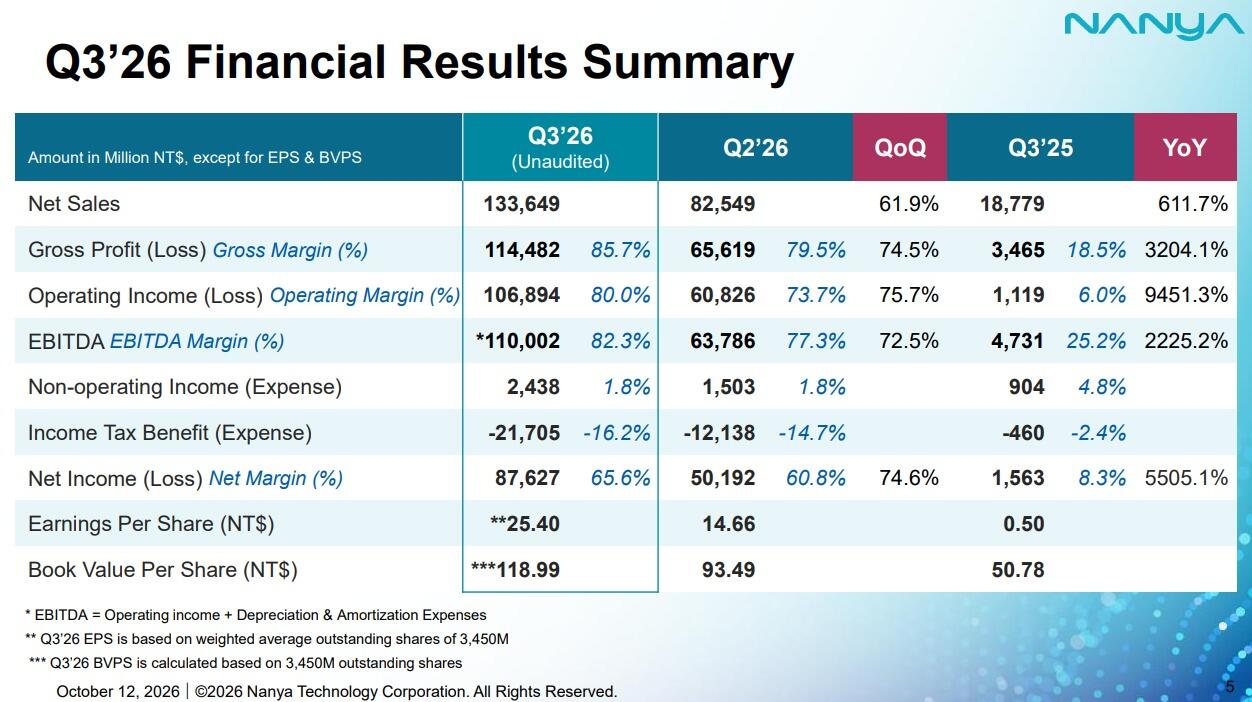
The irony, of course, is that the numbers keep getting better. Case in point: Taiwan's Nanya Technology, which reported Q3 results this morning that Goldman's Taipei desk called "another astonishing quarter":
And the outlook remains just as tight: management expects double-digit contract price gains and gross margins above 80% to remain "achievable" in 2027, with no bit shipment growth at all in early 2027 due to near-zero channel inventory, with volumes inflecting only after new fab output starts in Q4 2027. Goldman's desk, however, noted the uncomfortable truth in its personal take: there is "not much excitement recently to drive further re-ratings."
That is the memory market in one sentence: record earnings, shrinking multiples. Or as Pictet's Jon Withaar told Bloomberg, the memory names "have become value names, cheap at current earnings," and "retail and fast money hedge funds do not chase value." Growth is what they chase, and they are increasingly worried that it peaks right around when CXMT's 4F² chips hit the market.
Hedge funds certainly aren't waiting around to find out. Goldman's Prime Book shows that last week US Info Tech went from the most net bought sector in 4 of the past 5 weeks to the most net sold, at the fastest pace in seven weeks, with Tech Hardware, Storage & Peripherals and Semis the most sold subsectors. Meanwhile, the Samsung earnings that were supposed to restart the trade (a nearly ninefold surge in operating profit) produced a selloff instead, which is all you need to know about where expectations are.
Goldman's Korea research team flagged six things it will be listening for on Samsung's Oct 29 earnings call, and the first one tells you exactly what the market is worried about: "whether the company calls for a tighter memory supply in 2028 similar to Micron." The others include new LTAs with customers, the HBM4 ramp (and the impact of HBM "despeccing"), updated capex plans, and shareholder returns (good luck with that last one: the market just got a live demonstration of what happens when the buyback ends). SK Hynix reports the last week of October.
Before then, this week brings TSMC on Thursday, ASML on Wednesday (which is reportedly raising spare-part prices for its Korean customers by 10%, with Samsung and Hynix accepting the hike starting January 2027; nice work if you can get it), and SEMICON West, all of which will give the chip complex plenty of opportunities to either restore faith or provide more fodder for the peak-cycle crowd.
Privorotsky was careful to call this a concern about "peak memory earnings despite extraordinary near term fundamentals," and Nanya's results prove the near term is indeed extraordinary. But markets discount the future, and the future now includes a Chinese competitor that briefly became China's most valuable company in August, ASML tools stockpiled for three years, a 4F² product on the roadmap for this December, and the stated ambition of supplying half as much DRAM as SK Hynix by 2028.
The bulls will say the selloff is overdone and memory is "cheap at current earnings." We think the more likely outcome is that Korea, which led the memory trade on the way up and cracked first on the way down, is once again the leading indicator, just as we suggested back in June when we wrote that Micron won't be where you'll first hear the memory trade is over. Korea is now 30% off its highs and Hynix 45%; Micron is down 17% and about to enter a bear market.
Because nothing says "peak cycle" quite like 86% gross margins.
Tyler Durden Mon, 10/12/2026 - 11:05
Continue reading...
[ H/T ZeroHedge ]
Micron just delivered the kind of quarter that would have sent the stock into orbit in June. Instead, it is tumbling and about to lose the $1,000 handle.
Barely two weeks after Micron (MU) guided to $60-$63 billion in fiscal Q1 revenue, crushing the $56.8 billion consensus, and a week after Goldman calculated that Micron alone would deliver 19% of the entire S&P 500's Q3 earnings growth...
Source
... the memory giant has slumped below $1000, down almost 5%, the lowest price in over 3 weeks.
Sandisk was down even more, tumbling 7%, and according to Goldman's TMT desk, both names are now lower in 6 of their last 7 sessions. Micron is about to enter a bear market, down almost 20% from its June record close, and a stock where sentiment was "11/10" back in June is now trading like nobody wants to be the last one holding it.
The reason for the latest selloff is coming from the other side of the Pacific, where three things collided overnight: i) a Korean market reopening after Friday's Hangul Day holiday and catching up to two days of US chip selling, ii) the end of the record Samsung/SK Hynix buyback that we warned last week was the only thing propping up the Kospi, and iii) a weekend announcement out of Shanghai that China's DRAM champion CXMT has made "key progress" on the next-generation memory cell that Samsung and Hynix are still years away from mass producing.
Goldman's EMEA head of one-delta trading Rich Privorotsky summed it up in four words this morning (available to pro subs):
In other words, the fundamentals have never been better, and that is precisely the problem: they are all priced in.
Let's take a closer look at the latest Korean carnage, the CXMT news, and why the bull case (record margins, sold-out 2027) is now running into the one thing markets fear more than a shortage: the end of one.
Korea Catches Down
The Kospi tumbled 3.65% to 6,384.2 in what Goldman's Seoul trading desk called "a one-way move from the open," closing right on top of its 200-day moving average at 6,376 (available to pro subs). The tech-heavy Kosdaq did even worse, sliding 4.8%. Here's how the desk described the session:
The semi index KRXSEMI dropped 5.2%, while SK Hynix (000660 KS) and Samsung (005930 KS) each lost about 4.5% as they played catch-down to "SOX's two-day weakness on reopening." That two-day weakness came on Thursday, when Goldman's US desk saw "a heavy wave of selling in Semis / AI complex around OpenAI revenue headlines that continued through Friday despite the clarification update." Foreigners dumped $782 million of Hynix and $415 million of Samsung, while retail (+$710 million in Samsung) once again caught the falling knives.
Here is how the past week looked in real time, as we posted this morning:
That is an 8% drop in the three sessions since Samsung's buyback program ran out, and the Kospi is now 30% below its June 22 record close. Korea's market, the poster child of the AI trade in the first half, has become the worst performer in the second, and as Bloomberg noted in a piece we ran last night, turnover has collapsed 70% from its late-May peak while foreigners have pulled $131 billion from Korean stocks this year, the most of any major Asian market.
The Only Buyer Has Left The Building (As Predicted)
Regular readers will recall that on Sept 3 we warned that only record buybacks were preventing a Kospi crash, and last Wednesday that the W55 trillion ($40 billion) Samsung/Hynix repurchase program, the largest in Korean history, was ending weeks ahead of schedule. As we put it at the time:
Samsung's program effectively ended on Oct 6, and Hynix's has a handful of sessions left at most at which point the biggest buyer in Korea will be gone. The math since then is not pretty: the Kospi has dropped in every session since, and today's flow data show exactly the hole we flagged. With the corporate bid gone, the only remaining buyer is Korean retail, and even there Goldman notes the "size of net-buying [is] on a decreasing trend." Bloomberg's numbers paint the same picture: margin loans are down from a June peak of 38.6 trillion won to about 33 trillion, and investor deposits have fallen to roughly 100 trillion won from nearly 140 trillion.
Translation: Korea's retail army already got carted out once in July, and it is in no hurry to volunteer for round two.
The ZH chart below shows just how far Korea has decoupled from the US memory complex since the June top. SK Hynix is down 45% from its June 22 close; the Kospi and Samsung are down roughly 30%. Micron and the SOX, which held up on the back of blowout US earnings, are only now starting to catch the Korean cold.
Four Square F: Why CXMT's Weekend News Matters
And then there's China.
On Saturday, ChangXin Memory Technologies (CXMT) president Cao Kanyu told an industry event in Shanghai that the company has made "key progress" on a new DRAM cell structure and plans to roll out a server-memory product based on it by the end of 2026, according to the South China Morning Post.
The technology is the so-called "4F²" (four square F) design, where each memory cell occupies an area of 4F², with F being the minimum line width of the chip. Today's mainstream commercial DRAM uses a 6F² cell. CXMT says the core of its design is a proprietary Vertical Surrounding Gate (VSG) transistor that uses a vertical gate to curb current leakage while shrinking the cell footprint.
Some quick math: shrinking each cell from 6F² to 4F² cuts its area by a third, which means up to ~50% more cells on the same die at the same line width, before any of the real-world overhead that eats into the gain. For a company that is effectively locked out of EUV, a density gain that doesn't require a leading-edge lithography node is precisely the workaround one would expect.
Why does this matter for Samsung and Hynix? Because they are chasing the same thing on a much slower timeline. SK Hynix only unveiled its 4F² roadmap in 2025, and Samsung, according to Korea's The Elec, targets mass production of sub-10nm DRAM based on the design by 2028. If CXMT actually ships a 4F² server product by year-end (a big if, since "key progress" is the kind of phrase that tends to precede more key progress), Beijing's memory champion will have leapfrogged the Korean duo on cell architecture by about two years.
Of course, the CXMT threat is hardly news to our readers. Back in July, we reported that CXMT was testing a production line for next-gen bonded DRAM, closing the gap with Korea "far faster than expected", and three weeks later, as the stock exploded over 450% in its IPO debut, Goldman warned that the "memory industry has a new problem." When Goldman initiated coverage of CXMT a month later, the bank laid out the scale of that problem:
And for those still counting on export controls to keep China in check, there was this, from early September:
Then, three weeks ago, Acer's CEO Jason Chen went further, telling reporters that "the supply shortage problem has already completely disappeared" as Chinese capacity keeps coming onto the market, and accusing the Big 3 memory makers of using public statements to signal each other that prices will stay high (since antitrust law prevents them from just saying so to each other directly). He expects memory prices to peak around the middle of 2027. Acer, HP and Asus are already putting CXMT chips in their PCs.
Put it all together and you get Privorotsky's "peak memory earnings" concern: nobody is arguing with the next two quarters; the worry is the price of DRAM in 2028, when Chinese supply is projected to be half of Hynix's and new Korean fabs come online at the same time.
"Extraordinary Near Term Fundamentals"... Again
The irony, of course, is that the numbers keep getting better. Case in point: Taiwan's Nanya Technology, which reported Q3 results this morning that Goldman's Taipei desk called "another astonishing quarter":
- Revenue of NT$133.6 billion, up 62% QoQ and 612% YoY
- Gross margin of 85.7% (+6.2pp QoQ) and operating margin of 80%
- Blended ASPs up more than 60% QoQ, with over half of that driven by contract resets on expiring 2025 long-term agreements
And the outlook remains just as tight: management expects double-digit contract price gains and gross margins above 80% to remain "achievable" in 2027, with no bit shipment growth at all in early 2027 due to near-zero channel inventory, with volumes inflecting only after new fab output starts in Q4 2027. Goldman's desk, however, noted the uncomfortable truth in its personal take: there is "not much excitement recently to drive further re-ratings."
That is the memory market in one sentence: record earnings, shrinking multiples. Or as Pictet's Jon Withaar told Bloomberg, the memory names "have become value names, cheap at current earnings," and "retail and fast money hedge funds do not chase value." Growth is what they chase, and they are increasingly worried that it peaks right around when CXMT's 4F² chips hit the market.
Hedge funds certainly aren't waiting around to find out. Goldman's Prime Book shows that last week US Info Tech went from the most net bought sector in 4 of the past 5 weeks to the most net sold, at the fastest pace in seven weeks, with Tech Hardware, Storage & Peripherals and Semis the most sold subsectors. Meanwhile, the Samsung earnings that were supposed to restart the trade (a nearly ninefold surge in operating profit) produced a selloff instead, which is all you need to know about where expectations are.
What To Watch
Goldman's Korea research team flagged six things it will be listening for on Samsung's Oct 29 earnings call, and the first one tells you exactly what the market is worried about: "whether the company calls for a tighter memory supply in 2028 similar to Micron." The others include new LTAs with customers, the HBM4 ramp (and the impact of HBM "despeccing"), updated capex plans, and shareholder returns (good luck with that last one: the market just got a live demonstration of what happens when the buyback ends). SK Hynix reports the last week of October.
Before then, this week brings TSMC on Thursday, ASML on Wednesday (which is reportedly raising spare-part prices for its Korean customers by 10%, with Samsung and Hynix accepting the hike starting January 2027; nice work if you can get it), and SEMICON West, all of which will give the chip complex plenty of opportunities to either restore faith or provide more fodder for the peak-cycle crowd.
Bottom Line
Privorotsky was careful to call this a concern about "peak memory earnings despite extraordinary near term fundamentals," and Nanya's results prove the near term is indeed extraordinary. But markets discount the future, and the future now includes a Chinese competitor that briefly became China's most valuable company in August, ASML tools stockpiled for three years, a 4F² product on the roadmap for this December, and the stated ambition of supplying half as much DRAM as SK Hynix by 2028.
The bulls will say the selloff is overdone and memory is "cheap at current earnings." We think the more likely outcome is that Korea, which led the memory trade on the way up and cracked first on the way down, is once again the leading indicator, just as we suggested back in June when we wrote that Micron won't be where you'll first hear the memory trade is over. Korea is now 30% off its highs and Hynix 45%; Micron is down 17% and about to enter a bear market.
Because nothing says "peak cycle" quite like 86% gross margins.
Tyler Durden Mon, 10/12/2026 - 11:05
Continue reading...
[ H/T ZeroHedge ]