

The heads of state have gone home. For one week every September, New York fills with delegations from governments that spend the other 51 weeks collecting in the city. Then the motorcades leave, and the city goes back to running its own foreign policy.
New York has an Office for International Affairs. Los Angeles, Chicago, and Houston have some version of the same thing. These offices arrange meetings with consulates and United Nations missions, sign memorandums with foreign cities, and host visiting officials. What they do not have is the security architecture that surrounds the same work at the federal level: vetted personnel, clearances where the job requires them, and a channel for deconflicting sensitive foreign contacts with Washington.
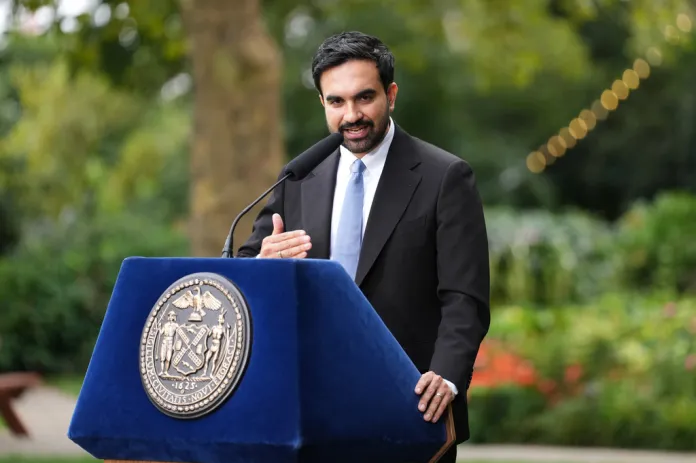
The gap became visible this summer. On July 7, Mayor Zohran Mamdani’s international affairs commissioner, Ana Maria Archila, was scheduled to meet Iran’s ambassador to the U.N., Amir-Saeid Iravani, at 2 U.N. Plaza, with two senior members of her office. The State Department, which had not been told, intervened, and the meeting was called off. A State Department official called the attempt unconscionable. Mamdani said he learned of it from a press inquiry. City Hall reportedly reprimanded the commissioner and ordered the meeting canceled. Two members of Congress from New York publicly defended it.
IRAN’S PROXIES SAY THEY FIGHT UNDER ONE COMMAND. AMERICA LEAVES IRAQ THIS WEEK
Take him at his word. The problem that remains is structural rather than personal. A city commissioner could put the ambassador of a government the United States was then fighting on her calendar, and the mayor’s office found out afterward.
The office had a selection criterion. It just was not a security one. In April, according to City Journal, staff were told to weigh engagement partly by the political alignment of the foreign officials involved. The commissioner who runs the office came to the job in February from the Working Families Party, without diplomatic experience.
The episode is now a records fight. In September, the Manhattan Institute, whose magazine broke the story, sued the city after City Hall set a six-month response date for its request for the commissioner’s calendar and for any other meetings she had arranged with American adversaries. The mayor’s law department says it is reviewing the suit.
It was not the first time the office had to be stopped. In June, the State Department warned Bogotá that an event pairing Mamdani with Colombian President Gustavo Petro would violate the terms of Petro’s visa, and the event, also arranged by Archila’s office, was called off. Petro’s visa had been revoked in September 2025, the same day he stood on a Manhattan street and urged American soldiers to disobey President Donald Trump. On Oct. 24, the Treasury Department sanctioned him. Mamdani, then a candidate, had met him formally in New York that day.
To an intelligence service, none of this looks like diplomacy. It looks like access. An officer operating under diplomatic cover cannot easily reach a cleared federal official. He can often reach a city commissioner who is not subject to the same vetting. What such access yields is real: the photograph, which is propaganda; the relationship, which is a starting point; and the small, unclassified details of how a city’s leadership thinks, travels, and decides, which are the raw material of a recruitment assessment.
This is not a novel worry. In July 2022, the National Counterintelligence and Security Center warned state and local leaders that Beijing was working to exploit exactly this layer of American government, using local relationships to press Washington toward friendlier policies. The bulletin described the strategy as using the local to surround the central. Its advice was procedural: vigilance, due diligence, and transparency in partnerships with foreign entities.
New York State has already produced a case study. Linda Sun, a deputy chief of staff to Gov. Kathy Hochul (D-NY) and an aide to former Gov. Andrew Cuomo before that, was charged in 2024 with acting as an unregistered agent of the Chinese government. Prosecutors alleged that she blocked Taiwanese officials from reaching the governor’s office and forged Hochul’s signature on invitations to Chinese officials. Her trial ended in December with a jury deadlocked on all 19 counts, and prosecutors have said they want to retry her. She is entitled to the presumption of innocence, and the outcome may yet be acquittal. The indictment is still an education in what the target set looks like. It is not the governor. It is the person who schedules the governor.
Cities have legitimate international business. New York is the host city of the U.N. and carries obligations it cannot waive on its own. Trade offices, sister-city programs, and diaspora outreach are ordinary municipal work, and a mayor who never met a foreign official would be a worse mayor. The answer is not to forbid the contact. It is to run it the way the federal government runs its own.
Three steps would address much of the gap, and none of them requires new legislation. First, a written deconfliction rule: Before a city official meets the mission or consulate of a country under U.S. sanctions or designated a state sponsor of terrorism, the State Department’s Office of Foreign Missions gets notice. Washington already has a precedent for a notification rule of this kind: since 2019, Chinese diplomats, including those at the U.N. mission in New York, have had to notify the State Department before official meetings with state, local, and municipal officials. No general notification requirement runs the other way. Second, basic vetting for the handful of municipal employees whose jobs put them in those rooms, using standardized background questions appropriate to the access involved, asked and adjudicated on a fixed schedule. Third, briefings. The FBI has run a clearance program for state and local officials since shortly after 9/11, and a city with this threat picture should be saturating it rather than discovering it during a crisis.
New York is a poor candidate for improvisation. As I wrote in these pages, the mayor is nine months into his term and still awaiting a federal security clearance, which means the official at the top of the structure receives the threat picture secondhand. Some senior officials in his administration do hold clearances: the police commissioner, the first deputy mayor, and the chief counsel. The office that arranges meetings with foreign missions holds none. And by law, a subordinate’s clearance does not travel upward: cleared aides cannot pass the contents of a classified briefing to a mayor who lacks one.
59% OF DEMOCRATS SUPPORT A MILITARY COUP AGAINST TRUMP. AS LONG AS IT WEARS A UNIFORM
This is not only a New York problem, and it is not a problem of one party. Governors fly to Beijing with trade delegations. Mayors sign agreements with cities whose friendship association counterpart answers to a party organ. State legislators take briefings arranged by people nobody checked. Washington spent two decades assuming that foreign policy runs through Washington. Adversaries spent the same two decades learning that it does not have to.
Counterintelligence at this level starts with bookkeeping: who met whom, who knew, and who was supposed to be told. New York’s foreign policy already exists. Its counterintelligence does not. The city will keep hosting the world every September. The question is whether anyone in City Hall is required to write down what happens the rest of the year.
Emzari Gelashvili is a San Francisco–based geopolitical analyst and columnist who monitors Russian-language media. From 1996 to 2008, he served as a senior official across Georgia’s Ministry of State Security, Ministry of Defense, and Ministry of Internal Affairs, with a counterintelligence career focused on Russian and Iranian intelligence operations, and he was a member of the Georgian Parliament from 2008 to 2012. His work appears in Newsweek, the Hill, the Washington Examiner, RealClearDefense, and RealClearWorld, and at emzargelashvili.substack.com.
Continue reading...
[ H/T Washington Examiner ]