



The economy of Iran is severely strained. At least in the near term, however, it is unlikely to experience a total collapse that would force the ruling regime into good faith negotiations with the United States.
Iran’s economy is certainly in dire shape. Inflation is rampant, the currency’s value is plummeting, oil exports have been severely disrupted, and years of sanctions have isolated the country from the global financial system. The recent American blockade has dramatically intensified these pressures. Yet, economic misery should not be confused with complete functional failure. Iran is considerably more resilient than President Donald Trump suggests.
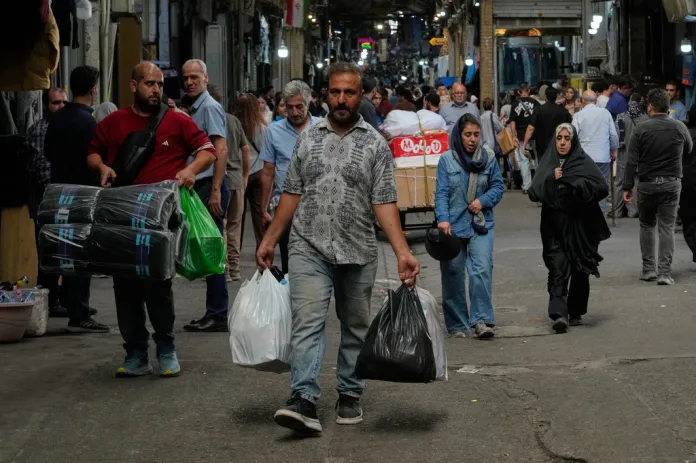
The International Monetary Fund projects that Iran’s economy will contract by 5.4% this year, contributing to an overall contraction of 29% since Trump first took office in 2017. Additionally, consumer price inflation will approach 70% this year, while official unemployment has risen from 7.3% to 9.1% over the past year, with underemployment almost certainly much higher. The state of Iran’s household sector is even worse. Food prices are rising faster than the overall inflation rate, destroying consumer purchasing power. Certain segments of the population are beginning to experience malnutrition, with pregnant women hit especially hard.
The Iranian rial provides perhaps the clearest indication of this deterioration. The currency recently fell to a record low of more than 2.5 million rials to the dollar, compared to roughly 1 million rials to the dollar a year ago. Crucially, Washington has targeted the Iranian government’s principal source of hard currency, oil.
For decades, Iran mastered circumventing American sanctions by transferring crude between tankers, relabeling shipments, and selling through intermediaries, primarily to China. Before the current blockade, China purchased about 90% of Iran’s oil exports. However, the blockade has changed the equation. Iran has gone roughly seven weeks without meaningful crude shipments through the Strait of Hormuz, depriving Tehran of the dollars needed to finance imports and government operations.
Nevertheless, an outright economic paralysis remains unlikely.
Iran has spent decades learning to function under sanctions, developing a surprisingly diversified domestic economy that encompasses agriculture, manufacturing, services, petrochemicals, and mining. An extensive informal economy and networks of intermediaries allow goods and money to move even when conventional financial channels are blocked.
Furthermore, the government can force much of the cost of adjustment onto its own population.
By allowing the rial to depreciate, permitting inflation to erode real wages and public expenditures, restricting imports, imposing capital controls, and directing scarce foreign currency toward politically vital industries, the state absorbs the shock. While this is an extraordinarily painful adjustment mechanism, it keeps the government functioning. The crucial distinction, therefore, lies between widespread impoverishment and structural collapse.
WHITE HOUSE DRUG CZAR WARNS OF EMERGING DRUG 100 TIMES MORE POTENT THAN FENTANYL
Iran is becoming dramatically poorer, but its economy has not ceased to function. Real wages are plummeting, inflation remains extraordinarily high, infrastructure is degrading, human capital is fleeing, and private-sector capital investment is nonexistent. Yet the government retains its general ability to pay security forces, distribute essential goods, and maintain basic state functions.
Iran’s economy is being squeezed harder than it has been in decades. While that pressure grants the U.S. valuable leverage, expecting economic hardship alone to produce the downfall of the Iranian state is a far-fetched dream.
James Rogan is a former U.S. diplomat who later worked in law and finance for over 30 years. He writes a subscription-based daily note on markets, economics, politics, and social issues. His email is roganjames8202@gmail.com.
Continue reading...
[ H/T Washington Examiner ]