





Some artists work in multiple mediums so skillfully that it’s difficult to identify which is primary. Who can say if Michelangelo, Degas, or Matisse were better painters or sculptors? Other artists have distinct, often overlooked sidelines: The artist who paints intermittently is a common type, most often for those working principally on works that require all sorts of collaborators and great amounts of time. Bernini, Vasari, or Le Corbusier couldn’t complete a building on their own or in a few days — but they could paint alone any day of the week.
One of these occasional painters is Louis Comfort Tiffany (1848-1933), our king of stained glass. (He had only one conceivable rival, John La Farge.) Before his titanic technical and aesthetic innovations in stained glass, he was a painter, a pursuit he kept up throughout his life.
It’s a sphere of his work often neglected. Most exhibitions, if they represent his paintings at all, do so by presenting just a handful of canvases amid glass and decor. Happily, this corner of his career is the square focus of a fascinating survey at the Nassau County Museum of Art in Roslyn Harbor, New York, “Louis Comfort Tiffany: Artist of the Gilded Age.”
To be clear, this show offers no proof that the world has weighted Tiffany’s talents improperly. He was arguably the greatest stained glass artist in human history. He was not that caliber of painter. Some of his paintings are downright ungainly, but many others are very good, and some are excellent. They shed light on his principal work with glass and interior design, both as preface and as counterpoint. Early works point to effects he couldn’t quite achieve with paint but could with glass. Later works seem like highly personal diversions from what was eventually the effectively industrial, 400-artisan-strong enterprise of Tiffany Studios.
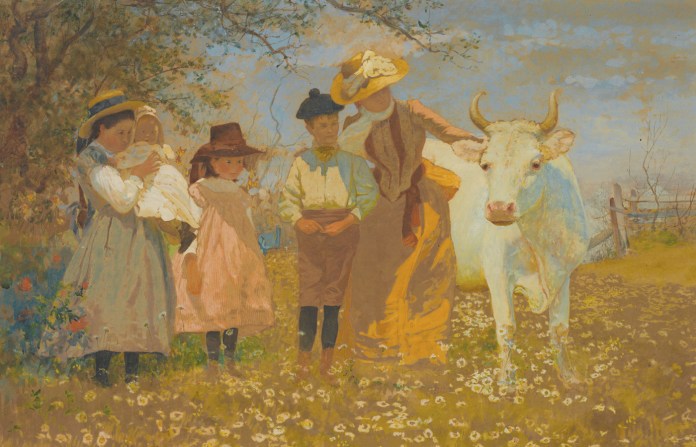
Family Group with Cow by Louis Comfort Tiffany, 1888. (Max Yawney/courtesy of Nassau County Museum of Art Permanent Collection)
" data-large-file="https://www.washingtonexaminer.com/wp-content/uploads/2026/10/LA.Culture.101426.jpg?w=696" height="658" width="1024" src="https://www.washingtonexaminer.com/wp-content/uploads/2026/10/LA.Culture.101426.jpg?w=696" alt="Family Group with Cow by Louis Comfort Tiffany, 1888. (Max Yawney/courtesy of Nassau County Museum of Art Permanent Collection)" class="wp-image-4762177" style="width:787px;height:auto" srcset="https://www.washingtonexaminer.com/wp-content/uploads/2026/10/LA.Culture.101426.jpg 1400w, https://www.washingtonexaminer.com/wp-content/uploads/2026/10/LA.Culture.101426.jpg?resize=300,193 300w, https://www.washingtonexaminer.com/wp-content/uploads/2026/10/LA.Culture.101426.jpg?resize=768,494 768w, https://www.washingtonexaminer.com/wp-content/uploads/2026/10/LA.Culture.101426.jpg?resize=1024,658 1024w, https://www.washingtonexaminer.com/wp-content/uploads/2026/10/LA.Culture.101426.jpg?resize=150,96 150w, https://www.washingtonexaminer.com/wp-content/uploads/2026/10/LA.Culture.101426.jpg?resize=696,447 696w, https://www.washingtonexaminer.com/wp-content/uploads/2026/10/LA.Culture.101426.jpg?resize=1068,687 1068w" sizes="auto, (max-width: 1024px) 100vw, 1024px">
Family Group with Cow by Louis Comfort Tiffany, 1888. (Max Yawney/courtesy of Nassau County Museum of Art Permanent Collection)
Throughout, we have evidence of the most important quality of an artist: creating relentlessly. As the exhibition text notes, “Tiffany tried his hand at almost everything, gaining understanding of the diverse artistic vocabulary in his day.” He produced Hudson River School-style paintings, Tonalist efforts, French Orientalist pieces, and, late in life, decidedly Impressionsistic works. The exhibition continues through Nov. 8.
At over 140 pieces, the Nassau County Museum of Art has, in recent decades, acquired one of the largest collections of Tiffany oils and watercolors held by any museum. These, as well as some borrowed works, a fair chunk from the collection of the Driehaus Museum in Chicago, make this show a rare chance to gain the measure of this work, although later this month, the Met is presenting a show on drawings from Tiffany Studios. It’s an auspicious time to view this material.
The exhibition has a very fitting Gilded Age host in the Nassau County Museum of Art, which is housed in a neo-Georgian mansion once home to Childs Frick, son of Henry Clay Frick. His father and sister, Helen Clay Frick, were avid art collectors. (Childs collected dinosaur bones, with many of his paleontological finds in the Museum of Natural History in New York.) This house has been home to art since the 1960s. It’s not far from where Laurelton Hall, Tiffany’s staggering house of his own design, stood in Oyster Bay before its destruction by fire in 1957 — it survives here as depicted in several paintings on view.
Tiffany did not lack for means — his father was the jeweler and merchant Charles Lewis Tiffany — but his early path into painting was an unconventional one. After attending two military academies, he was one of two pupils that Tonalist master George Inness ever had, even if this experience did not furnish all that many lessons. He also received some instruction from his friend (and later business partner), Hudson River painter Samuel Colman.
The sum of his formal artistic education was one year at the National Academy of Design in New York, where he exhibited his first painting the following year. He was off to Paris in 1868 to study with Leon Charles Adrien Bailly, an academic painter whose reputation has not survived particularly well. Tiffany did not seem to absorb his methods, in any case.
Tiffany founded his first decorative enterprise, Louis Comfort Tiffany and Associated American Artists, in 1879, and the first of his glassmaking enterprises in 1885.
What, then, of these paintings? The one monograph squarely on his paintings, Joan Elliott Price’s Louis Comfort Tiffany: The Painting Career of a Colorist, divides his work into four phases, and most of these categories reveal additional complications. Tiffany was a chameleonic stylist.
Hudson River influences of a variety of sorts are prominent earlier in his career. Luminism seems the clearest tendency. Tiffany tended to paint fairly heavily both in oil and in watercolors, where he frequently turned to large amounts of gouache (out of favor with watercolor purists of the era). There are a number of American scenes that fit the style. A few leap out as excellent. Among the works seen here, the undated oil After the Storm is especially striking.
He took after French artists early on, including Thomas Couture and Jean-Leon Gerome, and he particularly aped the Suez Canal-and-Aida French taste for Egyptian subjects, venturing there twice and producing a wide range of pieces on the subject.
There’s a copy of Loon Belly’s Pilgrims Going to Mecca (in the Musee d’Orsay) and many others in a variety of mediums. Tiffany had an eye for stirring compositions, such as that seen in his 1908 watercolor, Egyptian Pyramids Framed by Temple Columns. Figuration seemed to be a lifelong weakness for Tiffany — humans often look odd — and one work on oil features the strangest camel you might have ever seen. The career painter would have likely found some way to abstract their way out of this problem, but Tiffany was not one of those. Instead, he kept experimenting.
Some early paintings reflect French methods applied toward other topics, including a very picturesque and moody composition, Fruit Vendor Under the Sea Wall at Nassau, The Bahamas, from 1870.
He often studied architectural detail closely in his Middle Eastern scenes, and such details became common in his decor schemes. Yet, by and large, Tiffany did not achieve the acute intensity of color in his paintings that we associate with his glass work. There’s one undated piece, Canal Byway Near Piazza San Marco, that has a level of radiance comparable to that of Jasper Cropsey or Charles Courtney Curran, but Tiffany seemed incapable of quite hitting the target he might have been after with paint. A number of watercolor and pencil sketches for his own window designs seem to point to what was possible. His natural metier was found elsewhere.
IN ARTISTIC MANOR: REVIEW OF THE REOPENED FRICK
Several of his most exceptional pieces were painted after his other work was underway. The remarkable 1887 Pushing Off the Boat at Sea Bright, New Jersey, achieves a Charles-Francois Daubigny-like swirl of surf amid a Winslow Homer-like composition. A number of later standout oils are entirely subdued in tone, such as a Breton scene from 1922. By then, his itch for luminous color had been abundantly fulfilled.
But Tiffany continued to absorb contemporary artistic lessons. There’s a large and exceptionally good 1901 oil Oxen Backing at Somesville, Maine, which almost provides a scent of the barnyard in a scene radically earthier than anything else he was then turning out. The exhibition notes that “in the last two decades of his career, Tiffany favored almost entirely an Impressionist style in his paintings.” A 1917 watercolor, The Children Wading, bears the stamp of Monet. Not bad for a run in your spare time.
Anthony Paletta is a writer living in Brooklyn.
Continue reading...
[ H/T Washington Examiner ]