



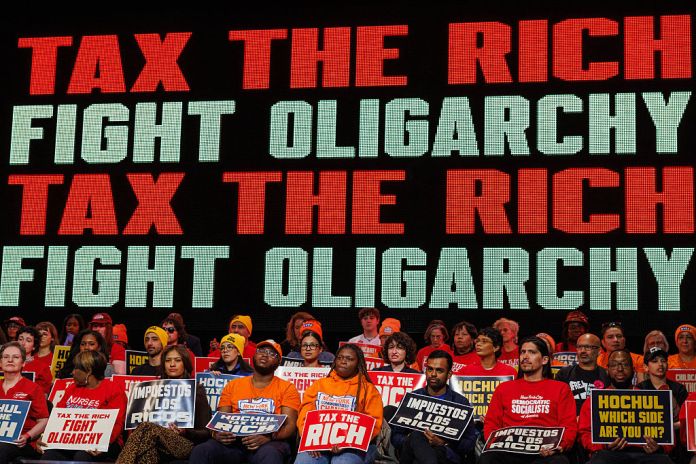
Supporters of a wealth tax or higher inheritance taxes often argue that it is a myth that rich people leave the country in response. So, what really happens when taxes on the wealthy are sharply increased?
The example of Sweden
In the 1970s, Sweden embarked on an experiment in “democratic socialism” that led frustrated entrepreneurs to leave the country. One prominent example was Ingvar Kamprad, the founder of the Swedish furniture company IKEA. For wealthy people like him, Sweden’s top marginal tax rate at the time was 85%. On top of that came a wealth tax that entrepreneurs had to pay out of their personal assets.
Kamprad wanted to sell one of the smaller companies he privately owned to IKEA at a profit to repay debts he personally owed to IKEA. But while Kamprad was preparing the sale, the Swedish government changed the tax legislation retroactively. He was left with substantial costs and became increasingly frustrated by what he regarded as the unfair and hostile treatment of entrepreneurs in his country.
In 1974, he moved to Denmark and later to Switzerland, where he lived for decades and for a time was Europe’s richest man. It was not until 2013, at an advanced age, that Kamprad returned to Sweden and once again paid taxes there — an example of how countries that tax the rich too heavily can ultimately end up hurting themselves.
The psychological effect
The German writer Hans Magnus Enzensberger wrote about Sweden at the time: “In such a society, it seems, the rich have little to laugh about. If only it were the taxes! As respectable citizens, they are willing to pay them, reluctantly perhaps, but punctually. What hurts them far more is the fact that no one sympathizes with their plight.” Sweden, Enzensberger wrote, had developed into a country where the rich felt “superfluous, disregarded and excluded.”
The social pressure was particularly intense because every Swede could find out how much other people earned. Anyone earning more than 50,000 kronor was listed in a “Taxeringskalender,” which was publicly accessible.
Sweden later abolished its inheritance, gift, and wealth taxes. Before these taxes were abolished, only about two dollar billionaires lived in Sweden. Today, according to calculations by Anders Ydstedt based on the Forbes list, there are 32, while another 13 Swedish billionaires live abroad.
When rich people leave a country, there are economic consequences. Economists Katrine Jakobsen, Henrik Kleven, Jonas Kolsrud, Camille Landais, and Mathilde Munoz have studied how wealthy individuals respond to wealth taxes. One of their findings: “When an entrepreneur subject to the wealth tax leaves a country, the employment in their businesses drops by 33%, gross investments by 22%, value-added by 34% and tax payments by 51%.”
France’s millionaire tax
In February 2012, in the middle of the French presidential election campaign, Socialist candidate Francois Hollande surprised the country by calling for a drastic tax increase on top earners. He announced that the portion of annual income above 1 million euros would be taxed at 75%.
After Hollande won the election, the plans triggered an intense debate over the departure of wealthy French citizens. The most famous example was actor Gerard Depardieu, who moved his residence to Belgium at the end of 2012 and accused the French government of punishing success and talent. Bernard Arnault, the CEO of LVMH and at the time France’s richest man, also applied for Belgian citizenship, although he explicitly denied that his decision was motivated by taxes.
In December 2012, France’s Constitutional Council ruled that the original version of the 75% tax was unconstitutional. Hollande nevertheless refused to abandon the plan and introduced the tax in a modified form, under which companies ultimately had to pay the levy on salaries exceeding 1 million euros.
In 2013, the number of taxpayers earning more than 100,000 euros a year who left France rose by 40%, while the number of those earning more than 300,000 euros who emigrated increased by as much as 46%. Interestingly, however, this exodus had already begun in 2011, when Hollande’s predecessor Nicolas Sarkozy was still in office. It was probably not only the actual tax burden but also the broader social climate, with its constant attacks on the rich, that contributed to the exodus.
Norway
A study by economists Roberto Iacono and Bard Smedsvik illustrates how strongly wealthy individuals respond to differences in wealth taxation. The study is based on a natural experiment in the small northern Norwegian municipality of Bø, which independently reduced its local wealth tax rate in 2021. The rate was cut from 0.85% to 0.35%. Their estimates suggest that a 1-percentage-point reduction in the wealth tax rate is associated with an increase of around 45% in average taxable wealth.
The reverse can also be observed. After Norway increased its wealth tax to as much as 1.1%, the emigration of wealthy individuals rose sharply. In 2022 alone, 261 people with assets exceeding 10 million Norwegian kroner left the country, followed by another 254 in 2023. With a total of 515 departures in just two years, the figure was more than twice as high as before the tax increase.
The government subsequently tightened its exit-tax rules as well. When individuals leave the country, unrealized capital gains above 3 million kroner are now subject to a tax of 37.8%.
United Kingdom
On April 6, 2025, the United Kingdom abolished its traditional non-dom tax regime. Until then, U.K. residents with a foreign “domicile” could, under certain conditions, keep foreign income and capital gains outside the scope of U.K. taxation as long as the money was not remitted to the U.K.
Since the reform, the U.K. has essentially operated a residence-based system: People who live in Britain on a long-term basis must also pay tax on foreign income and capital gains. At the same time, foreign assets belonging to long-term residents have been brought more extensively within the scope of the U.K. inheritance tax.
Henley & Partners subsequently projected that the U.K. would suffer a net loss of 16,500 millionaires through migration in 2025, compared with 10,800 in 2024 — the largest annual net outflow the consultancy had ever recorded for a single country.
Germany
Germany’s left-wing party Die Linke is calling for the wealth tax to be reintroduced. The proposed tax rate would rise from 1% to 5% on fortunes of up to 50 million euros, with a top rate of as much as 12%. A study commissioned by Die Linke itself from the German Institute for Economic Research, which is generally considered left-leaning and was presumably intended to support the party’s plans, concluded that the proposals would create “considerable economic risks.” According to the study, major international investors would “give Germany a wide berth” if the plans were implemented, significantly weakening Germany as a business location.
I GAVE MY BODY FOR THIS COUNTRY. I BLAME BOTH PARTIES FOR THE RISE OF SOCIALISM
Possible consequences would include job losses in Germany, lower value creation, and weaker economic growth, which in turn would reduce revenues from income taxes, social security contributions, and indirect taxes. According to the study, these effects could only be avoided if the tax burden were coordinated internationally — something that, however, appears highly unrealistic.
Unless socialists build a wall before implementing their plans, entrepreneurs will continue to leave countries that treat them this way. And they will leave not only because of the tax burden but also because of a social climate that fails to recognize their achievements and instead turns them into scapegoats for the failures of politicians.
Rainer Zitelmann is the author of The Power of Capitalism.
Continue reading...
[ H/T Washington Examiner ]