




The war in Iran has demonstrated the need for a significant increase in the production of missile interceptors, as well as the continued development of newer and cheaper alternatives.
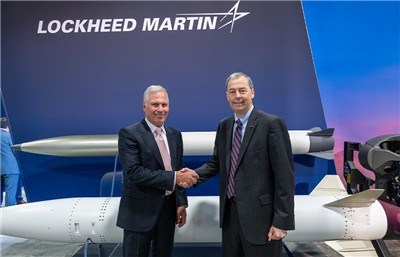
One of the military’s most-used air defense interceptors is Lockheed Martin’s PAC-3 MSE, each of which costs between $3 million and $4 million. Lockheed Martin unveiled its new PAC-3 Edge missile on Monday, which Paula Hartley, a company executive, told reporters at the Association of the United States Army annual convention in Washington, D.C., “is our solution to the future interceptor competition right now.”
One notable difference in the PAC-3 Edge is the missile contains a third-pulse motor, so it can intercept hypersonic and highly maneuverable threats.
“You shoot the missile with one motor, it detects a swarm or a threat,” she said. “It can fire that next motor. That threat moves again because they will. Right, these threats are remote. They cannot be predicted. They’re very advanced. We have a third motor. There is no system like this in the world right now. It’ll be the singular, most significant and advanced hit-to-kill missile in the world.”
Lockheed will likely reach the flight testing stage next year, Hartley added, noting that it would not be operational between “30 months from now” and “in the 2030 time frame.” She declined to specify the cost of an individual PAC-3 Edge missile, though she acknowledged “it’ll be a little bit of a premium” compared to the PAC-3 MSE.
A couple of months ago, Lockheed also unveiled another PAC-3 variant, still in its early stages, called the PAC-3 ACE, which is designed to be “half the price” of the PAC-3 MSE and “about two-thirds of the capability.” Lockheed expects to begin flight tests for the ACE next year as well.
Between the three PAC-3 variants, Lockheed does not believe one will completely replace the others. Rather, senior leaders believe each can play a role in a diversified arsenal. The company also intends for all three variants to be capable of being fired from the same launchers.
“There could be customers that will now take a look at ACE, MSE, and Edge, and they’ll make smart decisions based on their own operational analysis of what combination of those would be about that a little bit today,” Hartley said.
In previous years, companies had to contend with a solid-rocket motor bottleneck, though Lockheed has worked with General Dynamics to manage the problem. With that bottleneck largely resolved, the primary concern now is with the radar seeker that sits at the front of the PAC-3 missile.
MILITARY OFFICER ‘STILL IN SOLITARY CONFINEMENT 24 HOURS A DAY’ MONTHS AFTER CALLING FOR TRUMP’S IMPEACHMENT: ATTORNEY
Elsewhere at the AUSA convention, Anduril revealed its Steelfin interceptor, the stiffest competition to Lockheed’s PAC-3 MSE so far. Company executives are aiming for the missile to cost just one-third of the PAC-3 MSE and for production to scale even more easily. In a call to reporters ahead of the Monday reveal, Steve Milano, Anduril’s senior director of missiles, said the company was aiming to produce “multiple thousands” on the “low end,” with a “higher end” of “closer to hundreds of thousands” per year. The U.S. produced 620 PAC-3 MSE interceptors in 2025.
Anduril expects the Steelfin to enter production at the end of 2028 or beginning of 2029.
Continue reading...
[ H/T Washington Examiner ]