




It looks like a standard hex-sided bolt that can be purchased at any hardware store, but Army soldiers in the Pacific would have to wait several months to get them — that is, until they created their own solution to the backlog.
The Common Remotely Operated Weapon Station bolt is backordered and has an expected delivery timeline of February 2027, Col. R. Scott Carpenter, commander of U.S. Army Materiel Support Command-Korea, told reporters at the Association of the United States Army annual convention Monday in Washington.
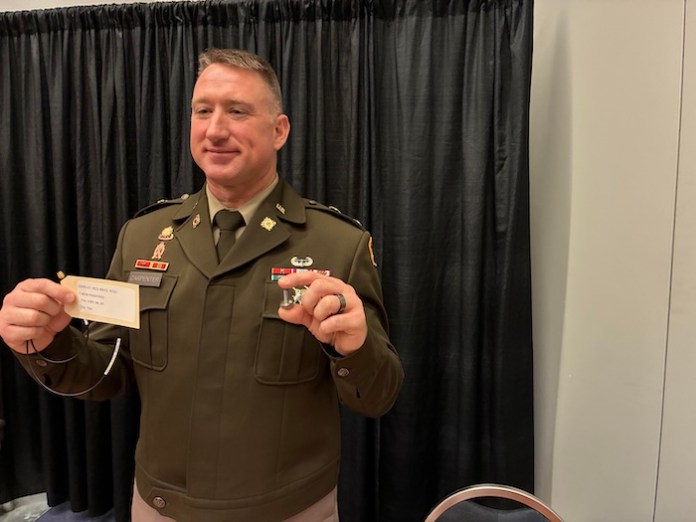
“It looks like a typical hex-sided bolt, correct? I mean, you should be able to go buy this at Home Depot or Lowe’s, but we can’t,” Carpenter said. “And if you look inside, and I’ll pass this around inside, you’ll see a little groove that’s cut out specifically for the CROWS system. So this bolt, again, I can’t get it until February, and there’s a need for it on the peninsula, even off the peninsula.”
Instead of waiting until February for the little bolts to be delivered, the troops at MSC-K experimented with how to produce them on their own. It took them less than two days.
“This bolt for the team to fabricate with the material cost is $1.27. If you include our labor rate, it’s about $100,” he said, adding that it costs more than $300 to order them in addition to the monthslong-wait.
Col. R. Scott Carpenter, commander of U.S. Army Materiel Support Command – Korea, holding up a bolt and cable his unit fabricated, taking a fraction of the time it would’ve taken to procure them through the normal process (h/t Mike Brest).
" data-image-caption="
Col. R. Scott Carpenter, commander of U.S. Army Materiel Support Command – Korea, holding up a bolt and cable his unit fabricated, taking a fraction of the time it would’ve taken to procure them through the normal process (h/t Mike Brest).
" data-large-file="https://www.washingtonexaminer.com/wp-content/uploads/2026/10/Col.-Carpenter.jpg?w=696" src="https://www.washingtonexaminer.com/wp-content/uploads/2026/10/Col.-Carpenter.jpg?w=696" alt="Col. R. Scott Carpenter, commander of U.S. Army Materiel Support Command – Korea, holding up a bolt and cable his unit fabricated, taking a fraction of the time it would've taken to procure them through the normal process (h/t Mike Brest)." class="wp-image-4764777" srcset="https://www.washingtonexaminer.com/wp-content/uploads/2026/10/Col.-Carpenter.jpg 700w, https://www.washingtonexaminer.com/wp-content/uploads/2026/10/Col.-Carpenter.jpg?resize=300,225 300w, https://www.washingtonexaminer.com/wp-content/uploads/2026/10/Col.-Carpenter.jpg?resize=150,113 150w, https://www.washingtonexaminer.com/wp-content/uploads/2026/10/Col.-Carpenter.jpg?resize=696,522 696w" sizes="auto, (max-width: 700px) 100vw, 700px">
Col. R. Scott Carpenter, commander of U.S. Army Materiel Support Command-Korea, holds up a bolt and cable his unit fabricated, taking a fraction of the time it would have taken to procure them through the normal process (Mike Brest/Washington Examiner).
In another example, two commanders informed the troops they were short 87 Joint Battle Command-Platform cables. Of them, there were six different types of cables. To order the cables, it would cost the service $1,850 and take 9-14 months for delivery. MSC-K was able to fabricate it within three days, and the material cost $145.
A Guam-based military unit needed a part that was not available on its own and would require purchasing the larger piece, which would have cost $46,000. Carpenter’s team built it through subtractive manufacturing for $82.
The two primary ways it is making these pieces are with additive manufacturing, or 3D printing, and subtractive manufacturing, which is the process of cutting the part out of a larger block of metal.
The examples represent both a significant problem facing the military at large, the lag time between order and delivery of a system or key parts, and the ingenuity of the rank and file to adapt to meet their needs the best they can. The objective, ultimately, is for U.S. troops to be able to maintain, sustain, and repair damaged equipment in the region instead of having to bring it back stateside, especially in times of conflict.
“What you really can take away, if you think about what Col. Carpenter talked through, like these simple innovations, I didn’t come up with them, he didn’t come up with them,” said Lt. Gen. Joe Hilbert, commanding general of Eighth Army. “Department of the Army civilians and young soldiers seeing a problem, and then thinking differently about how to solve it and how to fix it, they came up with it. Now, rather than taking equipment that might need a major overhaul and send it back to the United States, we’re looking at ways that we can overhaul it there in Korea and keep it in the fight longer. Keep it west of the [international date line] longer.”
MSC-K is a brigade-level command within the 19th Expeditionary Sustainment Command. It is a subordinate command of Eighth Army, which has been forward-deployed in South Korea for decades.
Carpenter said his overarching “goal” is to become “the advanced manufacturing center” for U.S. Pacific Command.
COAST GUARD EXPLORING BASING FAST RESPONSE CUTTERS IN PANAMA FOR COUNTER-CARTEL MISSION
The Eighth Army already has maintenance support teams that support the III Marine Expeditionary Force in Okinawa, Japan, and in Hawaii to support Army rotational units, Carpenter said.
The U.S. war in Iran demonstrated the significance of redundant supply chains, especially in contested environments. Following attacks on a key U.S. Navy base in Bahrain early in the war, the Navy was forced to rely on getting resupplied and restocked from a tiny island in the Indian Ocean called Diego Garcia, much farther away.
Continue reading...
[ H/T Washington Examiner ]