








"The Crowding Out Effect Is Immense": Broadcom, Oracle Join SpaceX In AI Chip-Debt SPV Stampede
A day after SpaceX went looking for $40 billion in chip-collateralized SPV debt, sending its CDS into geostationary orbit in the process, the rest of the AI complex has gotten in line.
According to the Wall Street Journal, Broadcom has spent the past few weeks working to arrange more than $50 billion in financing for OpenAI's custom AI chip, with Apollo and Blackstone among the lenders it has approached. Separately, Oracle - which has emerged as the weakest link in the entire credit-fueled AI bubble and will likely be the first domino to fall - is in talks with Apollo and Goldman Sachs to fund a big chip purchase through an off-balance sheet vehicle. Add the SpaceX deal, which we covered yesterday, and Broadcom's $60 billion Anthropic financing, which started syndicating last week, and the AI ecosystem has lined up roughly $150 billion in chip debt in about a week, without counting Oracle, which hasn't even put a number on its deal yet.
Regular readers will not be surprised. We have been warning since last October that the AI buildout runs on debt, and that the debt is increasingly moving off the balance sheet and into SPVs. What is new is that the borrowing has gotten so big that, by Goldman's own admission, it is now squeezing everyone else out of the capital markets.
Or, as Goldman's Rich Privorotsky put it in his morning note (available to pro subs):
Yes, Rich, you figured out the point we have been making for about a year now: US gov't yields are rising because hyperscalers have between $500-$800BN in debt to issue next year. Incidentally, the same point was echoed by JPMorgan's head TMT specialist Brian Heavey who said this morning that "price action is bearish early with Recession basket leading and Beta + rate sensitive lagging. SPCX bond raise getting a lot of attention but really shouldn't be surprising (although it continues to pressure govt bonds)."
Below we break down the three deals, why every one of them goes through a private credit fund rather than a bond desk, and who is footing the bill for AI's borrowing binge.
Start with the biggest one. Per the WSJ, the Broadcom financing for OpenAI "could include several gigawatts of OpenAI chip capacity" and is expected to close before the end of the year. The chips come out of OpenAI's in-house program, code-named Nexus, which names its custom chips after peppers: the first two generations are Jalapeño and Serrano. (Presumably Habanero is reserved for whoever ends up holding the debt.)
The deal comes a year after OpenAI and Broadcom announced a plan to co-develop 10 gigawatts of custom chips, to be deployed from the second half of 2026 through the end of 2029. Someone has to pay for those 10 gigawatts, and as the WSJ notes, OpenAI and Anthropic are a "new group of chip buyers... who don't have the financial firepower to purchase their own hardware." So Broadcom, the seller, is arranging the money for the buyer. The supplier finances the customer's purchase of the supplier's product, just as Nvidia did with xAI, and as Broadcom is already doing for Anthropic. There's a reason why it's called circular financing, in case you were confused.
That the number is still moving says a lot. Bloomberg, which confirmed the talks, says "no formal process has begun" and that the two could seek "around $30 billion of debt for the next leg." Whether it is $30 billion or $50 billion+, it lands right on top of the Anthropic deal, where banks sent out syndication letters last week for a $42 billion Class A senior-secured tranche, while Blackstone is leading an $18 billion Class B junior tranche and committing $9 billion from its own funds. And back in June, Broadcom set up a platform with Apollo and Blackstone as anchors to finance more than 20 gigawatts of AI compute through 2028, which, per Bloomberg, "will require hundreds of billions of dollars."
The bond market noticed the moment the Anthropic deal hit the tape:
It took about 12 hours for us to follow up with "Broadcom bonds: all time lows." Now Broadcom wants to do it all over again... for a different lab.
The Oracle deal is the most revealing of the three, because the WSJ is unusually frank about its purpose. The financing is meant to help Oracle "bridge the gap between when it has to pay for the hardware and when its cloud computing revenue starts coming in." The likely structure: investors fund a separate company that buys the chips, which Oracle then leases over time. Size: undisclosed, but Nvidia chips for a 1-gigawatt data center "would cost tens of billions of dollars" (rule of thumb is 1GW data center = $50-$60BN, rising to $100BN by the time Vera Rubin becomes the default). Oracle wants it done as soon as this year.
And why the separate company? Because, per the Journal, it "would help Oracle avoid borrowing more money itself, keeping debt costs under control." In other words, Oracle can no longer borrow cheaply on its own name, so it is renting its balance sheet from Apollo. One look at the Oracle credit page shows why.
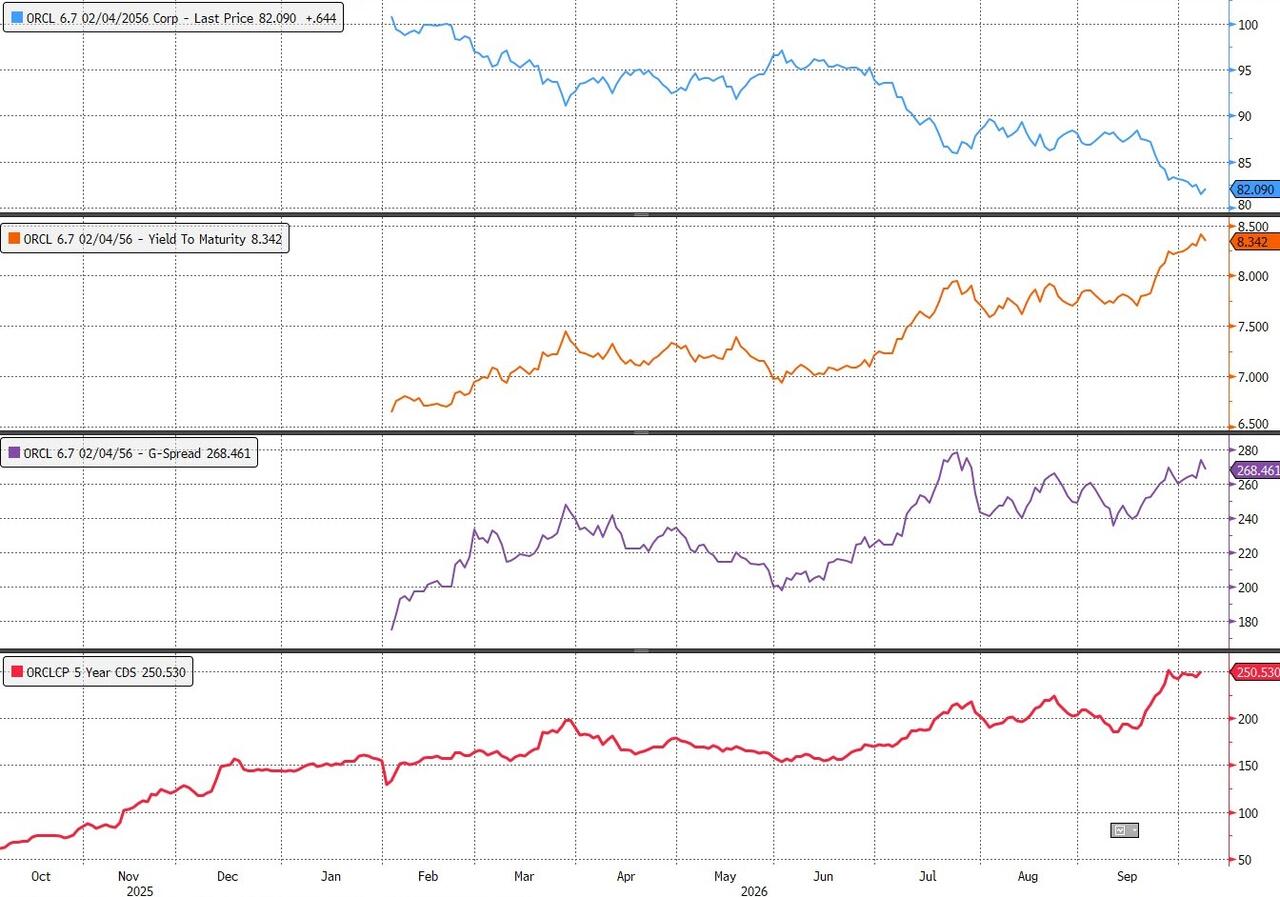
There's a reason for that. Two weeks ago, Oracle's 2056 bonds plunged to a record low after the force majeure at Project Jupiter, yielding over 8%, which is wider than the average single-B junk bond. Then Oracle's 1.3GW Wisconsin campus was next to slip. And just last night we put out the covenant comps on the roughly $80 billion of project debt already backing Oracle-leased data centers:
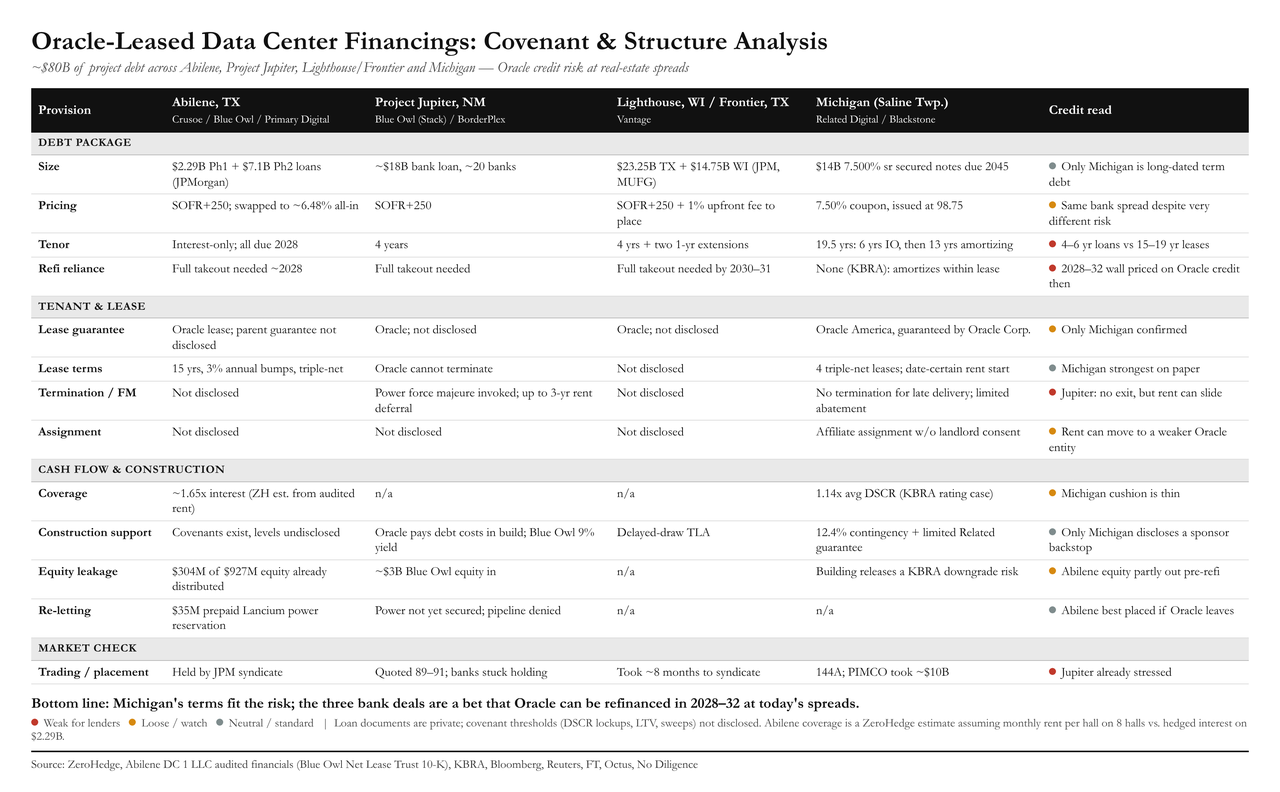
The takeaway: three of the four deals are short-dated bank loans against 15-19 year leases, i.e., a bet that Oracle can be refinanced in 2028-2032 at today's spreads. The Jupiter loans already trade at 89-91 cents. Now add a chip SPV on top, whose collateral (graphic chips) depreciates far faster than a building. What could go wrong?
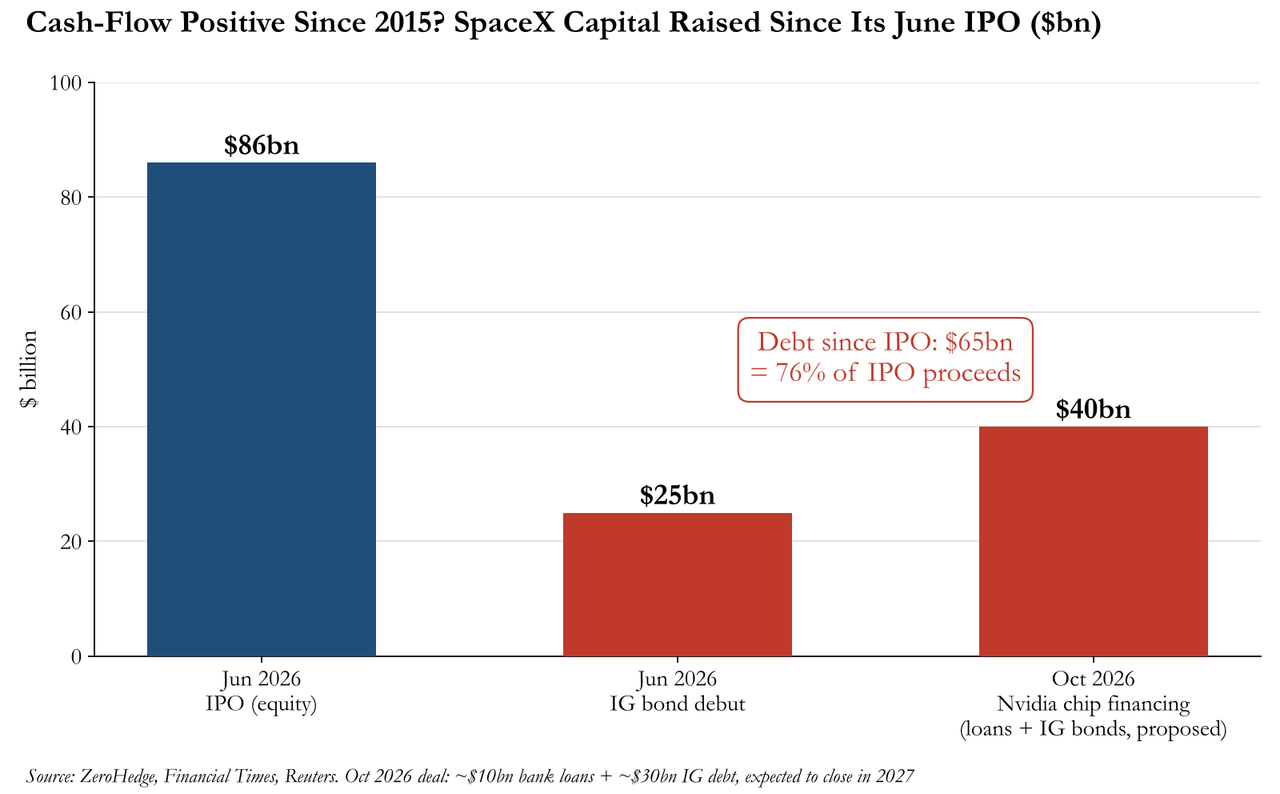
The SpaceX leg we dissected yesterday: about $10 billion in bank loans plus $30 billion of IG debt to buy Nvidia chips, led by Apollo, with Pimco circling, from a company that raised a record $86 billion in its June IPO and then sold $25 billion in bonds two weeks later. That's $65 billion of debt since June, or 76% of the IPO proceeds:
The WSJ confirms the talks, adding only that SpaceX "talked to lenders in recent days." The credit market's verdict came faster: per Reuters, SpaceX's five-year CDS widened almost 15bp to a record, as investors "seemed to have qualms about turning equity risk into credit risk." Musk avoids dilution; bondholders get the dilution instead.
That was no blip: SpaceX 5Y CDS jumped from around 181bp to 197bp, a new record wide, blowing through the late-July high of roughly 188bp and up about 30% since mid-September. For a company that IPO'd with CDS near 110bp in June, the market has nearly doubled the price of insuring SpaceX debt in under four months, and that's before the $30 billion of new "IG" paper even hits the tape.
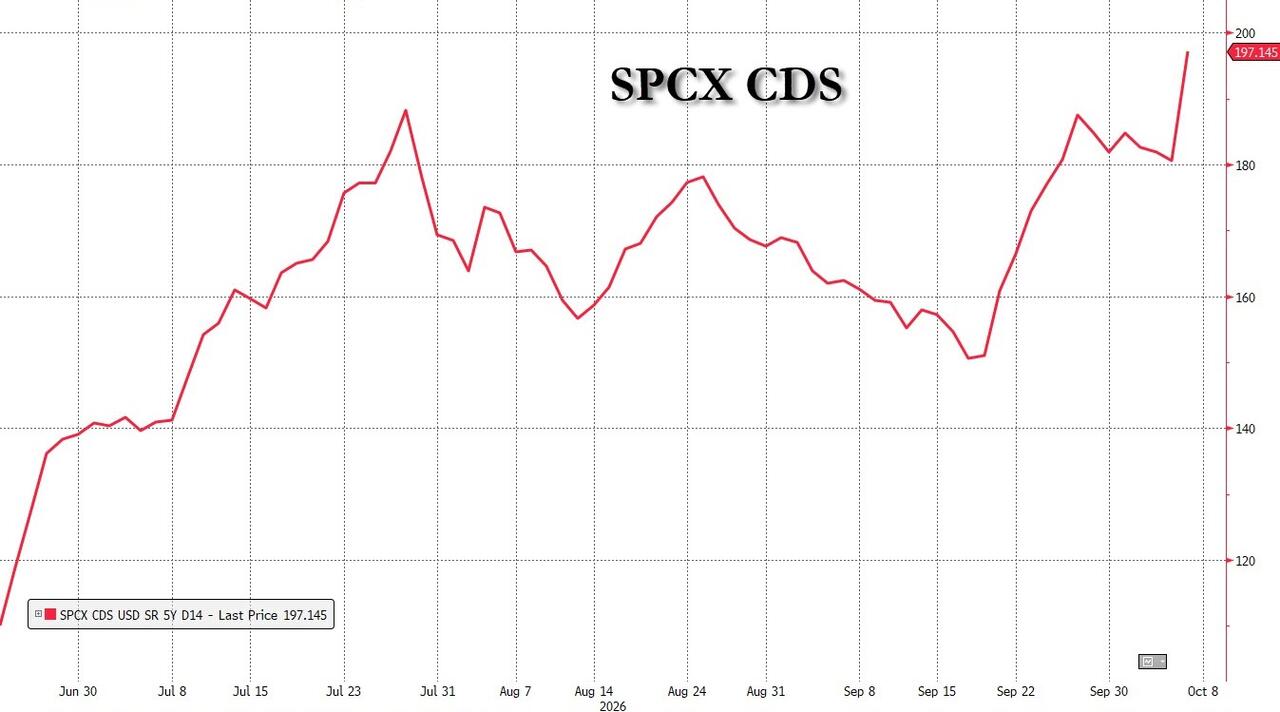
Put differently, the rating agencies still say BBB; the CDS market says it is pricing something else (and far worse) entirely. And as we noted yesterday, SpaceX's 2056 bonds already trade around 85 cents. Next stop: 200bp (by the time you read this, probably already there).
Put all three on one chart, next to the AI SPVs that came before them, and the trajectory speaks for itself:
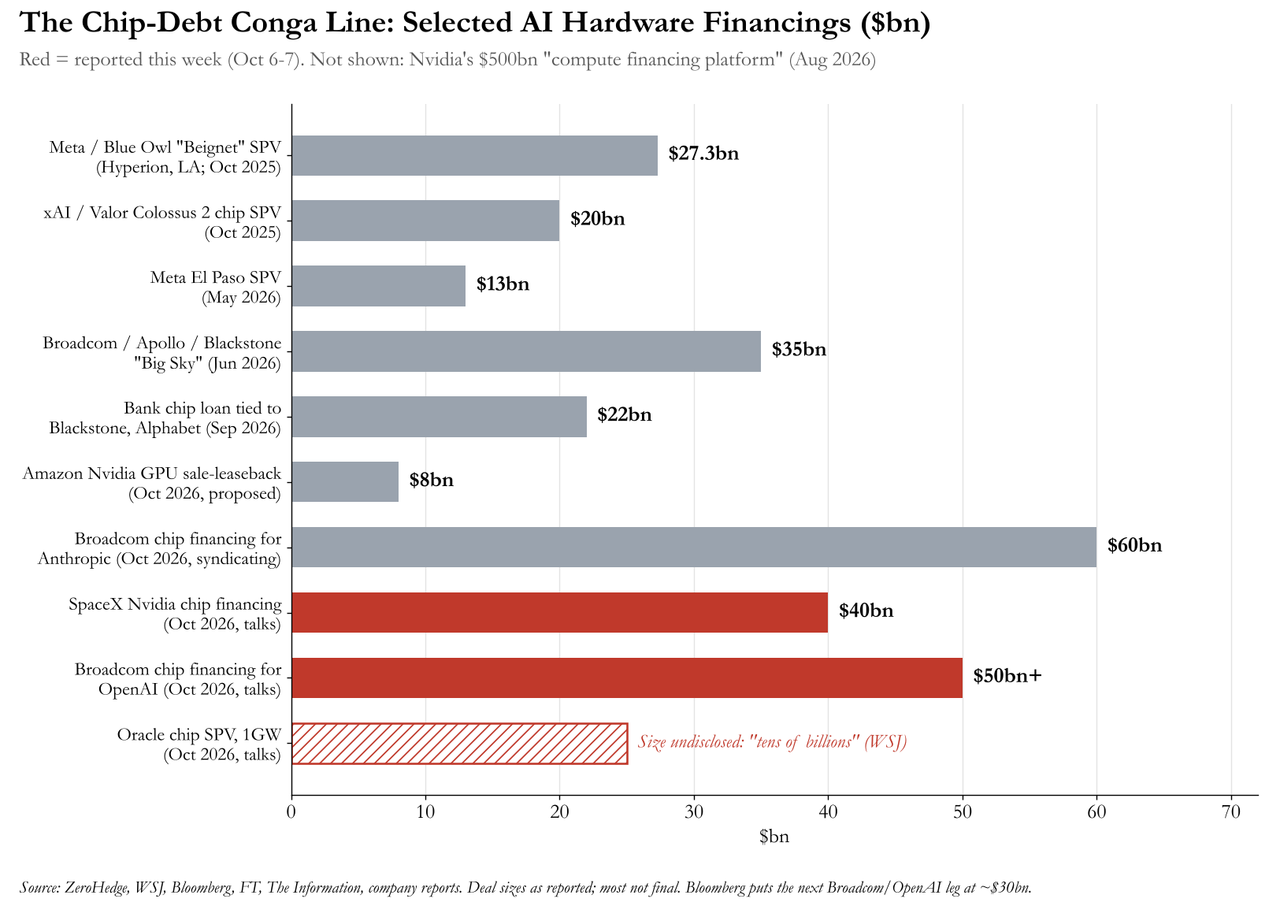
Apollo, for those keeping score, is in on all three of this week's deals, as well as Broadcom's June platform, xAI's Colossus financing and Nvidia's $500 billion "compute financing platform" from August.
Diversification at its finest? Just kidding... and when it all goes tits up - which it will - that's how many hundreds of billions in Athene life insurance policies vaporized? Maybe a question the regulators should ask now before waiting for what Michael Novogratz called the "biggest bubble in our lifetimes" to burst...
The WSJ is explicit on why these deals are going through Apollo and Blackstone rather than DCM desks: for their AI build-outs, cloud providers "issued hundreds of billions of dollars of bonds, pushing the public debt market to its limits."
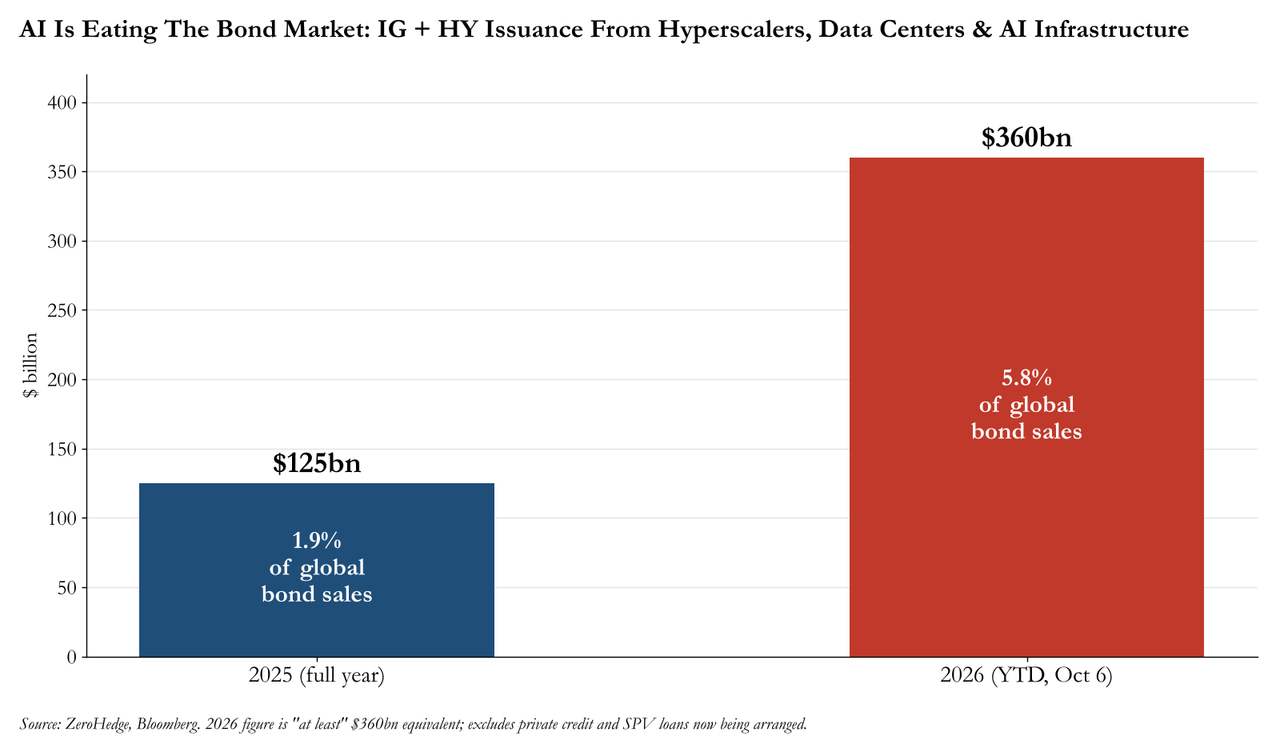
The numbers back that up. According to Bloomberg, IG and high yield issuance from hyperscalers, data centers and AI infrastructure projects has hit at least $360 billion this year, or 5.8% of all global bond sales, triple last year's 1.9% share:
And that's the conservative count. As we laid out earlier this week in "When Does The Credit Party End?", Goldman's Adam Crook (in his latest "AI Issuance Pulsecheck", available to pro subs) counts "$575bn+ of global gross AI-related debt issuance this year," with hyperscalers "only" 40% of the total, while Morgan Stanley (in "The State of AI Financing: A Pause, Not a Pullback", also available to pro subs) expected "a busier fall and 4Q, as the focus shifts to 2027 capex." One week into Q4, that call looks conservative too.
Meanwhile, the off-balance sheet pile keeps growing faster than the on-balance sheet one:
Every chip SPV in the chart above adds to that number, because a lease isn't debt... until it is.
Which brings us to the real story. Here is Privorotsky's full take, which Goldman liked so much it put it at the top of its What Matters Today email as "The Fight for Capital":
Translation: AI borrowers will pay whatever it takes, so everyone else has to pay more.
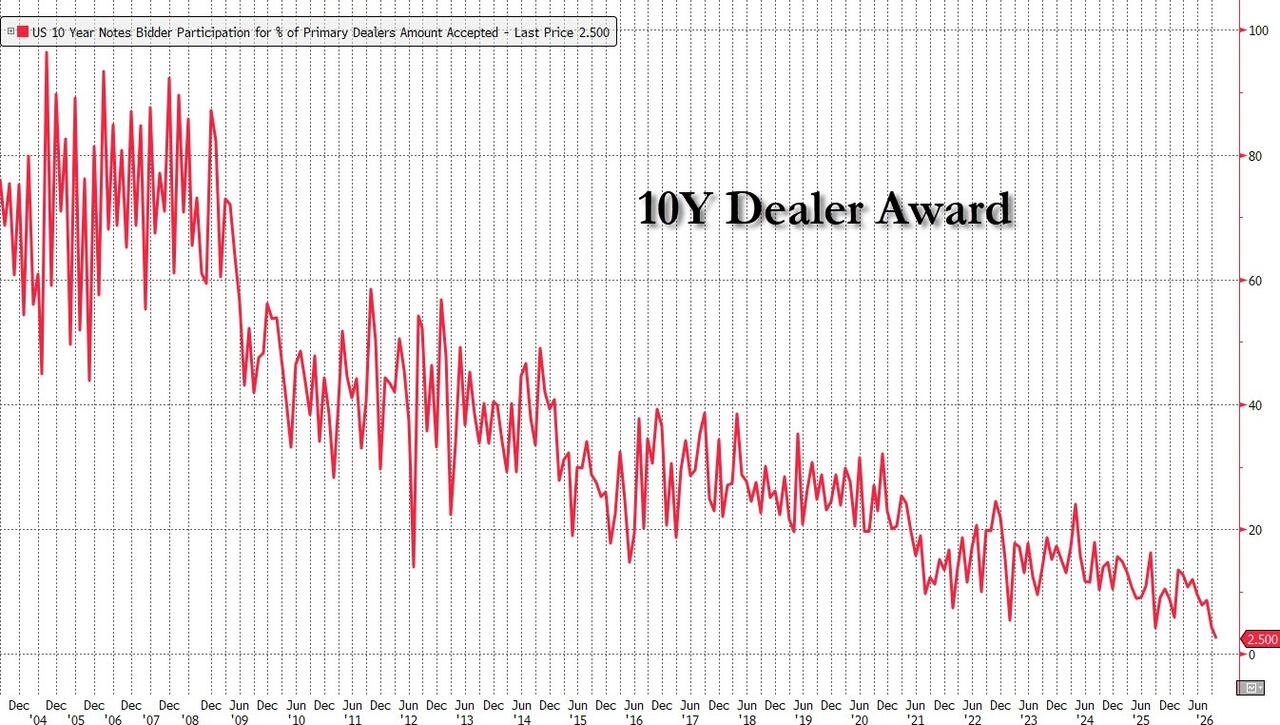
Reuters' Wayne Cole made the same point in this morning's Morning Bid ("Sovereign borrowers are no longer the big boys on the block as AI giants increasingly invade their turf"), noting that the prospect of more corporate competition pushed 10Y yields back up to 5.31% in Asia, a day after a blowout 10Y auction. Next up: the 30Y today, with yields around 5.70%. And if Privorotsky is right, a strong auction won't fix much when the marginal duration buyer is being offered investment-grade chip paper by Apollo.
Privorotsky sees just two ways this ends:
And he adds: "We may already be seeing the beginnings of that in CCC spreads."
We are (and we, as in ZeroHedge, have been pounding the table on this topic for, oh... just about a year now). Per Goldman's credit sales strats (in their "What We Are Monitoring in US Credit" update, available to pro subs), USD CCC spreads closed Wednesday at 998bp, up 219bp in three months and 123bp in one month, in the 99th percentile of the past year and two basis points from 1,000. Over the same period, the IG index was unchanged at 80bp:
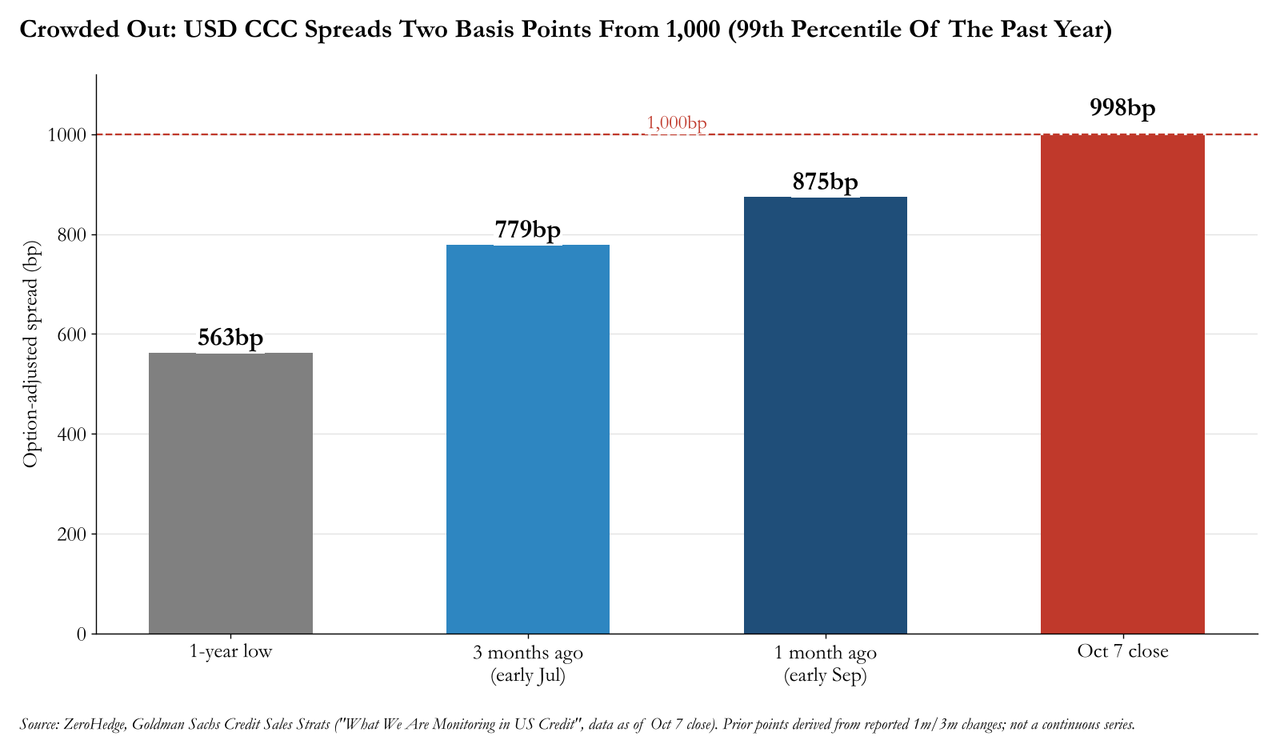
Put differently, the top of the capital structure is fine, the bottom is getting crushed, and the AI borrowers are the reason why. Privorotsky also flagged that the Russell has underperformed the Nasdaq in 17 of the last 20 sessions, which is the same story told in equities. (Think of it as "long artificial intelligence, short everyone who needs a loan.")
And as we tweeted last night, the cracks are no longer confined to junk:
Three of the four are AI borrowers. All are still somehow rated investment grade. All three are now going back to the well.
The WSJ ends its story on a note that would have sounded absurd two years ago: Oracle needs an off-balance sheet vehicle to keep "debt costs under control as the company competes against larger tech firms with bigger war chests." That's one of the biggest landlords of the AI race admitting that its own balance sheet is no longer up to the job. OpenAI and Anthropic don't have balance sheets to begin with (or income statements unless one counts annualizing a cherry-picked day as an MRR an "income statement"). And SpaceX, which "didn't need" an IPO in December, is now on its third trip to the capital markets in four months.
Privorotsky frames it as a fork: AI becomes self-financing, or capital gets rationed and the weak links break. With CCCs at 1,000bp, SpaceX CDS at a record 197bp, Oracle CDS at records, and the 30Y auction later today, we think the second path is already being priced, while the first one still depends on next quarter's hyperscaler earnings. A $50 billion loan for chips named Jalapeño suggests the borrowers aren't waiting to find out.
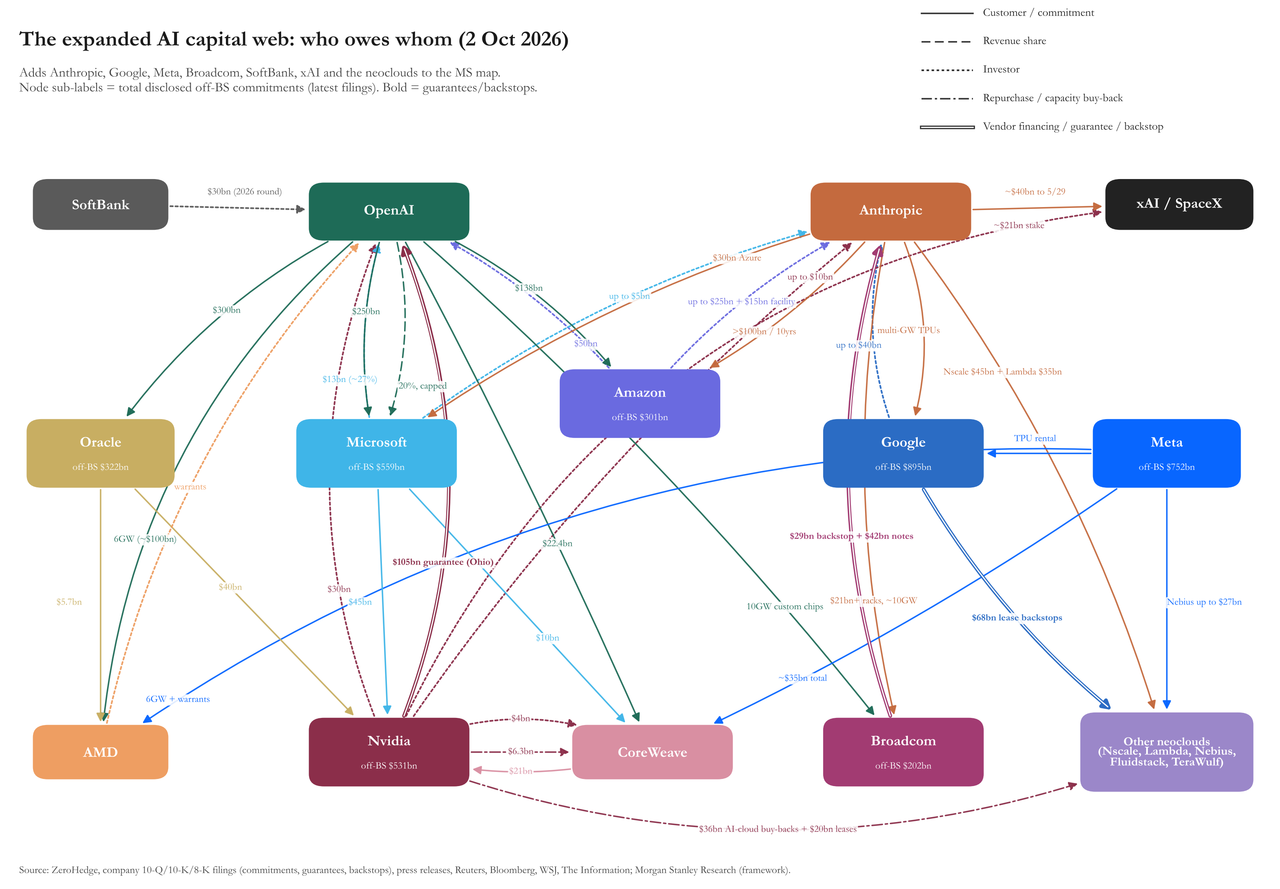
Here, once again, is who owes whom in the biggest circular financing diagram ever seen, which just got a few more arrows:
Much more in the full Goldman "GS Basics - Crowding Out" note, the "AI Issuance Pulsecheck" and the "What We Are Monitoring in US Credit" update, all available to pro subs.
Tyler Durden Thu, 10/08/2026 - 10:00
Continue reading...
[ H/T ZeroHedge ]
A day after SpaceX went looking for $40 billion in chip-collateralized SPV debt, sending its CDS into geostationary orbit in the process, the rest of the AI complex has gotten in line.
According to the Wall Street Journal, Broadcom has spent the past few weeks working to arrange more than $50 billion in financing for OpenAI's custom AI chip, with Apollo and Blackstone among the lenders it has approached. Separately, Oracle - which has emerged as the weakest link in the entire credit-fueled AI bubble and will likely be the first domino to fall - is in talks with Apollo and Goldman Sachs to fund a big chip purchase through an off-balance sheet vehicle. Add the SpaceX deal, which we covered yesterday, and Broadcom's $60 billion Anthropic financing, which started syndicating last week, and the AI ecosystem has lined up roughly $150 billion in chip debt in about a week, without counting Oracle, which hasn't even put a number on its deal yet.
Regular readers will not be surprised. We have been warning since last October that the AI buildout runs on debt, and that the debt is increasingly moving off the balance sheet and into SPVs. What is new is that the borrowing has gotten so big that, by Goldman's own admission, it is now squeezing everyone else out of the capital markets.
Or, as Goldman's Rich Privorotsky put it in his morning note (available to pro subs):
Yes, Rich, you figured out the point we have been making for about a year now: US gov't yields are rising because hyperscalers have between $500-$800BN in debt to issue next year. Incidentally, the same point was echoed by JPMorgan's head TMT specialist Brian Heavey who said this morning that "price action is bearish early with Recession basket leading and Beta + rate sensitive lagging. SPCX bond raise getting a lot of attention but really shouldn't be surprising (although it continues to pressure govt bonds)."
Below we break down the three deals, why every one of them goes through a private credit fund rather than a bond desk, and who is footing the bill for AI's borrowing binge.
Peppers, Gigawatts And $50 Billion
Start with the biggest one. Per the WSJ, the Broadcom financing for OpenAI "could include several gigawatts of OpenAI chip capacity" and is expected to close before the end of the year. The chips come out of OpenAI's in-house program, code-named Nexus, which names its custom chips after peppers: the first two generations are Jalapeño and Serrano. (Presumably Habanero is reserved for whoever ends up holding the debt.)
The deal comes a year after OpenAI and Broadcom announced a plan to co-develop 10 gigawatts of custom chips, to be deployed from the second half of 2026 through the end of 2029. Someone has to pay for those 10 gigawatts, and as the WSJ notes, OpenAI and Anthropic are a "new group of chip buyers... who don't have the financial firepower to purchase their own hardware." So Broadcom, the seller, is arranging the money for the buyer. The supplier finances the customer's purchase of the supplier's product, just as Nvidia did with xAI, and as Broadcom is already doing for Anthropic. There's a reason why it's called circular financing, in case you were confused.
That the number is still moving says a lot. Bloomberg, which confirmed the talks, says "no formal process has begun" and that the two could seek "around $30 billion of debt for the next leg." Whether it is $30 billion or $50 billion+, it lands right on top of the Anthropic deal, where banks sent out syndication letters last week for a $42 billion Class A senior-secured tranche, while Blackstone is leading an $18 billion Class B junior tranche and committing $9 billion from its own funds. And back in June, Broadcom set up a platform with Apollo and Blackstone as anchors to finance more than 20 gigawatts of AI compute through 2028, which, per Bloomberg, "will require hundreds of billions of dollars."
The bond market noticed the moment the Anthropic deal hit the tape:
It took about 12 hours for us to follow up with "Broadcom bonds: all time lows." Now Broadcom wants to do it all over again... for a different lab.
Oracle: Bridge To... Somewhere
The Oracle deal is the most revealing of the three, because the WSJ is unusually frank about its purpose. The financing is meant to help Oracle "bridge the gap between when it has to pay for the hardware and when its cloud computing revenue starts coming in." The likely structure: investors fund a separate company that buys the chips, which Oracle then leases over time. Size: undisclosed, but Nvidia chips for a 1-gigawatt data center "would cost tens of billions of dollars" (rule of thumb is 1GW data center = $50-$60BN, rising to $100BN by the time Vera Rubin becomes the default). Oracle wants it done as soon as this year.
And why the separate company? Because, per the Journal, it "would help Oracle avoid borrowing more money itself, keeping debt costs under control." In other words, Oracle can no longer borrow cheaply on its own name, so it is renting its balance sheet from Apollo. One look at the Oracle credit page shows why.
There's a reason for that. Two weeks ago, Oracle's 2056 bonds plunged to a record low after the force majeure at Project Jupiter, yielding over 8%, which is wider than the average single-B junk bond. Then Oracle's 1.3GW Wisconsin campus was next to slip. And just last night we put out the covenant comps on the roughly $80 billion of project debt already backing Oracle-leased data centers:
The takeaway: three of the four deals are short-dated bank loans against 15-19 year leases, i.e., a bet that Oracle can be refinanced in 2028-2032 at today's spreads. The Jupiter loans already trade at 89-91 cents. Now add a chip SPV on top, whose collateral (graphic chips) depreciates far faster than a building. What could go wrong?
SpaceX: The Arrow Gets A Price Tag
The SpaceX leg we dissected yesterday: about $10 billion in bank loans plus $30 billion of IG debt to buy Nvidia chips, led by Apollo, with Pimco circling, from a company that raised a record $86 billion in its June IPO and then sold $25 billion in bonds two weeks later. That's $65 billion of debt since June, or 76% of the IPO proceeds:
The WSJ confirms the talks, adding only that SpaceX "talked to lenders in recent days." The credit market's verdict came faster: per Reuters, SpaceX's five-year CDS widened almost 15bp to a record, as investors "seemed to have qualms about turning equity risk into credit risk." Musk avoids dilution; bondholders get the dilution instead.
That was no blip: SpaceX 5Y CDS jumped from around 181bp to 197bp, a new record wide, blowing through the late-July high of roughly 188bp and up about 30% since mid-September. For a company that IPO'd with CDS near 110bp in June, the market has nearly doubled the price of insuring SpaceX debt in under four months, and that's before the $30 billion of new "IG" paper even hits the tape.
Put differently, the rating agencies still say BBB; the CDS market says it is pricing something else (and far worse) entirely. And as we noted yesterday, SpaceX's 2056 bonds already trade around 85 cents. Next stop: 200bp (by the time you read this, probably already there).
Put all three on one chart, next to the AI SPVs that came before them, and the trajectory speaks for itself:
Apollo, for those keeping score, is in on all three of this week's deals, as well as Broadcom's June platform, xAI's Colossus financing and Nvidia's $500 billion "compute financing platform" from August.
Diversification at its finest? Just kidding... and when it all goes tits up - which it will - that's how many hundreds of billions in Athene life insurance policies vaporized? Maybe a question the regulators should ask now before waiting for what Michael Novogratz called the "biggest bubble in our lifetimes" to burst...
Why SPVs and Private Credit? Because The Bond Market Is Full
The WSJ is explicit on why these deals are going through Apollo and Blackstone rather than DCM desks: for their AI build-outs, cloud providers "issued hundreds of billions of dollars of bonds, pushing the public debt market to its limits."
The numbers back that up. According to Bloomberg, IG and high yield issuance from hyperscalers, data centers and AI infrastructure projects has hit at least $360 billion this year, or 5.8% of all global bond sales, triple last year's 1.9% share:
And that's the conservative count. As we laid out earlier this week in "When Does The Credit Party End?", Goldman's Adam Crook (in his latest "AI Issuance Pulsecheck", available to pro subs) counts "$575bn+ of global gross AI-related debt issuance this year," with hyperscalers "only" 40% of the total, while Morgan Stanley (in "The State of AI Financing: A Pause, Not a Pullback", also available to pro subs) expected "a busier fall and 4Q, as the focus shifts to 2027 capex." One week into Q4, that call looks conservative too.
Meanwhile, the off-balance sheet pile keeps growing faster than the on-balance sheet one:
Every chip SPV in the chart above adds to that number, because a lease isn't debt... until it is.
The Fight For Capital
Which brings us to the real story. Here is Privorotsky's full take, which Goldman liked so much it put it at the top of its What Matters Today email as "The Fight for Capital":
Translation: AI borrowers will pay whatever it takes, so everyone else has to pay more.
Reuters' Wayne Cole made the same point in this morning's Morning Bid ("Sovereign borrowers are no longer the big boys on the block as AI giants increasingly invade their turf"), noting that the prospect of more corporate competition pushed 10Y yields back up to 5.31% in Asia, a day after a blowout 10Y auction. Next up: the 30Y today, with yields around 5.70%. And if Privorotsky is right, a strong auction won't fix much when the marginal duration buyer is being offered investment-grade chip paper by Apollo.
Privorotsky sees just two ways this ends:
- "Either AI generates sufficient organic cash flow to become increasingly self financing, making the next hyperscaler earnings particularly important,"
- "or capital gets rationed elsewhere and the weaker parts of the economy begin to break."
And he adds: "We may already be seeing the beginnings of that in CCC spreads."
We are (and we, as in ZeroHedge, have been pounding the table on this topic for, oh... just about a year now). Per Goldman's credit sales strats (in their "What We Are Monitoring in US Credit" update, available to pro subs), USD CCC spreads closed Wednesday at 998bp, up 219bp in three months and 123bp in one month, in the 99th percentile of the past year and two basis points from 1,000. Over the same period, the IG index was unchanged at 80bp:
Put differently, the top of the capital structure is fine, the bottom is getting crushed, and the AI borrowers are the reason why. Privorotsky also flagged that the Russell has underperformed the Nasdaq in 17 of the last 20 sessions, which is the same story told in equities. (Think of it as "long artificial intelligence, short everyone who needs a loan.")
And as we tweeted last night, the cracks are no longer confined to junk:
Three of the four are AI borrowers. All are still somehow rated investment grade. All three are now going back to the well.
Bottom Line
The WSJ ends its story on a note that would have sounded absurd two years ago: Oracle needs an off-balance sheet vehicle to keep "debt costs under control as the company competes against larger tech firms with bigger war chests." That's one of the biggest landlords of the AI race admitting that its own balance sheet is no longer up to the job. OpenAI and Anthropic don't have balance sheets to begin with (or income statements unless one counts annualizing a cherry-picked day as an MRR an "income statement"). And SpaceX, which "didn't need" an IPO in December, is now on its third trip to the capital markets in four months.
Privorotsky frames it as a fork: AI becomes self-financing, or capital gets rationed and the weak links break. With CCCs at 1,000bp, SpaceX CDS at a record 197bp, Oracle CDS at records, and the 30Y auction later today, we think the second path is already being priced, while the first one still depends on next quarter's hyperscaler earnings. A $50 billion loan for chips named Jalapeño suggests the borrowers aren't waiting to find out.
Here, once again, is who owes whom in the biggest circular financing diagram ever seen, which just got a few more arrows:
Much more in the full Goldman "GS Basics - Crowding Out" note, the "AI Issuance Pulsecheck" and the "What We Are Monitoring in US Credit" update, all available to pro subs.
Tyler Durden Thu, 10/08/2026 - 10:00
Continue reading...
[ H/T ZeroHedge ]