





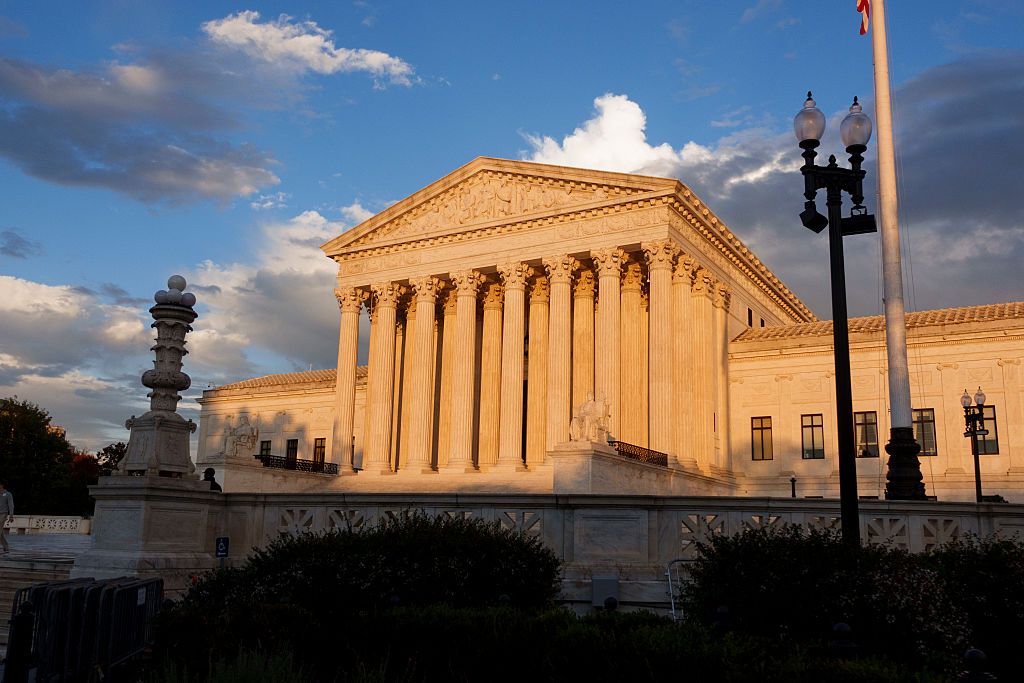
The justices of the Supreme Court aren’t scheduled to meet for a private conference – and vote on new petitions for review – for two-and-a-half weeks. But when they do, on Friday, Dec. 4, they will have a number of high-profile cases to consider – which could, in turn, lead to a busy spring.
The federal government and President Donald Trump are at the center of three of the biggest petitions for review up for consideration on Dec. 4.
In United States v. Talbott, the justices will decide whether to review a ruling by a federal appeals court in Washington, D.C., that bars the Trump administration from expelling several transgender servicemembers from the military.
In the government’s petition for review, U.S. Solicitor General D. John Sauer called the decision by the U.S. Court of Appeals for the D.C. Circuit “gravely erroneous” and argued that its “reasoning cannot be squared with this Court’s precedents or deference to the military.”
The challengers urged the court to stay out of the dispute, calling the D.C. Circuit’s decision “narrow” and temporary. And in any event, they added, the ruling is correct, because the Trump administration’s ban on transgender servicemembers was motivated by hostility to transgender people rather than “military judgments.”
In another case to be considered, Trump and the federal government have each filed petitions for review in connection with Trump’s challenge to the $83.3 million verdict entered against him in a lawsuit brought by E. Jean Carroll, who had alleged that in 1996 Trump had sexually abused her in a dressing room at a New York department store and that Trump in 2019 had defamed her by calling her a liar.
Trump’s petition for review points to the Supreme Court’s 2024 decision in Trump v. United States, in which it held that presidents generally have broad immunity for their acts while in office. Trump’s private attorney, Robert Giuffra, wrote that “[t]he threat of even a single damages judgment based on official acts will render all Presidents ‘unable to boldly and fearlessly carry out [their] duties for fear that [they] may be next.’”
The federal government’s petition for review asks the Supreme Court to also decide whether the federal government, rather than Trump, should be the defendant in Carroll’s case because Trump made the statements at the center of the dispute as part of his role as president.
And in United States v. Jackson and United States v. Office of the New York State Attorney General, the justices will decide whether to weigh in on the legality of Trump’s appointments of acting U.S. attorneys in Nevada and New York.
Under the Federal Vacancies Reform Act, the federal law that governs how the executive branch can temporarily staff vacant positions that require presidential appointment and confirmation by the Senate, interim officers can serve for 120 days. Under that law, then-Attorney General Pamela Bondi appointed Sigal Chattah as the interim U.S. Attorney for the District of Nevada, effective April 1, 2025, after Jason Frierson, who was nominated by then-President Joe Biden, stepped down.
With only a few days remaining before her interim appointment was set to expire, Chattah resigned, and Bondi designated her as the first assistant U.S. attorney. In that post, Bondi said, Chattah would have the power under the FVRA “to serve as Acting United States Attorney upon a vacancy in that office.” Bondi also gave Chattah the powers of a U.S. attorney for legal proceedings in Nevada.
Bondi followed a similar path for John Sarcone in the Northern District of New York, naming him first as the interim U.S. Attorney and then, when his interim term expired, naming him as the first assistant U.S. attorney and a “special attorney,” effectively designating him as the “Acting U.S. Attorney.”
When challenges to the legitimacy of Chattah’s and Sarcone’s appointments followed, lower courts agreed that neither had been validly appointed. Sauer then came to the Supreme Court, where he told the justices that Chattah’s appointment was not only lawful, but “a critical tool that the Executive Branch has used without meaningful objection for 25 years.” He urged the court to take up that case, and to hold the New York case until the Nevada case is resolved.
In addition to those disputes, the justices will consider three other noteworthy petitions for review on Dec. 4:
- Madigan v. United States, a challenge by the former speaker of the Illinois House of Representatives to his conviction on federal fraud and bribery charges.
- Alvarez v. Guerrero, in which a death-row inmate in Texas argues that his constitutional rights were violated when his lead lawyer “repeatedly” fell asleep during his trial.
- Herridge v. Chen, a journalist’s challenge to efforts to compel disclosure of her confidential sources.
One thing to keep in mind: although the justices are slated to vote on these cases for the first time on Dec. 4, they may not act on any of them right away. In particular, for several years, the court has had a general practice of not granting a petition for review until the justices have considered it at two conferences. After the Dec. 4 conference, the justices will meet again on Dec. 11.
Finally, yet another high-profile petition for review is likely to be before the justices soon: Trump v. Clinton, in which Trump is seeking to revive his lawsuit against Hillary Clinton (and several others, including the Democratic National Committee) alleging “a coordinated scheme … to undermine his candidacy and Presidency through fabricated accusations of Russian collusion.” Clinton originally waived her right to file a response to Trump’s petition, but the court called for a response, which she filed on Nov. 13. In her response, Clinton contends that “President Donald Trump and his attorneys” “attempt to frame a routine opinion disposing of a frivolous lawsuit as a threat to ‘the Presidency.’”
Continue reading...
[ H/T SCOTUSblog ]