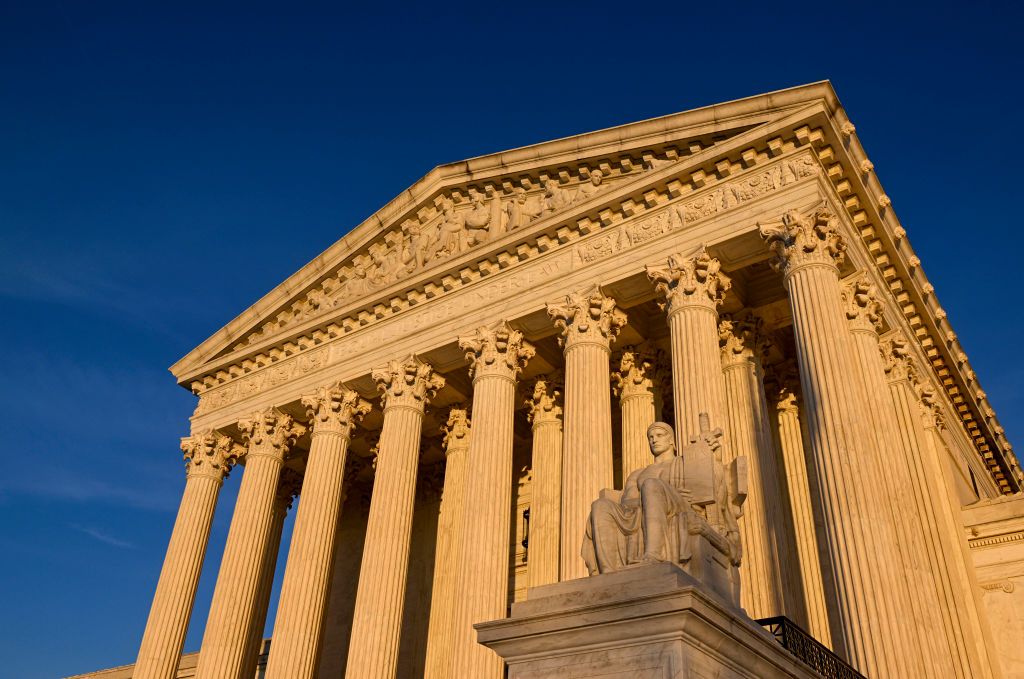




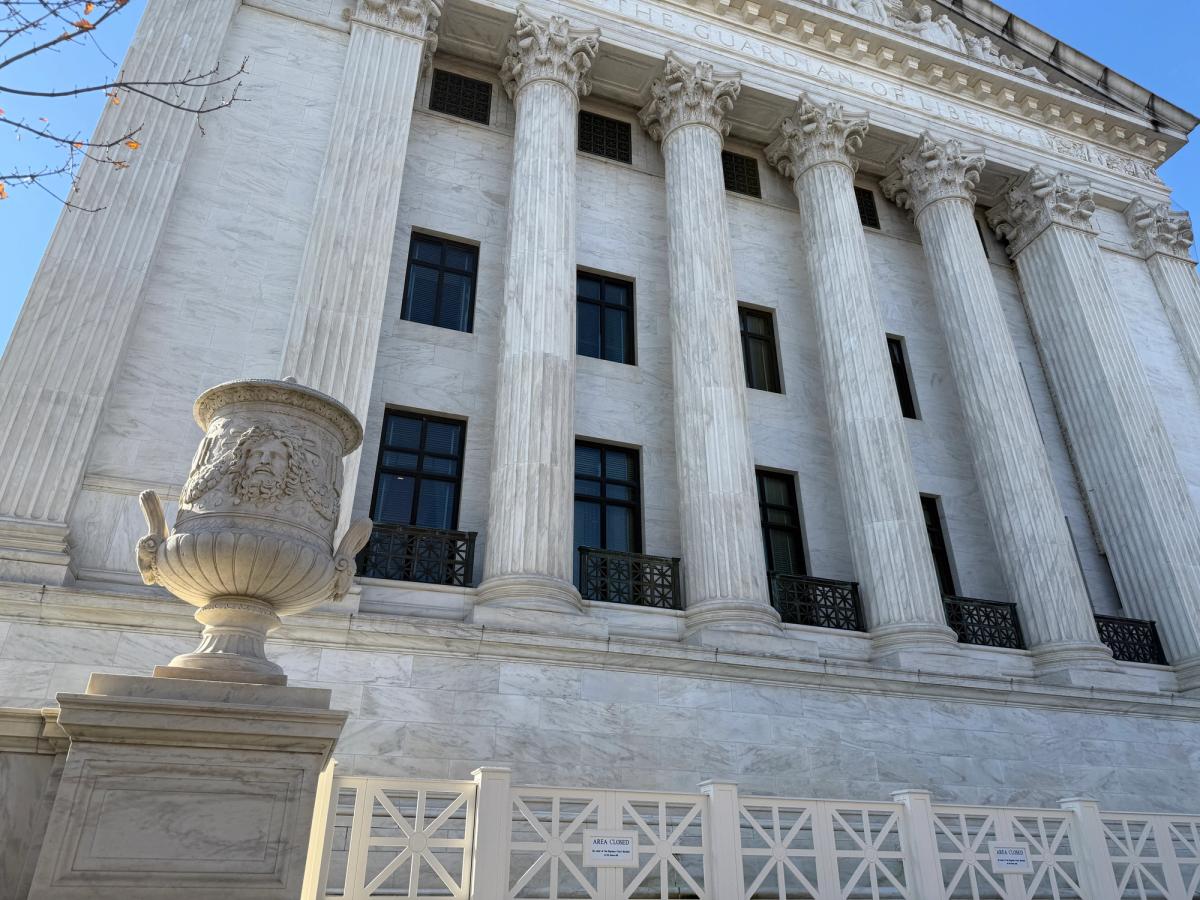
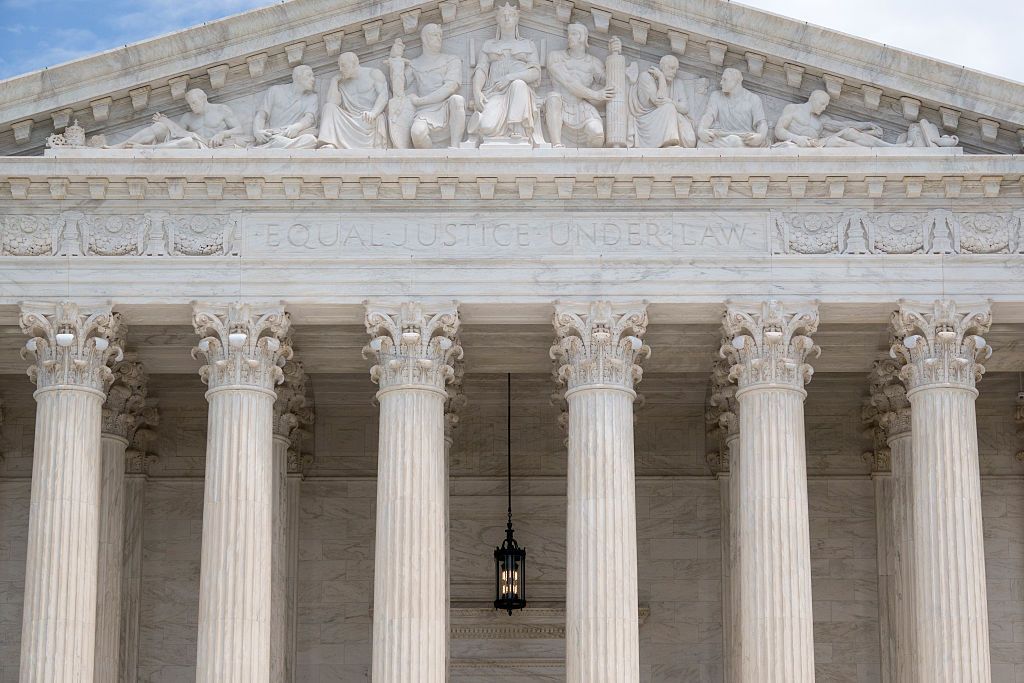
The Supreme Court on Monday denied review in several notable cases, including a clash between the Trump administration and University of California scholars over cuts to research funding; a California ophthalmologist’s challenge to diversity-related requirements for continuing medical education courses; and a dispute over Maryland’s ban on carrying firearms in “sensitive places.” It also invited the United States solicitor general to share the government’s views on a trio of cases brought against the Taliban by victims of terrorist attacks. These denials and requests were part of a list of orders from the justices’ private conference on Friday that was released on Monday morning.
The court previously announced, just after Friday’s conference concluded, that the justices had added two cases to this term’s oral argument docket: Mullin v. Refugee and Immigrant Center for Education and Legal Services, on whether the Trump administration can suspend access to asylum for immigrants at the U.S.-Mexico border; and Robinhood Markets, Inc. v. Sodha, on whether a financial-services company violated federal securities laws when it failed to disclose some interim financial data as part of its initial public offering.
Research funding and DEI
The research funding case, Trump v. Thakur, stemmed from a series of executive orders issued by President Donald Trump soon after he began his second term, which addressed, among other things, efforts to reduce government spending and the withdrawal of government support from “diversity, equity, and inclusion” (DEI) initiatives. Federal agencies responded to the orders by cutting grant funding for projects they linked to disfavored topics, including DEI, which, in turn, led to lawsuits from states, universities, and individual scholars challenging the funding cuts.
Thakur involved a group of faculty members and researchers at the University of California who lost research grants because of the executive orders. They challenged the grant terminations on behalf of a class of other UC scholars like them, contending that the administration had violated free speech and due process protections, as well as the federal law governing administrative agencies.
In June 2025, a federal district court in California issued a preliminary injunction requiring the Trump administration to reinstate grants for members of two overlapping classes: 1) UC researchers who were notified of a grant cut “by means of a form termination notice that does not provide a grant-specific explanation for the termination”; and 2) UC researchers who lost grant funding due to the DEI-related executive orders. The court held that cuts affecting the first group were likely to be found to be “arbitrary and capricious” – that is, lacking good cause and without providing a sound reason – in violation of the federal law governing administrative agencies and that cuts affecting the second group were likely to be found to violate the First Amendment.
The Trump administration appealed to the U.S. Court of Appeals for the 9th Circuit, which initially denied the government’s request to put the district court’s ruling on hold. However, that same day, the Supreme Court sided with the administration in National Institutes of Health v. American Public Health Association, an interim docket case that also addressed research funding. A divided Supreme Court paused a ruling from a federal court in Massachusetts that would have required NIH to pay grants it had moved to terminate, holding that the lower court did not have the power to rule on claims “‘based on’ the research-related grants or to order relief designed to enforce any ‘obligation to pay money’ pursuant to those grants.” In light of the Supreme Court’s decision, the government asked the 9th Circuit to reconsider. In an amended order issued in December 2025, the 9th Circuit granted part of the government’s request.
In a May 2026 ruling, the 9th Circuit pointed to the Supreme Court decision to explain why it was reversing the lower court’s ruling as to the class of researchers who had received form letters from the government about their grants. As in the NIH case, the district court likely lacked the authority to hear the claim involving that class and to require grant reinstatement, the 9th Circuit concluded.
However, the 9th Circuit affirmed the other part of the district court’s ruling, agreeing that members of the second class of researchers were likely to succeed on their claim that ending research grants over concerns about DEI violated the First Amendment. Although “the government has discretion to define subsidy programs in a way that reflects its preference to fund (or not fund) particular activities,” the 9th Circuit concluded, the Supreme Court has held that, once a subsidy program is established, the government “may not discriminate between speakers within that program to suppress viewpoints with which it disagrees.”
In August, the Trump administration asked the Supreme Court to review this second part of the 9th Circuit’s ruling, contending that it “conflicts with” Supreme Court precedent and “also interferes with executive-branch priorities in spending taxpayer funds, establishing a dangerous precedent that will hamstring every future administration when seeking to subsidize private projects that promote viewpoints aligned with government policy.” The First Amendment “does not require taxpayers to continue funding projects that the government concludes no longer serve the public interest,” asserted U.S. Solicitor General D. John Sauer.
In their brief opposing review, the researchers contended that the case was a poor candidate for review because the 9th Circuit’s decision does not conflict with any other federal appeals court or Supreme Court ruling. They further argued that the Trump administration failed to account for the fact that it is attempting to cut off already approved funds. “[T]he government can point to no case where this Court, or any court, has held that the President and federal agencies may terminate grants awarded through a merit-driven competitive process based on the perceived viewpoint of the research,” the researchers wrote.
On Monday, the Supreme Court denied the Trump administration’s petition without comment or noted dissent.
DEI and continuing education for doctors
Khatibi v. Yip also involved the First Amendment and DEI. It was brought to the Supreme Court by a California ophthalmologist, Dr. Azadeh Khatibi, who seeks to challenge the requirement, imposed by that state’s Medical Board, that continuing medical education courses include information about “the understanding of implicit bias” – that is, subconscious assumptions about people from different backgrounds.
Khatibi, who frequently teaches continuing education classes, and a group of doctors went to federal court, where they argued that the requirement violates the First Amendment. U.S. District Judge Monica Ramirez Almadani dismissed the case, ruling that the courses are government speech and therefore not subject to the First Amendment’s free speech clause.
After the 9th Circuit affirmed Ramirez Almadani’s decision, the doctors came to the Supreme Court, asking the justices to take up their case. They argued that Khatibi and other instructors like her “create and deliver their own original CME content without State drafting, editing, assignment of topics, or meaningful oversight.” If the lower court’s ruling is allowed to stand, they said, it “would license states to conscript private professionals—doctors, lawyers, teachers, engineers, and others—into advancing contested government ideologies whenever their instruction occurs in a licensure-related setting.”
The Medical Board urged the justices to deny review. It emphasized that the issue at the heart of the dispute is “narrow,” and that the 9th Circuit had “merely held that” the challengers “must abide by the State’s restrictions if they wish the courses that they teach be eligible for state-approved CME credit.”
On Monday, the Supreme Court denied the petition over objections from three justices. Justice Neil Gorsuch indicated, without explanation, that he would grant the petition for review. Justice Clarence Thomas, joined by Justice Samuel Alito, wrote an opinion dissenting from the denial of review, in which he asserted that the 9th Circuit’s decision in Khatibi’s case “fundamentally misunderstands” Supreme Court “precedents and the Constitution.” According to Thomas, “First Amendment protections do not give way simply because a State heavily regulates speech.”
The Second Amendment and “sensitive places”
Thomas also wrote a statement regarding the Supreme Court’s decision to deny review in Novotny v. Moore, a Second Amendment challenge to Maryland laws banning firearms in a wide variety of public places, such as government buildings, school grounds, public transportation, state parks, stadiums, and places that sell alcohol.
In rejecting the challenge to the restrictions, the U.S. Court of Appeals for the 4th Circuit relied on the idea, set out in the Supreme Court’s 2022 decision in New York State Rifle & Pistol Association v. Bruen, that the right to carry a gun in public does not apply in “sensitive places.” In their petition for review, the challengers contended that “[t]he constitutionality of these so-called ‘sensitive place’ bans is among the most critical questions facing the judiciary in the wake of this Court’s decision in” Bruen. They argued that the court’s precedent makes clear that although governments may impose some gun restrictions in “sensitive places,” that exception is a “narrow” one.
Maryland countered that there is no need for the Supreme Court to weigh in on this question now because there are “vast areas of shared consensus” among the lower courts with regard to restrictions on where guns may be carried and the rationale for such limits. The state pointed to what it characterized as a “[r]ich” historical tradition of laws that “restricted the carrying of firearms in specific locations.” The laws at issue in this case, the state said, “are consistent with” those laws “and the underlying principles of firearm regulation that they embody.”
In his statement, Thomas described himself as “skeptical” of the 4th Circuit’s conclusion that each of the challenged restrictions “‘is consistent with this Nation’s historical tradition of firearm regulation’ in ‘sensitive places.’” But he explained that he agreed with the justices’ decision to deny the petition for review, because “the breadth” of the challenge to Maryland’s many policies “would complicate” the Supreme Court’s consideration of the case. “In an appropriate and more narrowly focused case, however,” Thomas continued, “we should consider the scope of States’ authority to ban firearms in ‘sensitive places.’”
Other notable denials
The Supreme Court denied review in dozens of other cases on Monday, including disputes over how the federal judiciary handles sexual harassment and employment discrimination claims and the Colorado General Assembly’s rules for referring to transgender or nonbinary individuals during committee hearings.
Strickland v. Moritz involved a former federal public defender in North Carolina who contends that she was sexually harassed by her supervisor. At issue in the case was the adequacy of the internal system that the federal judiciary requires its employees to use for sexual harassment and employment discrimination claims.
Gays Against Groomers v. Garcia was a challenge by the nonprofit Gays Against Groomers, which describes itself as a group of “gays, lesbians, and others in the community” who are opposed to the transgender “agenda,” to the Colorado General Assembly’s ban on referring to transgender or nonbinary people by the wrong gender or by the name they used before their transition in legislative hearings. The U.S. Court of Appeals for the 10th Circuit turned away the lawsuit, holding that “the establishment and enforcement of rules of decorum for legislative proceedings fall within the sphere of legitimate legislative activity,” and are therefore protected by legislative immunity.
And in Custodia Bank v. Federal Reserve Board of Governors, the justices turned down an appeal brought by a Wyoming bank after the Federal Reserve Bank of Kansas turned down its application for an account with that bank. The Fed’s decision rested on its conclusion that, because Custodia’s business model was “narrowly focused on crypto-asset activities,” it presented a greater risk that was “highly likely inconsistent with safe and sound banking practices.” The 10th Circuit sided with the Fed, holding that federal law gives the Fed discretion to reject requests to open an account even if the entity making the request is otherwise eligible.
A call for the government’s views on terrorism-related cases
In its list of orders, the court also asked the Trump administration to weigh in on trio of cases brought against the Taliban by victims of the 1998 bombings at U.S. embassies in Kenya and Tanzania, as well as victims of the Sept. 11, 2001, terrorist attacks. The cases came to the Supreme Court in connection with the victims’ efforts to attach or receive funds from the Afghan central bank held at the Federal Reserve Bank of New York. The victims’ petitions for review asked the justices to weigh in on how the determination of whether an entity is a “foreign state” for purposes of the federal Foreign Sovereign Immunities Act, as well as the interpretation of the Terrorism Risk Insurance Act, which provides that when someone obtains a judgment against a terrorist group, they can obtain funds from the group’s seized or frozen assets.
The United States has not recognized the Taliban as Afghanistan’s official government, and the Taliban did not file a response to the petitions. Instead, a “friend of the court” brief from the head of Afghanistan’s permanent mission to the United Nations urges the justices to deny review. He tells the court that he “supports compensation for the Taliban’s victims. But,” he continues, “it cannot come from the Afghan people, who have no liability for the Taliban’s crimes and who resisted the Taliban, at great cost, alongside the United States.”
Justice Elena Kagan did not participate in the decision to seek the government’s views in two of the three cases, indicating that she had recused herself from the consideration of the cases because of her prior government service – presumably as the U.S. solicitor general during the Obama administration.
There is no deadline for the solicitor general to file his briefs.
Continue reading...
[ H/T SCOTUSblog ]