





As the two parties battle to control the Senate this fall, politically purple Michigan could be both close and decisive. The dynamics of Michigan’s race are also making some Jewish Democrats rethink their priors. And that’s where things get interesting.
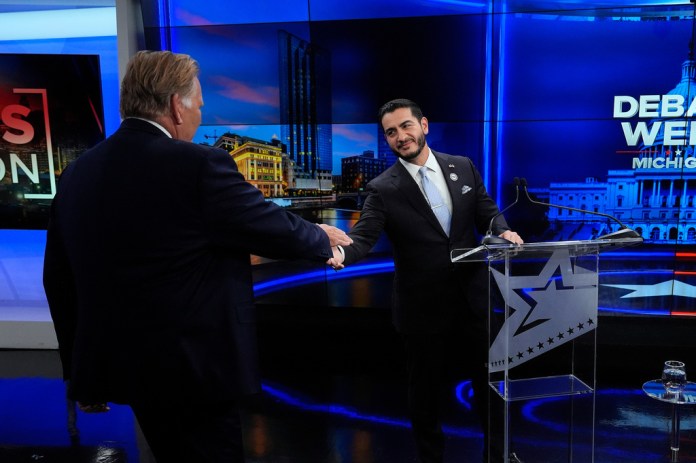
Michigan is home to approximately 130,000 Jews, many of whom voted enthusiastically for Rep. Haley Stevens (D-MI) in the Democratic primary. Since Stevens’s loss, however, Jewish Democrats and Democratic-leaning independents have had to decide: vote for anti-Zionist Democratic nominee Abdul el Sayed or his Republican opponent, former Rep. Mike Rogers? In classic Jewish fashion, that question has prompted a heated intra-communal debate.
Jewish clergy launched a petition of five “nonnegotiable” positions regarding American Jews and Israel, el Sayed’s campaign bogeymen. Noting that “American Jews now feel forced to fight for the party they long claimed as their political home,” signatories asked Democratic “leaders to treat explosive bigotry and violence against our community as the national emergency it is.” Since el Sayed still hasn’t responded to the petition, it remains unclear how its Democratic signatories will vote.
Meanwhile, over 500 Jewish Democrats and independents are publicly supporting Rogers, because they “have felt threatened and alienated by the politics and allies embraced by Abdul El-Sayed” and fear that if el Sayed wins, “the far-left and anti-Jewish elements in the Democratic Party would become dominant, including in the imminent 2028 presidential race.”
This is a rocky time for Jewish Michiganders. Michigan regional director of the Anti-Defamation League Elyssa Schmier told the Washington Examiner that while 159 incidents targeting Jews “or those perceived to be” either Jewish or “supportive of Jews” in Michigan were reported to the ADL between January and June 2025, 190 such incidents were reported during that same period in 2026. Notably, most 2026 incidents followed the March 12 terrorist attack on Temple Israel, a Detroit-area synagogue with 140 preschoolers inside.
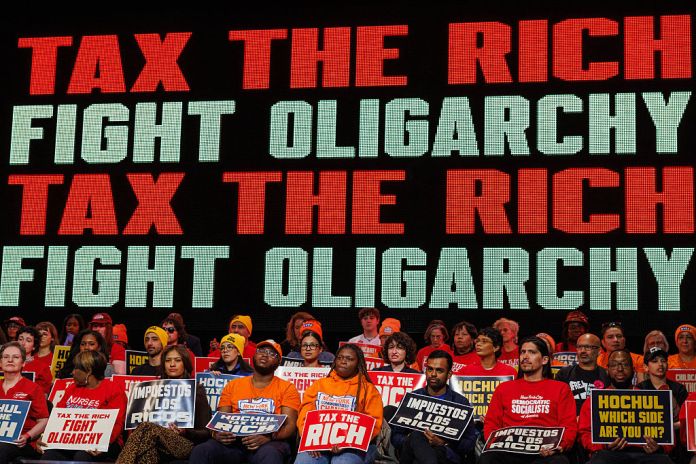
(Illustration by Amanda Boston Trypanis/Washington Examiner; AP photos)
" data-large-file="https://www.washingtonexaminer.com/wp-content/uploads/2026/10/Feat.Michigan.101426.jpg?w=696" height="658" width="1024" src="https://www.washingtonexaminer.com/wp-content/uploads/2026/10/Feat.Michigan.101426.jpg?w=696" alt="Mike Rogers Abdul el Sayed" class="wp-image-4762180" style="width:771px;height:auto" srcset="https://www.washingtonexaminer.com/wp-content/uploads/2026/10/Feat.Michigan.101426.jpg 1400w, https://www.washingtonexaminer.com/...26/10/Feat.Michigan.101426.jpg?resize=300,193 300w, https://www.washingtonexaminer.com/...26/10/Feat.Michigan.101426.jpg?resize=768,494 768w, https://www.washingtonexaminer.com/...6/10/Feat.Michigan.101426.jpg?resize=1024,658 1024w, https://www.washingtonexaminer.com/wp-content/uploads/2026/10/Feat.Michigan.101426.jpg?resize=150,96 150w, https://www.washingtonexaminer.com/...26/10/Feat.Michigan.101426.jpg?resize=696,447 696w, https://www.washingtonexaminer.com/...6/10/Feat.Michigan.101426.jpg?resize=1068,687 1068w" sizes="(max-width: 1024px) 100vw, 1024px">
(Illustration by Amanda Boston Trypanis/Washington Examiner; AP photos)
In short, this is not a typical election. Ten people familiar with Michigan politics and Michigan Jews shared their observations, confirming that el Sayed’s candidacy is dividing Jewish Michiganders and reshaping voting patterns.
Daniel Cherrin, who has “run for public office twice” as a Democrat but donated to both Democrats and Republicans, is a case in point.
“Many voters see this [as an] election between two choices: to stop or block the current [Trump] administration from implementing its agenda or to protect the Jewish community and work to reduce what is driving the rise of antisemitism,” Cherrin observed. “Whoever wins the Senate seat will be in office for at least six years, if not for decades to come.”
Cherrin is “really concerned” about the campaign season’s messages “about Jews overall and the movement behind” el Sayed.
“I feel threatened as a Jew in Michigan,” he said. “So, while abortion and Supreme Court appointments were top priorities in other years, “the most important issue to me in this race is Israel and the Jewish community.”
Rabbi Asher Lopatin, who leads a Detroit congregation, spoke in his personal capacity. He shared concerns echoed by others, including el Sayed’s obsessing “about Israel and Gaza and [the American Israel Public Affairs Committee],” and conveying “a hatred of the Jewish community.”
Lopatin believes el Sayed has demonstrated a “lack of sensitivity” by closely associating with “known antisemites” like Hasan Piker during the primary and responding to the March Detroit area terrorist attack by saying, “hurt people hurt people.” Taken together, he’s “someone you cannot vote for.”
Lopatin acknowledged that he doesn’t completely align with Rogers on the issues. For example, he is “very much for reproductive rights.” However, Lopatin prefers Rogers, who is “a pretty conventional, conservative Republican.”
Clinical social worker Troy Zukowski-Serlin has supported Democrats since Walter Mondale ran for president in 1984. However, he’s now resigned from his position with the Michigan Democratic Jewish Caucus, so he has “the freedom to campaign for” Rogers.
Zukowski-Serlin disagrees with Rogers on “a lot of policy issues,” but said Rogers accepts “Israel’s legitimacy.”
“He’s reached out to Jews; he rejects the genocide label, the apartheid label for Israel,” Zukowski-Serlin said. “So, I see him as friendly.”
Zukowski-Serlin also sees the importance of lifelong Jewish Democrats saying, “here’s our line in the sand” and voting Republican when Democrats cross that line by not recognizing Israel’s legitimacy and “push[ing] the genocide and apartheid lies about Israel.”
Like Cherrin, Zukowski-Serlin sees President Donald Trump as a comparatively short-term factor “for another couple of years, and he’ll probably be a lame duck after this election.” By contrast, he noted that Michigan’s next senator “will be there for six years, and they will have a big impact.” Zukowski-Serlin worries that “if el Sayed wins, this will be a shot in the arm for Palestinians to continue resisting accepting Israel as a legitimate state.”
Political activist and entrepreneur Hannan Lis, who has fundraised for national Democrats, opposes el Sayed’s vilification of Israel, portraying pro-Israel American Jews as a “fifth column,” and using “Jewish voters as a tool to divide and conquer.” Lis further takes issue with el Sayed’s “economic theory and his political theory. His social theory is basically a form of socialism. Some call it Marxism.”
Lis described Rogers as a “moderate Republican” with “sensible Midwestern values,” and the “far superior” candidate. He characterized Rogers as “a person of integrity, a guy who believes in public service, and frankly, he has a history of working across the aisle.” Lis clarified that his is “not a protest vote. It is a vote for somebody who’s going to represent Michigan voters in a way that is more in agreement with my values.”
Not everyone feels equally comfortable about crossing over, however. Jewish community leader and retired investor Michael Horowitz was “a classic independent” until identifying with Democrats during Trump’s first term. Horowitz is “leaning heavily towards Mike Rogers, and there is no way I will vote for el Sayed.”
But Horowitz said his vote in this election is “one of the most gut-wrenching decisions that I’ve ever had to make.”
Horowitz is concerned about Rogers “following Trump’s lead,” but sees el Sayed as the greater danger. El Sayed’s “rhetoric is antisemitic,” and as a capitalist, He is “uncomfortable” with the “communist Left” represented among el Sayed’s supporters.
“That wing of the party is much less interested in creating a big tent than in taking over the tent,” Hotowitz said. “I see them as a danger to the Democratic Party, and I see them as a danger to America.”
Cantor Rachel Gottlieb Kalmowitz, an officer of the Michigan Board of Cantors who emphasized that she was speaking only for herself, shared Horowitz’s uneasiness. Gottlieb Kalmowitz observed that “it feels very tense” for Jewish Michiganders.
“Jewish Democrats are in a very difficult spot,” after Stevens’s primary loss, she said, calling the upcoming general election an “existential vote.” “Jews are being given a really horrible choice.”
Gottlieb Kalmowitz referenced Queen Esther’s risking her life to save the Jewish people, before citing Hillel the Elder’s famous three-part quotation, urging both particularism and universalism: “It starts, ‘If I am not for myself, who will be for me?’ And in this moment, [Jews] have to put our own survival above anything else. And so, the fact that I disagree with Mike Rogers on so many social issues, etc., that does not reach the same level as voting for our survival.” Without surviving, “we can’t continue to help the other causes that we believe in.”
Gottlieb Kalmowitz considers “people like el Sayed, who speak well and look good and seem reasonable and intelligent… the most dangerous, when they repeat this lie of genocide” and offer ‘context’ when Jews are attacked or threatened. It makes American Jews less safe.”
Some Jewish voters see a Republican-controlled Senate “as a huge risk to America, because they’re so much against Trump,” and they “will be in a tough position,” Lopatin observed. But if “an openly racist Democrat [were] running against a Republican, what would you do?,” Lopatin asked, offering a thought experiment. “You would never vote for that person, the people… that are torn” because “certain things are just not acceptable.”
Rabbi Lopatin believes that logic should apply here, too.
As the country hurtles toward Election Day, it’s clear that this particular race has already generated a very different response than the election of outspoken anti-Zionist Rep. Rashida Tlaib (D-MI) did in 2018. Lopatin explained that Tlaib “represented one district,” rather than “the whole state. So, it’s a much bigger deal” and “scarier.”
Lis had recognized Tlaib as a directional change for Democrats, but “not to the extent of what we see now.” He estimated “the change started probably 15, 20 years ago. It’s just been escalating.”
Horowitz noted that the Democratic Socialists of America’s “socialist, communist agenda wasn’t a national discussion in 2018. It is now.”
For his part, Zukowski-Serlin described Tlaib as “a fringe candidate” without “much of a following in Congress.” By contrast, “Abdul would be the first Muslim U.S. senator in American history and someone who is very outspoken in being anti-Israel.” His victory “would be an international story.” And “if I’m Hamas, Hezbollah, the Houthis, [or] Iranian leaders, an Abdul el Sayed win would be a major victory for them and what I call the digital intifada… He’s a classic example of what is called the Red-Green Alliance.”
Horowitz credited el Sayed with “being a wonderful speaker, a good candidate,” and “quick on his feet.” But looking ahead, “should [el Sayed] be elected, he will be a leader in a movement that I am totally concerned about, anxious about, and could never support,” Horowitz said.
Cantor Gottlieb Kalmowitz shared similar qualms. She believes el Sayed harbors “national ambitions” beyond the Senate and “represents this new kind of Democrat, who is anti-Zionist and with thinly veiled antisemitism.” Electing “this far-left, anti-Jewish, Democratic senator” means “amplifying that part of the party that used to be seen as extreme” and “making that seem moderate, making that seem reasonable, making that a standard bearer. And that is terrifying to me,” Gottlieb Kalmowitz said.
These voters hope Democrats hear a message in their crossing over. Cherrin, for example, hopes the party reflects and considers why longtime voters are feeling alienated.
Lopatin argued “it’s poison for the Democratic Party that they don’t speak out against antisemitism.” He specified that he meant “embracing someone like Hasan Piker. I mean, justifying, rationalizing . . . the near bombing of Temple Israel . . . calling all of Israel ‘blood thirsty.’” And “the fact that the Democratic Party is riddled with these people that talk in those ways is very scary,” Lopatin said, speaking “as someone who has admired the Democratic Party.”
Zukowski-Serlin shared, “I’m very angry with the party, and I’ll come right out and say that I feel a sense of betrayal from party leaders and even fellow Democrats.” Relatedly, Zukowski-Serlin is currently weighing whether his future lies with the Democrats or in becoming a political independent. For Lis, “This takeover of the mainstream Democratic Party has been a disaster for the party. I don’t believe that the Democratic Party can succeed in America unless it’s moving to the center.” So, if speaking publicly about his support for Rogers makes “the Democratic Party pay attention, and be more intentional about” promoting more moderate candidates, Lis will “be very happy with that.”
“If we as American Jews say that it is okay that this is what the Democratic Party is becoming, it’s saying that we don’t deserve to have a state, that we don’t deserve to be safe, that we can continue to be scapegoated, and lied about, and attacked,” Gottlieb Kalmowitz said.
THE WAR ON EUROPEAN JEWS AND THE NEW REALITY OF AMERICAN JEWISH LIFE
Reflecting on singer Ed Sheeran’s recent, initial silence about Macklemore’s anti-Zionist opening act on Sheeran’s tour, she added, “It’s becoming so acceptable to make Jews feel uncomfortable, unsafe, [and] unwelcome. We need to say ‘no.’”
The Democratic Party has been undergoing a major shift. Its big tent may be spacious, but increasingly, there’s no room for Zionists. That offers Republican candidates like Rogers an opportunity to recruit disaffected Democrats and Democratic leaning independent voters. The GOP should seize it.
Melissa Langsam Braunstein (@slowhoneybee) is an independent writer in metropolitan Washington.
Continue reading...
[ H/T Washington Examiner ]