


.jpg)
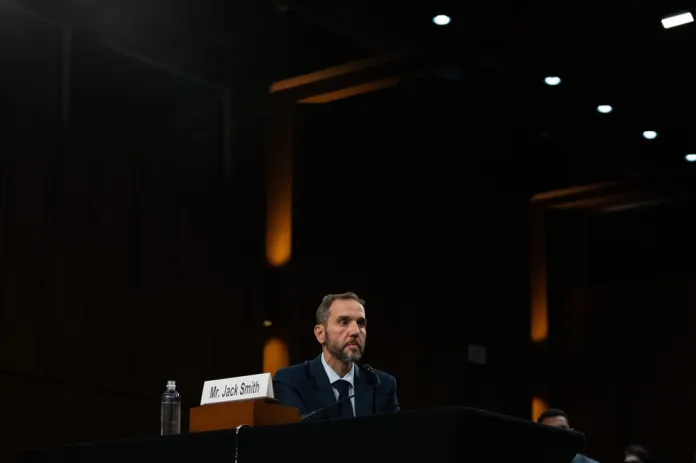
Former special counsel Jack Smith defended secretly obtaining Republican lawmakers’ phone records, but he could not say on Tuesday whether his subpoenas sought their physical locations, nor could he recall key details about his demands for conservative fundraising information.
The Senate Judiciary Committee marked Smith’s first time testifying to its members about the nature of his investigations into President Donald Trump prior to Trump’s reelection, as Republicans confronted Smith with records showing how far those investigations extended beyond the president. At the outset of the hearing, Chairman Chuck Grassley (R-IA) disclosed that investigators obtained at least 4,782 donor checks, including for contributions to Trump as small as $1.
Former Justice Department special counsel Jack Smith testifies before the Senate Judiciary Committee on Capitol Hill, Tuesday, Sept. 29, 2026, in Washington. (AP Photo/Allison Robbert)
" data-large-file="https://www.washingtonexaminer.com/wp-content/uploads/2026/09/AP26272643375937.jpg?w=696" src="https://www.washingtonexaminer.com/wp-content/uploads/2026/09/AP26272643375937.jpg" alt="Jack Smith." class="wp-image-4747283" srcset="https://www.washingtonexaminer.com/wp-content/uploads/2026/09/AP26272643375937.jpg 1024w, https://www.washingtonexaminer.com/wp-content/uploads/2026/09/AP26272643375937.jpg?resize=300,200 300w, https://www.washingtonexaminer.com/wp-content/uploads/2026/09/AP26272643375937.jpg?resize=768,512 768w, https://www.washingtonexaminer.com/wp-content/uploads/2026/09/AP26272643375937.jpg?resize=150,100 150w, https://www.washingtonexaminer.com/wp-content/uploads/2026/09/AP26272643375937.jpg?resize=696,464 696w" sizes="(max-width: 1024px) 100vw, 1024px">
Former Justice Department special counsel Jack Smith testifies before the Senate Judiciary Committee on Capitol Hill, Tuesday, Sept. 29, 2026, in Washington. (AP Photo/Allison Robbert)
The previously unreported extension of Smith’s sprawling investigation concerned checks covering donations to Trump’s campaign and Trump-aligned groups from September 2019 through August 2023 by Americans across all 50 states, Washington, D.C., and Puerto Rico. They contained home addresses, bank account and routing numbers, and signatures. The records were routed to former FBI agent Walter Giardina.
“Every member on this committee ought to be outraged for what happened to their constituents,” Grassley said.
A sweeping investigation of the conservative movement
Grassley for months has released records showing the surveillance by Smith’s team extended to a large number of Republican lawmakers as well. Those discoveries led Grassley to delay Smith’s appearance before the committee to ensure maximum oversight over his handling of the cases. Smith previously testified before the House counterpart committee in January.
Sen. Mike Lee (R-UT) pressed Smith on whether the collection of lawmakers’ phone toll records also extended to tracking their whereabouts.
“Do you define toll records to include geolocation data?” Lee asked.
“I would have to look at the subpoena,” Smith replied.
Smith said investigators primarily wanted to establish who communicated with who, when calls occurred, and their duration, rather than what was said on the calls. He could not recall whether the demands included other information.
As part of Smith’s surveillance sweep, he obtained communications between Trump White House officials and members of Congress through National Archives records. Grassley has said subpoenas for 87 White House phones yielded communications involving 44 lawmakers, including the contents of personal conversations, not just phone tolls.
Smith said he consulted with the Department of Justice’s Public Integrity Section before seeking congressional toll records.
“My recollection is that they approved of the subpoenas,” he said.
That defense was telling, in part because new disclosures made public Tuesday morning about his top prosecutors, J.P. Cooney and Molly Gaston, showed they discussed desires to curtail congressional protections almost two years before joining Smith’s team. In a Jan. 5, 2021, message, Cooney, who is now running as a Democrat for Congress, advocated repealing the speech or debate clause while acknowledging prosecutors remained bound by it, the Washington Examiner first reported on Tuesday. The speech or debate clause gives members of Congress special protections from the other two branches of government for their legislative activities.
Sen. Darline Graham Nordone (R-SC) challenged the secrecy surrounding investigators’ acquisition of her late brother Lindsey Graham’s records.
“How the hell was Lindsey going to tamper with evidence he didn’t even have in his possession?” she asked, emphasizing that Verizon was the third party in possession of the records. Smith had sought to conceal the fact that he obtained lawmakers’ phone records by arguing that he was worried that members would destroy evidence if they had known about the subpoenas.
Smith called Graham “a patriotic public servant” but said he likely would have been a potential witness in a trial against Trump, saying the late senator had investigated and rejected Trump’s election claims, a point he made earlier in the hearing as well for figures such as former Vice President Mike Pence and former Republican Arizona House Speaker Rusty Bowers.
Pressed on why the nondisclosure order cited evidence destruction, Smith pointed to possible witness intimidation by Trump. He offered no explanation of how Graham could have tampered with or destroyed Verizon’s phone tolls concerning his name.
“I think you’re just trying to bully my brother and other allies of President Trump,” Graham Nordone said.
Sen. Ted Cruz (R-TX) encountered similar memory lapses from the former special counsel. Smith could not recall whether his team subpoenaed records concerning the Republican National Committee or Turning Point USA, but remembered that his team sought records from the Conservative Partnership Institute.
“OK, good. We found one,” Cruz replied.
Asked about donor and fundraising information, Smith said he had not seen the subpoenas “in a very long time.” He argued that investigators needed to determine whether people or organizations illegally attempted to block the peaceful transfer of power, although records used in that prosecution contained no evidence that any of the targeted groups were involved with criminal activity. Critics have characterized the sweep of conservative groups as overly broad.
Classified documents questions
Grassley also released records challenging aspects of Smith’s classified documents prosecution. According to the chairman, NARA’s inspector general initially requested DOJ assessment and guidance about Trump’s retention of some classified documents from his first term, rather than making a criminal referral. Internal communications described the FBI’s early assessment that the classified information “spillage” issue was unlikely to become a criminal matter.
Separately, Grassley said former NARA general counsel Gary Stern edited DOJ court filings, challenging Smith’s representations about the archive agency’s limited role.
Democrats pushed to obtain more details about Smith’s account that are still under seal due to a federal court order issued by U.S. District Judge Aileen Cannon, a Trump appointee, in the classified documents case. Sen. Adam Schiff (D-CA) announced plans to seek a vote at the next committee business meeting to subpoena Volume Two of Smith’s report, though Democrats lack the majority’s support in the committee.
Asked whether the Biden DOJ wanted the report released, Smith said he submitted his reports under department regulations. He also cited Cannon’s restrictions.
The hearing’s hostility sometimes gave way to spectacle. Sen. Eric Schmitt (R-MO) questioned Smith about an Atlanta Hawks game, but Smith recalled watching the Iowa Hawkeyes in Maryland instead. Schmitt called him a “total dirtbag” during the tense exchange.
Speaking afterward with Andrew Kolvet on The Charlie Kirk Show, Schmitt said the purpose was to question Smith and see “if he ensnares himself in lies because he’s done that before.”
Schmitt also defended his line of questioning in response to an NBC News reporter. “We’re asking if he was in Atlanta on Feb. 3 [2024] because there’s text messages about him being at a basketball game, a Hawks game. … My job here today was to ask questions and get answers.”
Grassley closed the hearing by accusing Smith’s team of using “thuggish tactics to target the entire Republican political apparatus.”
GRASSLEY SAYS SMITH SUBPOENAED NEARLY 5,000 CHECKS FROM TRUMP DONORS AS PART OF ARCTIC FROST
He added the record would remain open for one week for written questions, with responses expected within two weeks.
“This hearing is part of my investigative work, not the end of it,” Grassley said. “My and Sen. Johnson’s investigation will continue.”
Continue reading...
[ H/T Washington Examiner ]