






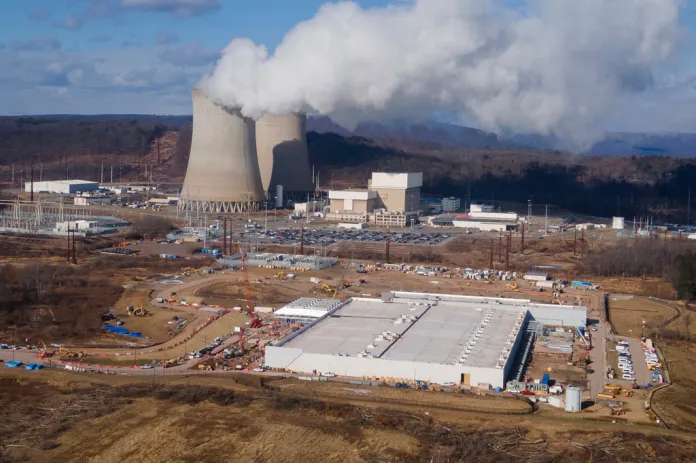
The Nuclear Regulatory Commission on Tuesday approved the Tennessee Valley Authority’s permit to build a small modular reactor at its planned Clinch River site near Oak Ridge.
The permit is only the second issued in the United States for a commercial advanced reactor and the first for the BWRX-300, a 300-megawatt design that developers say could be built more quickly and economically than traditional nuclear plants.
The approval comes as utilities and technology companies race to develop new sources of electricity to meet soaring demand, particularly from data centers supporting artificial intelligence. The Trump administration has made expanding nuclear power a key part of its energy strategy and has cast advanced nuclear technology as part of the broader competition with China over AI and energy.
“This construction permit is more than a regulatory achievement — it’s foundational for America’s nuclear future,” TVA interim President Mike Skaggs said in a statement.
The Department of Energy is backing advanced reactor development through its Pilot Reactor Program, established through executive orders signed by President Donald Trump last year to accelerate the development and deployment of new nuclear technologies.
Small modular reactors, or SMRs, are designed to produce up to about 300 megawatts of electricity, roughly a third the size of many conventional nuclear units. Their smaller, standardized components can be manufactured in factories and transported to plant sites, potentially reducing construction time and complexity while allowing utilities to add reactors incrementally as electricity demand grows.
But the technology remains largely unproven at commercial scale in the U.S., and the cost of building the first reactors remains a major question.
TVA is negotiating with industry partners over cost-sharing arrangements for the Clinch River project. The utility has emphasized that it does not want ratepayers to bear the full cost of deploying a first-of-its-kind technology.
“Our priority is ensuring the people of the Valley do not shoulder the costs of first-of-a-kind technology that benefits the nation and world,” Skaggs said. “Strategic partnerships enable shared responsibility, shared value, and shared progress as we deploy advanced nuclear infrastructure to meet our nation’s energy security and AI dominance goals.”
TVA has not announced when construction will begin. The permit, however, is only the first major regulatory step. The utility will need to build the reactor and obtain a separate operating license from the NRC before it can begin producing electricity.
The project also represents a test of whether federal regulators can speed up nuclear development while maintaining the safety reviews required for nuclear facilities.
The NRC said it completed its review of TVA’s application in 14 months, four months ahead of schedule.
“Four months ahead of schedule is what the new NRC looks like,” Chairman Ho K. Nieh said. “Today’s Clinch River decision demonstrates that the new NRC can make rigorous and credible safety decisions that enable major American nuclear projects to move forward.”
Congress passed legislation in 2024 to accelerate the NRC’s review process, while the Trump administration has pushed the agency to streamline nuclear regulations further.
The Clinch River project is one of several efforts underway to revive U.S. nuclear construction.
AI’S DATA CENTER PROBLEM COULD MOVE TO SPACE
TerraPower, a nuclear company founded by Bill Gates, received a construction permit in March for a sodium-cooled reactor in Wyoming. The company is building the reactor as part of an effort to develop a new generation of nuclear plants capable of operating alongside renewable energy sources.
Other companies are pursuing different reactor designs, including projects aimed specifically at supplying power to data centers and other large electricity users.
Continue reading...
[ H/T Washington Examiner ]