







IRS Takes Aim At AQR's Tax-Slashing "Holy Grail", Warns Crackdown May Be Retroactive
For three years Wall Street's hottest product wasn't a stock, a sector or even an AI trade - it was losing money. Specifically, losing it in a very precise, very engineered way so that the "losses" could be handed to the IRS while the portfolio itself kept compounding. But now the taxman has finally noticed.
On Monday, Treasury and the IRS released Notice 2026-62 and Revenue Ruling 2026-20, a double-barreled warning shot at the "tax alpha" industry. Among the targets: strategies that help wealthy clients harvest losses to shelter ordinary income - the salaries, bonuses and wages taxed at the highest rates - a niche best known through AQR's Delphi Plus, the flagship of what is now the world's largest hedge fund, Bloomberg reports.
The punchline, and the part that should be making some family offices sweat: the IRS said any guidance it ultimately publishes "could apply retroactively" to transactions that already took place.
The notice reads like a greatest-hits album of structured tax trades. According to the text, Treasury is studying (and may designate as listed transactions or "transactions of interest"):
The IRS did concede that plain-vanilla stock-focused long-short strategies may fit "long-standing, well established techniques." It is the ordinary-loss machinery it has a problem with, noting that "certain of these tax-aware funds appear to be primarily tax-motivated rather than being directed toward generating an economic return from genuine investment activity." Which, in fairness, is also the marketing pitch. Comments are due by October 28.
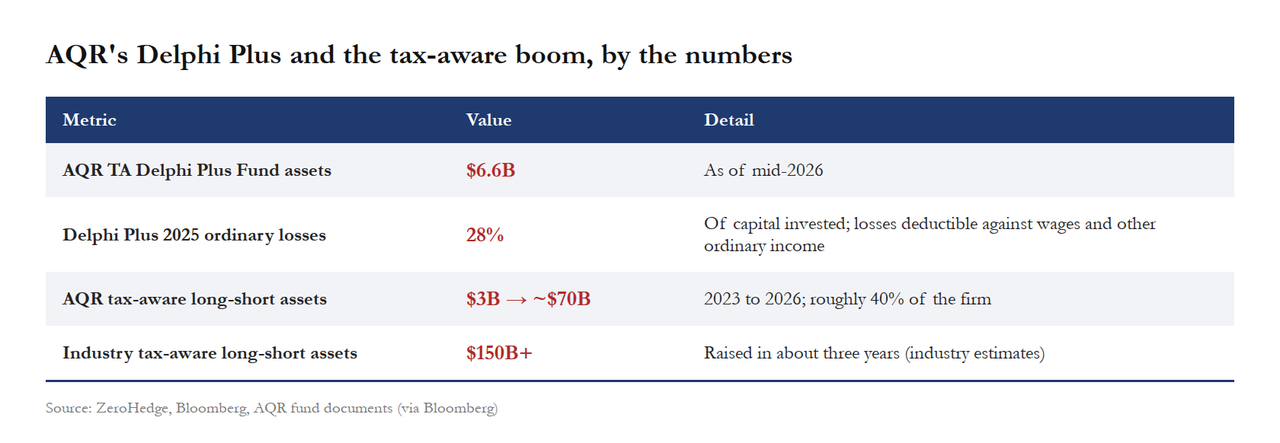
AQR's Delphi Plus is the best-known product aimed at exactly this outcome. The AQR TA Delphi Plus Fund had $6.6 billion at midyear and, per documents seen by Bloomberg, recorded ordinary losses in 2025 equal to 28% of capital invested. Put differently: a client who wrote a $10 million check got roughly $2.8 million of losses to deduct against their W-2 in year one, while the portfolio itself was designed to keep the winners running.
It's unclear whether AQR's trades already work around the IRS's concerns. The firm didn't respond to Bloomberg, and has previously said it adapts strategies "to operate within all relevant guidance and regulations." Notably, AQR had already added disclosure warning clients that the IRS could retroactively disallow the benefits - so nobody can say they weren't told.
Short seller Nathan Koppikar of Orso Partners, who has been betting authorities would step in, called ordinary-income shielding the industry's "holy grail." NYU Law's Daniel Hemel was more blunt: the total addressable market is "huge if the Treasury doesn't do anything about it" - it would be "carried interest on steroids."
That's the real issue. Capital-gains harvesting mostly helps people who already have large embedded gains. Ordinary-income sheltering, on the other hand, appeals to every well-paid surgeon, lawyer and Goldman MD in the country. That's a much bigger tax base, and a much bigger hole in federal receipts at a time when the 10-year just briefly topped 5% for the first time since 2023.
We first flagged the explosion of this trade back in March in "Wall Street's Trillion-Dollar Bet On 'Tax Alpha'", noting that more than $1 trillion was sitting in tax-efficiency strategies, from direct indexing to the far more exotic long-short structures.
Since then the numbers have only gotten sillier. Cliff Asness's firm, which had shrunk below $100 billion by 2022 after a brutal quant winter, rode tax-aware products back to the top: its long-short tax assets went from about $3 billion in 2023 to roughly $70 billion, around 40% of the firm. One of the more aggressive variants, per Bloomberg's August feature, could turn a $100 million investment into more than $580 million of tax-offsetting losses over a decade. When your "losses" are nearly 6x your principal and the account is still up, you are no longer running a hedge fund so much as a deduction factory.
The warning lights were there. Treasury officials said at a New York conference in July that some of these structures produce "outcomes Congress did not intend" and were "potentially abusive." Schwab and Fidelity quietly started limiting new accounts pursuing the strategy - rare restraint from two firms that generally don't turn away billions in AUM.
The companion Revenue Ruling went after the other darling of the tax-alpha crowd: the Section 351 ETF conversion, where an investor seeds a brand-new ETF with a pile of highly appreciated stock, and the ETF then swaps it out via in-kind redemptions for a diversified portfolio - no tax bill. We noted the headline as it crossed:
Rev. Rul. 2026-20 applies substance-over-form and step-transaction doctrines, treats the ETF as a mere conduit, and recharacterizes the whole thing as a taxable exchange between the contributing investor and the authorized participant. More than 100 ETFs, with over $20 billion in seed assets, have launched via 351 exchanges since 2021, per Tax Alpha Insider. Those issuers - and the crypto ETF crowd that has been using in-kind redemptions to sidestep the RIC income test - are now scrambling with their lawyers.
As the notice went out, Treasury Secretary Scott Bessent chimed in on X, saying the department "is serious about cracking down on transactions designed to dodge taxes or exploit our federal tax code."
For an administration that just cut taxes, it may seem odd to go after the rich's favorite deductions. But a Treasury funding a massive deficit with long yields near 5% can do the math: every dollar of wage income sheltered by a currency forward is a dollar of Treasury supply that has to be sold to someone else.
This is a notice, not a regulation, and the comment window runs to late October. But the retroactivity language is the tell. By refusing to grandfather existing trades, the IRS has effectively put a question mark next to every 2025 and 2026 K-1 that shows outsized ordinary losses. Expect three things:
As one long-time skeptic put it when the trade was booming: when something seems too good to be true, it probably is. In this case, it may also be retroactively too good to be true.
Tyler Durden Sun, 10/04/2026 - 07:35
Continue reading...
[ H/T ZeroHedge ]
For three years Wall Street's hottest product wasn't a stock, a sector or even an AI trade - it was losing money. Specifically, losing it in a very precise, very engineered way so that the "losses" could be handed to the IRS while the portfolio itself kept compounding. But now the taxman has finally noticed.
On Monday, Treasury and the IRS released Notice 2026-62 and Revenue Ruling 2026-20, a double-barreled warning shot at the "tax alpha" industry. Among the targets: strategies that help wealthy clients harvest losses to shelter ordinary income - the salaries, bonuses and wages taxed at the highest rates - a niche best known through AQR's Delphi Plus, the flagship of what is now the world's largest hedge fund, Bloomberg reports.
The punchline, and the part that should be making some family offices sweat: the IRS said any guidance it ultimately publishes "could apply retroactively" to transactions that already took place.
What the IRS is going after
The notice reads like a greatest-hits album of structured tax trades. According to the text, Treasury is studying (and may designate as listed transactions or "transactions of interest"):
- Tax-aware funds that manufacture capital gain / ordinary loss mismatches - i.e., gains that get taxed at the lower cap-gains rate while losses are ordinary and offset wages
- Same-day acquisitions and dispositions of foreign currency forwards (hello, Section 988)
- Selective terminations of notional principal contracts (read: equity swaps), and identified straddles with mixed character - the swaps-plus-futures combos Bloomberg flagged
- "Box spread" ETFs that mimic T-bill returns without generating current income
- Various Section 852(b)(6) ETF redemption games, including using in-kind redemptions to dodge the RIC qualifying-income test
The IRS did concede that plain-vanilla stock-focused long-short strategies may fit "long-standing, well established techniques." It is the ordinary-loss machinery it has a problem with, noting that "certain of these tax-aware funds appear to be primarily tax-motivated rather than being directed toward generating an economic return from genuine investment activity." Which, in fairness, is also the marketing pitch. Comments are due by October 28.
Delphi Plus: the "holy grail"
AQR's Delphi Plus is the best-known product aimed at exactly this outcome. The AQR TA Delphi Plus Fund had $6.6 billion at midyear and, per documents seen by Bloomberg, recorded ordinary losses in 2025 equal to 28% of capital invested. Put differently: a client who wrote a $10 million check got roughly $2.8 million of losses to deduct against their W-2 in year one, while the portfolio itself was designed to keep the winners running.
It's unclear whether AQR's trades already work around the IRS's concerns. The firm didn't respond to Bloomberg, and has previously said it adapts strategies "to operate within all relevant guidance and regulations." Notably, AQR had already added disclosure warning clients that the IRS could retroactively disallow the benefits - so nobody can say they weren't told.
Short seller Nathan Koppikar of Orso Partners, who has been betting authorities would step in, called ordinary-income shielding the industry's "holy grail." NYU Law's Daniel Hemel was more blunt: the total addressable market is "huge if the Treasury doesn't do anything about it" - it would be "carried interest on steroids."
That's the real issue. Capital-gains harvesting mostly helps people who already have large embedded gains. Ordinary-income sheltering, on the other hand, appeals to every well-paid surgeon, lawyer and Goldman MD in the country. That's a much bigger tax base, and a much bigger hole in federal receipts at a time when the 10-year just briefly topped 5% for the first time since 2023.
How AQR got here
We first flagged the explosion of this trade back in March in "Wall Street's Trillion-Dollar Bet On 'Tax Alpha'", noting that more than $1 trillion was sitting in tax-efficiency strategies, from direct indexing to the far more exotic long-short structures.
Since then the numbers have only gotten sillier. Cliff Asness's firm, which had shrunk below $100 billion by 2022 after a brutal quant winter, rode tax-aware products back to the top: its long-short tax assets went from about $3 billion in 2023 to roughly $70 billion, around 40% of the firm. One of the more aggressive variants, per Bloomberg's August feature, could turn a $100 million investment into more than $580 million of tax-offsetting losses over a decade. When your "losses" are nearly 6x your principal and the account is still up, you are no longer running a hedge fund so much as a deduction factory.
The warning lights were there. Treasury officials said at a New York conference in July that some of these structures produce "outcomes Congress did not intend" and were "potentially abusive." Schwab and Fidelity quietly started limiting new accounts pursuing the strategy - rare restraint from two firms that generally don't turn away billions in AUM.
Meanwhile, the 351 "black hole" gets plugged too
The companion Revenue Ruling went after the other darling of the tax-alpha crowd: the Section 351 ETF conversion, where an investor seeds a brand-new ETF with a pile of highly appreciated stock, and the ETF then swaps it out via in-kind redemptions for a diversified portfolio - no tax bill. We noted the headline as it crossed:
Rev. Rul. 2026-20 applies substance-over-form and step-transaction doctrines, treats the ETF as a mere conduit, and recharacterizes the whole thing as a taxable exchange between the contributing investor and the authorized participant. More than 100 ETFs, with over $20 billion in seed assets, have launched via 351 exchanges since 2021, per Tax Alpha Insider. Those issuers - and the crypto ETF crowd that has been using in-kind redemptions to sidestep the RIC income test - are now scrambling with their lawyers.
Bessent: "serious"
As the notice went out, Treasury Secretary Scott Bessent chimed in on X, saying the department "is serious about cracking down on transactions designed to dodge taxes or exploit our federal tax code."
For an administration that just cut taxes, it may seem odd to go after the rich's favorite deductions. But a Treasury funding a massive deficit with long yields near 5% can do the math: every dollar of wage income sheltered by a currency forward is a dollar of Treasury supply that has to be sold to someone else.
What's next
This is a notice, not a regulation, and the comment window runs to late October. But the retroactivity language is the tell. By refusing to grandfather existing trades, the IRS has effectively put a question mark next to every 2025 and 2026 K-1 that shows outsized ordinary losses. Expect three things:
- Product tweaks: managers will try to lean on the "well established" stock-only long-short safe harbor and pull back on FX forwards and swap terminations.
- Slower inflows: the ~$1 billion a week that had been pouring into tax-aware long-short is unlikely to keep going at that pace while a retroactive audit risk hangs over the product.
- Unwind risk: if clients head for the exits, the leveraged long-short books behind these products (often 130/30 to 250/150) will have to be delevered. Keep an eye on crowded shorts in names these quant books favor.
As one long-time skeptic put it when the trade was booming: when something seems too good to be true, it probably is. In this case, it may also be retroactively too good to be true.
Tyler Durden Sun, 10/04/2026 - 07:35
Continue reading...
[ H/T ZeroHedge ]