


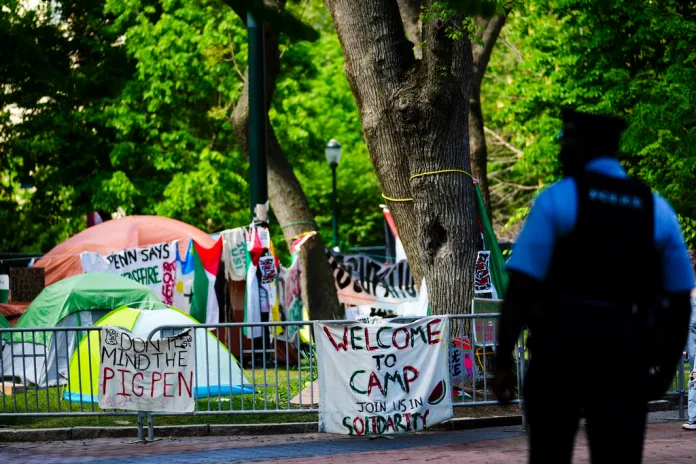
In the days, weeks, and now three years since the attacks in Israel of Oct. 7, 2023, American college campuses have become a battleground of their own. I know this all too well — the final year of my college experience was defined by the antisemitism I faced on campus after the attacks.
On Oct. 9, 2023, I posted a short statement in my personal capacity that I stood with the people of Israel and my Jewish community, and that being “a Jewish student on a college campus should not be a safety hazard.” Within days, I was being accused online of supporting genocide, and a campaign had begun to force me to resign from the office I was elected to that April.
Antisemitism on college campuses predates my undergraduate experience. But when I arrived at the University of California, Santa Barbara in the fall of 2021, Jewish, Israeli, and pro-Israel students were still welcomed far more widely on campus than we are today.
I learned that campus culture changes quickly. My campus experience began with the COVID-19 lockdowns of 2020 and entered its final, upsetting phase when antisemitism spiraled out of control after Hamas‘s horrific invasion of Israel. Anti-Israel radicals seized upon the massacre of over 1,200 innocent people, widespread rape and sexual violence, and the abduction of over 250 hostages (including 12 Americans) to celebrate this “victory” against Israel.
By early 2024, the anti-Jewish hostility that had been building since Oct. 7, 2023, had made me one of its primary targets. I was the student government president and the daughter of Jewish immigrants from the former Soviet Union. Handwritten signs targeting me appeared outside my office, falsely charging me with supporting genocide and proclaiming that “resistance is justified.” Then began the direct threats: “You can run, but you can’t hide, Tessa Veksler.” One read “F*** a ‘neutral’ A.S. President.” I was expected to ignore the massacre of my own people as a condition of holding office. The Multicultural Center’s official Instagram account posted photographs of the signs with the caption, “In case we aren’t clear, let us spell it out.”
Some of the signs argued that Jews did not belong in a multicultural space at all and that Jewish students are not entitled to the protections extended to everyone else on campus. This phenomenon was not unique to UC Santa Barbara. In 2025, 47% of young American Jews indicated they were the victims of antisemitism, in person or online.
I did not feel safe on campus, and couldn’t imagine how any Jewish student could begin to feel safe when the most visible Jewish leader on campus was being explicitly targeted. The university’s first statement described the signs as “unauthorized and unofficial messages” under review. It temporarily closed the Multicultural Center, and Black Studies faculty responded with a statement calling for a “day of interruption.” Rather than sounding the alarm on how our campus climate had devolved into the complete exclusion of Jewish students from university spaces, the response from many was to blame me for the temporary closing of the MCC and for the silencing of free speech. The irony of this still doesn’t escape me.
On April 10, the student Senate debated a recall petition to remove me from office. The recall failed by one Senate vote, but not before six long hours of painful discourse around whether or not my Jewish identity and Zionist beliefs made me equipped to lead. I finished my term (the last two weeks of it), graduated in June 2024, and have been fighting for Jewish students on American college campuses ever since.
The sign said I could run, but I could not hide. I didn’t run, and I didn’t hide. I walked past those walls to my office every day until my term was over and I graduated.
HEROES JUST STOPPED A HIJACKING. MAMDANI CAN’T EVEN DEFINE ANTISEMITISM
In February 2024, I told the UC Santa Barbara administration that there was “no room for delay in addressing“ what was happening to Jewish students, and that the university had to act decisively and demand accountability.
Two and a half years later, I’m still asking for the same thing, and I intend to keep asking until every university listens.
Tessa Veksler is a public speaker, content creator, & advocate.
Continue reading...
[ H/T Washington Examiner ]