








Senate Majority Leader John Thune was on the clock.
It was in the middle of the night, less than 72 hours before President Donald Trump’s July 4 deadline to sign the One Big Beautiful Bill Act. And Thune didn’t have the votes.
The tall, lean Republican from South Dakota had been majority leader for less than five months, and this was his first big test. In an expansive interview recalling how the legislation cleared Congress, Thune admitted there were times he wasn’t sure he could get it to Trump’s desk.
With all Democrats firmly against the massive bill, Thune could only lose three votes. As June 30 slipped into July 1, the GOP defections were fluid.
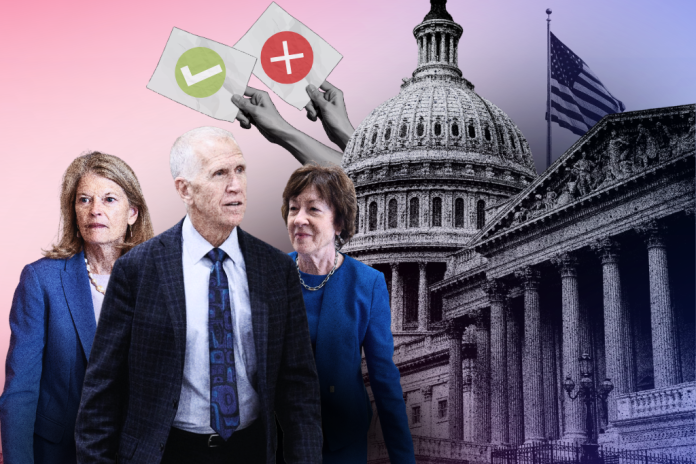
Three Republicans — Sens. Susan Collins (ME), Rand Paul (KY), and Thom Tillis (NC) — were no or leaning no. They would all end up rejecting it. Collins and Tillis opposed the bill’s Medicaid reductions, while Paul objected to the provision lifting the debt ceiling by $5 trillion. The final hours were intently focused on winning over the decisive vote of Sen. Lisa Murkowski (R-AK).
“At 2:30 [a.m], I thought we were there,” Thune told the Washington Examiner. “At 5:30 [a.m.], we weren’t.”
HOW THE BIG BEAUTIFUL BILL BECAME LAW: READ MORE FROM THE WASHINGTON EXAMINER’S 10-PART SERIES
Thune anticipated losing three Republicans, though at various times “thought we would lose more….We had a window of getting 50 [votes], but it wasn’t a long window.”
Now 65, Thune, who had moved up the Senate leadership ladder since narrowly defeating Democratic Leader Tom Daschle (SD) in 2004, has had a hot-and-cold relationship with Trump. After Thune voted to certify Joe Biden’s election victory in 2020, Trump publicly suggested that then-South Dakota Gov. Kristi Noem should challenge the senator in the 2022 GOP primary.
After wrestling with whether to seek reelection back then, Thune announced he would run again for a fourth term in January 2022.
At the time, he said, “I’ve always promised I would do the work, even when it was hard, uncomfortable or unpopular.” Thune has certainly encountered all that while working with Trump, who finally got his wish when Mitch McConnell (KY) bowed out as the Senate’s top Republican, opening the door for Thune’s ascension.
Under the Senate’s arcane budget reconciliation rules, the majority party doesn’t need 60 votes to break a filibuster. Both parties have used this partisan process to pass sweeping legislation, including Obamacare in 2009 and Trump’s first tax cuts in 2017. No Republican voted for Obamacare, and not one Democrat backed Trump’s tax cuts. Much of the Trump tax law was set to expire at the end of 2025, and Republicans campaigned in 2024 to extend it in order to prevent a $4.5 trillion tax increase.
To do this, they needed the trifecta: control of the House, Senate, and the White House. Democrats, who had the White House and Senate in 2024, had their own reconciliation plans if they were able to take back the House.
But the 2024 election was a complete disaster for Democratic presidential nominee Kamala Harris and the Democratic Party. Trump won all seven battleground states and was the first Republican to win the popular vote in 20 years. Republicans captured the Senate by picking up four seats, while the House, contrary to pundit predictions, remained in the GOP’s hands.
Learning from 2017 mistakes
Unlike 2017, Trump hit the ground running in 2025. Trump’s first-term transition plan was rudderless, as many on his team assumed Hillary Clinton would win. Trumpworld simply wasn’t ready for its initial 100 days in office, and it showed. Trump wasted crucial political capital out of the gate when the GOP’s 2017 effort to repeal and replace Obamacare was blown up on the Senate floor in spectacular fashion by Arizona Sen. John McCain’s thumbs-down vote.
House Majority Leader Steve Scalise (R-LA) noted that “Trump was the new guy in 2017” — he had a rocky relationship with McConnell and a not-so-great rapport with then-Speaker Paul Ryan (R-WI). Both McConnell and Ryan had urged Trump to tackle healthcare first back then, and the president has long regretted listening to their advice.
So this time around, Scalise and other top Republicans were committed not to “stumble again.” Six months before the 2024 election, Scalise met with Trump at his Mar-a-Lago resort and told him his committee chairmen would be ready to move on his agenda in January. Scalise told the Washington Examiner, “We did not want to be the dog who caught the car.”
Similarly, Thune said he talked to Sen. Mike Crapo (R-ID), chairman of the Senate Committee on Finance and the chamber’s top GOP tax writer, “months” before Trump won his second term.
The good news for Republicans was that they had a mandate from the 2024 election as Democrats retreated to the political wilderness to assess what went wrong. The bad news for Republicans was that their margins in both chambers were razor-thin, so unity was key.
No Senate Republican rejected the 2017 tax measure — McCain missed the vote for health reasons — but a dozen Republican lawmakers rejected it in the lower chamber. House Republican leaders in 2025 could afford just a few GOP no votes.
Persuading Lisa Murkowski
Lacking numbers, Democrats had little to no power to thwart what they call the “One Big Ugly Bill.” However, under Senate rules, they could offer amendments on the floor to change it. Democrats pursued dozens of such measures during the “vote-a-rama” process, though the vast majority of them failed. Their real intent, however, was to put GOP senators in tough reelection races on record, setting them up for campaign ads in the fall of 2026.
As the voting marathon continued through the early morning of July 1, Senate GOP leaders focused on Sen. Lisa Murkowski (R-AK), an independent-minded Republican who doesn’t shy away from bucking Trump. She had voted in 2017 against the Obamacare rollback, declined to back Brett Kavanaugh for the Supreme Court, and deemed Trump “guilty” on his second impeachment trial.
Sen. Lisa Murkowski (R-AK), a member of the Senate Appropriations Committee and a key swing vote on the budget reconciliation bill, leaves the chamber as Republicans plan to begin a final push to advance President Donald Trump’s big tax breaks and spending cuts legislation.
" data-image-caption="
Sen. Lisa Murkowski (R-AK), a member of the Senate Appropriations Committee and a key swing vote on the budget reconciliation bill, leaves the chamber as Republicans plan to begin a final push to advance President Donald Trump’s big tax breaks and spending cuts legislation. (AP Photo/J. Scott Applewhite)
" data-large-file="https://www.washingtonexaminer.com/...ki-June-2025-scaled-e1780364948411.webp?w=696" src="https://www.washingtonexaminer.com/...ki-June-2025-scaled-e1780364948411.webp?w=696" alt="Sen. Lisa Murkowski (R-AK)" class="wp-image-3460234" style="aspect-ratio:1.500045867351619;width:549px;height:auto" srcset="https://www.washingtonexaminer.com/...urkowski-June-2025-scaled-e1780364948411.webp 1024w, https://www.washingtonexaminer.com/...025-scaled-e1780364948411.webp?resize=300,200 300w, https://www.washingtonexaminer.com/...025-scaled-e1780364948411.webp?resize=768,512 768w, https://www.washingtonexaminer.com/...025-scaled-e1780364948411.webp?resize=150,100 150w, https://www.washingtonexaminer.com/...025-scaled-e1780364948411.webp?resize=696,464 696w" sizes="(max-width: 1024px) 100vw, 1024px">
Sen. Lisa Murkowski (R-AK), a member of the Senate Appropriations Committee and a key swing vote on the budget reconciliation bill, leaves the chamber as Republicans plan to begin a final push to advance President Donald Trump’s big tax breaks and spending cuts legislation. (J. Scott Applewhite/AP Photo)
Less than two weeks before the final Senate vote, Murkowski outlined her concerns about the bill’s Medicaid on a Sunday morning show: “So I’ve been pretty clear that when it comes to Medicaid, those cuts that would harm Alaskan beneficiaries, that’s not something that I can take home, right? We have some of the highest healthcare costs in the country. We have 40% of Alaska’s kids that are on Medicaid.”
Getting Murkowski to yes wouldn’t be easy.
Senate Majority Whip John Barrasso (R-WY), whose primary job is to get the votes necessary to move the party’s agenda, didn’t leave Murkowski’s side for hours.
Barrasso, an orthopedic surgeon and Trump ally, noted it was “all hands on deck.” He credited Thune as well as Republican Sen. Dan Sullivan (R-AK), Murkowski’s Alaska colleague who served on the whip team, in persuading her to approve the massive bill.
Barrasso told the Washington Examiner, “It seemed I was the best member of the whip team to be working with her,” adding they both come from rural, energy-rich states with large Native American populations. Many others, including the late Sen. Lindsey Graham (R-SC), were in Murkowski’s ear.
Murkowski had defied history by winning the general election as a write-in candidate after losing her Republican primary in 2010. Twelve years later, Trump put his stellar record in Republican primaries on the line and endorsed a Murkowski opponent. The senator won again.
Throughout the bill’s deliberations, Murkowski took issue with its immense scope and its Medicaid and food stamp provisions. Yet she was open to exchanging her “yes” vote for a deal that would help her state.
Any agreement would have to pass muster with the non-partisan Senate parliamentarian, who had already ejected a number of Republican priorities from the legislation because they didn’t comply with the Byrd rule, an incredibly complicated reconciliation budgetary guardrail.
“We did some creative and inventive things in the middle of the night,” Thune said, describing the situation as “incredibly fraught” and “incredibly hard.”
The son of a decorated World War II pilot, Thune said, “Failure was not an option.”
The obstacles to passage were ever-present.
Usually, Congress works to pass legislation with one focus, such as transportation or technology. The reconciliation measure was basically 100 bills in one, headlined with tax cuts but also encompassing school choice, securing the border, relief for farmers, easing regulations, defense funding, combating crime, energy, healthcare, and infrastructure.
The winners and losers of the ‘big, beautiful bill’
That meant almost every lobbying group was engaged. Business interests were on board, but other powerful stakeholder groups were hammering on-the-fence Republicans. All the while, Thune had to win over his colleagues and deal with a president not known for his patience.
“You have to be a good listener” and sometimes a “therapist,” the level-headed Thune said, while suggesting he lost his cool at times during the rollercoaster ride of emotions.
After hours of negotiations, as some senators and their aides caught cat naps and others loaded up on caffeine, GOP leaders and Murkowski struck a deal. It included clean energy tax credits, concessions on Medicaid and food stamps, and other priorities for the Last Frontier.
Critics pounced, comparing Murkowski’s enticements to the “Cornhusker kickback,” a carve-out deal that secured then-Sen. Ben Nelson (D-NE) to get him to back Obamacare in 2009.
Even though she secured significant concessions, Murkowski was not a slam-dunk yes. Far from it. One GOP aide told the Washington Examiner that she went back and forth on the final legislation.
“There were plenty of times I thought she was going to vote no,” the aide said.
Murkowski declined requests to be interviewed for this series. It’s clear to see why she wouldn’t want to relive the experience, which she called “agonizing.”
Asked by NBC for comment on Paul’s remark that Murkowski voted yes on the bill because it was a “bailout for Alaska at the expense of the rest of the country,” the Alaska senator silently stared at a reporter for more than 10 seconds before saying she “tried to take care of Alaska’s interests.”
Hitting the July 4 deadline
Many times after a tough “yes” vote, lawmakers will say the bill wasn’t perfect. Murkowski didn’t do that. She openly said she didn’t like the Senate-passed bill, adding she wanted the House to change it and send it back to the Senate.
“My sincere hope is that this is not the final product,” Murkowski said at the time, adding the bill needed “more work” and it “was not good enough” for the American public and “not ready for the president’s desk.”
Thune told the Washington Examiner he was aware that getting the votes one more time was probably not going to happen. A Senate Republican, whom Thune did not name, told him, “You better make sure the House passes it because if it comes back over here, we can’t pass it again.”
Senate Majority Leader John Thune (R-SD) at the Capitol on Monday, June 30, 2025 as the Senate debates President Donald Trump’s “one, big beautiful” bill. (Graeme Jennings/Washington Examiner)
" data-large-file="https://www.washingtonexaminer.com/wp-content/uploads/2025/06/063025_THUNE-15-scaled.webp?w=696" height="683" width="1024" src="https://www.washingtonexaminer.com/wp-content/uploads/2025/06/063025_THUNE-15-scaled.webp?w=696" alt="Senate Majority Leader John Thune (R-SD) at the Capitol on Monday, June 30, 2025 as the Senate debates President Donald Trump's "one, big beautiful" bill. (Graeme Jennings/Washington Examiner)" class="wp-image-3458327" style="width:502px;height:auto" srcset="https://www.washingtonexaminer.com/wp-content/uploads/2025/06/063025_THUNE-15-scaled.webp 2560w, https://www.washingtonexaminer.com/...06/063025_THUNE-15-scaled.webp?resize=300,200 300w, https://www.washingtonexaminer.com/...06/063025_THUNE-15-scaled.webp?resize=768,512 768w, https://www.washingtonexaminer.com/...6/063025_THUNE-15-scaled.webp?resize=1024,683 1024w, https://www.washingtonexaminer.com/.../063025_THUNE-15-scaled.webp?resize=1536,1025 1536w, https://www.washingtonexaminer.com/.../063025_THUNE-15-scaled.webp?resize=2048,1366 2048w, https://www.washingtonexaminer.com/...06/063025_THUNE-15-scaled.webp?resize=150,100 150w, https://www.washingtonexaminer.com/...06/063025_THUNE-15-scaled.webp?resize=696,464 696w, https://www.washingtonexaminer.com/...6/063025_THUNE-15-scaled.webp?resize=1068,713 1068w, https://www.washingtonexaminer.com/.../063025_THUNE-15-scaled.webp?resize=1920,1281 1920w" sizes="(max-width: 1024px) 100vw, 1024px">
Senate Majority Leader John Thune (R-SD) at the Capitol on Monday, June 30, 2025, as the Senate debates President Donald Trump’s “one, big beautiful” bill. (Graeme Jennings/Washington Examiner)
The final Senate bill took more than 24 hours to pass. And it officially did right after noon on July 1 when Vice President JD Vance cast the tiebreaking vote to make the final tally 51-50. Trump opined that House passage would be “easier,” but it was far from easy.
House Republican leaders had to keep a procedural vote open for more than seven hours, setting a record at the time for the longest vote in the lower chamber’s history.
The legislation eventually cleared the House as Trump and House leaders arm-twisted the Republican holdouts. The measure never made it back to the Senate and was signed by Trump on Independence Day.
Rep. Jodey Arrington (R-TX), chair of the House Committee on the Budget, acknowledged that many of his GOP colleagues didn’t like the idea of embracing the Senate legislation and instead wanted to return to sender. But if that had happened, Arrington said, “Would this thing have imploded? And would we have lost all the gains that we made? I think we would have.”
Sending back a modified version to the Senate would have ensured that Trump’s July 4 deadline would have been missed. There was also another factor: fatigue.
The tight timetable for the big beautiful bill had set in motion a series of committee, floor, and final passage deadlines that drained lawmakers who desperately wanted some downtime back home over the holiday weekend.
Barrasso said, “People were pretty exhausted on both sides of the aisle.”
Murkowski, who later accused the administration of reneging on concessions she had secured for wind and solar projects, did not attend the July 4 signing ceremony.
Surrounded by first lady Melania Trump, Republican lawmakers, and administration officials on the South Lawn of the White House, Trump signed the bill into law. The late Sen. Lindsey Graham (R-SC) exchanged pleasantries with Treasury Secretary Scott Bessent, telling Trump that the treasury secretary deserved a raise. House Speaker Mike Johnson (R-LA) gave Trump the House gavel that had been used to officiate the passage of the historic bill.
LINDSEY GRAHAM’S MEMORIAL SERVICE SET FOR JULY 28 IN DC
Trump thanked many people for the legislation’s success, including Thune, whom he called a “fantastic guy.” The president handed out signing pens as photos were snapped with everyone smiling and giving the patented Trump “thumbs up” sign.
But Thune was not there. He opted to spend Independence Day with his family in South Dakota and celebrated by doing what he described as “one big beautiful backflip” into the Missouri River.
Members of the Washington Examiner’s staff who have worked on this series over the past several months are Haris Alic, Hailey Bullis, Bob Cusack, Christian Datoc, James A. Downs, Gabrielle M. Etzel, Lauren Green, Zach Halaschak, Chris Irvine, Joseph Lawler, Naomi Lim, Maydeen Merino, Callie Patteson, Mabinty Quarshie, Samantha-Jo Roth, David Sivak, and Ramsey Touchberry.
Continue reading...
[ H/T Washington Examiner ]