








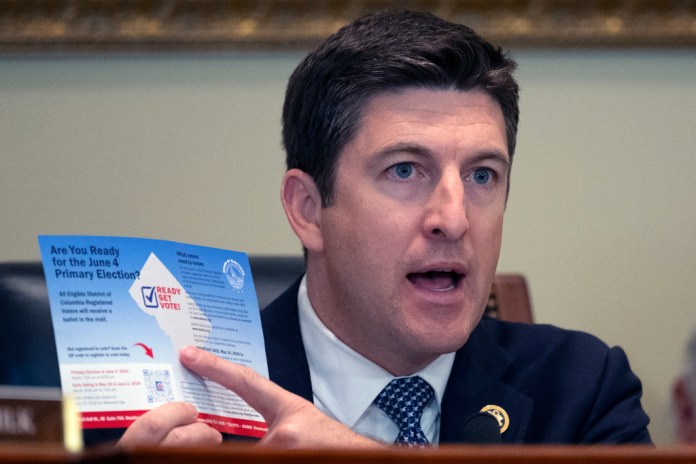
EXCLUSIVE — House Administration Committee Chairman Bryan Steil (R-WI) did not rule out the inclusion of a ban on mail-in ballots in Republicans’ third-party-line budget bill.
During an interview with the Washington Examiner on July 23, Steil said that conversations have already begun over what policies the House Administration Committee wants to include in its portion of the reconciliation bill. When asked if the committee was discussing including a provision to ban mail-in ballots, Steil said he was “not ruling anything in or out at this time on reconciliation.”
The House Administration Committee was allotted $10 billion in the House’s budget resolution for election law reforms, as the committee has oversight authority of federal elections. House GOP leadership has previously said they hope to include as much of the SAVE America Act, Republicans’ voter ID and proof of citizenship bill, into the budget bill “as possible” with the committee’s portion of the legislation.
President Donald Trump has repeatedly pushed for a ban on mail-in ballots, with limited exceptions, to be passed as part of the SAVE America Act, and has expressed a desire to see a ban on mail-in ballots included in the budget bill as well.
The House is waiting with bated breath to see if the Senate passes its own budget resolution to begin the reconciliation process, but Steil said that he thinks there is “a lot” Republicans can do regarding election integrity in their portion of the budget bill.
“I’m not ready to preview everything that we’re going to come out with, assuming we’re successful in the Senate,” Steil said. “But I think there’s a lot of work we can do that can pass the Byrd test in the Senate. Of course, the easiest path [is] the Senate can pass the SAVE America Act, absolutely. But I think there’s also a lot we can do inside reconciliation to advance the agenda for election integrity.”
GOP hard-liners have been pushing for “mandatory” language to be written in the House’s version of the reconciliation bill for voter ID and proof of citizenship, the main components of the House-passed SAVE America Act, instead of a “watered-down” version that would incentivize the implementation of election integrity measures through grant programs floated by the House Administration Committee and GOP leadership.
Any policy included in reconciliation would have to have a budgetary impact or be nixed by the Senate parliamentarian, as it would not pass the Senate’s Byrd Rule, which governs policies allowed in reconciliation bills.
In its current form, the SAVE America Act would not pass the Byrd Rule, meaning Republicans would need to overrule the parliamentarian’s ruling, something Senate Majority Leader John Thune (R-SD) has previously refused to do.
Steil said he is a “firm believer” that voters should have to request ballots, and referred to his election reform package, the Make Elections Great Again Act, which he introduced earlier this year.
“I think you should have to request a ballot,” Steil said. ”What we call universal vote by mail often does not require individuals to request a ballot.… In Washington, D.C., you don’t need to request a ballot. And so, in high-turnover neighborhoods, in particular, young adults living in apartments. Those apartments will open a mailbox and have four or five ballots from people that previously lived there. That just shows you what a poor system states that don’t have that check. So I’ve been a firm believer that you should have to request the ballot when it’s sent to you.”
Steil continued, “It shouldn’t just automatically be sent because states aren’t cleaning up their voter rolls, and so like I said, there’s a lot of stuff I think we can do in reconciliation, and we’re in discussions about what all those vehicles look like.”
The chairman’s Make Elections Great Again Act is a wide-ranging election reform package that would require photo ID to vote, states to verify citizenship when registering to vote, mail-in ballots to be received by the time polls close on Election Day, the use of paper ballots, and stricter voter list maintenance requirements. The legislation, if enacted, would also ban ballot harvesting, ranked choice voting, and universal vote by mail.
The House passed its budget framework, which allocates money for the Pentagon, farm aid, and election reforms, last week, but it’s uncertain when the Senate will pass its own.
Thune pumped the brakes last week on the House’s efforts to begin the reconciliation process by saying the Senate would not move the party-line measure until a government funding bill is passed. He also floated using the House-passed measure as a vehicle to do so.
HOUSE GOP THREADS SAVE AMERICA ACT INTO LEGISLATIVE AGENDA IN EFFORT TO BREAK SENATE
Until the Senate passes a budget framework, the House cannot move forward with the reconciliation process.
“The Senate’s got to pass the budget, so that’s No. 1, and then we’re off and running,” Steil said.
Continue reading...
[ H/T Washington Examiner ]