

Eight black candidates in the home stretch of their gubernatorial campaigns in states across the country are vying for a win that would be historic, given there have been just five black governors, and only three elected, since the United States was established.
Three of the 2026 candidates are Republican, mounting campaigns in Florida, Minnesota, and Michigan. One of them, Byron Donalds in the Sunshine State, recently complained that the GOP campaigns have not received the attention their Democratic counterparts have received because of their party, stoking questions about what role race should play in the electoral process.
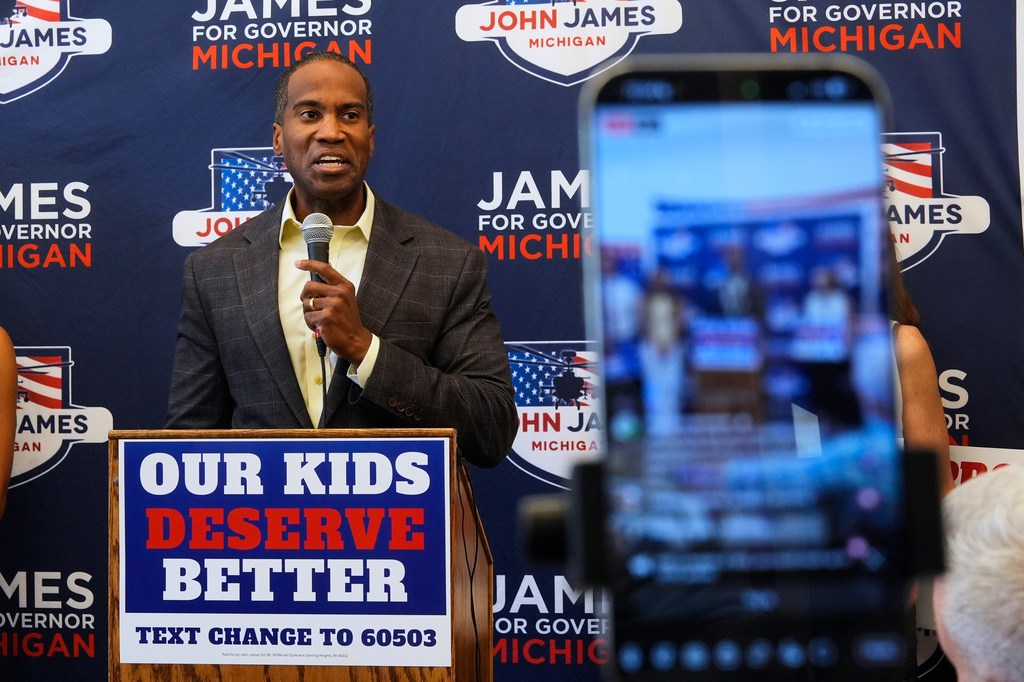
In places like Michigan, where Rep. John James (R-MI) is challenging Democrat Jocelyn Benson, political experts believe race could have a pivotal effect on the election’s outcome, due to the intense battleground dynamics. But they also say that playing up race isn’t necessarily the answer to running a victorious campaign.
“There’s a distinction between the historic significance of John James’s candidacy and how voters ultimately make their decisions,” Republican strategist Kristin Combs, who is based in Michigan, told the Washington Examiner.
Combs noted that Michigan is home to more than 1.3 million black residents. She said that in three of the last four gubernatorial elections, the difference between the Republican and Democratic candidates was less than 500,000 votes in the swing state.
“That puts into perspective just how important every segment of the voting population can be,” she said. “Race hasn’t been a continuous theme throughout this campaign, but it could absolutely have an impact on the outcome. Michigan is a purple state, and the behavior of any individual voting bloc can have a significant impact.”
Combs believes Donalds raised a fair question about whether the conversation in races where the GOP candidates are black would look different if those running were Democrats, because of “a long-standing argument among Republican leaders that Democrats take black voters for granted.” But she argued that race isn’t the final determinant for most voters. While a win by James would be statistically significant regardless of political affiliation, making him Michigan’s first black governor, she said that wouldn’t necessarily translate into votes. Candidates need to understand that voters are looking at a number of factors, “including the issues that impact their families, their communities, and their futures,” she said.
“Republicans also have to recognize that if we want to expand our base, we have to earn those votes,” Combs said. “You can’t simply show up at election time and expect people to change their political loyalties.”
Combs isn’t the only one suggesting that issues trump ethnicity when it comes to voter motivation. The economy, the future of democracy, healthcare, education, and immigration are the top issues to voters, in that order, according to the Pew Research Center. In an election cycle where polling shows widespread dissatisfaction with the cost of living and President Donald Trump’s work on the economy, that could prove devastating for Black candidates in the Republican Party, even if they stood to make history with a win.
“This goes back to policy. Even if James was a Democrat and said this economy was working for everybody, he will still lose support,” Longtime Democratic strategist Doug Wilson said. “Mr. James and Rep. Donalds are supporters of an economic agenda that a majority of the country believes it is not working for them. If they were Democrats, the narrative would be that they are supporters of an agenda that many Americans and the party would reject.”
Historically, black voters have been firmly cemented in the Democratic Party’s base. Candidates like Donalds, running as a black Republican in Florida, have fought to push the demographic into the GOP arms after Trump nearly doubled his support among black voters between 2020 and 2024.
“When I was at FAMU a couple of weeks ago, I told the students, You’ve been loyal to the Democrat Party, but the Democrat Party has not been loyal to you or to black America,” Donalds said during a Fox News interview earlier this week. “Black voters need to take a look at these elections and the policies that are gonna improve their lives, and more and more, you’ll find that that’s in the Republican Party.”
“If myself or John [James] were running as Democrats, every news outlet in the country would talk about how historic it is. But because we’re conservatives, they just want to ignore it,” he added.
James has argued that his candidacy is important to expand representation for black people in higher office. He told NBC News earlier this month that after growing up in a family where his father couldn’t attend a major university because of his skin color, his gubernatorial campaign is a chance to “show people that this is still a great country where amazing things are possible.”
“He had a dirt-floor living room, and now he has a son who’s knocking on the door to become Michigan’s first Black governor. You look at that, and you see what can happen in America in one generation, and it gives you hope,” James said. “I believe very strongly that representation matters … I believe very strongly that, particularly for black and brown children, if you can see it, you can be it.”
Democratic strategist Kaivan Shroff suggested that focusing on representation for certain demographics through a racial lens alone misses the mark for voters. He said Donalds’ arguments only works “if you reduce diversity to a box-checking exercise, which is exactly what conservatives constantly accuse Democrats of doing” through controversial DEI policies.
“Representation is not just identity. Voters also care about what a candidate represents politically,” Shroff said. “Nobody would tell women they are obligated to celebrate the first woman president if she spent her career trying to roll back women’s rights. The same principle applies here.”
“Being the first Black governor of Michigan would be historic, but Black voters are perfectly capable of separating that milestone from whether they actually agree with John James on the issues facing their families and their communities,” he added.
TRUMP RIPS ALASKA’S ‘CORRUPT’ RANKED CHOICE VOTING IN ATTACK ON MURKOWSKI
Combs, the Michigan GOP strategist, argued Republicans are managing a fine balancing act.
“There’s a big difference between recognizing the historic significance of his candidacy and suggesting that his race should determine whether someone votes for him. The two are not the same,” she said. “We aren’t asking voters to support John James because he is Black. We’re asking them to support him because they agree with his policies and priorities.”
Continue reading...
[ H/T Washington Examiner ]