



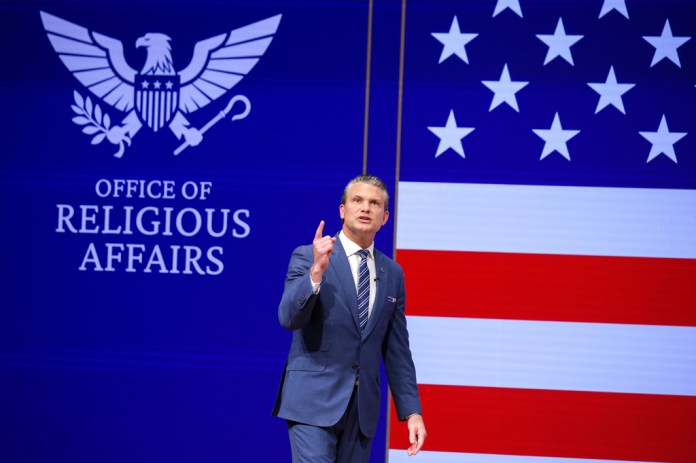
Last week, Secretary Hegseth gave a speech at Quantico to an assembled audience of military members to discuss the state of the military. Looking beyond the inflammatory rhetoric he tends to employ, the substance behind his six new initiatives to increase the warfighting capacity of the military is worth examination.
Let’s start with the creation of a new 4-star-level combatant command, the Autonomous Warfare Command, which is probably the most substantive of the initiatives. On the surface, creating more 4-star generals and commands seems like the wrong way to go, especially given his other announcement to continue the effort started earlier this year to cut general officer billets by 20%. Whether this new command succeeds will depend on which organizations within the Pentagon it subsumes, how it both competes with and interacts with other warfighting commands, and how much authority and money it receives. If the new command is just another layer between the warfighter and the engineer, then this will fail. If it functions as an advocate, interface, and accelerant, then maybe it succeeds.
In the end, the success of this command will come down to money, without which it will fail. The Pentagon has requested over $125 billion in reconciliation money planned for next-generation technology, autonomy, and the industrial base.
In our 2025 report, Pentagon Shock Therapy, we recommended something similar, but more adaptable to the threat. Our recommendation for a single no-color-of-money, multi-year fund to be applied to the toughest national security challenges and opportunities as they arise, starting with drones, was intended to ensure America leads in capability for the warfighter rather than struggling to catch up and produce what it needs when crises arise.
If this new command is combined with sufficient funds and with Project Meridian (discussed next), then it could produce its intended effect. The call for a 4-star-level command also mirrors proposals in Congress, so this plan appears to be politically aligned. While promising, this effort will remain incomplete until it is funded and provided with acquisition authority.
Next, Hegseth announced an effort to study the future of warfare titled “Project Meridian.” He has enlisted Elon Musk, Palmer Luckey, and Newt Gingrich to lead the effort. Musk and Luckey are the world’s leading technologists and, more importantly, industrialists. Both are great at rapidly turning technological innovation into products that are easy to produce at scale. Gingrich also brings knowledge of political and legislative processes, an effective bipartisan strategy that the Pentagon has lacked. Asking them for assistance is a home run.
Hegseth also described a program called “Fortress America.” This program is intended to make military bases more resilient from an infrastructure perspective. It is hard to be against this — however, without knowing the details of the approach or incremental costs, it is difficult to determine if this is affordable, resilient, and effective. Water, power, and internet are all needed, but these industries are driven by economies of scale. One has to wonder whether the investments and then the ongoing costs would be better spent strengthening this infrastructure across the entire country. This represents another incomplete effort, at least until more details are known.
Perhaps the one announcement that could not have been anticipated was his announcement of “The Next Great American Base.” This one is probably the most tenuous, as it will take many, many years, require congressional legislation to acquire land, and then add to a base footprint that is already too large and politically nearly impossible to right-size. Instead, perhaps the secretary needs to acquire a large tract of land, maybe by expanding White Sands Missile Range, where drones and EW weapons can be tested and trained without worrying about commercial aviation or signal interference. Or the focus on basing could shift to address the current real deficiency of protecting existing bases from an increasing number and sophistication of low- and high-grade threats. This effort, while well-intentioned, may need a shift in focus.
Next, Hegseth is expanding the ROTC program, calling for five new schools, “America’s Corps of Cadets.” Teaching strong values and true servant leadership skills along with superior technical proficiency supports American security and prosperity and, other than providing direction and oversight, should not cost much if offset by a reduction in lower-priority activities led by the Personnel and Readiness Undersecretary. This is another slam dunk.
Finally, Hegseth is establishing an Office of Religious Affairs. Though an important element of warfighter welfare, fixing the current Department structure and budget allocation for this service, with emphasis on chaplain participation regarding policy and budget, would be more consistent with efforts to reduce bureaucracy. At a minimum, establishing such a new principal staff assistant and budget should be offset with a similar reduction to other, lower-priority or non-core mission activities within the Secretariat. This is a good idea, but should be structured to fix what is broken while producing a net-neutral level of new headquarters layers.
BREAKING DOWN HEGSETH’S MAJOR ANNOUNCEMENTS FROM HIS ‘STATE OF THE FORCE’ ADDRESS
So, what does this all portend when looked at holistically? Two lines of effort are related to new weapons and development, two to installations and facilities, and two to people. While producing a net positive in calling attention to key initiatives, the details of implementation, particularly engagement with Congress for timely money and authority, will determine success. The bottom line is that the Pentagon needs its full 2027 budget request.
Otherwise, these important pronouncements will be nothing more than organizational shifting and aspirational change — and not useful to the warfighter.
Continue reading...
[ H/T Washington Examiner ]