Futures Split As Blue-Wave Chip Purge Enters Day Two; Oil Rebounds, BoE Hikes
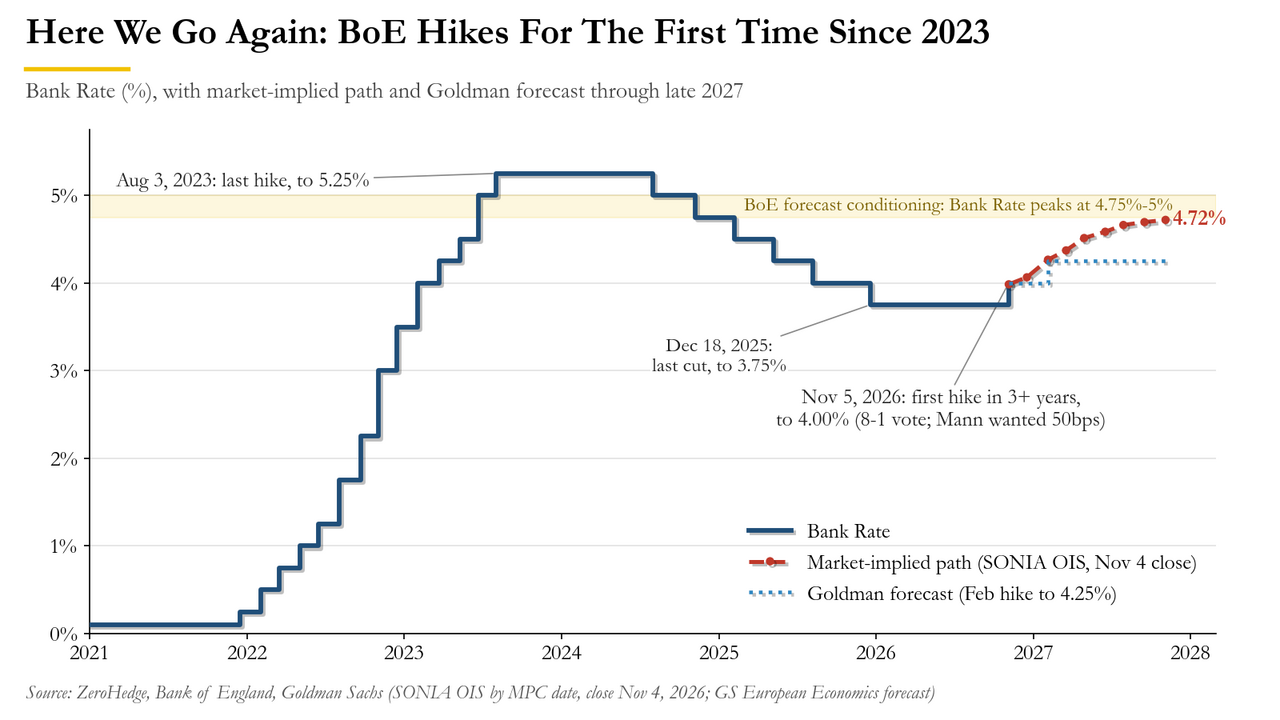
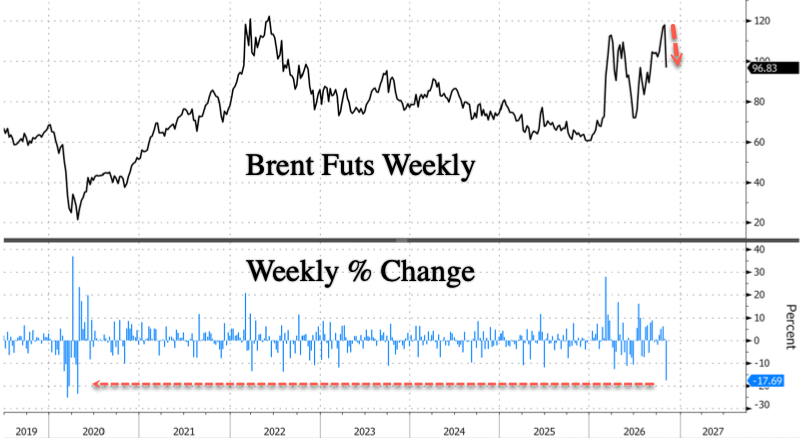
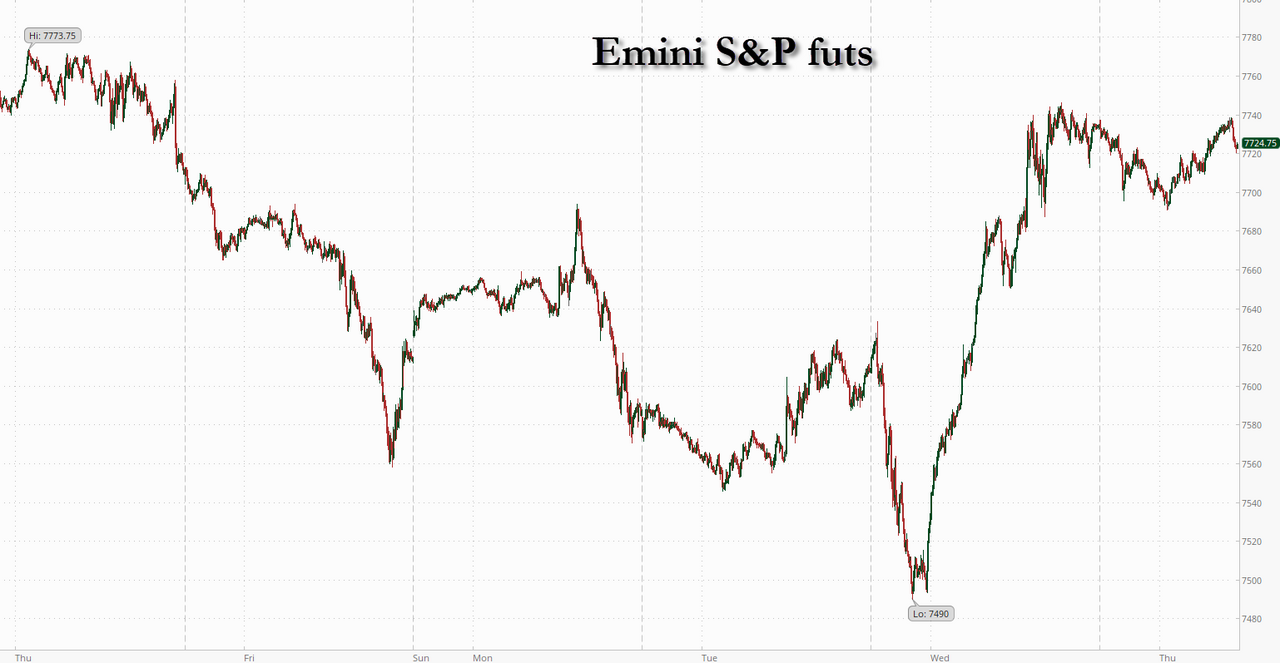
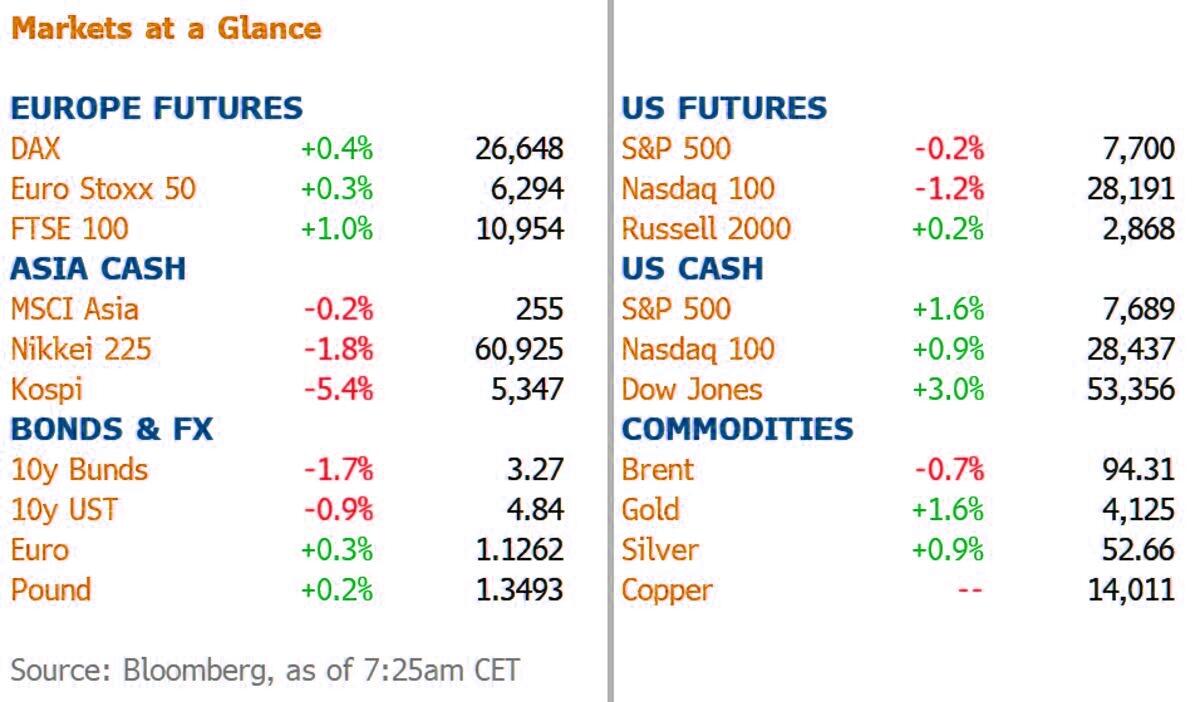
US futures are mixed, with the Nasdaq lagging as the post-midterm rotation out of chipmakers and the AI complex enters a second day, after the Democratic sweep raised fears of a data center backlash, Qualcomm tumbled on a weak forecast and the Kospi crashed almost 6%, while oil rebounded modestly from Wednesday's plunge and the BoE hiked rates for the first time in three years; as a result the 10Y yield touched 4.83%, the lowest since Sept. 10. As of 6:20am ET, S&P futures are 0.1% higher while Nasdaq futures are down 0.5%, Russell 2000 futures add 0.4% and Dow futures are 0.7%; this follows Wednesday's session when the S&P jumped 1.6% for its best day since August and the Dow soared 3%. In premarket trading, semis are again getting hit (the SOXX ETF was down 2% premarket per Bloomberg) with Qualcomm sliding 10% after a lackluster forecast, continuing the hyperscalers vs semis split we flagged yesterday, while the Mag 7 is mixed with Amazon and Meta higher and Tesla and Nvidia lower; AppLovin soars 16% on blowout guidance. The day's driver is the blue wave (again): with Democrats set to control both chambers, traders are pricing tighter regulation of data centers (Goldman's Alec Phillips sees moratoria potentially hitting about 45% of planned US data centre capacity expansion), a quicker end to the Iran war and less fiscal largesse, which is why hyperscalers that own compute are bid and everything that builds, powers or supplies it is offered. Treasuries are extending their rally, with the 10Y at 4.87% after earlier touching 4.83%, as the midterm result fuels expectations that the administration's tax and spending plans will be contained and after the Treasury's refunding hinted at less long-end issuance. The dollar is flat after its worst day in two months, cable erased losses after the BoE hiked 25bps to 4% in an 8-1 vote (Mann wanted 50bps) and Bailey warned it was unlikely to be the last hike unless the Iran war is resolved. In commodities, Brent rebounds 1.6% to $96.15 after crashing almost 9% on Wednesday, as Iran claims tankers hit mines near Hormuz and Ukraine struck Russia's Ryazan refinery; gold extends its post-midterm rally above $4,100 and silver trades around $52.7. Bitcoin is little changed. US economic data slate includes Challenger job cuts (already out: 43,994 in October, down 71.3% y/y), initial jobless claims, Q3 nonfarm productivity and unit labor costs (all 8:30am ET). Fed speaker slate includes Hammack (8:50am), Barkin (9:10am) and Logan (7:00pm). The Treasury sells $115bn of 4-week and $110bn of 8-week bills at 11:30am.
In premarket trading, Mag 7 stocks are mixed: Elon Musk-led stocks are set to extend declines after the electric-carmaker and SpaceX lost a combined $130 billion in market value Wednesday following Democrats’ lanslide win. Tesla (TSLA) -2%, Amazon (AMZN) +1.6%, Meta Platforms (META) +1%, Alphabet (GOOGL) +1.2%, Apple (AAPL) +0.7%, Microsoft (MSFT) -0.06%, Nvidia (NVDA) -1.3%
In other corporate news, the AI capex hangover continues to spread: Micron paused work on a $4.5 billion Taiwan chip plant after a labor row, and China blocked the roughly $5.4 billion sale of ABB's robotics unit to SoftBank. Meanwhile the hyperscalers that "won" the election are busy raising cash anyway: Meta raised €9 billion in its first euro bond on a record €53 billion of orders, and Microsoft raised $25 billion in a 10-tranche bond offering. Goldman and Apollo are in talks with investors to start selling portions of a roughly $40 billion chip financing deal for SpaceX, and Apple is cutting employee budgets for AI usage as part of a cost-cutting effort. Wendy's rejected a takeover proposal from a Trian Partners-led group; DTE Energy agreed to sell its DTE Vantage business for about $3 billion; SS&C priced an upsized $1.05 billion of convertible notes.
The global framing is unchanged from yesterday: the midterm-fueled rotation out of the AI trade is entering a second day, with previously unloved markets and economically sensitive stocks outperforming at the expense of chipmakers. Asia took the semi pain overnight, with the Kospi tumbling almost 6% (and triggering a trading halt) as SK Hynix and Samsung slumped, while Hong Kong was the other side of the trade, with the Hang Seng Tech index up more than 5%. Europe, the market with the least AI in it, extended its outperformance with the Stoxx 600 surpassing its August closing record.
“Chip names are under pressure because traders see Democrats as bad news for data centers and thus demand for compute,” said Hao Hong, chief investment officer at Lotus Asset Management. “Some money is rotating into consumer names in Korea, China and elsewhere now.”
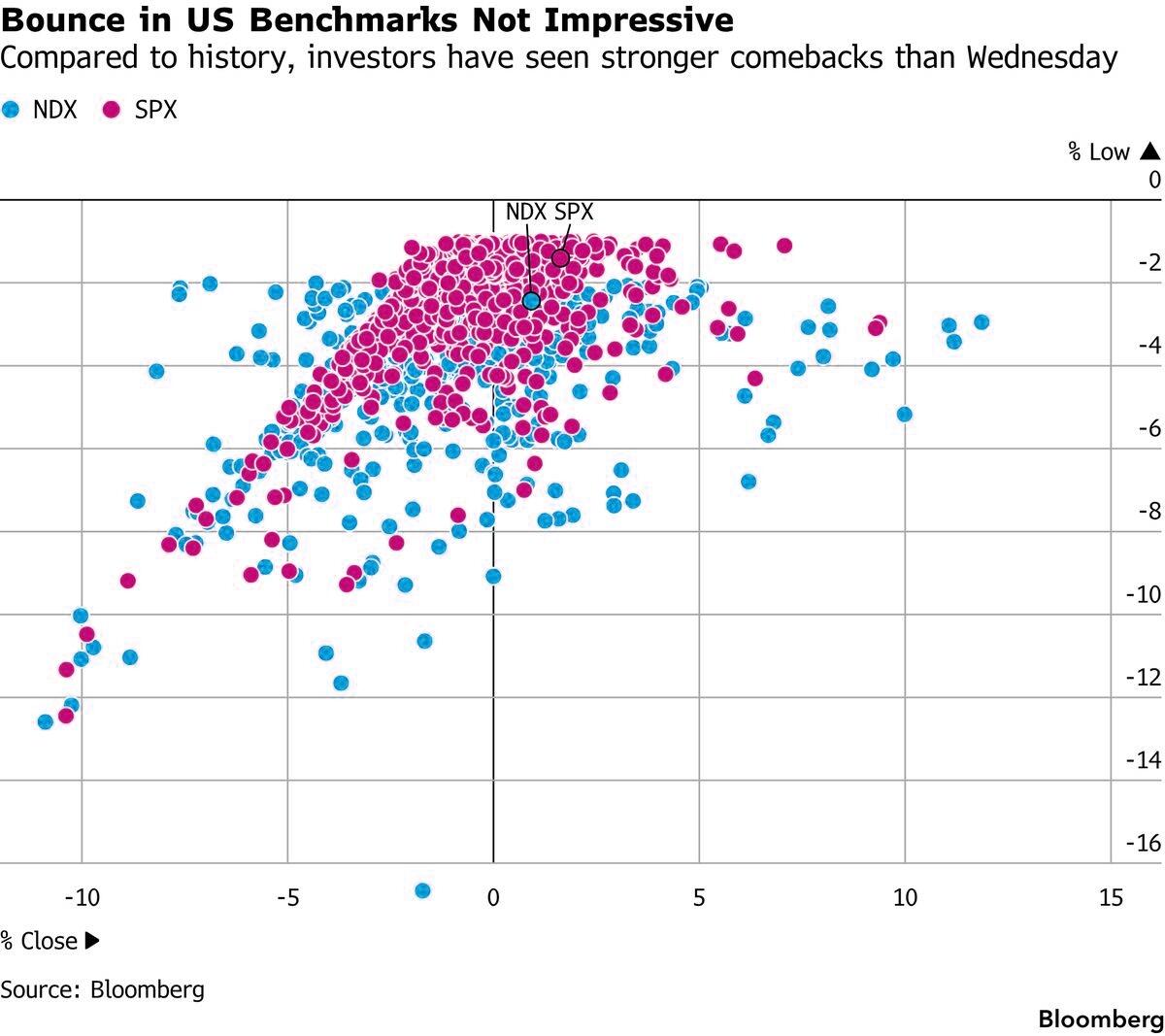
As Bloomberg's Jan-Patrick Barnert notes, Wednesday's post-vote bounce was fairly ordinary by historical standards: the Dow jumped 3%, the S&P rose 1.6% and the Nasdaq 100 closed up just 0.9% after rising as much as 2.3%, while semis fell 3.1%, energy lost 4.8% and a Goldman basket of AI data-center names sank 5.4% on a day consumer discretionary stocks gained 6.1% (as we noted yesterday). In other words, a typical bounce in a market that is still rotating, rather than healing.
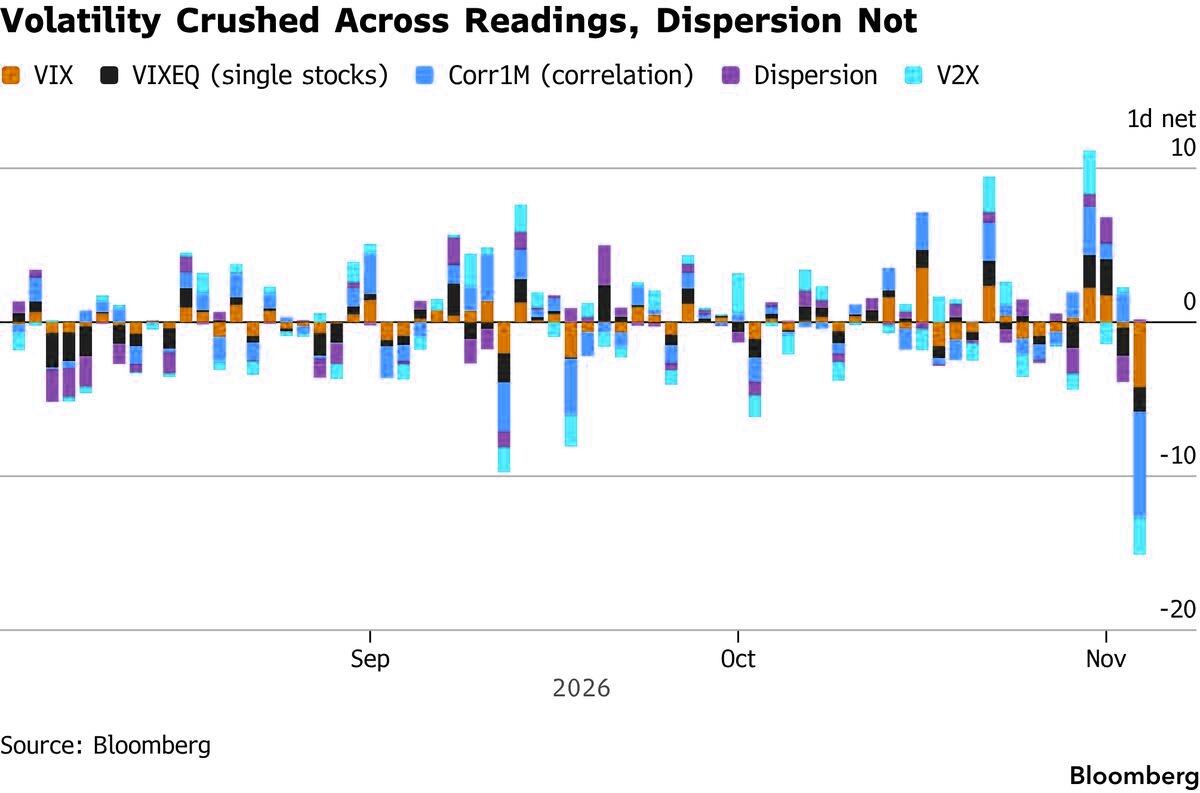
The options market tells the same story: every broad volatility gauge fell (the VIX by 4.2 points to 16.6), but single-stock volatility eased far less and the Cboe dispersion index did not budge, while implied correlation dropped almost 7 points to below 10. That is what a rotation looks like in the options market.
Bloomberg macro strategist Simon White adds that semis are the sector most exposed to a liquidity-driven flattening of the yield curve, with the 3m-10y curve having flattened over 40 bps since early October, at a time when the sector is still crowded despite nursing a drawdown of 30%. "Post midterm fears of data-centre approvals are the sort of trigger that could cajole the crowd to the exits, just as the yield curve flattening exerts extra pressure," he writes.
Over at JPMorgan, Andrew Tyler's Market Intelligence desk says futures point to a continued rotation / Momentum unwind, with "Semis and Memory sell off" continuing, Mag 7 names mixed and defensives leading ex-AI cyclicals premarket. Equity derivatives specialist Christina Jones cautions that the move "feels more positioning-driven versus a true fundamental rotation", adding that "Conviction is low across the board." JPM positioning strategist Arun Jain notes the post-hyperscaler selloff was the second -6z move in Momentum in a week and the largest single-month underperformance in more than 40 years at -5.8z. Tyler remains Tactically Bullish and expects a Tech rebound, arguing that the Blue Wave "has created another wrinkle" for those waiting to re-risk into AI, and that "it tough to see the bottom ahead of capital markets events occurring, though the setup is increasingly attractive."
JPM's credit research team, looking at the data center fallout, says the market will now pay a premium for capacity that is already built: "we used to pay a premium for IG leases, now we are going to pay a premium for stuff that is already built". They don't expect material changes to 2027 capital plans, but see some impact in 2028 and beyond, flagging Texas (about 27% of the MW of data center capacity funded in the HY project finance market) as the primary focus, and expect weakness in IPPs such as VST, TLN and CEG.
Goldman's desks are saying much the same. Rich Privorotsky writes that "The market bought the election dip… thank heaven for everything that wasn't semi-related", and that "This is rotation, not wholesale liquidation." John Flood's "standout theme on our trading desk right now is buying Hyperscalers vs Selling Semis", while Ismail Abbas sums it up: the "new political backdrop is good for those who own compute (hyperscalers) and bad for those who have to build out, sell into, or power datacenters (neoclouds, semis, power, etc)". GS political economist Alec Phillips expects Democratic state and local wins to bring short-term moratoria on data centres, though "these moratoria will not be long-lived" (more in our note from last night). Flood also points out that since 1952 the S&P has averaged +7.5% through year end after midterms and was higher 6 and 12 months later in all 18 cases.
On the macro side, the collapse in the Iran war risk premium remains the other big story: Brent is down about $18 over the last five days (one of its biggest 5-day declines in recent history per Goldman) after Vice President Vance said "The reason we lost is the war" and Trump said it was "largely true" that Republicans lost because of the war, as we discussed yesterday. Lower oil means lower inflation expectations: the 1yr US inflation swap fell to a two-month low of 2.16% on Wednesday, per DB. In Europe, France braces for a day of strikes and demonstrations over the cost of living as budget talks remain deadlocked, while it sells €12 billion of long-dated bonds in a test of demand.
In Europe, the Stoxx 600 rises 0.5% to 660.5 and hit a fresh record, surpassing its August closing high, as the region extends its outperformance driven by the rotation out of the global AI trade and a strong earnings season. Miners are the best performers while telecoms and defense fall as Rheinmetall and Deutsche Telekom results disappoint; Rheinmetall plunged as much as 18% after cutting its sales outlook, extending the post-midterm defense rout. JPM's desk notes Resources, Construction, Banks and Retail are among the top sectors with Telecom and Staples sold, and Beta and Momentum leading. Here are the biggest European movers:
Asian stocks were split down the middle by the rotation. The Kospi plunged 5.79% to 5,383.80, its biggest drop since Oct. 15, with Samsung down 7.6% and SK Hynix down as much as 10% intraday, and the Taiex fell 3.2% as foreigners dumped Taiwan stocks (the Taiwan dollar slid to its lowest in over a year). Japan's Nikkei fell 1.8% as Ibiden, Kokusai and Murata each dropped more than 15%, while Toyota surged 16.7% after expanding its buyback to ¥1.3 trillion. On the other side, the Hang Seng jumped 3.7% to 24,796.98, its best day since February 2025, with the Hang Seng Tech index up 5.6% (Goldman was pitching China AI last night), while India's Nifty rose 2.5%, Australia's ASX 200 gained 2.6% and Indonesia's JCI added 2.3%. China's CSI 300 rose 0.3%. As Goldman's Jeremiah Khong put it, "the post US midterm rotation accelerated, with investors moving away from AI and semiconductor hardware and towards value, cyclical and domestically oriented markets."
In FX, the Bloomberg Dollar Spot Index steadied after the midterms broke the greenback out of one of its tightest ranges in years and sent it to its worst day in two months; DXY trades in a 101.20-101.47 range. EUR/USD pared a 0.4% gain to trade little changed around 1.1235, while GBP/USD erased losses after the BoE hike to trade around $1.3471 (the pound's effective exchange rate earlier hit the highest since 2016). USD/JPY is slightly lower around 158 with the yen getting mild support from lower oil, NOK saw little reaction as Norges Bank held at 4.50% and said it is prepared to hike if needed, and SEK slipped after a cooler CPIF print. In EM, the Philippine peso jumped 1% on the oil slump while Taiwan's central bank sold the most dollars since June.
In rates, Treasuries headed for a second day of gains, with the 10-year yield touching 4.83%, the lowest since Sept. 10, before paring the move to trade around 4.87%; JPM's desk says the curve is twisting flatter, led by the long end. The bid comes from the Democratic sweep fueling expectations that tax and spending plans will be contained, the plunge in oil and the Treasury's refunding hint of less long-end issuance. Gilts rallied as much as 66 ticks into the BoE before paring gains after the 25bps hike, with the UK 10-year now about 1bp higher at 5.14% and money markets pricing a 50% chance of another hike in December. Bunds are also bid, with the 10Y at 3.27%, the lowest since Aug. 28, while French OATs underperform (10Y up 2bps to 4.79%) ahead of strikes and a long-dated bond sale, keeping the OAT-Bund spread around 150bps. Today's US supply is limited to $115bn of 4-week and $110bn of 8-week bills, while South Korea is reportedly weighing large-scale purchases of long-term USTs (Seoul says the report "differs from facts"). Fed speaker focus is on Hammack and Barkin, though Friday's payrolls (consensus 65k) is the week's real test.
Not everyone buys the rally. “I do not think that we’re at the beginning of a 100-basis-point rally in US Treasuries,” said Amy Xie Patrick, head of income strategies at Pendal. Brandywine’s Tracy Chen sees a window instead: “We’re in a honeymoon period of this expectation of gridlock or divided government to rein some of the fiscal spending,” adding “This time window is great for the bond rally. We like the belly of the curve from five-year to seven. That’s the sweet spot.”
In commodities, oil is bouncing after Wednesday's rout: WTI for December gained 0.8% to $88.84 and Brent for January rose 1.6% to $96.15 by 6:25am ET, still down over 18% from last Friday's close. Supply headlines are piling up again: Iran's navy claimed a tanker hit a mine in Hormuz on Thursday morning (the IRGC said two tankers caught fire after hitting mines), UKMTO said a tanker was struck by two projectiles north of Qatar late Wednesday, and Ukraine confirmed a strike on Russia's Ryazan refinery ahead of next week's talks; on the other hand, Iran and Oman's foreign ministers discussed arrangements to secure sea routes, and US crude output hit a record 14mln bpd. US natgas trades around $2.94. Spot gold extends its post-midterm rally above $4,100/oz (range $4,057.84-4,146.99) on lower yields and a weaker dollar, silver is firmer around $52.7, and LME copper is higher in a $13,940-14,136/t range.
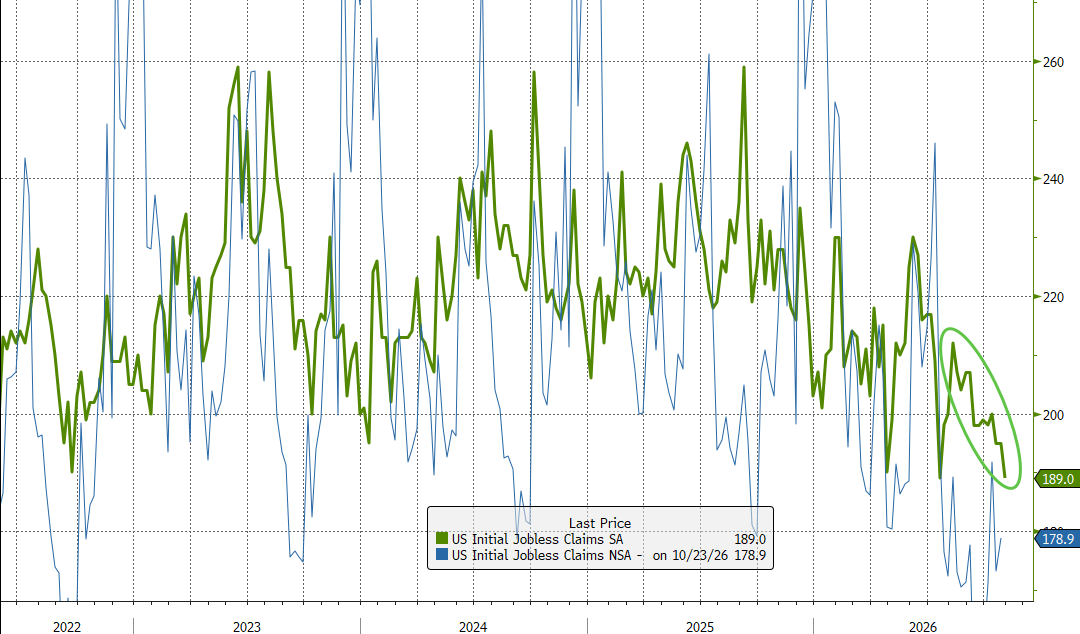
US economic data slate includes initial jobless claims (est. 196k), continuing claims, and Q3 nonfarm productivity and unit labor costs (all 8:30am ET). Fed speaker slate includes Hammack (8:50am), Barkin (9:10am) and Logan (7:00pm). Banxico decides at 2pm; BoC Governor Macklem speaks to the Senate at 10:30am. Notable earnings before the open include ConocoPhillips, Zoetis, Cigna, Duke and Southern; after the close, Airbnb, DraftKings, Cloudflare, Axon and Lumentum.
Market Snapshot
Top Overnight News
A more detailed look at global markets courtesy of Newsquawk
APAC stocks were ultimately mixed after the rally on Wall Street as yields declined and oil slumped in the aftermath of the blue tsunami in the US Midterms, while a rotation out of chip stocks was evident overnight. ASX 200 rallied as gains were led by strength in mining and tech, with gold miners boosted by the surge in the precious metal to above USD 4,100/oz, while energy and financials were at the other end of the spectrum following a slump in oil prices and a drop in NAB's FY profit. Nikkei 225 wiped out its opening gains and more, amid weakness in electronics and tech stocks, while the drop in oil prices ultimately failed to provide a cushion despite Japan's heavy reliance on oil imports. KOSPI underperformed with a sidecar triggered amid a rotation out of semiconductor stocks after the blue wave in the US Congress raised concerns over the AI buildout. Hang Seng and Shanghai Comp were mixed as the mainland was constrained, while the Hong Kong benchmark surged as hyperscalers and ecommerce stocks benefited from the rotations out of semis.
Top Asian News
European equities (STOXX 600 +0.4%) are entirely in the green, continuing to build on the strength seen in the prior session. Gains across major indices vary between 0.2-1.2%; the FTSE MIB lags vs peers, whilst the CAC 40 outperforms. European sectors hold a strong positive bias; Basic Resources benefit from the risk tone, and underlying strength in metals prices whilst Energy lags given the recent sell off in oil. Key movers: Evotec (+6.9%, Q3 rev. falls but moves forward with restructuring), ArcelorMittal (+4.9%, tops Q3 estimates), Diageo (+3.0%, organic sales beat and holds guidance), Rheinmetall (-16.3%, cuts 2026 sales outlook and order delays), Deutsche Telekom (-2.1%, decent results and announces share buyback), Commerzbank (-1.9%, rev. missed expectations). Hefty selling across major tech/memory names overnight, saw the KOSPI close with losses in excess of 5%. Heavy constituents such as SK Hynix (-5%) and Samsung (-7.5%) fell, with the pair hit in catch-up play to action seen stateside, amidst growing woes of increased AI regulation following the Democratic sweep; Japan’s Kioxia slumped c. 13%. And whilst the recent sell-off can be attributed to the US midterms, it comes despite a slew of positive demand-related comments from several memory firms; Kioxia recently mentioned that clients are negotiating contracts extending into 2029, whilst Samsung expects tight supply through 2027 and 2028. US equity futures are mixed, with underperformance in the NQ (-0.5%), as the AI/memory sell-off continues into today. ARM Holdings (-3.2%): Reported weaker than expected royalty revenue, partly pressured by memory-related smartphone market weakness, and only modestly upbeat quarterly guidance. Qualcomm (-9.2%): Reported weaker than expected smartphone chip sales, driven by sluggish handset demand, rising memory costs and declining Apple-related revenue, alongside disappointing margin and earnings guidance.
Top European News
FX
Central Banks
Fixed Income
Commodities
Trade/Tariffs
Geopolitics: Iran
Geopolitics: Ukraine
Geopolitics: Other
Crypto
US Event Calendar
Central Bank Speakers
DB's Jim Reid concludes the overnight wrap
In virtually every US election, there is usually some reason why markets are concerned going into it, which then magically fades afterwards. The 2026 midterms seem no different, as yesterday the S&P 500 (+1.58%) posted its best day in three months, whilst bond yields fell sharply around the world. This was mainly driven by relief that the political uncertainty was over, but we also saw concerns ease across the whole range of risk factors that have dominated recent weeks. For instance, Brent crude oil prices (-8.67%) closed beneath $100/bbl for the first time since September, significantly dampening fears over inflation. Similarly, the Franco-German 10yr spread (-11.8bps) tightened sharply, which led to a bit more optimism on Europe. And we even saw a decent rebound in tech stocks, with the NASDAQ (+1.44%) recovering despite fears 24 hours earlier that tech might see a fresh slump.
However as we'll see below some parts of the tech space traded poorly yesterday amid uncertainty as to what the election result will mean for regulation of things such as data centers. This uncertainty has accelerated overnight with Nasdaq futures back down -1.18% and the KOSPI -5.68% lower dragged down by SK hynix (-9.60%) and Samsung (-7.57%). The Korean index triggered a 5 minute trading halt just before I finished typing this.
Elsewhere in Asia, the Nikkei (-1.24%) is also under pressure, as chipmakers and AI-related stocks extended the previous session's declines. In contrast, Chinese equities are outperforming the region in what is developing into a big global rotation over the last 24 hours. The Hang Seng (+3.09%) is benefiting, after also being helped by Beijing unveiling fresh support measures that boosted sentiment toward domestic semiconductor companies. Meanwhile, Australia's S&P/ASX 200 (+2.61%) is also trading significantly higher. S&P 500 futures are down -0.28% so holding on to most of yesterday's gains so far with Stoxx futures (+0.11%) just about maintaining its big boost from yesterday.
This has capped off a remarkable 24 hours for financial markets, with huge moves as investors reacted to the midterm elections. Just to bring you up to speed, it was apparent pretty soon after the counting began that the Democrats were on course to control both the House of Representatives and the Senate in the new Congress, with stronger-than-expected margins in both. Indeed, we’ve already started to see the political consequences, with widespread reports that Republican House Speaker Mike Johnson will step down from leading the House Republicans next year. Meanwhile, CBS reported that Trump had asked advisers if Defense Secretary Hegseth should go. He has been at the hawkish end on the war with Iran, and much of the rally yesterday was linked to a reappraisal of the likelihood of imminent strikes on Iran in light of the election result.
When it came to the market reaction, there was relief among investors that the results weren’t disputed, which helped to reduce political uncertainty. Moreover, the prospect of divided government also eased concerns about the fiscal trajectory, given it’ll now be more difficult to pass tax cuts or spending packages. That helped to bring down Treasury yields, which in turn offered further support to risk assets. In terms of the outcome, it was already expected in polls and prediction markets that the Democrats would win at least one chamber, whilst it was always known that Trump would retain his veto power as well. We did also see a narrative emerge that the scale of the Democratic Party’s win would reduce the leverage of its leftist wing over policy. But when it comes to the headline result, it’s not too different from investor expectations beforehand, even if the scale of the Democratic victory was bigger than expected. In many respects, the overall rally fits into the classic midterm pattern we’ve previously highlighted. After all, in 20 out of 20 midterm elections since WWII, the S&P 500 has been higher one year later. And as I pointed out in my CoTD yesterday, the Republican losses in the House were basically on the historical trendline for what would be expected given President Trump’s approval rating. So it was a very normal election with a very normal market reaction before and after the vote, despite fears that this time would be different.
Nevertheless, there were several equity segments where we did see a specific midterm reaction. For example, Trump Media & Technology Group (-24.54%) had its worst daily performance since 2024. Moreover, some of the most AI-exposed stocks struggled, with CoreWeave (-9.90%) and the Philly semiconductor index (-3.13%) also losing ground. Another underperformer was defence stocks, with the Aerospace & Defense subcomponent of the S&P 500 down -1.25%. But while chips stocks struggled, the Mag-7 (+2.24%) outperformed, led by outsized gains for Microsoft (+6.68%), Amazon (+6.12%) and Apple (+5.31%), with the latter reaching a new all-time high. So sizeable differentiation playing out in the tech space.
The general optimism helped the S&P 500 (+1.58%) to its best day since August, with the gains led by the more cyclical sectors. And the moves received a further boost from another batch of strong US data. For instance, the ADP report on private payrolls showed a +86k increase in October (vs. +67k expected), which added to the optimism before tomorrow’s jobs report. Meanwhile, the ISM services index also came in broadly around consensus at 54.5 in October (vs. 54.8 expected), though encouragingly its prices paid index saw an unexpected decline (73.0 vs 74.0 prev, 74.6 exp.).
Otherwise, markets also got a tailwind from another sharp decline in oil prices, with Brent crude (-8.67%) plummeting again to $94.62/bl. That helped to ease concerns about inflation and saw investors dial back the chance of rapid rate hikes. In part, that followed comments from Vice President JD Vance on X that “The reason we lost is the war”, which implicitly pointed away from a further escalation. And in turn, that led to a huge decline in inflation expectations, with the Euro 1yr inflation swap (-25.9bps) down to a two-month low of 3.10%, whilst the 1yr US inflation swap (-24.9bps) hit a two-month low of 2.16%.
That backdrop led to a big rally for sovereign bonds on both sides of the Atlantic. Treasury yields fell across the curve, with the 2yr yield (-4.9bps) down to 4.58%, whilst the 10yr yield (-7.6bps) fell to 4.89%. They are another -4.3bps lower this morning. And in Europe there were even sharper moves given the continent’s exposure to energy prices. Yields on 10yr bunds (-5.8bps) fell to 3.27%, whilst 10yr OATs (-17.6bps) saw their biggest daily decline since April, falling to 4.77%. That also pushed the Franco-German 10yr spread down by -11.8bps to 150bps, marking its tightest level in the last couple of weeks. And it wasn’t just European bonds that outperformed, as European equities also put in a very strong day. In fact, the STOXX 600 (+1.82%) had its best day since June and the DAX (+2.22%) had its best day since April. European banks (+4.62%) also had their best day since April. So crudely a big rotation from data centres to everything else across the globe.
Looking forward, one of the main highlights today will be the Bank of England’s latest decision at 12:00 London time. They’re widely expected to deliver their first rate hike since 2023, with a 25bp move that takes their policy rate up to 4%. In their preview, our UK economists expect there to be a 6-3 vote tally in favour of a hike, and they think the big changes will come in the form of the BoE’s updated forecasts. Their view is that the Bank will show peak CPI nearer 4.25% in Q1 2027, although they also expect an upgrade to the 2026 growth forecast to 1.4%. For more information, see their full preview here.
There wasn’t much other data yesterday, although we did get the Euro Area flash CPI print for October. That came in as expected by the consensus, with headline inflation up to a 3-year high of +4.0% in October, whilst core inflation remained at +2.5%. Otherwise, the US trade deficit was a bit smaller than expected in September, at $105bn (vs. $107.9bn expected).
Earlier this morning, data showed Australia's seasonally adjusted trade surplus surged to A$2.83bn in September from A$184mn in August, comfortably exceeding economists' expectations of A$940mn and marking the highest surplus in seven months.
In central bank news, minutes from the BOJ's September meeting reinforced the case for further policy tightening. Policymakers generally agreed that interest rates should continue to rise, with one member highlighting the possibility of a faster pace of hikes. Another noted that while there was no need for immediate action, the BOJ should continue to calibrate policy carefully to prevent excessive and persistent inflationary pressures.
Looking at the day ahead, we’ll get the Bank of England’s latest policy decision, and hear from ECB President Lagarde, the ECB’s Cipollone, Moulin, Schnabel, Zigman, Lane, Nagel and Dolenc, and the Fed’s Hammack and Barkin. Otherwise, data releases from Europe include German factory orders and Euro Area PPI for September, along with the October construction PMIs from Germany and the UK. In the US, we’ll also get the weekly initial jobless claims, and nonfarm productivity for Q3.
Tyler Durden Thu, 11/05/2026 - 08:20
Continue reading...
[ H/T ZeroHedge ]
US futures are mixed, with the Nasdaq lagging as the post-midterm rotation out of chipmakers and the AI complex enters a second day, after the Democratic sweep raised fears of a data center backlash, Qualcomm tumbled on a weak forecast and the Kospi crashed almost 6%, while oil rebounded modestly from Wednesday's plunge and the BoE hiked rates for the first time in three years; as a result the 10Y yield touched 4.83%, the lowest since Sept. 10. As of 6:20am ET, S&P futures are 0.1% higher while Nasdaq futures are down 0.5%, Russell 2000 futures add 0.4% and Dow futures are 0.7%; this follows Wednesday's session when the S&P jumped 1.6% for its best day since August and the Dow soared 3%. In premarket trading, semis are again getting hit (the SOXX ETF was down 2% premarket per Bloomberg) with Qualcomm sliding 10% after a lackluster forecast, continuing the hyperscalers vs semis split we flagged yesterday, while the Mag 7 is mixed with Amazon and Meta higher and Tesla and Nvidia lower; AppLovin soars 16% on blowout guidance. The day's driver is the blue wave (again): with Democrats set to control both chambers, traders are pricing tighter regulation of data centers (Goldman's Alec Phillips sees moratoria potentially hitting about 45% of planned US data centre capacity expansion), a quicker end to the Iran war and less fiscal largesse, which is why hyperscalers that own compute are bid and everything that builds, powers or supplies it is offered. Treasuries are extending their rally, with the 10Y at 4.87% after earlier touching 4.83%, as the midterm result fuels expectations that the administration's tax and spending plans will be contained and after the Treasury's refunding hinted at less long-end issuance. The dollar is flat after its worst day in two months, cable erased losses after the BoE hiked 25bps to 4% in an 8-1 vote (Mann wanted 50bps) and Bailey warned it was unlikely to be the last hike unless the Iran war is resolved. In commodities, Brent rebounds 1.6% to $96.15 after crashing almost 9% on Wednesday, as Iran claims tankers hit mines near Hormuz and Ukraine struck Russia's Ryazan refinery; gold extends its post-midterm rally above $4,100 and silver trades around $52.7. Bitcoin is little changed. US economic data slate includes Challenger job cuts (already out: 43,994 in October, down 71.3% y/y), initial jobless claims, Q3 nonfarm productivity and unit labor costs (all 8:30am ET). Fed speaker slate includes Hammack (8:50am), Barkin (9:10am) and Logan (7:00pm). The Treasury sells $115bn of 4-week and $110bn of 8-week bills at 11:30am.
In premarket trading, Mag 7 stocks are mixed: Elon Musk-led stocks are set to extend declines after the electric-carmaker and SpaceX lost a combined $130 billion in market value Wednesday following Democrats’ lanslide win. Tesla (TSLA) -2%, Amazon (AMZN) +1.6%, Meta Platforms (META) +1%, Alphabet (GOOGL) +1.2%, Apple (AAPL) +0.7%, Microsoft (MSFT) -0.06%, Nvidia (NVDA) -1.3%
- Adma Biologics (ADMA) is up 20% after the biotech boosted its adjusted Ebitda guidance for the full year.
- Albemarle (ALB) rises 3% after the lithium producer reported third-quarter adjusted earnings per share that beat the average analyst estimate as energy storage and specialties segments benefited from higher pricing.
- AppLovin (APP) is up 19% after the mobile-app marketing company’s third-quarter results beat expectations and it gave an outlook that is above the analyst consensus estimate.
- Caris Life Sciences (CAI) slumps 14% after providing results and guidance; analysts note a lack of volume upside for the fourth quarter as a key concern.
- Cava (CAVA) sinks 8% on concern the company’s momentum is slowing despite the popularity of new dishes such as salmon bowls and barbecue pita chips.
- Celsius (CELH) rises 6% after the energy drink’s revenue and adjusted Ebitda for the third quarter handily beat Street estimates.
- Dutch Bros (BROS) falls 14% after the coffee chain cut its adjusted Ebitda forecast for the full year.
- Expedia (EXPE) is down 6% after the online travel agency provided guidance, with the midpoint of its fourth-quarter gross bookings forecast trailed the average analyst estimate,
- Elf Beauty (ELF) climbs 5% after the cosmetics company boosted its net sales forecast for the full year.
- Fastly (FSLY) falls 13% after the cloud-platform provider posted quarterly results and provided guidance.
- Goodyear Tire (GT) falls 4% after third quarter results disappointed.
- LegalZoom (LZ) tumbles 17% after posting third quarter results and a fourth quarter forecast.
- Molson Coors (TAP) falls 4% after the company cut its annual guidance for EPS and net sales, citing persistent softer global beer industry trends.
- MNTN (MNTN) falls 45% after the advertising and marketing platform posted disappointing third-quarter results and appointed a new CEO.
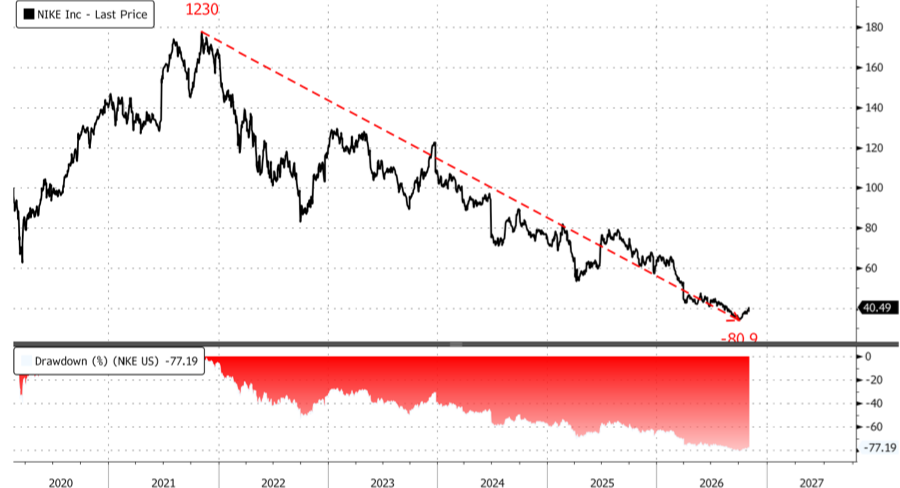
- Nike (NKE) is down 1% after Truist Securities downgrades the stock to sell, saying the company has “risks across the portfolio and an inflated valuation.”
- Sezzle (SEZL) climbs 28% after financial technology company posted third quarter results.
- Sunrun (RUN) rises 24% after the solar company reported third-quarter revenue that beat the average analyst estimate. Analysts also note that free cash flow is expected to improve in 2027.
- Tapestry (TPR) gains 11% after the accessories company’s first-quarter results topped Wall Street expectations, and management boosted its annual guidance, as well as its capital returns projection.
- Veracyte (VCYT) tumbles 31% after the diagnostics company’s full-year revenue forecast fell short of Wall Street estimates.
- Wendy’s (WEN) slips 1% after the company rejected the takeover proposal from a Trian Partners-led group.
- Zillow (Z) falls 14% after the digital real estate company reported adjusted earnings per share and revenue for the third-quarter that missed the average analyste estimate.
In other corporate news, the AI capex hangover continues to spread: Micron paused work on a $4.5 billion Taiwan chip plant after a labor row, and China blocked the roughly $5.4 billion sale of ABB's robotics unit to SoftBank. Meanwhile the hyperscalers that "won" the election are busy raising cash anyway: Meta raised €9 billion in its first euro bond on a record €53 billion of orders, and Microsoft raised $25 billion in a 10-tranche bond offering. Goldman and Apollo are in talks with investors to start selling portions of a roughly $40 billion chip financing deal for SpaceX, and Apple is cutting employee budgets for AI usage as part of a cost-cutting effort. Wendy's rejected a takeover proposal from a Trian Partners-led group; DTE Energy agreed to sell its DTE Vantage business for about $3 billion; SS&C priced an upsized $1.05 billion of convertible notes.
The global framing is unchanged from yesterday: the midterm-fueled rotation out of the AI trade is entering a second day, with previously unloved markets and economically sensitive stocks outperforming at the expense of chipmakers. Asia took the semi pain overnight, with the Kospi tumbling almost 6% (and triggering a trading halt) as SK Hynix and Samsung slumped, while Hong Kong was the other side of the trade, with the Hang Seng Tech index up more than 5%. Europe, the market with the least AI in it, extended its outperformance with the Stoxx 600 surpassing its August closing record.
“Chip names are under pressure because traders see Democrats as bad news for data centers and thus demand for compute,” said Hao Hong, chief investment officer at Lotus Asset Management. “Some money is rotating into consumer names in Korea, China and elsewhere now.”
As Bloomberg's Jan-Patrick Barnert notes, Wednesday's post-vote bounce was fairly ordinary by historical standards: the Dow jumped 3%, the S&P rose 1.6% and the Nasdaq 100 closed up just 0.9% after rising as much as 2.3%, while semis fell 3.1%, energy lost 4.8% and a Goldman basket of AI data-center names sank 5.4% on a day consumer discretionary stocks gained 6.1% (as we noted yesterday). In other words, a typical bounce in a market that is still rotating, rather than healing.
The options market tells the same story: every broad volatility gauge fell (the VIX by 4.2 points to 16.6), but single-stock volatility eased far less and the Cboe dispersion index did not budge, while implied correlation dropped almost 7 points to below 10. That is what a rotation looks like in the options market.
Bloomberg macro strategist Simon White adds that semis are the sector most exposed to a liquidity-driven flattening of the yield curve, with the 3m-10y curve having flattened over 40 bps since early October, at a time when the sector is still crowded despite nursing a drawdown of 30%. "Post midterm fears of data-centre approvals are the sort of trigger that could cajole the crowd to the exits, just as the yield curve flattening exerts extra pressure," he writes.
Over at JPMorgan, Andrew Tyler's Market Intelligence desk says futures point to a continued rotation / Momentum unwind, with "Semis and Memory sell off" continuing, Mag 7 names mixed and defensives leading ex-AI cyclicals premarket. Equity derivatives specialist Christina Jones cautions that the move "feels more positioning-driven versus a true fundamental rotation", adding that "Conviction is low across the board." JPM positioning strategist Arun Jain notes the post-hyperscaler selloff was the second -6z move in Momentum in a week and the largest single-month underperformance in more than 40 years at -5.8z. Tyler remains Tactically Bullish and expects a Tech rebound, arguing that the Blue Wave "has created another wrinkle" for those waiting to re-risk into AI, and that "it tough to see the bottom ahead of capital markets events occurring, though the setup is increasingly attractive."
JPM's credit research team, looking at the data center fallout, says the market will now pay a premium for capacity that is already built: "we used to pay a premium for IG leases, now we are going to pay a premium for stuff that is already built". They don't expect material changes to 2027 capital plans, but see some impact in 2028 and beyond, flagging Texas (about 27% of the MW of data center capacity funded in the HY project finance market) as the primary focus, and expect weakness in IPPs such as VST, TLN and CEG.
Goldman's desks are saying much the same. Rich Privorotsky writes that "The market bought the election dip… thank heaven for everything that wasn't semi-related", and that "This is rotation, not wholesale liquidation." John Flood's "standout theme on our trading desk right now is buying Hyperscalers vs Selling Semis", while Ismail Abbas sums it up: the "new political backdrop is good for those who own compute (hyperscalers) and bad for those who have to build out, sell into, or power datacenters (neoclouds, semis, power, etc)". GS political economist Alec Phillips expects Democratic state and local wins to bring short-term moratoria on data centres, though "these moratoria will not be long-lived" (more in our note from last night). Flood also points out that since 1952 the S&P has averaged +7.5% through year end after midterms and was higher 6 and 12 months later in all 18 cases.
On the macro side, the collapse in the Iran war risk premium remains the other big story: Brent is down about $18 over the last five days (one of its biggest 5-day declines in recent history per Goldman) after Vice President Vance said "The reason we lost is the war" and Trump said it was "largely true" that Republicans lost because of the war, as we discussed yesterday. Lower oil means lower inflation expectations: the 1yr US inflation swap fell to a two-month low of 2.16% on Wednesday, per DB. In Europe, France braces for a day of strikes and demonstrations over the cost of living as budget talks remain deadlocked, while it sells €12 billion of long-dated bonds in a test of demand.
In Europe, the Stoxx 600 rises 0.5% to 660.5 and hit a fresh record, surpassing its August closing high, as the region extends its outperformance driven by the rotation out of the global AI trade and a strong earnings season. Miners are the best performers while telecoms and defense fall as Rheinmetall and Deutsche Telekom results disappoint; Rheinmetall plunged as much as 18% after cutting its sales outlook, extending the post-midterm defense rout. JPM's desk notes Resources, Construction, Banks and Retail are among the top sectors with Telecom and Staples sold, and Beta and Momentum leading. Here are the biggest European movers:
- Air France-KLM shares surged as much as 14% after reporting better than expected third quarter earnings and efficiency measures, notably at its Dutch unit.
- Lanxess shares soar as much as 20% after results from the German specialty chemicals maker showed improving free cash flow.
- Diageo shares rise as much as 5.2% after the spirits maker’s first-quarter update showed what analysts said was a stronger-than-expected start to the year.
- JCDecaux rises as much as 8.5% after a third-quarter report in which revenue and organic growth exceeded expectations.
- HelloFresh rises as much as 15% after the food subscription firm reported adjusted Ebitda for the third quarter that beat the Bloomberg consensus estimate.
- Yubico surges as much as 33% as DNB Carnegie says the Swedish cybersecurity company delivered “total blowout numbers” in the third quarter.
- Rheinmetall shares fall as much as 18% after the German defense firm cut its full-year sales outlook, citing likely delays in the Arminius contract.
- Maersk shares fall as much as 12% after analysts flagged a miss on third-quarter earnings and said an uplift in the shipping company’s guidance disappointed investors who were hoping for more.
- Deutsche Telekom shares fall as much as 3.4% after the telecom operator projects as much as €2b worth of shares to be bought back next year, a target that analysts say could disappoint investors after already tracking behind a shareholder return goal this year.
- Siemens Healthineers drops as much as 4.6% after the German medical technology firm lowered its sales outlook for next year.
- Commerzbank shares fall as much as 3.5% after the German bank disappointed investors by lowering its outlook for lending income this year.
- Kontron declines as much as 8.9% as Jefferies says the IT services firm had “another underwhelming quarter.”
Asian stocks were split down the middle by the rotation. The Kospi plunged 5.79% to 5,383.80, its biggest drop since Oct. 15, with Samsung down 7.6% and SK Hynix down as much as 10% intraday, and the Taiex fell 3.2% as foreigners dumped Taiwan stocks (the Taiwan dollar slid to its lowest in over a year). Japan's Nikkei fell 1.8% as Ibiden, Kokusai and Murata each dropped more than 15%, while Toyota surged 16.7% after expanding its buyback to ¥1.3 trillion. On the other side, the Hang Seng jumped 3.7% to 24,796.98, its best day since February 2025, with the Hang Seng Tech index up 5.6% (Goldman was pitching China AI last night), while India's Nifty rose 2.5%, Australia's ASX 200 gained 2.6% and Indonesia's JCI added 2.3%. China's CSI 300 rose 0.3%. As Goldman's Jeremiah Khong put it, "the post US midterm rotation accelerated, with investors moving away from AI and semiconductor hardware and towards value, cyclical and domestically oriented markets."
In FX, the Bloomberg Dollar Spot Index steadied after the midterms broke the greenback out of one of its tightest ranges in years and sent it to its worst day in two months; DXY trades in a 101.20-101.47 range. EUR/USD pared a 0.4% gain to trade little changed around 1.1235, while GBP/USD erased losses after the BoE hike to trade around $1.3471 (the pound's effective exchange rate earlier hit the highest since 2016). USD/JPY is slightly lower around 158 with the yen getting mild support from lower oil, NOK saw little reaction as Norges Bank held at 4.50% and said it is prepared to hike if needed, and SEK slipped after a cooler CPIF print. In EM, the Philippine peso jumped 1% on the oil slump while Taiwan's central bank sold the most dollars since June.
In rates, Treasuries headed for a second day of gains, with the 10-year yield touching 4.83%, the lowest since Sept. 10, before paring the move to trade around 4.87%; JPM's desk says the curve is twisting flatter, led by the long end. The bid comes from the Democratic sweep fueling expectations that tax and spending plans will be contained, the plunge in oil and the Treasury's refunding hint of less long-end issuance. Gilts rallied as much as 66 ticks into the BoE before paring gains after the 25bps hike, with the UK 10-year now about 1bp higher at 5.14% and money markets pricing a 50% chance of another hike in December. Bunds are also bid, with the 10Y at 3.27%, the lowest since Aug. 28, while French OATs underperform (10Y up 2bps to 4.79%) ahead of strikes and a long-dated bond sale, keeping the OAT-Bund spread around 150bps. Today's US supply is limited to $115bn of 4-week and $110bn of 8-week bills, while South Korea is reportedly weighing large-scale purchases of long-term USTs (Seoul says the report "differs from facts"). Fed speaker focus is on Hammack and Barkin, though Friday's payrolls (consensus 65k) is the week's real test.
Not everyone buys the rally. “I do not think that we’re at the beginning of a 100-basis-point rally in US Treasuries,” said Amy Xie Patrick, head of income strategies at Pendal. Brandywine’s Tracy Chen sees a window instead: “We’re in a honeymoon period of this expectation of gridlock or divided government to rein some of the fiscal spending,” adding “This time window is great for the bond rally. We like the belly of the curve from five-year to seven. That’s the sweet spot.”
In commodities, oil is bouncing after Wednesday's rout: WTI for December gained 0.8% to $88.84 and Brent for January rose 1.6% to $96.15 by 6:25am ET, still down over 18% from last Friday's close. Supply headlines are piling up again: Iran's navy claimed a tanker hit a mine in Hormuz on Thursday morning (the IRGC said two tankers caught fire after hitting mines), UKMTO said a tanker was struck by two projectiles north of Qatar late Wednesday, and Ukraine confirmed a strike on Russia's Ryazan refinery ahead of next week's talks; on the other hand, Iran and Oman's foreign ministers discussed arrangements to secure sea routes, and US crude output hit a record 14mln bpd. US natgas trades around $2.94. Spot gold extends its post-midterm rally above $4,100/oz (range $4,057.84-4,146.99) on lower yields and a weaker dollar, silver is firmer around $52.7, and LME copper is higher in a $13,940-14,136/t range.
US economic data slate includes initial jobless claims (est. 196k), continuing claims, and Q3 nonfarm productivity and unit labor costs (all 8:30am ET). Fed speaker slate includes Hammack (8:50am), Barkin (9:10am) and Logan (7:00pm). Banxico decides at 2pm; BoC Governor Macklem speaks to the Senate at 10:30am. Notable earnings before the open include ConocoPhillips, Zoetis, Cigna, Duke and Southern; after the close, Airbnb, DraftKings, Cloudflare, Axon and Lumentum.
Market Snapshot
Top Overnight News
- Getting data centers built is “going to be harder” after the midterm elections, said Meta Platforms President Dina Powell McCormick—but perhaps not as hard as it now appears. WSJ
- Micron Technology Inc. has suspended plans for a memory chip plant in Taiwan due to a labor dispute, throwing into question the fate of a major production base for crucial AI components. BBG
- President Trump has conceded that the Iran war cost Republicans dearly in the midterms. Now he must decide whether to cut his losses and reach a deal — or double down and go back to bombing.
- House could vote to impeach Hegseth as soon as next week as Republicans turn against the Def. Sec. CNN
- Iran’s navy claimed a tanker hit a mine in Hormuz on Thursday morning, IRNA reported; UKMTO separately said a tanker was struck by two unidentified projectiles 50NM north of Qatar late Wednesday. BBG
- Iran and Oman’s foreign ministers discussed arrangements to secure sea routes and measures to keep trade and energy flowing. BBG
- After Yemen’s Iran-backed Houthi rebels attacked Saudi Arabian oil tankers in the Red Sea and seized territory commanding the strategic Bab al-Mandeb chokepoint, the kingdom reached out to the group to see what it would take to arrive at a negotiated halt to the hostilities. The answer it got back: $51 billion. WSJ
- The oil industry is bracing for Democrats to use their newfound political muscle to push for a deal with Donald Trump to impose a windfall tax on surging crude prices, people familiar said. BBG
- BOE Hikes rates as expected, 8-1. BBG
- BOE Governor Bailey said the hike is unlikely to be the last unless the Iran war is resolved; Catherine Mann dissented in favor of a 50bps hike, and traders now see a 50% chance of another hike in December. BBG
- Gold’s fortunes may be about to turn. Speculators are returning after two months of pullback as the Democratic sweep raises hopes for an end to the Iran war and tempers Fed rate-hike expectations.
- China’s considering selling dollar and offshore yuan denominated bonds as early as this month, people familiar said, as Beijing seeks to deepen its presence in international debt markets. BBG
- China blocked the sale of ABB’s robotics unit to SoftBank, dealing a blow to the Japanese investment firm’s plans to expand into physical AI. BBG
- Ukraine confirmed a strike on Russia’s Ryazan refinery, one of the country’s largest, as it steps up attacks on Russia’s oil industry ahead of trilateral talks next week. BBG
- Wendy’s rejected a takeover proposal from a Trian Partners-led group. BBG
- DTE Energy agreed to sell its DTE Vantage business for about $3 billion. BBG
- Taiwan’s central bank sold the most foreign exchange since June as the Taiwan dollar slid to its lowest in over a year on equity outflows. BBG
- South Korea’s Finance Minister said to closely monitor changes in US policies on AI and tariffs, as well as Middle East conflict after the midterm elections, while they will be prepared for the possibility of increased market volatility. Newsquawk
- Japan said that US midterm election results will not affect the strength of the bilateral alliance: Kyodo
- Democratic state and local wins are likely to lead to short-term data centre moratoria, potentially affecting about 45% of planned US data centre capacity expansion, though GS expects these moratoria will not be long-lived. GIR (Phillips)
- JPM credit research: no material changes expected to 2027 data center capital plans, but some impact in 2028 and beyond; Texas, where ~27% of HY project-finance-funded data center MW are being built, is the primary focus. JPM
A more detailed look at global markets courtesy of Newsquawk
APAC stocks were ultimately mixed after the rally on Wall Street as yields declined and oil slumped in the aftermath of the blue tsunami in the US Midterms, while a rotation out of chip stocks was evident overnight. ASX 200 rallied as gains were led by strength in mining and tech, with gold miners boosted by the surge in the precious metal to above USD 4,100/oz, while energy and financials were at the other end of the spectrum following a slump in oil prices and a drop in NAB's FY profit. Nikkei 225 wiped out its opening gains and more, amid weakness in electronics and tech stocks, while the drop in oil prices ultimately failed to provide a cushion despite Japan's heavy reliance on oil imports. KOSPI underperformed with a sidecar triggered amid a rotation out of semiconductor stocks after the blue wave in the US Congress raised concerns over the AI buildout. Hang Seng and Shanghai Comp were mixed as the mainland was constrained, while the Hong Kong benchmark surged as hyperscalers and ecommerce stocks benefited from the rotations out of semis.
Top Asian News
- Chinese Foreign Minister Wang Yi met with North Korean delegation in Beijing, while he stated China is ready to advance deeper, practical and positive development of China-North Korea ties and seeks deeper and more constructive relations with North Korea.
- Foxconn (2317 TT) Oct (TWD): Revenue 1.31tln (+45% Y/Y).
- Sony (6758 JT) H1 2026 (JPY): Operating profit 1.10tln (prev. 768.93bln Y/Y), Revenue 6.27tln (prev. 5.73tln Y/Y); sees FY operating profit at 1.87tln (prev. guidance 1.72tln).
- Nintendo (7974 JT) Q2 2026 (JPY): Operating Income 73.9bln (exp. 88.1bln). Total Unit Sales. Switch 2, hardware: 26.35mln. Switch 2, software: 73.21mln.
- Toyota (7203 JT) H1 (JPY) net 2.24tln (prev. 1.77tln Y/Y), rev. 26.96tln (prev. 24.63tln Y/Y), raises FY net forecast to JPY 3.57tln from 3.25tln, but cuts FY rev. forecast to 53.5tln from 54.0tln, raises share buyback to JPY 1.3tln. Toyota sees FY global auto sales 10.99mln units vs. prev. forecast of 11.18mln. Will set up a robotics department under Takefumi Shiga.
European equities (STOXX 600 +0.4%) are entirely in the green, continuing to build on the strength seen in the prior session. Gains across major indices vary between 0.2-1.2%; the FTSE MIB lags vs peers, whilst the CAC 40 outperforms. European sectors hold a strong positive bias; Basic Resources benefit from the risk tone, and underlying strength in metals prices whilst Energy lags given the recent sell off in oil. Key movers: Evotec (+6.9%, Q3 rev. falls but moves forward with restructuring), ArcelorMittal (+4.9%, tops Q3 estimates), Diageo (+3.0%, organic sales beat and holds guidance), Rheinmetall (-16.3%, cuts 2026 sales outlook and order delays), Deutsche Telekom (-2.1%, decent results and announces share buyback), Commerzbank (-1.9%, rev. missed expectations). Hefty selling across major tech/memory names overnight, saw the KOSPI close with losses in excess of 5%. Heavy constituents such as SK Hynix (-5%) and Samsung (-7.5%) fell, with the pair hit in catch-up play to action seen stateside, amidst growing woes of increased AI regulation following the Democratic sweep; Japan’s Kioxia slumped c. 13%. And whilst the recent sell-off can be attributed to the US midterms, it comes despite a slew of positive demand-related comments from several memory firms; Kioxia recently mentioned that clients are negotiating contracts extending into 2029, whilst Samsung expects tight supply through 2027 and 2028. US equity futures are mixed, with underperformance in the NQ (-0.5%), as the AI/memory sell-off continues into today. ARM Holdings (-3.2%): Reported weaker than expected royalty revenue, partly pressured by memory-related smartphone market weakness, and only modestly upbeat quarterly guidance. Qualcomm (-9.2%): Reported weaker than expected smartphone chip sales, driven by sluggish handset demand, rising memory costs and declining Apple-related revenue, alongside disappointing margin and earnings guidance.
Top European News
- Numerous reports of bomb threats on planes across Europe across the European morning, resulting in several diversions and landings, no confirmed bombs/devices on any craft as things stand.
- German Chamber of Commerce forecasts German GDP growth of 1% in 2026 (prev. saw 0.3%), and expects 1% growth in 2027.
- UK Chancellor Healey pledged to overhaul public spending controls and vowed that new rules to ringfence “preventative” programmes would save money in the future, according to FT.
FX
- DXY is flat within a 101.20-101.47 range, having pared its overnight post-midterm losses. Modest upside was seen in early European trade as T-note futures waned slightly from their best levels, while crude rose more than USD 1/bbl in the space of 15 minutes this morning despite a lack of headlines. The index sits above its 50DMA at 101.02, but remains beneath its 21DMA at 101.96.
- EUR/USD is flat/firmer within a 1.1223-1.1268 range. German Factory Orders came in slightly below expectations at 4.4% M/M (exp. 4.8%), while French Industrial Production unexpectedly contracted 0.5% M/M (exp. +0.3%). No reaction was seen to the data with the USD the main driver of the day.
- GBP/USD is flat/subdued within a 1.3459-1.3501 range, having failed to sustain a move above 1.3500 ahead of the BoE, where a 25bps hike to 4.00% is expected, with the vote split on watch as always (full Newsquawk preview available). The pair holds above its 50, 100 and 200 DMAs (1.3364, 1.3390 and 1.3420). Yesterday's high printed at 1.3503. UK Construction PMI disappointed at 43.6 (exp. 46.1). EUR/GBP trades within a 0.8327-0.8349 range, beneath its 21DMA at 0.8393.
- USD/JPY is lower within a 157.78-158.43 range, with the yen getting mild tailwinds from lower oil prices. The pair is capped by its 200DMA at 158.63. Japanese PM Takaichi said she will continue to cooperate with Trump to strengthen US-Japan ties.
- Antipodeans are mixed: NZD/USD outperforms within a 0.5615-0.5658 range, around its 21DMA at 0.5638, while AUD/USD is little changed within a 0.7000-0.7025 range, despite a much wider-than-expected Australian trade surplus.
- NOK saw little reaction as Norges Bank held at 4.50%, as expected, reiterating that "it will likely be necessary to keep the policy rate elevated for a time, and we are prepared to raise the policy rate if needed". SEK saw modest pressure after Swedish CPIF came in cooler at 1.1% Y/Y (exp. 1.4%).
Central Banks
- White House delays hearing on Fed Governor Cook to December 14th, according to New York Times.
- BoJ September meeting Minutes stated members agreed it was appropriate that the bank continue to raise the policy interest rate and adjust the degree of monetary accommodation.
- ECB's Moulin said elevated yields present a fresh challenge for the financial sector.
- ECB's Schnabel summarises her history at the ECB. Takeaway one: preserve room for manoeuvre by avoiding commitments. Takeaway two: what matters is how shocks affect the inflation outlook. Takeaway three: protect monetary dominance. Takeaway four: implement monetary policy efficiently.
- RBA's Hauser said some people's confidence in policy delivery, particularly on inflation, has fallen; adds that monetary policy works with lag, pain often precedes gain. Last meeting had a lively discussion.
- Norges Bank maintains its Key Policy Rate at 4.50%, as expected; " It will likely be necessary to keep the policy rate elevated for a time, and we are prepared to raise the policy rate if needed".
- SNB Chairman Schlegel said the central bank would intervene if price stability were at risk; there have not yet been any significant second-round effects.
- SNB Chairman Schlegel said inflation in Switzerland has risen and October reading was higher than expected, with the central bank to watch the situation closely, particularly for second round inflationary effects.
- BCB holds rates at 13.75% as expected; decision unanimous.
- PBoC set USD/CNY midpoint at 6.7156 vs exp. 6.6783 (prev. 6.7180).
Fixed Income
- A bullish session for fixed income, as the energy pull back and the AI/tech sell off lead to a reassessment of inflation and growth views for the near term, and by extension are causing market pricing for interest rates to pare.
- This is perhaps most evident in the UK, with Gilts higher by some 66 ticks at best, hitting 87.35 with the 10yr yield now at its lowest since early-September and just under 5.1%, vs a 5.53% recent peak. Action that is slightly less pronounced at the short-end, given the long-end has also benefited from the DMO pivoting further away from that area of the curve and the general global shift on that as well; for example, the 20yr yield is at its lowest since early-July, and some 50bps off the 6% October peak.
- For the UK, today’s main event is the BoE. The first hike of the Middle East cycle is expected, though likely subject to 7-2 dissent but with 6-3 a possibility and Breeden the one to watch for that. Further, while tightening today, the hike may have a dovish feel vs market pricing now of c. 75bps of tightening, against the recent +100bps peak, given the WTD energy moves and the pushback Governor Bailey has previously given to pricing, and as even the hawks (e.g. Pill) have described it as excessive.
- Elsewhere, USTs are bid by a couple of ticks, but off the 107-07 overnight peak. Focus for the US is on today’s data, Friday’s payrolls and then developments around/during the weekend in the Middle East. Updates on that a little light in recent trade, as the midterms continue to be digested; but, pressure around War Secretary Hegseth remains.
- Bunds also bid, with the themes very much the same. No move to ECB’s Schnabel this morning, with her speech looking back on her time at the ECB, as December is her final meeting. Currently, above 123.00 with gains of 30 ticks, but around 10 off the session high. Supply features, and the French outing is in focus as an appetite test after the recent sovereign adjustments, and into a weekend of more planned domestic protests. Currently, the OAT-Bund 10yr yield spread is around 148bps, and a touch narrower on the session.
- South Korea is planning a "large scale" acquisition of US Treasuries, Korea Economic Daily reported citing sources.
- Spain sold EUR 5.466bln vs exp. EUR 4.5-5.5bln 3.10% 2031, 3.40% 2036, 3.50% 2041 Bono.
- Japan sold JPY 1.97tln 10yr JGBs, b/c 3.21x (prev. 3.76x), average yield 2.768% (prev. 3.101%).
- Meta Platforms (META) files pricing term sheet for up to EUR 9bln senior notes in six tranches.
- Microsoft (MSFT) raises USD 25bln in a 10-tranche bond offering.
Commodities
- Crude benchmarks are steadier after Wednesday's slump of more than 8%, which came as the Democratic sweep reduced the likelihood of an extended US/Iran war. Prices rose over USD 1/bbl for Brent in early European trade despite a lack of fresh headline catalysts. Since then, UKMTO reported a tanker was struck by two unidentified projectiles 50NM north of Qatar's Madinat ash Shamal late yesterday. On diplomacy, Iran's Foreign Minister and the Sultanate of Oman discussed regional developments and political efforts to achieve peace and stability in the region in a telephone call. Note, there is a wider spread between WTI Dec and Brent Jan quotes, potentially as US crude production hit a new record of 14mln bpd in yesterday's EIA data.
- WTI Dec'26 trades firmer within a USD 86.65-88.54/bbl range, while Brent Jan'27 is also stronger within USD 93.44-95.91/bbl. Dutch TTF is slightly lower but well off worst levels, tracking the price action in crude oil counterparts.
- Spot gold extends its post-midterm rally above USD 4,100/oz, within a USD 4,057.84-4,146.99/oz range (vs yesterday's USD 3,919.93-4,070.53/oz range), amid softer yields and the weaker overnight dollar and potentially some geopolitical hedging. It has reclaimed its 21DMA at USD 4,078/oz, with the 50 and 100DMAs (USD 4,206/oz and USD 4,203/oz) the next upside levels. Spot silver is firmer within a USD 52.21-53.48/oz range (vs yesterday's USD 48.97-52.46/oz range), while platinum and palladium futures are also higher.
- 3M LME copper is firmer within a USD 13,940.08-14,136.18/t range, with demand subdued alongside the mixed risk appetite in Asia, potentially as the AI/memory sell-off continued after the Democratic sweep. The KOSPI closed more than 5% lower, with Samsung and SK Hynix hit.
Trade/Tariffs
- Japanese Prime Minister Takaichi said she will continue to cooperate with US President Trump to strengthen US-Japan ties.
- China's MOFCOM to maintain anti-dumping duties on US-origin n-propanol imports for five years from November 6th.
- Chinese Vice Premier Ding Xuexiang said at CIIE that China's overall tariff has been reduced to 7.3% and that China will import more fine products and services.
Geopolitics: Iran
- Iran and Oman Foreign Ministers discussed arrangements to secure sea routes.
- Iran's IRGC Ground Forces Commander declares a full readiness to respond decisively to any hostile action, Sepah News reported.
- Iran Foreign Minister and the Sultanate of Oman discuss regional developments and political efforts to achieve peace and stability in the region in a telephone call, Al Alam reported.
- UKMTO reported a tanker was struck by two unidentified projectiles 50NM north of Madinat ash Shamal, Qatar, on November 4 at 23:20 UTC.
- IRGC announced that two oil tankers suffered fires after hitting mines last night as they attempted to pass through the 'illegal' passage south of the Strait of Hormuz. A tugboat that approached the supertanker to fight the fire also caught fire. It seized two drones after intercepting them. Affirms that it maintains control of navigation in the Strait of Hormuz.
Geopolitics: Ukraine
- Russian Kremlin spokesperson Peskov said Russian President Putin may hold international talks today; Peskov adds diesel shipped under a deal with the US will find buyers, TASS reported.
- Ukraine confirmed a strike on Russia's Ryazan refinery.
- Russia strikes logistics centre in Ukraine's Kharkiv region and a power plant in Dnipropetrovsk region, according to the Russian Defence Ministry.
- Explosion reported in oil refinery in Russia's Ryazan after it was attacked by Ukrainian drones, according to IRIB.
- Multiple Ukrainian drone attacks target industrial zone of Russia's Ryazan oil refinery.
Geopolitics: Other
- Israel conducts artillery shelling on areas in southern Lebanon, according to SNN.
- Top Democrat on the House Armed Services Committee called for probes into the Iran war and US military strikes in the Caribbean and Latin America, according to WSJ.
- Yemeni armed forces announced a series of successful military operations against Saudi military targets, causing significant damage, according to Press TV.
- Yemeni missile attacks reportedly target Yanbu in Saudi Arabia, Fars News reported citing Arab sources.
- Saudi Civil Defense noted an early warning activated in Sharurah.
- Israeli forces reportedly raid Nablus in the West Bank, according to Al Alam.
- North Korea said the EU should mind its own business instead of criticising North Korea human rights issues, according to KCNA.
- South Korea's Defence Ministry reported suspected multiple missile launches by North Korea.
- South Korea's Cheonghae Navy unit will expand operations into sea near the Strait of Hormuz, according to Yonhap.
- North Korea test-fired a newly designed advanced air-defence missile system, KCNA reported.
Crypto
- South Korea plans to delay the introduction of digital asset taxes by two years to 2029, according to the Finance Ministry.
US Event Calendar
- 5:30am: Oct. Challenger Job Cuts YoY, prior -19.9% (actual: -71.3%; 43,994 cuts)
- 8:30am: Oct. 31 Initial Jobless Claims, est. 196k, prior 194k
- 8:30am: Oct. 24 Continuing Claims, est. 1710k, prior 1701k
- 8:30am: Oct. 31 Initial Claims 4-Wk Moving Avg, prior 196.75k
- 8:30am: 3Q P Nonfarm Productivity, est. 2.7%, prior 1.4%
- 8:30am: 3Q P Unit Labor Costs, est. 0.4%, prior 1.2%
- 10:30am: EIA weekly natural gas storage
- 11:30am: US to sell USD115 Bln 4-Week Bills
- 11:30am: US to sell USD110 Bln 8-Week Bills
Central Bank Speakers
- 8:50am: Fed’s Hammack Speaks on Panel in Zurich
- 9:10am: Fed’s Barkin in Moderated Conversation
- 7:00pm: Fed’s Logan Moderates Discussion
DB's Jim Reid concludes the overnight wrap
In virtually every US election, there is usually some reason why markets are concerned going into it, which then magically fades afterwards. The 2026 midterms seem no different, as yesterday the S&P 500 (+1.58%) posted its best day in three months, whilst bond yields fell sharply around the world. This was mainly driven by relief that the political uncertainty was over, but we also saw concerns ease across the whole range of risk factors that have dominated recent weeks. For instance, Brent crude oil prices (-8.67%) closed beneath $100/bbl for the first time since September, significantly dampening fears over inflation. Similarly, the Franco-German 10yr spread (-11.8bps) tightened sharply, which led to a bit more optimism on Europe. And we even saw a decent rebound in tech stocks, with the NASDAQ (+1.44%) recovering despite fears 24 hours earlier that tech might see a fresh slump.
However as we'll see below some parts of the tech space traded poorly yesterday amid uncertainty as to what the election result will mean for regulation of things such as data centers. This uncertainty has accelerated overnight with Nasdaq futures back down -1.18% and the KOSPI -5.68% lower dragged down by SK hynix (-9.60%) and Samsung (-7.57%). The Korean index triggered a 5 minute trading halt just before I finished typing this.
Elsewhere in Asia, the Nikkei (-1.24%) is also under pressure, as chipmakers and AI-related stocks extended the previous session's declines. In contrast, Chinese equities are outperforming the region in what is developing into a big global rotation over the last 24 hours. The Hang Seng (+3.09%) is benefiting, after also being helped by Beijing unveiling fresh support measures that boosted sentiment toward domestic semiconductor companies. Meanwhile, Australia's S&P/ASX 200 (+2.61%) is also trading significantly higher. S&P 500 futures are down -0.28% so holding on to most of yesterday's gains so far with Stoxx futures (+0.11%) just about maintaining its big boost from yesterday.
This has capped off a remarkable 24 hours for financial markets, with huge moves as investors reacted to the midterm elections. Just to bring you up to speed, it was apparent pretty soon after the counting began that the Democrats were on course to control both the House of Representatives and the Senate in the new Congress, with stronger-than-expected margins in both. Indeed, we’ve already started to see the political consequences, with widespread reports that Republican House Speaker Mike Johnson will step down from leading the House Republicans next year. Meanwhile, CBS reported that Trump had asked advisers if Defense Secretary Hegseth should go. He has been at the hawkish end on the war with Iran, and much of the rally yesterday was linked to a reappraisal of the likelihood of imminent strikes on Iran in light of the election result.
When it came to the market reaction, there was relief among investors that the results weren’t disputed, which helped to reduce political uncertainty. Moreover, the prospect of divided government also eased concerns about the fiscal trajectory, given it’ll now be more difficult to pass tax cuts or spending packages. That helped to bring down Treasury yields, which in turn offered further support to risk assets. In terms of the outcome, it was already expected in polls and prediction markets that the Democrats would win at least one chamber, whilst it was always known that Trump would retain his veto power as well. We did also see a narrative emerge that the scale of the Democratic Party’s win would reduce the leverage of its leftist wing over policy. But when it comes to the headline result, it’s not too different from investor expectations beforehand, even if the scale of the Democratic victory was bigger than expected. In many respects, the overall rally fits into the classic midterm pattern we’ve previously highlighted. After all, in 20 out of 20 midterm elections since WWII, the S&P 500 has been higher one year later. And as I pointed out in my CoTD yesterday, the Republican losses in the House were basically on the historical trendline for what would be expected given President Trump’s approval rating. So it was a very normal election with a very normal market reaction before and after the vote, despite fears that this time would be different.
Nevertheless, there were several equity segments where we did see a specific midterm reaction. For example, Trump Media & Technology Group (-24.54%) had its worst daily performance since 2024. Moreover, some of the most AI-exposed stocks struggled, with CoreWeave (-9.90%) and the Philly semiconductor index (-3.13%) also losing ground. Another underperformer was defence stocks, with the Aerospace & Defense subcomponent of the S&P 500 down -1.25%. But while chips stocks struggled, the Mag-7 (+2.24%) outperformed, led by outsized gains for Microsoft (+6.68%), Amazon (+6.12%) and Apple (+5.31%), with the latter reaching a new all-time high. So sizeable differentiation playing out in the tech space.
The general optimism helped the S&P 500 (+1.58%) to its best day since August, with the gains led by the more cyclical sectors. And the moves received a further boost from another batch of strong US data. For instance, the ADP report on private payrolls showed a +86k increase in October (vs. +67k expected), which added to the optimism before tomorrow’s jobs report. Meanwhile, the ISM services index also came in broadly around consensus at 54.5 in October (vs. 54.8 expected), though encouragingly its prices paid index saw an unexpected decline (73.0 vs 74.0 prev, 74.6 exp.).
Otherwise, markets also got a tailwind from another sharp decline in oil prices, with Brent crude (-8.67%) plummeting again to $94.62/bl. That helped to ease concerns about inflation and saw investors dial back the chance of rapid rate hikes. In part, that followed comments from Vice President JD Vance on X that “The reason we lost is the war”, which implicitly pointed away from a further escalation. And in turn, that led to a huge decline in inflation expectations, with the Euro 1yr inflation swap (-25.9bps) down to a two-month low of 3.10%, whilst the 1yr US inflation swap (-24.9bps) hit a two-month low of 2.16%.
That backdrop led to a big rally for sovereign bonds on both sides of the Atlantic. Treasury yields fell across the curve, with the 2yr yield (-4.9bps) down to 4.58%, whilst the 10yr yield (-7.6bps) fell to 4.89%. They are another -4.3bps lower this morning. And in Europe there were even sharper moves given the continent’s exposure to energy prices. Yields on 10yr bunds (-5.8bps) fell to 3.27%, whilst 10yr OATs (-17.6bps) saw their biggest daily decline since April, falling to 4.77%. That also pushed the Franco-German 10yr spread down by -11.8bps to 150bps, marking its tightest level in the last couple of weeks. And it wasn’t just European bonds that outperformed, as European equities also put in a very strong day. In fact, the STOXX 600 (+1.82%) had its best day since June and the DAX (+2.22%) had its best day since April. European banks (+4.62%) also had their best day since April. So crudely a big rotation from data centres to everything else across the globe.
Looking forward, one of the main highlights today will be the Bank of England’s latest decision at 12:00 London time. They’re widely expected to deliver their first rate hike since 2023, with a 25bp move that takes their policy rate up to 4%. In their preview, our UK economists expect there to be a 6-3 vote tally in favour of a hike, and they think the big changes will come in the form of the BoE’s updated forecasts. Their view is that the Bank will show peak CPI nearer 4.25% in Q1 2027, although they also expect an upgrade to the 2026 growth forecast to 1.4%. For more information, see their full preview here.
There wasn’t much other data yesterday, although we did get the Euro Area flash CPI print for October. That came in as expected by the consensus, with headline inflation up to a 3-year high of +4.0% in October, whilst core inflation remained at +2.5%. Otherwise, the US trade deficit was a bit smaller than expected in September, at $105bn (vs. $107.9bn expected).
Earlier this morning, data showed Australia's seasonally adjusted trade surplus surged to A$2.83bn in September from A$184mn in August, comfortably exceeding economists' expectations of A$940mn and marking the highest surplus in seven months.
In central bank news, minutes from the BOJ's September meeting reinforced the case for further policy tightening. Policymakers generally agreed that interest rates should continue to rise, with one member highlighting the possibility of a faster pace of hikes. Another noted that while there was no need for immediate action, the BOJ should continue to calibrate policy carefully to prevent excessive and persistent inflationary pressures.
Looking at the day ahead, we’ll get the Bank of England’s latest policy decision, and hear from ECB President Lagarde, the ECB’s Cipollone, Moulin, Schnabel, Zigman, Lane, Nagel and Dolenc, and the Fed’s Hammack and Barkin. Otherwise, data releases from Europe include German factory orders and Euro Area PPI for September, along with the October construction PMIs from Germany and the UK. In the US, we’ll also get the weekly initial jobless claims, and nonfarm productivity for Q3.
Tyler Durden Thu, 11/05/2026 - 08:20
Continue reading...
[ H/T ZeroHedge ]