





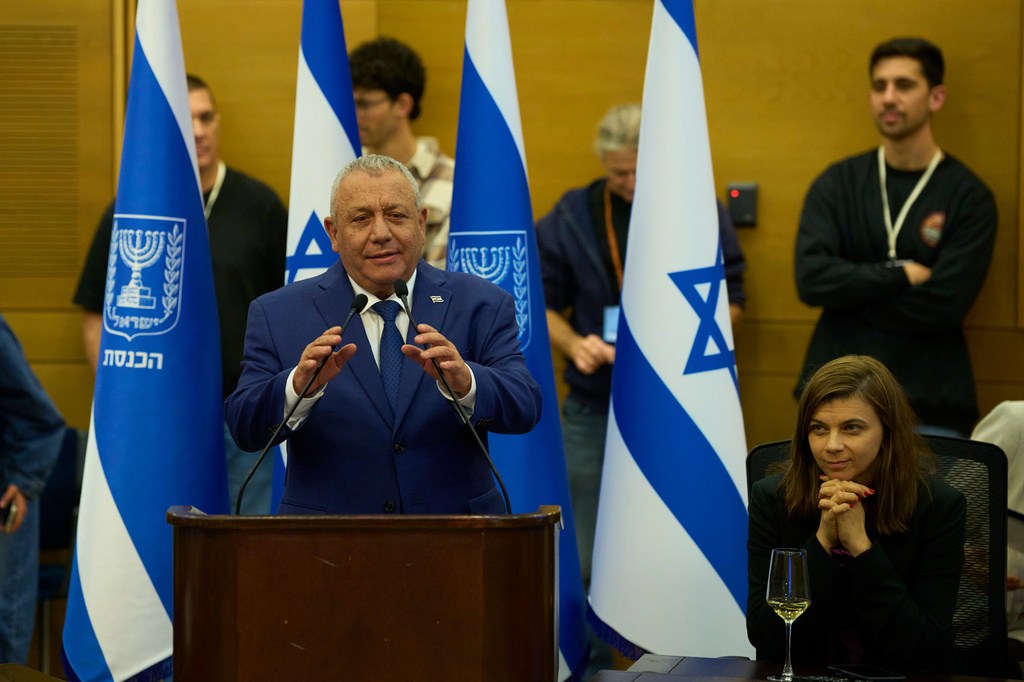
Gadi Eisenkot’s Yashar party reached a coalition deal with Yair Golan’s left-wing Democrats, putting them one step closer to forming a parliamentary majority in Israel’s Knesset.
Eisenkot and Golan announced the deal in a joint statement on Thursday. It was a notable reversal after the Democrats suspended negotiations Tuesday after finding out Yashar was carrying out parallel negotiations with Prime Minister Benjamin Netanyahu’s Likud party.
As part of the new coalition deal, the Democrats will be given four portfolios, including national security, labor and welfare (currently separate but set to merge under Eisenkot’s plan), communications, and culture and sports. They were further given the Social Equality Ministry, which will also be merged into one of the four portfolios.
The Democrats said in their statement that they unsuccessfully sought the Justice Ministry, but accepted a deal without it as “national responsibility require us to act swiftly, reach agreements and demonstrate a willingness to compromise.” The party added that to assuage their concerns, Yashar agreed to commit to a full repeal of Netanyahu’s controversial judicial overhaul.
“In doing so, we are paving the way for ending the Netanyahu government and saving Israeli democracy,” the Democrats said, noting that final details were being worked out before they signed.
Yashar won 21 seats, the second-highest share of the 120-seat Knesset, in October’s elections, behind Likud’s 27. The Democrats won eight seats, and the right-wing Yisrael Beiteinu, which previously struck a deal with Yashar, won seven. Altogether, Eisenkot has 36 seats, still short of the requisite 61 but in a stronger position than Netanyahu’s Likud, which has alienated most other significant parties.
The 12-seat Beyachad party, led by former Prime Ministers Naftali Bennett and Yair Lapid, is expected to join Yashar’s coalition, which would net Eisenkot a total of 48 seats.
The Democrats were widely expected to strike a deal with Yashar, in which lies its only hope of joining a government. Questions remain whether the two Arab parties, Joint List and Ra’am, with their 19 seats, will join the coalition. The Arab parties currently represent the only viable way for Eisenkot to form a majority, but the prospect remains highly controversial among Israelis, including many Yashar and coalition members.
The Democrats, with only eight seats, have been the only party openly warm to the Arab parties since the Oct. 27 elections. Eisenkot has imposed four conditions to coalesece, including explicitly declaring Hamas a terrorist group. The Joint List and Ra’am have both tried towing a middle line, largely avoiding commenting on the matter.
ISRAEL LAUNCHED FIRST ARMORED INCURSION INTO HAMAS TERRITORY SINCE CEASEFIRE
The only other way to form a majority would be winning over two highly conservative Jewish parties, United Torah Judaism and Shas, who would give Eisenkot exactly 61 seats.
Eisenkot has a mandate to form a majority coalition until Dec. 6, though President Isaac Herzog can extend the time to Dec. 20.
Continue reading...
[ H/T Washington Examiner ]