





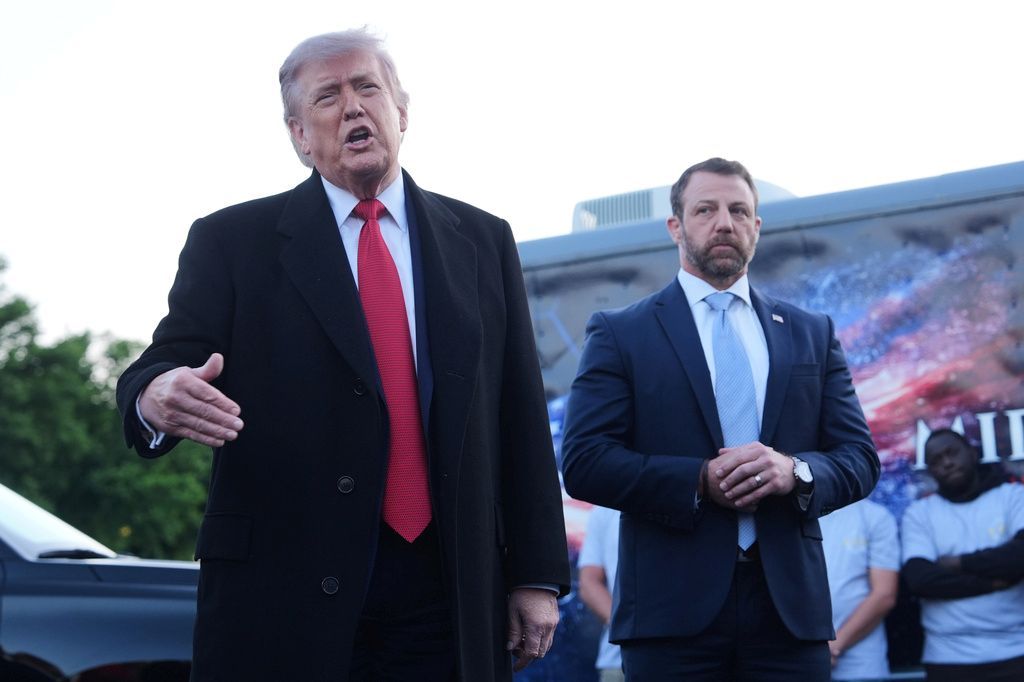
The Trump administration’s decision this week to extend deportation protection and work permits for Sudanese and Ukrainian illegal immigrants in the United States went against the White House’s vow to end these types of programs. Political pressure and armed conflicts abroad created difficult situations for administration officials to get around, leading them to continue the programs.
The continuation of temporary protected status for the two countries also costs federal immigration authorities the chance to arrest and deport more than 105,000 illegal immigrants who would have lost deportation protection had the program been canceled.
The Department of Homeland Security announced on Monday evening that both populations would “retain protections” until a final announcement is made on their status, adding that a decision “will be made at the appropriate time.” This means that Ukrainian and Sudanese immigrants can live and work in the U.S. until the department determines otherwise.
CBS News reported over the weekend that the Trump administration would extend TPS for the more than 105,000 people covered by the program for 18 additional months, going against President Donald Trump’s first- and second-term promises to end TPS for countries that have been protected under it for decades.
Roughly 103,700 Ukrainians and 1,900 Sudanese immigrants were eligible to apply for TPS as it was extended.
“Ukraine is a political hot potato so not touching it,” a senior Trump administration official aware of the decision prior to its announcement on Monday wrote in a text message to the Washington Examiner.
Andrew Arthur, resident fellow in law and policy at the Center for Immigration Studies in Washington, agreed that it likely came down to politics in the case of Ukraine.
“Ukraine is still at war with Russia, and with the (questionable and risible, to put it kindly) contentions that Trump is somehow pro-Putin, there is no way that DHS could have ended Ukraine TPS at this juncture without advancing that narrative,” Arthur wrote in a text message.
The initial decisions to grant TPS to both Sudan in 1997 and Ukraine in 2022 were the result of “ongoing armed conflict,” according to Aaron Reichlin-Melnick, senior fellow at the American Immigration Council.
“Under the law, the question for the Secretary is a factual one as to whether the armed conflict is still ongoing, and that’s it,” Reichlin-Melnick wrote in a text message. “This is different than situations where TPS is granted on the basis of ‘extraordinary and temporary conditions’ in a country, as there is no separate ‘national interest’ determination. That has been the rationale cited by the administration when terminating multiple TPS grants, but would not apply here.”
Arthur said the armed conflict in Sudan was legitimate when compared to conflicts in places like Haiti, where the Trump administration ended TPS earlier this year.
“Fighting between the Sudanese Armed Forces (SAF) and the Rapid Support Forces (RSF) has internally displaced about 9 million people in that country,” Arthur said. “Haiti and Somalia may be economic and criminal basket cases, but Sudan — like — is a war zone that fits the TPS ‘ongoing armed conflict’ definition in section 244(b)(1)(A) of the [Immigration Nationality Act].”
Former DHS Secretary Alejandro Mayorkas announced in March 2022 that the U.S. would grant TPS to Ukrainian citizens in the country amid Russia’s invasion, which began in February 2022.
Sudanese immigrants were given protection in response to an armed conflict and political instability that began in 1997 and had its status renewed.
OBAMA RIPS ‘APPALLING’ INVESTIGATION OF ILHAN OMAR: ‘SHOULD OUTRAGE ALL AMERICANS’
Under TPS, those from certain countries who were in the U.S. illegally at the time of a natural disaster, war, famine, or similar situation can apply for permission to legally remain at work in the country for two-year terms until their home country says it is stable for people to return.
The White House and DHS did not provide comment on the department’s decision to extend TPS.
Continue reading...
[ H/T Washington Examiner ]