






Super El Niño, Hormuz Fertilizer Squeeze, Black Sea: Goldman Sees Upside Risk To Food Prices
Wheat futures just touched a two-month low, which for some is a sign the food-inflation scare of the summer has come and gone. Goldman disagrees.
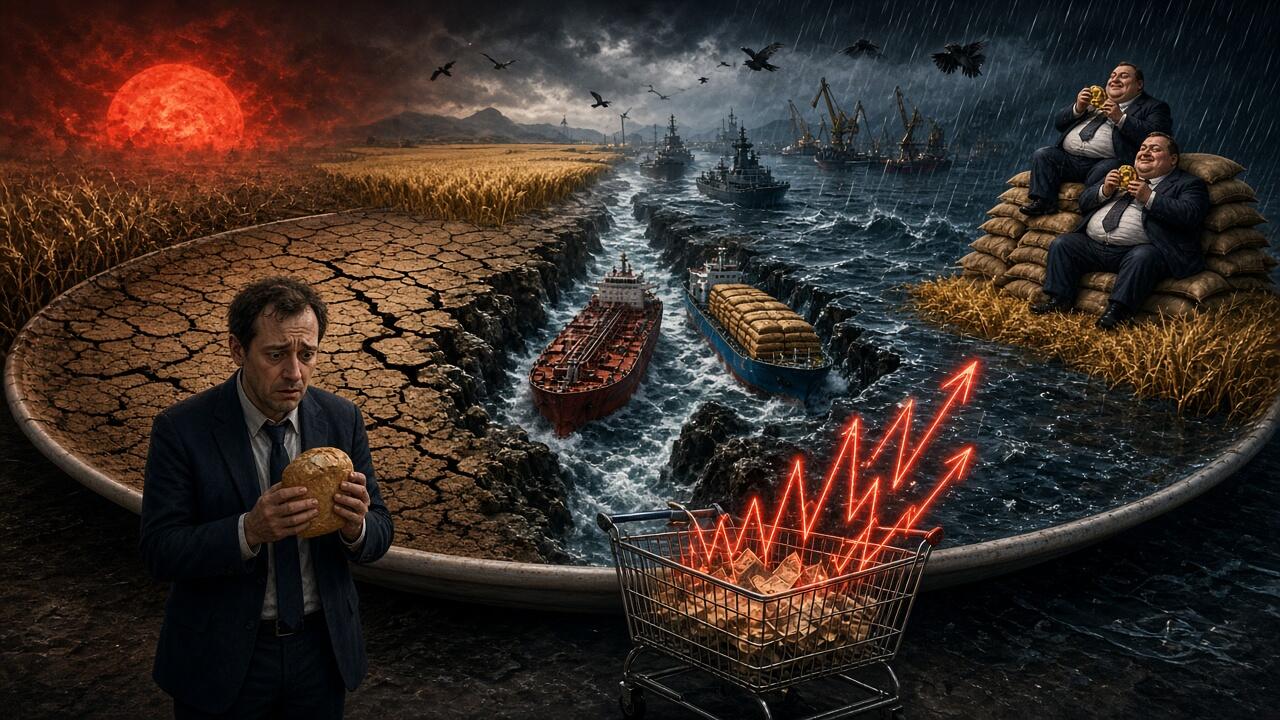
In a new note making the broader case for commodities as a portfolio hedge (available to pro subs), the bank's commodities team led by Daan Struyven and Lina Thomas lists agriculture as one of three tactical reasons to own the asset class, arguing that the Iran and Russia-Ukraine conflicts, a high probability of a weather-disrupting Super El Niño and potential food export restrictions all create upside risks to agricultural prices, which are already up 19% year-over-year on the BCOM agriculture index.
Regular readers will recall that the same team sounded the food-crisis alarm back in September (Sep 8), just days after global food prices hit 2022 highs (Sep 5). Six weeks later, with grain prices off the boil, the message is the same: don't confuse a correction with an all-clear.
As we put it at the time:
Below: what has rallied, why the September pullback happened, and the three shocks Goldman thinks could still send food prices higher.
The BCOM Agriculture Spot Index has climbed from 100 at the start of the year to roughly 120 (our read of the chart), with a clear step up after the Strait of Hormuz closed, again on renewed Black Sea tensions, and again after NOAA's super El Niño announcement in July. Soybean oil and sugar are each up 32% YoY, wheat 31%, soybean meal 29% and cotton 26%, while cocoa (-6%) and coffee (-22%) are the only major laggards.
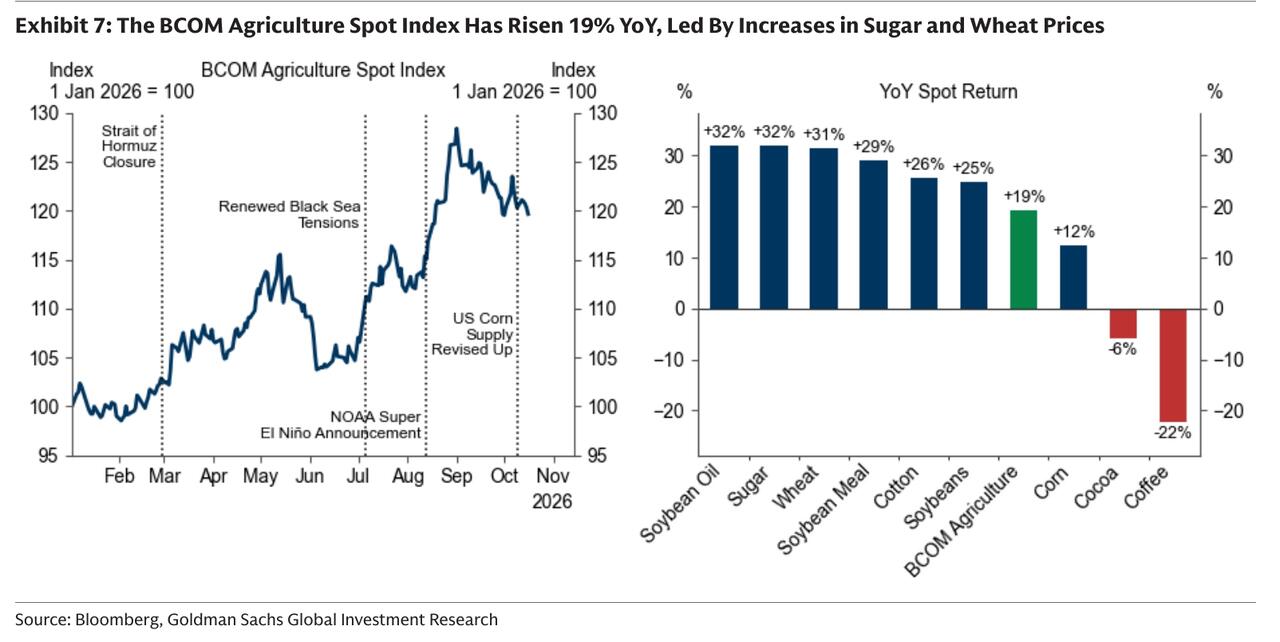
As for the recent dip, Goldman puts it down to the US, not the Gulf: grain prices corrected in September after US government data showed a less-tight-than-feared corn balance and speculative length began to reverse, "removing risk premium." In other words, the hot money left. The underlying risks did not.
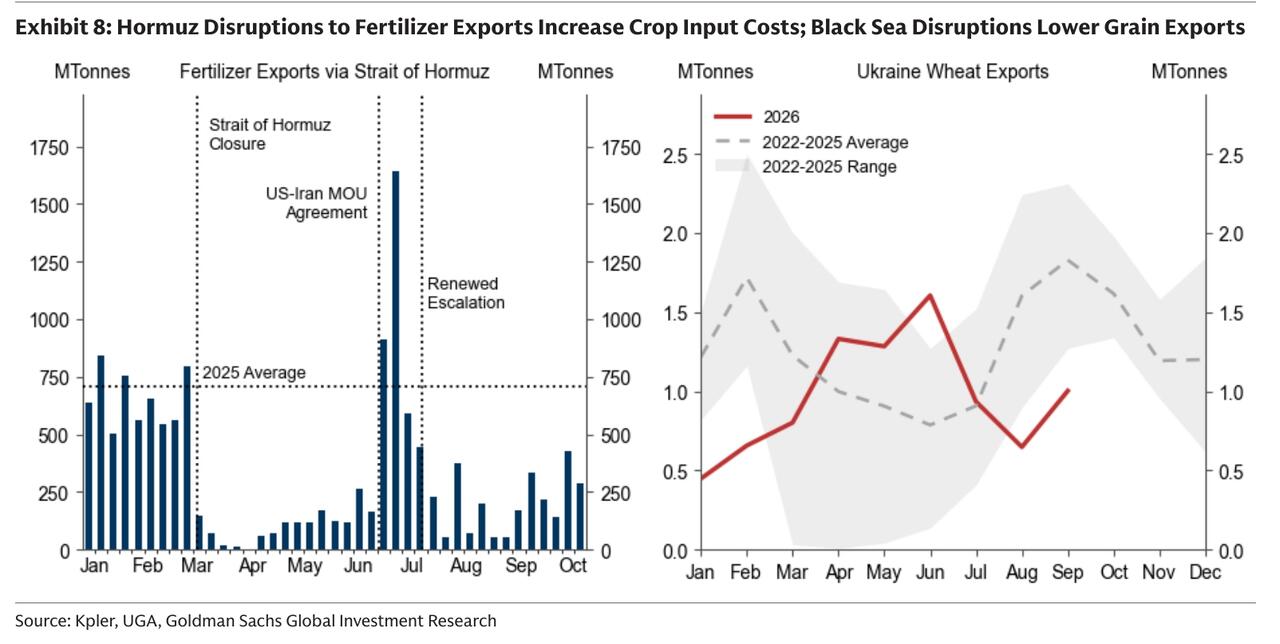
The Strait of Hormuz typically carries one third of global fertilizer exports, and those flows "remain low." The chart below is worth a moment: fertilizer exports through Hormuz collapsed after the strait closed in March, spiked briefly to more than double the 2025 average around the US-Iran MOU (our read of the chart) as stranded cargoes rushed out, then sank again on renewed escalation and have stayed well below normal since.
Fertilizer isn't the only input cost. The war also pushes up diesel for planting, harvesting and transport, and higher fuel prices plus biofuel mandates divert crops into fuel tanks: Brazil (sugar) and India (sugar/corn) have recently raised ethanol mandates, while Indonesia has raised palm-oil biodiesel blending mandates. Energy security, it turns out, is paid for at the supermarket. We have documented the farm-level fallout, with US farmers in "survival mode" as the war sent diesel costs soaring (Sep 22).
The Black Sea typically accounts for 15-20% of global grain trade, and the right-hand panel above shows Ukrainian wheat exports have slipped back below their 2022-2025 average after a mid-year bounce.
Weekend strikes between Russia and Ukraine have made any deal to restart exports "increasingly unlikely," according to Bloomberg, even as wheat futures slid to their lowest in more than two months.
The market, for now, is betting on ample supply elsewhere. Goldman is betting the market is too relaxed.
The weather wildcard is the big one. Citing NOAA's October ENSO strength forecast, Goldman puts the probability of the current El Niño reaching "super" strength (Niño-3.4 relative index at least +2.0°C this winter) at 81%. That is actually down from the more than 90% the bank cited in September, but it still means a better than four-in-five chance of something we have previously described as the strongest El Niño in 75 years (Jul 9).
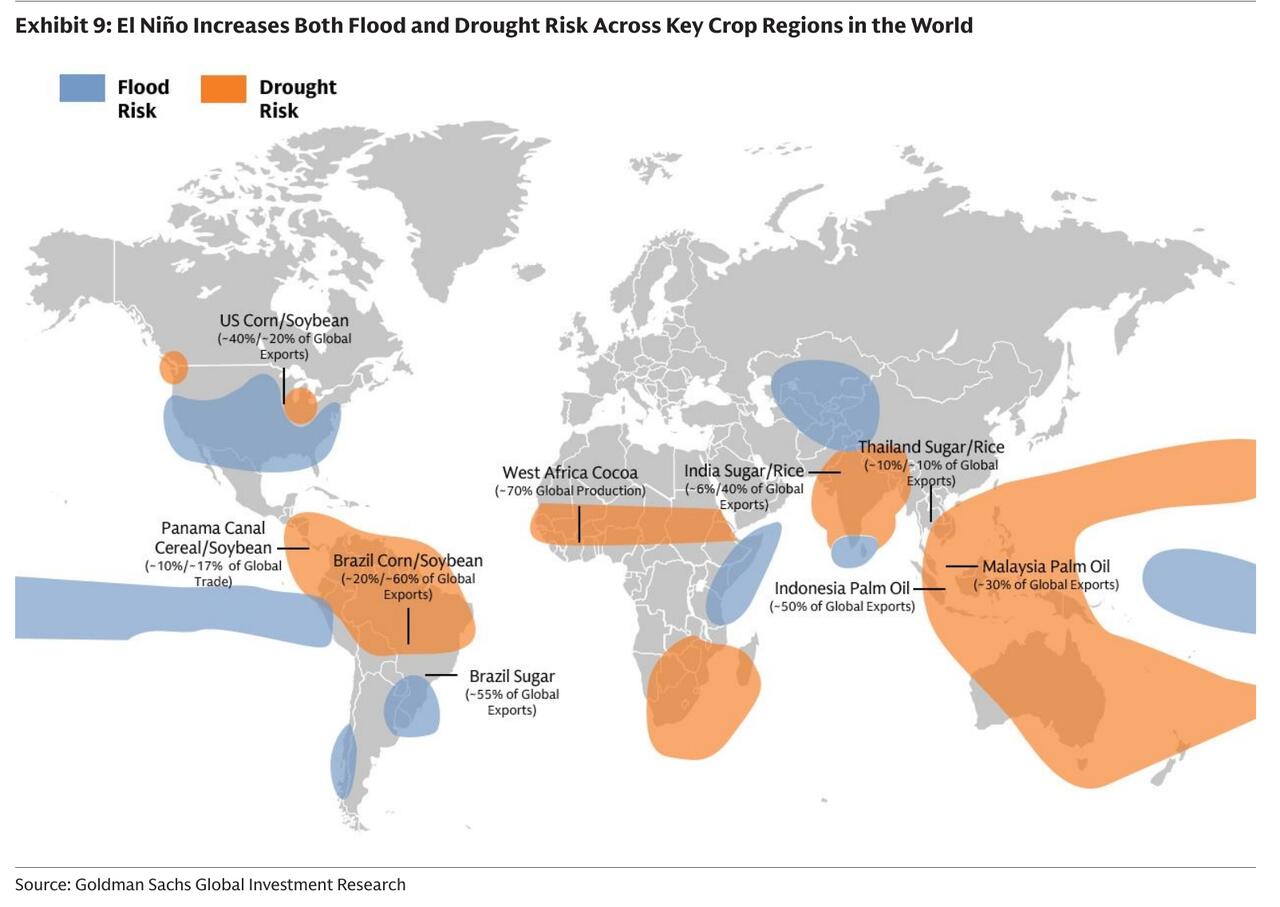
The map shows why "simultaneously" is the key word: flood risk across the US corn and soybean belt (roughly 40% of global corn and 20% of soybean exports), drought risk across Brazil's corn and soy belt, India and Thailand's sugar and rice, West African cocoa, and Southeast Asian palm oil, which accounts for most of the world's exports. Even Panama Canal grain flows are on the list, which will not surprise anyone who saw NOAA's winter outlook (Oct 15).
JPMorgan has already pinpointed when El Niño could start wreaking havoc on food supply chains (Sep 19), so Goldman is in good company here.
The fourth ingredient is policy. In September, Thomas and Struyven warned that these shocks are hitting "an increasingly inward-looking agriculture market," where precautionary export restrictions and stockpiling can remove far more supply from global markets than the original disruption itself. Today's note keeps "potential food export restrictions" on the list of upside risks. Put differently: the first country to ban rice exports rarely ends up being the last.
The September correction looks like positioning, not fundamentals: specs bailed on a friendlier-than-feared US corn number, while every one of the actual supply threats (Hormuz fertilizer, the Black Sea, the El Niño, the mandates) is still in place. And food is the inflation that central banks can't look through and voters never forget. A world where energy shocks already drive bonds and equities lower together is not one that needs a second, weather-driven price shock layered on top, but that is precisely the setup heading into a super El Niño winter.
We'll check back after the next NOAA ENSO update in November.
Much more in the full Goldman "Commodity Views: Conflict, Climate and the Case for Commodity Diversification" note, available to pro subs.
Tyler Durden Wed, 10/21/2026 - 08:00
Continue reading...
[ H/T ZeroHedge ]
Wheat futures just touched a two-month low, which for some is a sign the food-inflation scare of the summer has come and gone. Goldman disagrees.
In a new note making the broader case for commodities as a portfolio hedge (available to pro subs), the bank's commodities team led by Daan Struyven and Lina Thomas lists agriculture as one of three tactical reasons to own the asset class, arguing that the Iran and Russia-Ukraine conflicts, a high probability of a weather-disrupting Super El Niño and potential food export restrictions all create upside risks to agricultural prices, which are already up 19% year-over-year on the BCOM agriculture index.
Regular readers will recall that the same team sounded the food-crisis alarm back in September (Sep 8), just days after global food prices hit 2022 highs (Sep 5). Six weeks later, with grain prices off the boil, the message is the same: don't confuse a correction with an all-clear.
As we put it at the time:
Below: what has rallied, why the September pullback happened, and the three shocks Goldman thinks could still send food prices higher.
Up 19% YoY, Even After The Pullback
The BCOM Agriculture Spot Index has climbed from 100 at the start of the year to roughly 120 (our read of the chart), with a clear step up after the Strait of Hormuz closed, again on renewed Black Sea tensions, and again after NOAA's super El Niño announcement in July. Soybean oil and sugar are each up 32% YoY, wheat 31%, soybean meal 29% and cotton 26%, while cocoa (-6%) and coffee (-22%) are the only major laggards.
As for the recent dip, Goldman puts it down to the US, not the Gulf: grain prices corrected in September after US government data showed a less-tight-than-feared corn balance and speculative length began to reverse, "removing risk premium." In other words, the hot money left. The underlying risks did not.
Shock 1: Hormuz Starves The Fertilizer Trade
The Strait of Hormuz typically carries one third of global fertilizer exports, and those flows "remain low." The chart below is worth a moment: fertilizer exports through Hormuz collapsed after the strait closed in March, spiked briefly to more than double the 2025 average around the US-Iran MOU (our read of the chart) as stranded cargoes rushed out, then sank again on renewed escalation and have stayed well below normal since.
Fertilizer isn't the only input cost. The war also pushes up diesel for planting, harvesting and transport, and higher fuel prices plus biofuel mandates divert crops into fuel tanks: Brazil (sugar) and India (sugar/corn) have recently raised ethanol mandates, while Indonesia has raised palm-oil biodiesel blending mandates. Energy security, it turns out, is paid for at the supermarket. We have documented the farm-level fallout, with US farmers in "survival mode" as the war sent diesel costs soaring (Sep 22).
Shock 2: The Black Sea
The Black Sea typically accounts for 15-20% of global grain trade, and the right-hand panel above shows Ukrainian wheat exports have slipped back below their 2022-2025 average after a mid-year bounce.
Weekend strikes between Russia and Ukraine have made any deal to restart exports "increasingly unlikely," according to Bloomberg, even as wheat futures slid to their lowest in more than two months.
The market, for now, is betting on ample supply elsewhere. Goldman is betting the market is too relaxed.
Shock 3: The Super El Niño
The weather wildcard is the big one. Citing NOAA's October ENSO strength forecast, Goldman puts the probability of the current El Niño reaching "super" strength (Niño-3.4 relative index at least +2.0°C this winter) at 81%. That is actually down from the more than 90% the bank cited in September, but it still means a better than four-in-five chance of something we have previously described as the strongest El Niño in 75 years (Jul 9).
The map shows why "simultaneously" is the key word: flood risk across the US corn and soybean belt (roughly 40% of global corn and 20% of soybean exports), drought risk across Brazil's corn and soy belt, India and Thailand's sugar and rice, West African cocoa, and Southeast Asian palm oil, which accounts for most of the world's exports. Even Panama Canal grain flows are on the list, which will not surprise anyone who saw NOAA's winter outlook (Oct 15).
JPMorgan has already pinpointed when El Niño could start wreaking havoc on food supply chains (Sep 19), so Goldman is in good company here.
The Multiplier: Export Bans
The fourth ingredient is policy. In September, Thomas and Struyven warned that these shocks are hitting "an increasingly inward-looking agriculture market," where precautionary export restrictions and stockpiling can remove far more supply from global markets than the original disruption itself. Today's note keeps "potential food export restrictions" on the list of upside risks. Put differently: the first country to ban rice exports rarely ends up being the last.
Bottom Line
The September correction looks like positioning, not fundamentals: specs bailed on a friendlier-than-feared US corn number, while every one of the actual supply threats (Hormuz fertilizer, the Black Sea, the El Niño, the mandates) is still in place. And food is the inflation that central banks can't look through and voters never forget. A world where energy shocks already drive bonds and equities lower together is not one that needs a second, weather-driven price shock layered on top, but that is precisely the setup heading into a super El Niño winter.
We'll check back after the next NOAA ENSO update in November.
Much more in the full Goldman "Commodity Views: Conflict, Climate and the Case for Commodity Diversification" note, available to pro subs.
Tyler Durden Wed, 10/21/2026 - 08:00
Continue reading...
[ H/T ZeroHedge ]