



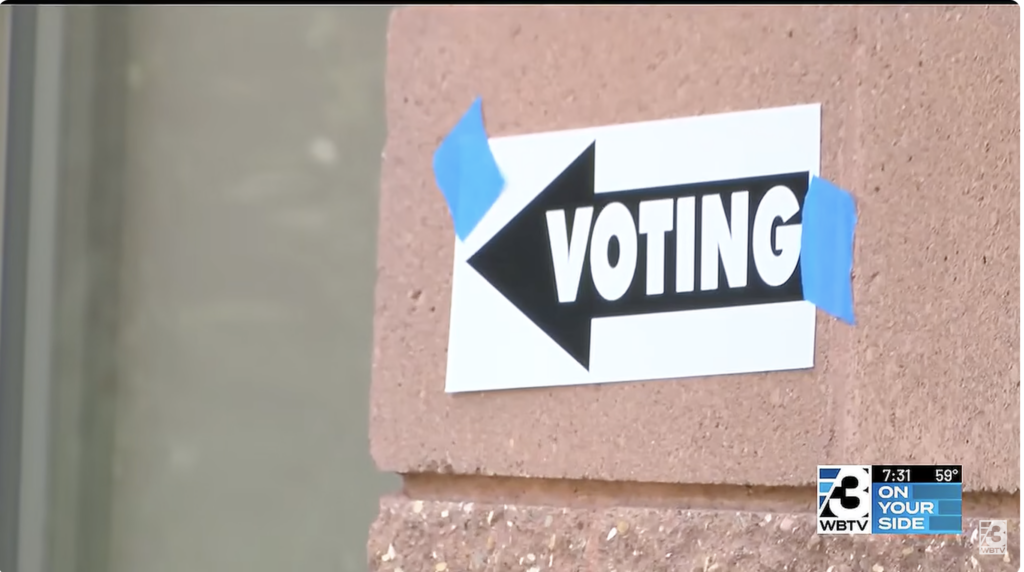


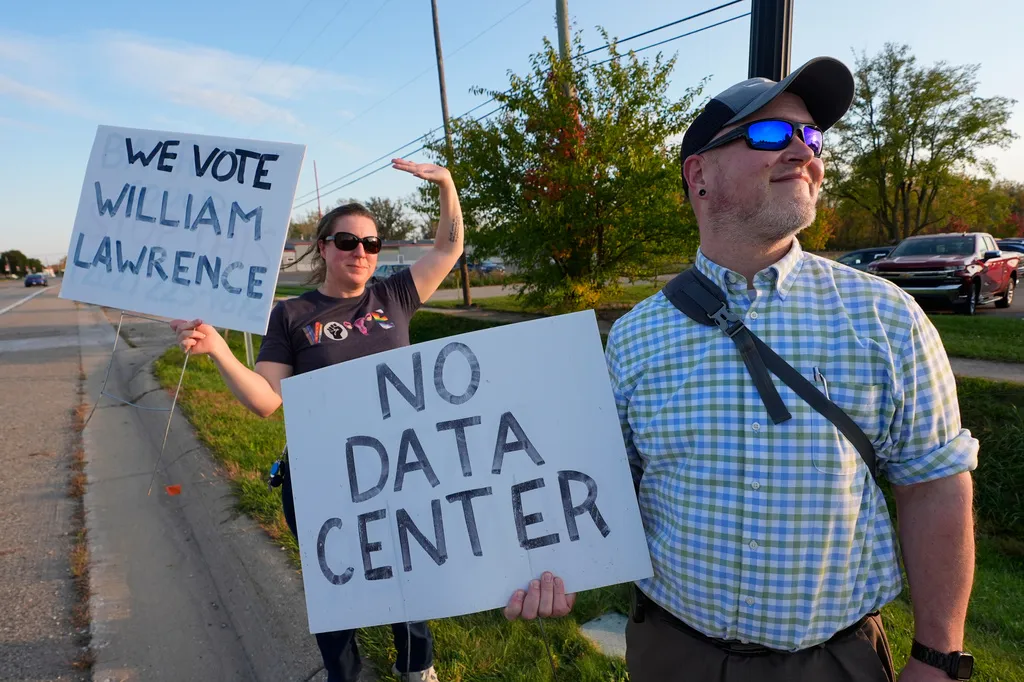
Voters across the country in this year’s midterm elections will decide on ballot initiatives to slow down development or issue guardrails for data centers, which have seen sharply increasing public backlash.
President Donald Trump has pushed for data center development, arguing they are necessary in order to win the artificial intelligence race against China. However, the 41 ballot measures across eight states reveal the growing public opposition to data centers.
Communities across the country have raised concerns about data centers increasing energy costs, water usage, and noise pollution.
As of September, more than half of people say that data centers are mostly bad for the environment, up from 39% in January, a Pew Research poll found. Half believe data centers are mostly bad for home energy costs and 49% say they are mostly bad for people’s quality of life nearby, up from 30% in January.
Moratoriums and bans
Of the 41 ballot measures, three would temporarily pause data center development. For instance, the city of Bloomington, Illinois, will vote on an initiative to advise the city to impose a moratorium on large-scale data centers.
A measure in York County, Maine, would set a 180-day moratorium on data centers. One in Wiscasset, Maine, would set a six-month moratorium for new or expanded data centers.
In the past year, moratoriums have become popular among local governments as a way to slow down development to provide additional time to set guardrails on data centers.
Some lawmakers in Congress have also called for a federal moratorium, including House Energy and Commerce Committee ranking member Frank Pallone (D-NJ).
Others who have called for a moratorium include Rep. Alexandria Ocasio-Cortez (D-NY) and Sen. Bernie Sanders (I-VT), who introduced a bill in March to pause new data center development as lawmakers work on regulations for AI.
Some communities and voters have sought to take it a step further with some ballot measures pushing for outright bans of data centers in their communities.
Voters in the city of Alhambra, California, will decide whether to ban data centers in their town. If the measure passes, Alhambra would become the second city in California to outright ban data centers. In Monterey Park, voters passed a ban on data centers earlier this summer.
Ohio voters push back against data centers
Ohio accounts for the highest number of ballot measures related to data centers in the country.
Ohio has 21 measures that address data centers, with five that would outright ban them, in the cities of Granville, Hubbard, Piqua, Upper Sandusky, and Urbana.
Data centers have rapidly become a major issue in Ohio, which has over 200 data centers, the fifth most of any state. Most are in central Ohio, where there is available land and transmission access.
Data centers are also playing a central role in the Ohio Senate race between former Democratic Sen. Sherrod Brown and Sen. Jon Husted (R-OH). Both candidates have not expressed support for outright bans of data centers but have different approaches to regulating the AI facilities.
Brown has centered his campaign on taking down “big corporations” that are raising utility bills to defend communities and resources. He said data centers should pay the full cost of their utility use.
“Ohioans shouldn’t be forced to subsidize these costs,” Brown says on his website. He has noted that data centers should safely process water by using closed-loop water systems and called for an end to data center tax breaks.
Brown has also spent millions on ads attacking Husted, claiming that he promoted data center construction when he was lieutenant governor.
In September, Husted sponsored the Ratepayer Protection Act, a bill that would require states to consider standards for new data centers to cover the costs of new generation, transmission, and infrastructure upgrades.
The House passed it earlier this year with bipartisan support. But Senate Democrats blocked the bill from passing in the upper chamber last month, arguing it did not go far enough because compliance is voluntary, denying a win for Republicans ahead of the midterm elections.
In a statement to the Washington Examiner, Husted said: “Data centers are, and should remain, a local decision. Every community has different priorities, and local leaders are best equipped to decide what’s right for their residents.”
Over the summer, the National Republican Senatorial Committee warned tech companies that data centers were becoming extremely unpopular, and Democrats have made it a “centerpiece” of their campaigns, specifically pointing to the Ohio Senate race.
Other data center restrictions on the ballots
Several other ballot measures would impose restrictions, requirements, or voter approval on data center development.
Voters in Morgan County, Illinois, will decide whether to advise officials to impose restrictions on construction and operation of data centers in the county. Seven jurisdictions in the state of Illinois will have data center-related ballot measures.
In Hardwood, North Dakota, residents will be voting on a measure aimed at creating more transparency from local officials on data center development. If passed, it would require additional review before the city approves industrial developments, including data centers.
Measures in Grove City, Ohio, and Janesville, Wisconsin, would require voter approval for developments. Voters across the country have demanded more say and transparency on data center developments in their communities.
LIST: WHERE ALL THE CANDIDATES IN COMPETITIVE RACES STAND ON DATA CENTERS
In Grove City, residents will decide whether to require voter approval of projects, expansions, or property transfers involving at least 50 contiguous acres, more than 20 megawatts of peak electrical demand, or more than 500,000 gallons of water per day, and establishing standards for approved facilities.
Residents in Janesville will decide whether to require voter approval for any development project, lease, sale, or transfer exceeding $450 million on the undeveloped General Motors site.
Continue reading...
[ H/T Washington Examiner ]