







The midterm “bluenami” has changed the electoral map for the presidency and Congress in ways that could make it harder for Republicans in political cycles to come.
Most notably, Senate Republicans may be out of power until at least after the 2030 midterm elections, and the path for Democrats to the White House in 2028 has been widened by the party’s historic gains in once-deep-red territories such as Texas, South Carolina, and Kansas. With outstanding Senate races in Alaska and Mississippi, where Democratic challengers lead the incumbent Republicans, along with several House races, the fallout for the GOP is not yet over.
“If [Republicans] don’t learn the lessons, then they have no chance in 2028, and they’re going to be in the wilderness for a long time,” centrist former Maryland Republican Gov. Larry Hogan said at the Ronald Reagan Institute in Washington. “But if they take this as a teachable moment to say, ‘Hey, we had to hit rock bottom before we decided to try to do things differently,’ then I think we’ve got a chance to come back.”
These are the battleground states and regions where control of the White House and Congress are likely to be determined in the 2028 general elections.
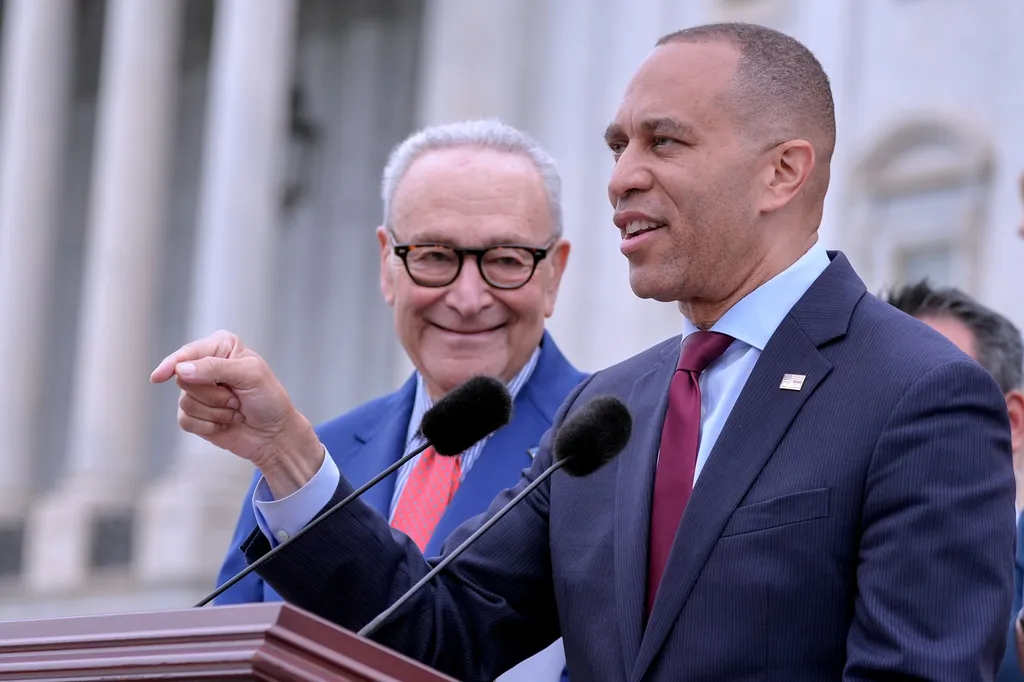
House Minority Leader Hakeem Jeffries, D-N.Y., right, speaks as Senate Minority Leader Chuck Schumer, D-N.Y., left, listens during a news conference, Thursday, May 21, 2026, on Capitol Hill, in Washington. (AP Photo/Mariam Zuhaib)
" data-large-file="https://www.washingtonexaminer.com/wp-content/uploads/2026/11/AP26141564706498.jpg?w=1024" src="https://www.washingtonexaminer.com/wp-content/uploads/2026/11/AP26141564706498.jpg?w=1024" alt="House Minority Leader Hakeem Jeffries, D-N.Y., right, speaks as Senate Minority Leader Chuck Schumer, D-NY, left, listens during a news conference, Thursday, May 21, 2026, on Capitol Hill, in Washington. " class="wp-image-4795855" srcset="https://www.washingtonexaminer.com/wp-content/uploads/2026/11/AP26141564706498.jpg 1024w, https://www.washingtonexaminer.com/wp-content/uploads/2026/11/AP26141564706498.jpg?resize=300,200 300w, https://www.washingtonexaminer.com/wp-content/uploads/2026/11/AP26141564706498.jpg?resize=768,512 768w" sizes="(max-width: 1024px) 100vw, 1024px">
House Minority Leader Hakeem Jeffries, D-N.Y., right, speaks as Senate Minority Leader Chuck Schumer, D-NY, left, listens during a news conference, Thursday, May 21, 2026, on Capitol Hill, in Washington. (AP Photo/Mariam Zuhaib)
White House
Gone are the days of only seven swing states from the 2024 presidential election. Democrats have more than doubled that figure for 2028, based on Senate and governor performances in longtime red states.
In 2024, all eyes were on Arizona, Michigan, North Carolina, Georgia, Nevada, Pennsylvania, and Wisconsin. Altogether, those states accounted for 93 electoral votes.
Now, Ohio, Iowa, and Florida are also back in the mix, along with the former GOP strongholds of South Carolina, Kansas, Texas, Alaska, and Mississippi. Those states make up another 117 votes.
The sprawling map sets the stage for a historically expensive contest. But it will also test whether Democrats’ downballot successes can translate upward.
It’s far from certain that states such as Texas, Kansas, and South Carolina, which elected Democratic senators or governors for the first time in decades, will be equally competitive for president two years from now. But Democrats are already saying that’s the case. Republicans are hoping that this cycle was a fluke as backlash to President Donald Trump and his administration’s handling of affordability issues, especially tariffs and the gas price hike attributable to the war with Iran.
“But everyone knows why we lost. And any honest conversation about where we go from here must start there,” Vice President JD Vance, a possible 2028 presidential candidate, wrote in a lengthy post-election analysis. “To the people who are just pissed at the results, you should be. Let’s take that anger and get back to the work of saving our country.”
Senate
This cycle, Democrats have so far flipped seven GOP-held Senate seats: South Carolina, North Carolina, Texas, Maine, Ohio, Iowa, and Kansas. Republican seats in Alaska and Mississippi remained too close to call. Democrats are looking at a 54-seat majority minimum that could expand to 56.
In 2028, the map doesn’t get much better for Republicans, likely keeping Democrats in control of the upper chamber no matter the outcomes of the White House and House until at least the 2030 cycle.
Turn on JavaScript to see the 2026 results map.
“Winning in states that have been red for a decade, or even decades, can’t be a one-time phenomenon,” Senate Minority Leader Chuck Schumer (D-NY) said in a speech at the Center for American Progress. “Some of the very same states where we won this election will offer new opportunities to expand our majority in 2028: Iowa, Kansas, the Carolinas, and more.”
He continued: “As we look to 2028 and beyond, we need to start identifying — now, in 2027 — to solidify our position in the states we won, build up our party infrastructure in those areas, and continue to expand the map into new states.”
Republicans will have to defend at least seven competitive seats that are up in 2028: North Carolina, Iowa, Wisconsin, Florida, Kansas, Alaska, and South Carolina.
Democrats will need to defend the same figure: Nevada, Pennsylvania, New Hampshire, Arizona, Ohio, Georgia, and Minnesota. The deck is even further stacked in Democrats’ favor, considering all of those states have trended blue in recent cycles either for president, governor, or senators.
“As we head into 2027, Senate Republicans will not stand idly by as the far-left, socialist wing of the Democrat Party attempts to unwind everything we’ve done,” Senate Majority Leader John Thune (R-SD) posted. “Thankfully, we still have President Trump in the White House, and we’ll work with him to stop the worst impulses of Democrat extremism. We cannot let their fringe positions become the mainstream.”
House
Democrats flipped so many seats in the House that they built a southern border wall of blue districts. As of Friday, the number of flipped seats stood at more than 40 and was likely to climb further from outstanding races, giving Democrats a majority also north of 40.
The 2024 battleground House map featured roughly 54 seats that were either toss-ups or slightly favored either party, according to nonpartisan election forecast Cook Political Report. Only 12 of them were held by Democrats, compared to 42 by Republicans.
The number of competitive seats will grow in 2028, but it’s not yet clear by how many. Democrats will have far more new districts to defend after flipping so many, which spanned states including Texas, Pennsylvania, Arizona, California, Nevada, Iowa, Wisconsin, Michigan, Colorado, North Carolina, Ohio, Virginia, and New Jersey.
Midcycle redistricting could also play a factor.
The effort to redraw House seats to boost Republicans in places such as Texas, Florida, Ohio, and North Carolina backfired this cycle. Republicans won just 2 of 15 of those seats across the country, while Democrats in California won all five of the state’s redrawn districts. Those races outside California could be particularly tough places for Democrats to retain their seats.
State governments
Democrats also created new power trifectas nationwide thanks to the party’s blue wave, sweeping control of state governments and enabling them to redraw more congressional maps in their favor before the 2028 elections, should they choose to do so. Democrats added at least five states where they will control both legislative chambers and the governor’s office: Michigan, Minnesota, Nevada, Pennsylvania, and Wisconsin.
But it’s not yet clear whether state Democrats have the desire to continue the redistricting wars started by Trump and Texas Republicans, or if national party leaders will prod them to do so. Some state leaders have already resisted the effort, such as Gov. Mikie Sherrill (D-NJ), while others like Gov. Wes Moore (D-MD), a possible 2028 White House hopeful, are forging ahead.
WHERE DEMOCRATS COULD USE THEIR LANDSLIDE VICTORIES TO REDISTRICT
House Minority Leader Hakeem Jeffries (D-NY), poised to become speaker of the House in January, did not rule out pressuring Democratic governors and legislatures to redraw districts next year in Democrats’ favor.
“They messed around, and now they’re going to find out,” Jeffries told reporters of further countering Republicans.
Continue reading...
[ H/T Washington Examiner ]