

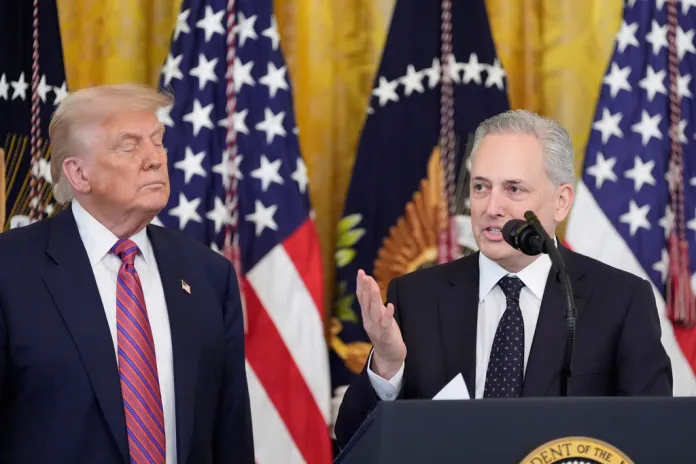
One of President Donald Trump’s top advisers on artificial intelligence suggested Wednesday the recent deluge of warnings about AI from industry marks little more than a political ploy.
David Sacks, who co-chairs President Donald Trump’s Council of Advisors on Science and Technology, described the idea that “AI is going to end civilization within a very short amount of time,” which has been perpetuated as a possibility by Anthropic and OpenAI over the past week, as a “hoax,” during Politico’s Decoded Summit in Washington, D.C.
Those companies are now calling for certain government coordination and a series of reforms they say will make the industry safer. But Sacks posited that existing product liability regulations overseeing the industry and other barriers to existential threats are already in place. The debate has been orchestrated to raise panic ahead of the midterm elections, he suggested, and manipulate politicians into giving major AI companies a victory in what is disguised as an effort to make AI safer. Sacks suggested the Anthropic researcher Jacob Coxon’s resignation from the company, which sparked Anthropic’s and OpenAI’s new emphasis on reform, was less than organic, and pointed to former President Barack Obama’s comments on AI to argue that the existential debate is driven more by political ploys than a real crisis.
“We should just realize that we’re seven weeks away from an election, and so what’s happening is a fairly technical conversation about, you know, alignment is now being seized on and is being politicized by basically political actors who want to use it,” Trump’s adviser said.
“I mean, look, even President Obama just came out and said Democrats should use this issue in the election,” he said. “So we should just realize that that’s happening at the same time that there is a conversation, a needed technical conversation happening about how do we give users what they want from AI, as opposed to getting an, let’s say, unexpected result.”
Coxon’s resignation: Viral tweet or ‘orchestrated’ campaign?
Sacks suggested the publicization and timing of Coxon’s resignation from Anthropic was “part of an orchestrated media campaign” designed to instill fear, after the researcher announced last week he was leaving in a viral post to X that warned, “AI could kill us all by the end of the decade.” That announcement sparked the latest wave of calls for an AI “slowdown,” and suggestions from top leaders such as OpenAI’s Sam Altman and Anthropic CEO Dario Amodei that unless their calls for certain changes are met, AI could be used to destroy humanity.
“The Wall Street Journal somehow published an article about his resignation tweet storm 18 minutes before that tweet storm was actually posted,” Sacks said. “Yet he claimed he wasn’t working with anybody on this. It’s like, come on, we have to recognize that we’re seven weeks before an election, and there’s a huge incentive here to create these narratives to alarm the public.
“The media is pumping out all this fear that makes the public alarmed, and then they poll on that, and then sure enough, the polling reflects that sense of alarm. Then they take those polls to the politicians and say, ‘See, the public is afraid.’ So then you get all these politicians saying, ‘Oh, we have to do something,’ right?” Sacks said. “We’ve seen this in the past. … This is the fear. We had elements of this with COVID.”
When pressed to say whether he believes there is a zero percent chance of AI destroying humanity, Sacks declined to offer a direct answer, saying that “if we do the right things,” and AI labs “take responsibility for the development of their products, then I think it is zero.” The White House adviser repeatedly raised concerns that companies such as Anthropic and OpenAI are deflecting their core responsibility to handle the technology, pointing to a recent incident in which around 700 OpenAI agents appeared to autonomously hack into Hugging Face, an episode that stoked concerns about the ability of AI to act rationally without human direction.
“You could say the agents escaped the lab,” he said. “OK, that’s one way of talking about it. Another way of talking about it is that OpenAI did not have control over their lab. The agents were not supposed to be able to get on the internet; they did. That was potentially negligent, and then there was no monitoring of what was happening for about a week. So you could argue that was negligent as well … product liability would definitely attach in that case if there had been actual damages.
“I don’t think we should talk about these matters in ways that obscure the fact that it is the responsibility of these companies to maintain control, and if they don’t maintain control, they are actually liable,” Sacks said. “Obviously there are risks associated with the technology, and we should have an intelligent conversation about how to manage those risks. … What I don’t want to do is have a conversation that deflects responsibility and accountability away from those companies.”
OpenAI and Anthropic: Are their doomsday predictions valid?
Sacks was pressed on whether it was wise to frame concerns about AI getting out of control as a “hoax,” as Trump has done. He responded that he believes there are plenty of incentives in place designed to incentivize AI companies in the U.S. against building products that would pose a threat to humanity, saying, “You have the court system; you have the plaintiffs’ bar again, civil lawsuits; you have potential criminal liability; you have the whole regulatory state.” Sacks also argued that concerns were raised by some of the same people who have made similarly inaccurate “fear-mongering” predictions about AI in the past.
“Just last year, OK, we were told that there’d be a jobs apocalypse with respect to AI,” Sacks said. “In fact, it was the same people promoting this new apocalypse. Dario Amodei said that we would have 10 to 20% unemployment. We’d have a knowledge worker bloodbath. Has any of that come true? No, it hasn’t. In fact, we’ve seen huge amounts of net job creation, and we’re at near record lows on unemployment right now.”
ANTHROPIC CEO PITCHES AI SLOW-DOWN PLAN AFTER OPENAI-HUGGING FACE HACK: ‘WE OWE IT TO HUMANITY’
While he praised aspects of Mark Zuckerberg’s Meta’s approach to the debate, Sacks raised fears, based on Amodei’s essay on AI reforms, that Anthropic and Altman’s OpenAI are looking to gain antitrust exemptions that would create a type of technology cartel in the U.S. He continued to criticize the two companies over their positioning on “Pacing the Frontier,” arguing they should be “internalizing a sense of responsibility instead of deflecting it, instead of seeking antitrust waivers, instead of seeking product liability waivers, which they are trying to do.”
“There are a lot of companies in America that would love to be free from competition, but we don’t give them that,” Sacks said. “When Dario [Amodei] says we have to pace the frontier, he almost makes it sound like it’s somebody else. You know, if you look at the frontier right now, it’s two companies: it’s Anthropic and OpenAI. They have a duopoly market share in this country. If you measure it based on revenue, if you look at model capabilities, the frontier is two companies.”
Continue reading...
[ H/T Washington Examiner ]