



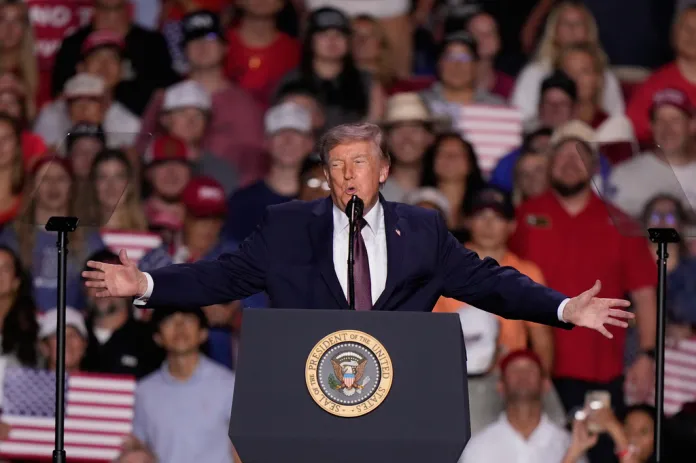


President Trump walked straight into one of the hottest political fights in Ohio on Saturday night — and refused to pretend there is an easy answer.
America needs the computing power to win the artificial-intelligence race. Ohio wants the jobs, construction and investment that come with it.
But families and small businesses should not be handed the electric bill for somebody else’s multibillion-dollar data center.
That is the line Trump drew in Vandalia: keep the investment in America and make the companies carrying enormous new power demands pay their own way.
Do not hand China a victory because Washington could not solve the cost problem.
That is a much tougher argument than simply shouting “yes” or “no” at every new project — and it may be the only serious one on the table.
The Associated Press reports that Trump defended the data-center buildout during his rally for Republican Sen. Jon Husted. Husted’s reelection fight against former Democratic Sen. Sherrod Brown has become one of the most closely watched races in the country.
Trump acknowledged the pressure the issue has created in Ohio, where residents are looking at higher power demand, construction disruption and questions about who pays for grid upgrades. He then made the economic and national-security case plainly: Ohio stands to make enormous money from the projects, and rejecting them outright would send that investment somewhere else.
“Look, there’s so much money to be made for Ohio,” Trump told the crowd. “You can’t just turn them off. They’ll go to China.”
The warning matters because data centers are not ordinary warehouses. They can consume the power of a small city, and the new transmission lines, substations and generating capacity needed to support them can cost billions.
That does not make the industry dispensable. It makes the payment structure decisive.
Trump also praised Husted’s effort to put federal pressure behind the principle that the largest new users should bear the costs they create. That turns the argument from a false choice — innovation or affordable electricity — into a direct question of accountability.
All roads today in Ohio lead to Vandalia.
Welcome back to Ohio, President Trump!pic.twitter.com/z9c9UxIhqR
— Ohio Republican Party (@ohiogop) October 3, 2026
The administration has already begun building a national framework around that idea. In July, the White House announced that more than 200 utilities, power cooperatives, data-center developers and state leaders had joined its Ratepayer Protection Pledge.
The pledge is not a ban on data centers. It is a commitment to prevent the cost of serving massive new computing facilities from simply washing through to everybody else’s monthly bill.
The White House says participating companies are expected to support the power generation and grid infrastructure their projects require, while utilities and state regulators design rates that do not force residential customers to underwrite corporate expansion. The administration also wants new generation built quickly enough to avoid a scramble for limited electricity that could push prices higher across an entire region.
That approach fits Trump’s broader AI strategy. The White House AI Action Plan calls for faster permitting of data centers, semiconductor plants and the energy infrastructure needed to run them.
The plan treats computing capacity as strategic infrastructure, alongside chips and power generation. Its goal is to keep the next generation of computing, manufacturing and national-security technology under American control.
It also recognizes a hard physical fact: software may be weightless, but AI is not. Training and running advanced models takes land, cooling systems, transmission capacity and a huge supply of dependable electricity.
If the United States cannot approve and power those facilities, the investment does not disappear. It moves to countries willing to build them, taking the supply chains, engineering talent and leverage with it.
The political risk is obvious, however. Voters will not celebrate an “AI boom” if their electric bills rise while a hyperscale facility receives favorable treatment.
Trump did not dismiss that concern in Ohio. He argued that growth and ratepayer protection have to happen together.
Husted has tried to turn that principle into law. According to Sen. Jon Husted, the Ratepayer Protection Act would direct states and utility regulators toward rate structures that make large data centers cover the generation, transmission and distribution investments needed to serve them.
Husted attempted to advance the bill by unanimous consent, but it was blocked. That means the measure has not passed, even as the cost fight intensifies in states attracting the largest projects.
The proposal would not have Washington set every local electric rate. It would establish a national expectation that existing homeowners and small businesses should not become the default financing mechanism for unusually large new loads.
States would retain the role of designing the actual protections. That distinction matters because power markets, utility structures and available generation differ widely from one region to another.
The federal principle is simple enough to fit on the back of an electric bill: a company demanding the power of a city should not be treated like another family adding a refrigerator.
Ohio has already moved in that direction. The Public Utilities Commission of Ohio approved a special tariff for data centers in AEP Ohio’s territory after concluding that enormous new power requests create risks for other customers.
The structure includes financial commitments intended to keep existing ratepayers from absorbing stranded costs if a proposed project reserves capacity and then fails to use it. That is especially important when utilities must build years ahead of actual demand.
That is the sort of unglamorous policy detail that determines whether the AI buildout becomes a genuine Ohio boom or a political backlash. It shifts more of the risk toward the customer creating the demand.
The servers may be cutting edge. The fight underneath them is as old as politics: who benefits, who pays and who gets stuck holding the bag.
The economic backdrop makes the question even more urgent. The rally came as another round of layoffs hit the region, and voters are looking for durable private-sector growth rather than slogans.
Data centers can bring major construction spending and tax revenue, but permanent staffing at a completed facility may be modest compared with a traditional factory. Communities have every right to demand a clear return.
Trump’s answer is not to surrender the industry. It is to negotiate from strength: build in Ohio, hire Americans, expand the grid, and do not send the invoice to a grandmother trying to keep her lights on.
That is the real choice.
America can build the infrastructure required to beat China without forcing its own citizens to subsidize some of the richest companies on Earth. If Trump and Husted can make that bargain stick, Ohio will not have to choose between the future and an affordable electric bill.
This is a Guest Post from our friends over at WLTReport. View the original article here.
The post President Trump Defends Ohio’s AI Boom: “They’ll Go To China” If America Turns Data Centers Away appeared first on 100PercentFedUp.com.
Continue reading...
[H/T 100PercentFedUp]


