


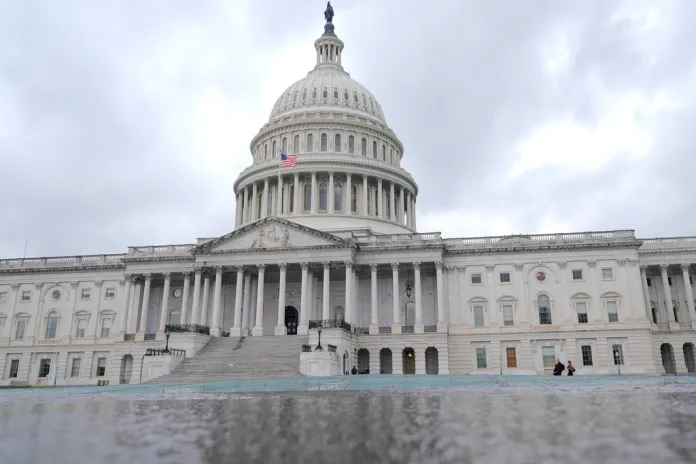
Federal offices opened on Thursday without a shutdown, and Washington will treat that as an accomplishment. It should not. The House passed a stopgap bill, 370-48, that holds agencies at last year’s spending levels through Dec. 11. That is the safety net. The fall is what came before it.
In the past 12 months, the government stopped operating three times. The first lapse ran 43 days, from Oct. 1 to Nov. 12, 2025, and the Congressional Budget Office estimated it cost the economy about $11 billion in real GDP. A four-day shutdown followed from Jan. 31 to Feb. 3, then a 76-day lapse at the Department of Homeland Security from Feb. 14 to April 30. FedTools totals 123 days. A budget process that fails that often is not under stress. It is broken.
Every controller knows what happens to a business that closes its doors for a third of a year. The lost output is only part of it. Contractors sit idle, vendors price in the risk of late payment, and projects restart at a higher cost. Taxpayers fund all of it, and no budget line shows the total.
A private company that learned in October its funding might vanish in December would build a reserve and a contingency plan. Washington builds neither. Agencies cannot commit to a hire, a contract, or a grant beyond the next deadline, so every manager spends the fall planning for two budgets at once: the one that might arrive and the one that might not. That is a cost in time and attention, and it recurs every year.
Behind the numbers are people. Federal employees worked without pay or waited at home through each lapse, and their pay returned only after Congress acted. When the House passed this stopgap bill, Rep. Hal Rogers (R-KY) said the vote removed “any fear of losing federal pay, benefits, or services.” That a lawmaker must promise relief from a problem Congress created says enough.
The stopgap itself has become routine. Congress has enacted 139 continuing resolutions since 1998 and has not finished all 12 appropriations bills by Oct. 1 since fiscal 1997. A continuing resolution freezes spending at last year’s levels, so agencies run on a plan written for a world that no longer exists. New programs cannot start, and priorities that arose this year go unfunded.
This bill shows the cost of that freeze. It leaves out the Iran war supplemental the president requested, along with most Pentagon “anomalies,” including a $1 billion request for nuclear propulsion on the planned Trump-class battleship and language that would let munitions programs such as the Patriot Advanced Capability-3, Tomahawk, and the advanced medium-range air-to-air missile sign multiyear obligations. Those choices are not resolved. They are deferred to a deadline five weeks after Election Day.
Stopgaps also attract riders that receive little scrutiny. According to FedTools, this one blocks an Office of Management and Budget rule requiring senior political appointees to approve grants until Dec. 11 and bars the DHS from shifting funds to Border Patrol. Whatever one thinks of those policies, they were settled inside a must-pass bill with a fraction of the debate a budget would have drawn.
The fix is not exotic. The Prevent Government Shutdowns Act would extend funding automatically in two-week increments and restrict other congressional business, including member travel, until appropriations pass. A version cleared a Senate committee 10-2 in 2020. Critics warn that an automatic extension removes the pressure to finish. They have a point, which is why the pressure belongs on members, not on federal workers and the public. In May, the Senate took up a resolution on withholding senators’ own pay during future shutdowns. Pair that principle with an automatic extension, and shutdowns end, while the incentive to finish on time stays with the people who control the calendar.
YOU’RE PAYING THE INTEREST ON TRUMP’S $166 BILLION TARIFF REFUND
Three steps are feasible now. First, require the Congressional Budget Office to publish a quarterly report on what continuing resolutions cost in delayed contracts, hiring, and grants, so the price of a stopgap appears next to the price of a budget. Second, pass the automatic extension with member-pay and travel restrictions attached. Third, stop settling policy through stopgap riders: If a change deserves to become law, it deserves a vote.
Dec. 11 is 10 weeks away. By the record, Congress is as likely to extend again as to finish. Taxpayers have already paid for three lapses in a year and an $11 billion hit from one of them. They should not be asked to pay for a fourth before someone asks why Congress cannot pass the budget it is paid to pass.
Jose Navarro is a financial controller and founder of the Navarro Report, a public finance and government accountability publication based in San Diego. He has more than two decades of experience in public finance, nonprofit management, and government contract compliance.
Continue reading...
[ H/T Washington Examiner ]