





China this week urged the United States to “cooperate” with Beijing on artificial intelligence, as the two countries race to dominate the world’s most powerful technology.
President Donald Trump has warned that China is seeking to unseat Washington as the world’s dominant superpower by beating the U.S. in the AI race. But Chinese Ambassador to the U.S. Xie Feng claimed Beijing believes the relationship “should be a race of catching up with one another, not a wrestle in which one either wins or loses,” during an interview with Newsweek published Wednesday.
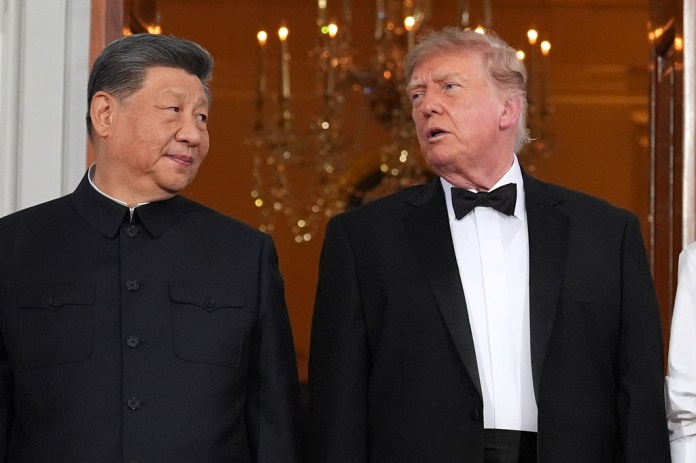
The Chinese ambassador urged Washington not to draw an “iron curtain” around AI, but to view it as a “new frontier for China-U.S. cooperation,” as he detailed what occurred during Chinese President Xi Jinping’s three-day visit with Trump in the U.S. last week. Feng revealed that the two sides held “the first AI Dialogue” at the time, said that November will feature the next round of discussions on AI to “jointly prevent the misuse and abuse of AI,” and noted that the two countries agreed to establish a bilateral communication channel “for AI incidents.”
“This proves that AI can very well become a new frontier for China-U.S. cooperation, rather than a new arena for confrontation or conflict,” Feng said. “We need to jointly install guardrails and brakes, rather than engaging in an arms race.”
“We may have competition, but we may cooperate even more,” he added. “The right thing to do is to draw on each other’s strengths, not guard against each other.”
Feng also touched on the idea of open versus closed AI models, jabbing Washington over how the U.S. relied on Chinese-led models.
The U.S. has typically led on closed models, including through OpenAI and Anthropic’s systems. Such systems are more expensive and have historically had better capabilities than their open counterparts, though that edge is being erased. China has dominated the open-model market with typically free systems that are easy for users to download and customize for their individual and business preferences. Some experts have raised concerns that China is flooding the market with free open models to undermine the U.S. advantage and make users reliant on systems linked to Beijing.
Feng noted that over the summer, when OpenAI’s rogue models initiated an autonomous cyberattack against startup Hugging Face, the company used a Chinese open model to stop the hack. He suggested the U.S. should start embracing open models, warning that “technological decoupling, enclosure, and self-isolation are the real recipe for risk.”
“When an AI model escaped the sandbox in the U.S. in July, it was an open-weight model developed by a Chinese company that came to the rescue,” he said.
“Facts have proven that open source and openness do not create insecurity,” the ambassador added. “We hope the U.S. will work with China in the same direction, help each other succeed with an open mind, and live up to our shared responsibility through cooperation, so as to jointly ensure that rather than heralding the dusk of humanity, new technologies such as AI will usher in the dawn of a new era.”
President Donald Trump, from right, and first lady Melania Trump attend a tea with China’s President Xi Jinping, from left, and his wife Peng Liyuan in the Red Room of the White House, Friday, Sept. 25, 2026, in Washington. (AP Photo/Jacquelyn Martin)
" data-large-file="https://www.washingtonexaminer.com/wp-content/uploads/2026/10/AP26268634921847.jpg?w=696" src="https://www.washingtonexaminer.com/wp-content/uploads/2026/10/AP26268634921847.jpg?w=696" alt="President Donald Trump and first lady Melania Trump attend a tea with China's President Xi Jinping and his wife Peng Liyuan in the Red Room of the White House." class="wp-image-4750661" srcset="https://www.washingtonexaminer.com/wp-content/uploads/2026/10/AP26268634921847.jpg 1024w, https://www.washingtonexaminer.com/wp-content/uploads/2026/10/AP26268634921847.jpg?resize=300,200 300w, https://www.washingtonexaminer.com/wp-content/uploads/2026/10/AP26268634921847.jpg?resize=768,512 768w, https://www.washingtonexaminer.com/wp-content/uploads/2026/10/AP26268634921847.jpg?resize=150,100 150w, https://www.washingtonexaminer.com/wp-content/uploads/2026/10/AP26268634921847.jpg?resize=696,464 696w" sizes="(max-width: 1024px) 100vw, 1024px">
President Donald Trump, from right, and first lady Melania Trump attend a tea with China’s President Xi Jinping, from left, and his wife Peng Liyuan in the Red Room of the White House, Friday, Sept. 25, 2026, in Washington. (Jacquelyn Martin/AP Photo)
Some lawmakers, such as Sen. Ted Cruz (R-TX), have raised concerns that China is operating an undercover campaign in the U.S. to turn public opinion against AI so Beijing can win the technology race and dominate the world.
Feng’s comments this week are unlikely to ease such speculation. The ambassador praised what he described as a reversal of negative American attitudes toward China since 2023, saying it occurred after a “joint effort” to tackle “the political correctness” of being anti-China.
AI LEADERS SUGGEST ‘OPTIONAL’ WORK ON HORIZON: WHY IT MIGHT JUST BE A PIPE DREAM
“When I arrived in the U.S. in 2023, I felt that the so-called ‘political correctness’ of being tough on China was spreading across American society,” he said. “So I decided that one of my tasks would be to find all those friends who stand for developing China-U.S. relations, so we can put in the effort together. It is encouraging to see that, under the guidance of the two presidents and with the joint efforts of people in both countries, American public opinion toward China has shown a sustained positive rebound after five years.”
“China is willing to be a partner and friend of the U.S.,” Feng added. “We hope the U.S. side will actively respond and take action to work with China in the same direction.”
Continue reading...
[ H/T Washington Examiner ]