






.jpg)

Washington has left itself no shortage of work for when it returns after the Nov. 3 midterm elections with a lengthy to-do list that includes averting a government shutdown, which could be exponentially complicated by the election results.
The Senate held its final pre-election vote Wednesday night, while the House departed Washington Sept. 16. Neither will be back until after the midterm elections, when it’ll be known whether Republicans will maintain their narrow majorities next year.
Senate Majority Leader John Thune (R-SD) previewed a jam-packed agenda for the so-called lame duck period, when lawmakers will have only a few working weeks before the new Congress convenes in January 2027. Chief among those items are “must-pass” bills to prevent a government shutdown, including reauthorizing the Foreign Intelligence Surveillance Act and the annual military policy bill, the National Defense Authorization Act.
And if Republicans lose one or both chambers, they could go for a Hail Mary and try to corral the party to pass a third-party-line budget reconciliation bill. But Thune questioned if the Senate would have the votes among his own members to advance it and then protect it from Democratic amendments. The House already passed this summer a $95 billion blueprint for a third package centered on funding for the military and the Iran war, farm relief, and election security measures.
Thune lumped a third-party-line spending bill among the “potential options” Congress could tackle, such as raising the debt ceiling, which could expire as soon as early 2027.
“Do we have 50 [votes] to do something?” Thune said of reconciliation, which bypasses a 60-vote filibuster. “Do we have 50 to protect it once we’re on? And that’s not something I’ve seen yet.”
The NDAA for fiscal 2027 is also due by the end of this year. And Section 702 of FISA, which allows intelligence agencies to conduct warrantless spying on foreign nationals, expired in June. The government can still operate surveillance under the law until March 2027, but the Trump administration says it could go fully dark on Nov. 20 because of judicial review procedures.
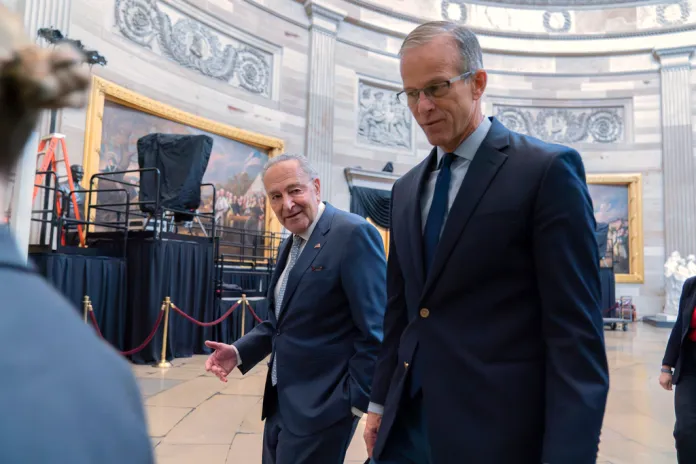
Senate Minority Leader Chuck Schumer, D-N.Y., left, and Senate Majority Leader John Thune, R-S.D., leads a Senate procession through the Rotunda to the House Chamber for a joint session of congress to confirm the Electoral College votes, at the Capitol on Monday, Jan. 6, 2025, in Washington. Walking behind her is Sen. Chuck Grassley R-Iowa. (AP Photo/Jose Luis Magana)
" data-large-file="https://www.washingtonexaminer.com/wp-content/uploads/2026/10/AP25006724602003-1.jpg?w=696" src="https://www.washingtonexaminer.com/wp-content/uploads/2026/10/AP25006724602003-1.jpg?w=696" alt="Senate Minority Leader Chuck Schumer (D-NY), left, and Senate Majority Leader John Thune (R-SD)." class="wp-image-4750771" srcset="https://www.washingtonexaminer.com/wp-content/uploads/2026/10/AP25006724602003-1.jpg 1024w, https://www.washingtonexaminer.com/wp-content/uploads/2026/10/AP25006724602003-1.jpg?resize=300,200 300w, https://www.washingtonexaminer.com/wp-content/uploads/2026/10/AP25006724602003-1.jpg?resize=768,512 768w, https://www.washingtonexaminer.com/wp-content/uploads/2026/10/AP25006724602003-1.jpg?resize=150,100 150w, https://www.washingtonexaminer.com/wp-content/uploads/2026/10/AP25006724602003-1.jpg?resize=696,464 696w" sizes="auto, (max-width: 1024px) 100vw, 1024px">
Senate Minority Leader Chuck Schumer (D-NY), left, and Senate Majority Leader John Thune (R-SD) lead a Senate procession through the Rotunda to the House Chamber for a joint session of Congress to confirm the Electoral College votes, at the Capitol on Monday, Jan. 6, 2025, in Washington. (Jose Luis Magana/AP Photo)
A stopgap government funding measure expires Dec. 11, at which point a shutdown will occur unless Congress takes action. Whether lawmakers can finally pass the fiscal 2027 budget that was due Sept. 30, or whether they seek to kick the can down the road with another short-term measure, is likely to hinge on the election results and how high tensions flare afterward.
BIPARTISAN DATA CENTER BILL FRACTURES DEMOCRATS AHEAD OF MIDTERM ELECTIONS
Prior to the Senate’s departure late Wednesday, the upper chamber accomplished dozens of low-stakes housekeeping tasks via unanimous consent. It also teed up a Nov. 9 vote to advance a long-awaited bipartisan permitting deal reached this week to boost new energy projects and mandate cost protections for utility ratepayers against rising electricity prices from data centers.
Ten ambassadors and a military promotion were confirmed. Nearly three dozen bills or resolutions were passed or adopted, ranging from training Labor Department employees to assist with preventing human trafficking to designating September as “School Bus Safety Month.”
Continue reading...
[ H/T Washington Examiner ]