





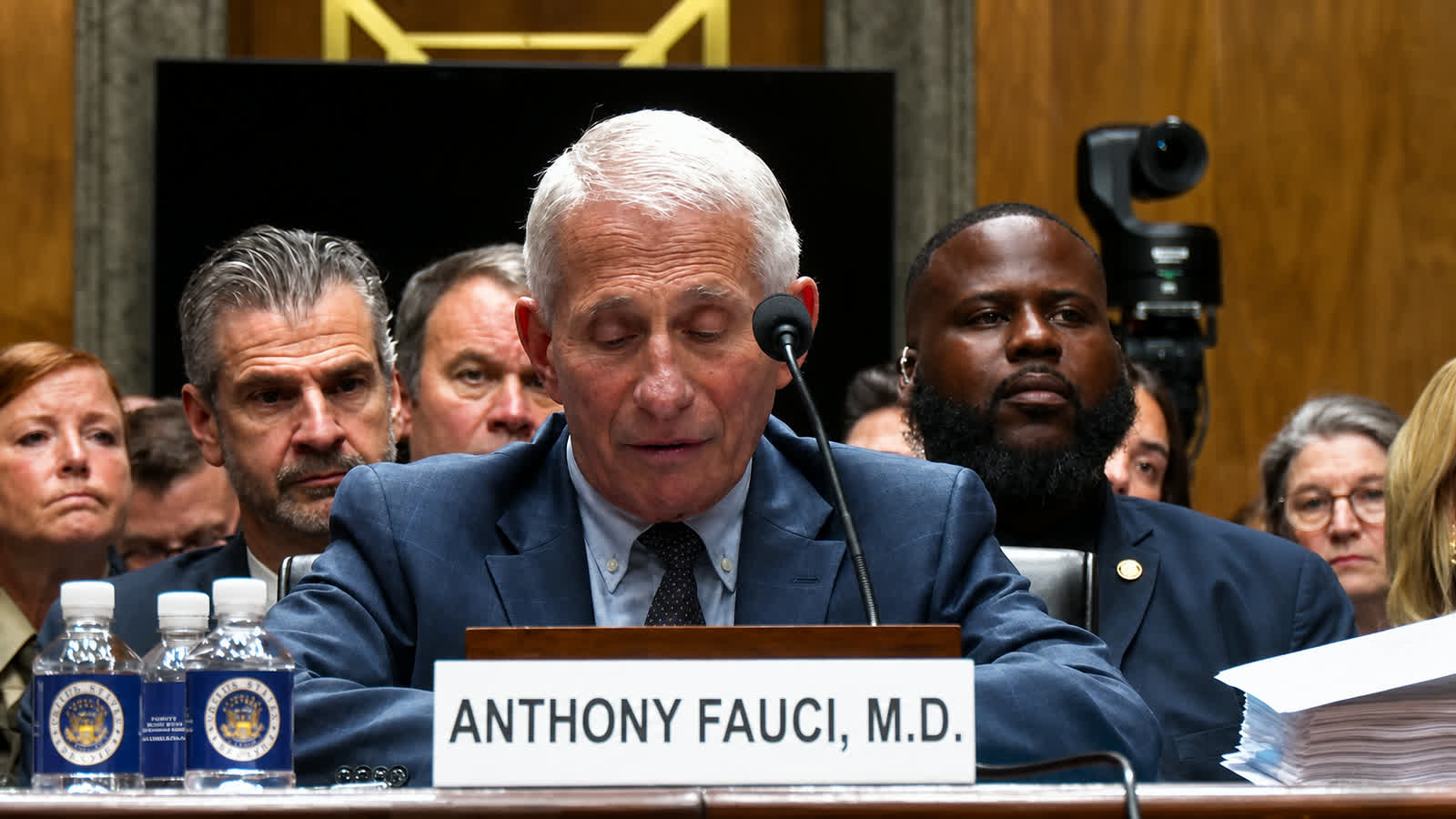
Dr. Anthony Fauci spent Wednesday morning saying almost nothing.
His face, posture and voice may have told a different story.
Fauci invoked the Fifth Amendment again and again during a blistering Senate hearing on the government’s handling of COVID-19, refusing to answer even basic questions from lawmakers.
One veteran body-language analyst who studied the hearing says the former White House medical adviser’s demeanor changed dramatically when the questioning got personal.
But the wider field of deception research adds an important warning: visible stress can reveal pressure without proving a lie.
The body-language assessment comes from The New York Post, which asked behavioral analyst Dr. Lillian Glass to review Fauci’s appearance before the Senate Homeland Security and Governmental Affairs Committee.
Glass focused on what she described as abrupt shifts in Fauci’s breathing, complexion, posture, blinking and voice when certain senators pressed him. She characterized the combined changes as “signals of deception.”
During Sen. Josh Hawley’s questioning, Glass said Fauci appeared increasingly guarded: his shoulders rose, his face reddened, his voice weakened and his movements became more restless. She read the sequence as a marked retreat from the upright, confident posture he displayed at the beginning.
She identified another sharp change during Sen. Bernie Moreno’s confrontation. In her assessment, Fauci looked down, swallowed hard, handled his pen repeatedly and spoke more softly as the exchange grew hotter.
That assessment is interpretive. It cannot establish whether Fauci lied.
Viewers did not need an expert to see that the hearing was tense.
The Senate Homeland Security and Governmental Affairs Committee convened the July 29 hearing at 8:30 a.m. in the Dirksen Senate Office Building. Fauci, the former director of the National Institute of Allergy and Infectious Diseases, appeared under subpoena.
Fauci used his opening statement to accuse Chairman Rand Paul of trying to manufacture grounds for a prosecution. On the advice of counsel, he then invoked his Fifth Amendment right and declined to answer questions about the pandemic response, COVID origins, federal research funding and his own records.
Paul’s office counted 111 invocations of the Fifth during the hearing. The committee video runs for roughly three hours and preserves the senators’ questions, Fauci’s opening statement and the repeated refusals in full.
The official hearing record identifies Fauci as the sole witness on the first panel. It also confirms the exact date, time, location and committee responsible for the proceeding.
The hearing moved from hostile to surreal.
Hawley began asking questions so simple that no one could mistake them for an effort to obtain incriminating testimony: the day of the week, the color of Fauci’s tie and the color of the carpet in front of him.
Fauci still declined to answer.
Hawley then accused him of using federal employees to help pursue prestige awards and financial prizes while the country was in crisis. Moreno later confronted Fauci over pandemic restrictions in a profanity-laced exchange that became one of the hearing’s most explosive moments.
Fauci’s attorney, David Schertler, was also removed from the hearing room after attempting to speak while Paul had not recognized him.
The Associated Press reported that Paul plans to put a contempt resolution before the committee next week. The chairman has not said whether he will seek a criminal referral or another sanction.
Democrats called the hearing an attempt to entrap Fauci and defended his decision not to engage. Republicans argued that the refusal deprived Congress of answers on research funding, pandemic policy and Fauci’s earlier statements.
Former President Joe Biden’s 2025 pardon covers Fauci’s conduct before the pardon. It would not necessarily shield any new statement made under oath at Wednesday’s hearing, which was central to Fauci’s stated reason for remaining silent.
That legal context matters because taking the Fifth is not an admission of guilt.
So does the science of reading people.
A major peer-reviewed review indexed by the National Library of Medicine concluded that known nonverbal signs of deception are generally faint and unreliable. Authors Aldert Vrij, Maria Hartwig and Pär Anders Granhag found that people are mediocre at identifying lies when they rely on visible behavior.
The 2019 Annual Review of Psychology paper examined the theories behind supposed deception cues, what liars actually do and how accurately observers separate lies from truth. Its conclusion cuts against the popular idea that a single tell can expose dishonesty.
Stress responses such as flushing, blinking, altered breathing or fidgeting can appear when someone is deceptive.
They can also appear when someone is angry, anxious, exhausted, humiliated or sitting through three hours of hostile questioning before television cameras.
That does not make Glass’s observations meaningless. Her most compelling point is not that one blink or one swallow proves a lie.
It is that Fauci’s baseline appeared to change when particular subjects and senators entered the conversation.
That kind of shift is worth noticing.
It is not a verdict.
The real evidentiary questions remain in the documents, prior testimony, funding records and contradictions that senators placed into the hearing record.
Those facts can be checked. A facial expression cannot.
Still, Fauci’s silence created a vacuum, and his body became one of the few things left for the public to examine.
He arrived upright and defiant.
By the most confrontational exchanges, even a skeptic of body-language analysis could see the strain.
Whether that strain came from deception, fury or fear is still an open question. But after 111 refusals to answer, Congress is preparing to ask the next one: whether Fauci should be held in contempt.
Continue reading...
[ H/T WLT Report ]