




Better Late Than Never? EU Prepares Import Cap On Chinese Hybrids As Germany's Industrial Base Burns
Some ten years after it should have, Europe is finally reaching for the brakes.
According to Bloomberg, the European Commission is preparing so-called safeguard measures to limit imports of Chinese hybrid vehicles, most likely via tariff-rate quotas that slap a levy on anything above a set volume. The cap would be time-limited, and Brussels plans to use hybrids as a "test case" which, if successful, could be replicated in other sectors where the bloc is drowning in Chinese imports.
Our reaction this morning was short and to the point:
The market liked it anyway: Volkswagen jumped as much as 4.6%, Renault 6.1% and Mercedes 2%, while Goldman's European autos basket (GSXEAUTO) was up 90bps mid-morning, helped by a parallel headline that Germany and France want to water down the EU's combustion-engine rules.
Why hybrids? Because when Brussels slapped tariffs on Chinese EVs in late 2024, Beijing simply did what any exporter would do and drove around the wall. Chinese hybrids don't face the steep levies applied to EVs, and the result is exactly what you would expect: Chinese-made hybrids now account for a quarter of all hybrid sales in Europe, and one in three plug-in hybrids. Monthly imports of Chinese hybrids into the EU have exploded from 3,800 vehicles in October 2024 to 50,000 in July 2026, a roughly 13-fold surge (per FT data cited by Brussels Signal).
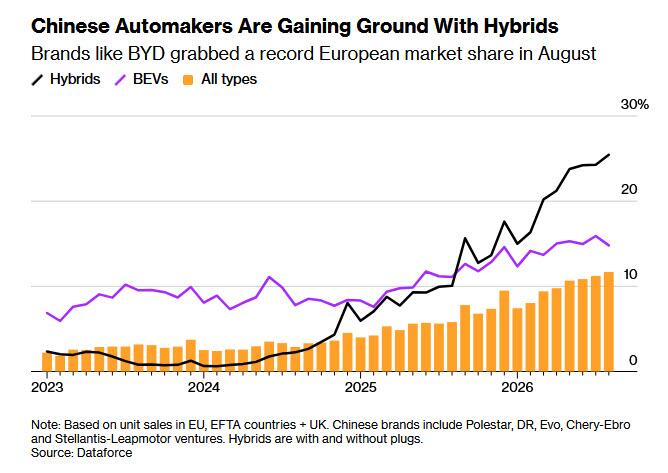
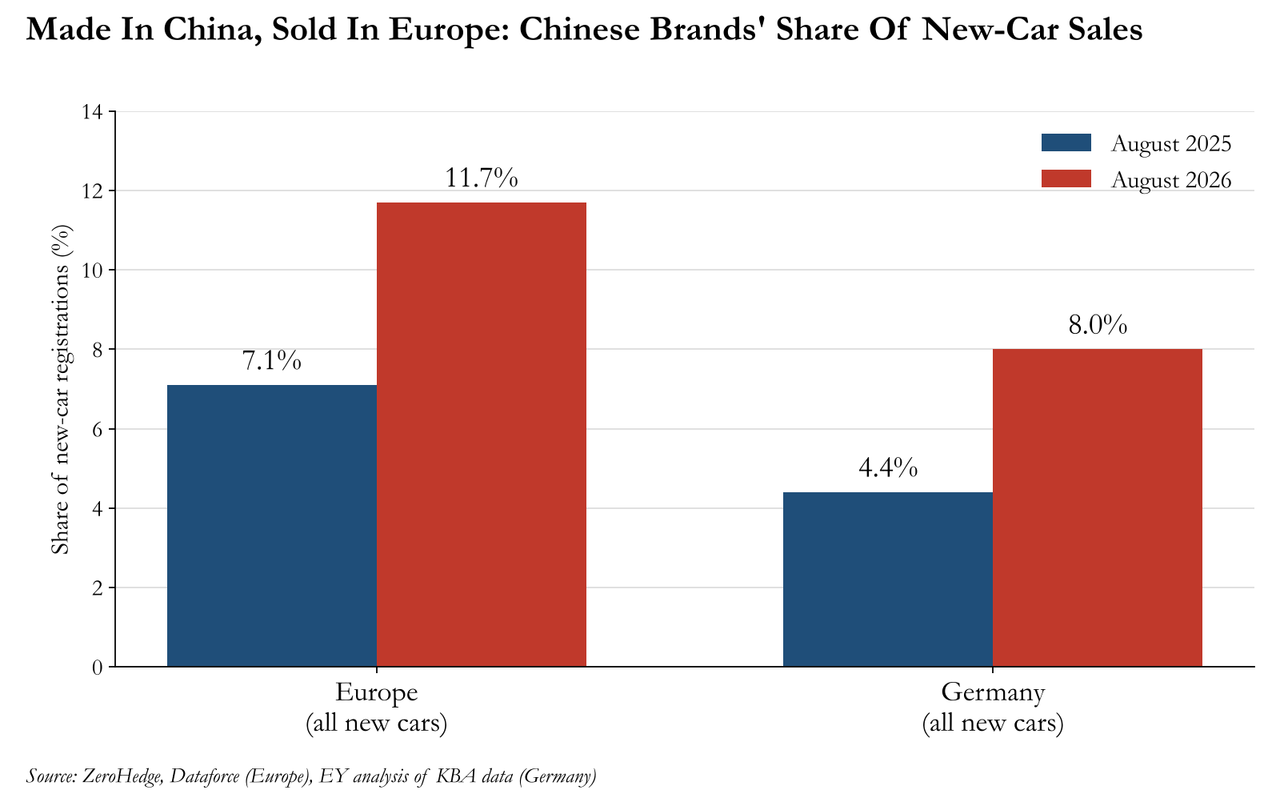
Overall, Chinese brands grabbed a record share of Europe's car market in August: 11.7% of all new-car registrations, up from 7.1% a year earlier (Dataforce), with BYD alone selling 26,007 cars, up 128% YoY. In Germany, where the pain is most acute, Chinese registrations jumped around 90% in August, lifting their share to a record 8% from 4.4% (EY analysis of KBA data).
Regular readers know we have been tracking this flood for a while, from "China Floods Europe With Cheap Cars, Grabs Record Market Share As Domestic Brands Buckle" two weeks ago, to "BYD's EU Invasion Deepens Germany's Auto Industry Crisis", and all the way back to June 2024, when Beijing dangled perks to German automakers to kill the EV tariffs (spoiler: Berlin duly voted against them, only to end up destroying its local manufacturing base).
The timing of Brussels' epiphany is hardly a coincidence. Just yesterday, German factory orders plunged 10.6% MoM in August, ten times worse than the 1.0% drop expected and among the biggest monthly drops on record.
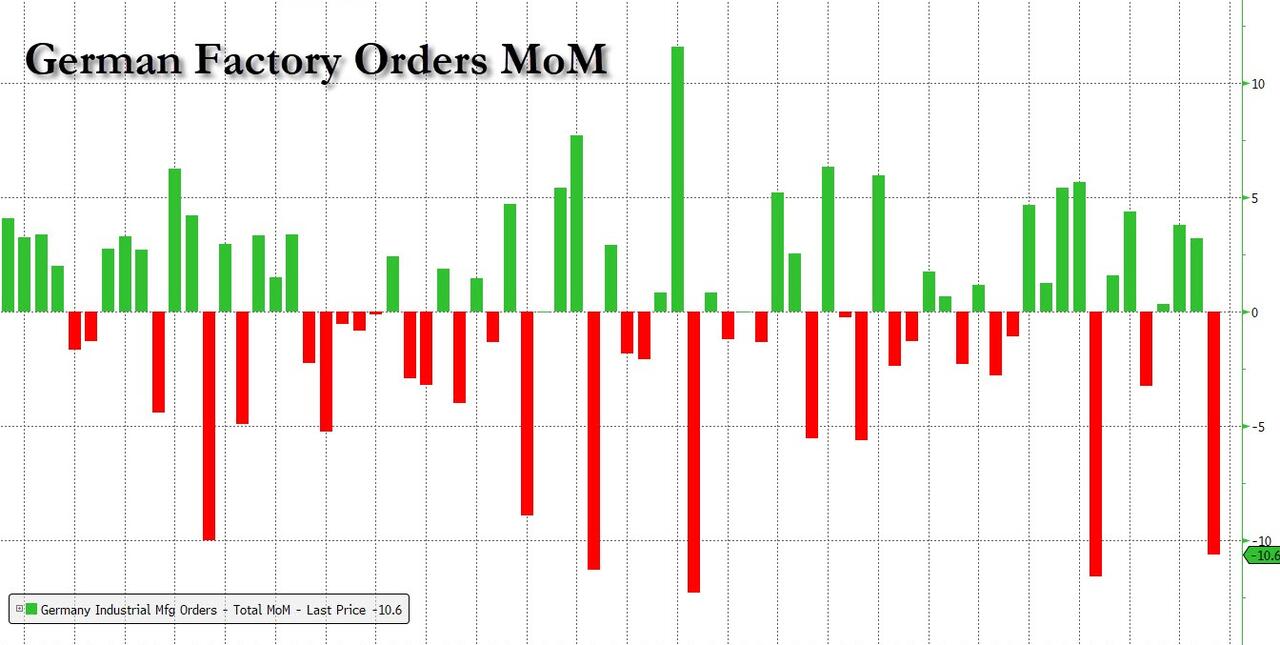
To be fair, much of the drop was a reversal of July's surge in large orders for aircraft, ships, trains and military vehicles, which tumbled 61.5% after more than doubling the prior month. In other words, the only thing that had been propping up German industrial demand was the debt-fueled arms spending boom (which has sent formerly frugal Germany's debt soaring), and when that took a breather, the floor fell out: domestic orders crashed 17.3% and capital goods orders 15.3%. On a less volatile three-month basis, orders ex-large contracts were down 2.6%, which is "underlying weakness" in Destatis-speak.
And while this morning's industrial production print was a pleasant surprise (+2.0% MoM vs +0.5% expected), it was all construction (+9.3%). Auto production fell 5.4%, after a 9.2% plunge in July, and manufacturing output is still down 0.4% YoY. Nothing says "industrial renaissance" like a factory economy where the only thing growing is cement and tanks.
As we put it last month, when the Bundesbank's Nagel blamed the AfD for scaring off investors:
Even Deutsche Bank, which has rarely been accused of anti-Beijing hysteria, now openly talks of "the second China shock hitting the European manufacturing sector." In a note published this morning ahead of Trade Commissioner Šefčovič's trip to Beijing ("Crunch time for EU-China trade relations", available to pro subs), DB's Marion Muehlberger writes that Germany is the most exposed of the large EU economies:
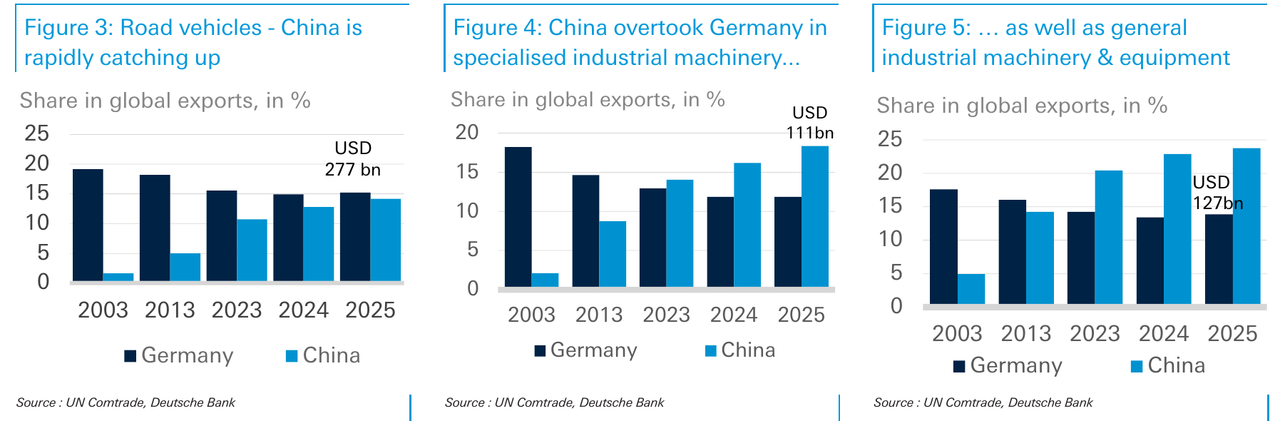
And cars are actually the good news: in specialised industrial machinery, the crown jewel of the Mittelstand, China overtook Germany back in 2023, and in general industrial machinery China's share of global exports is now well above Germany's.
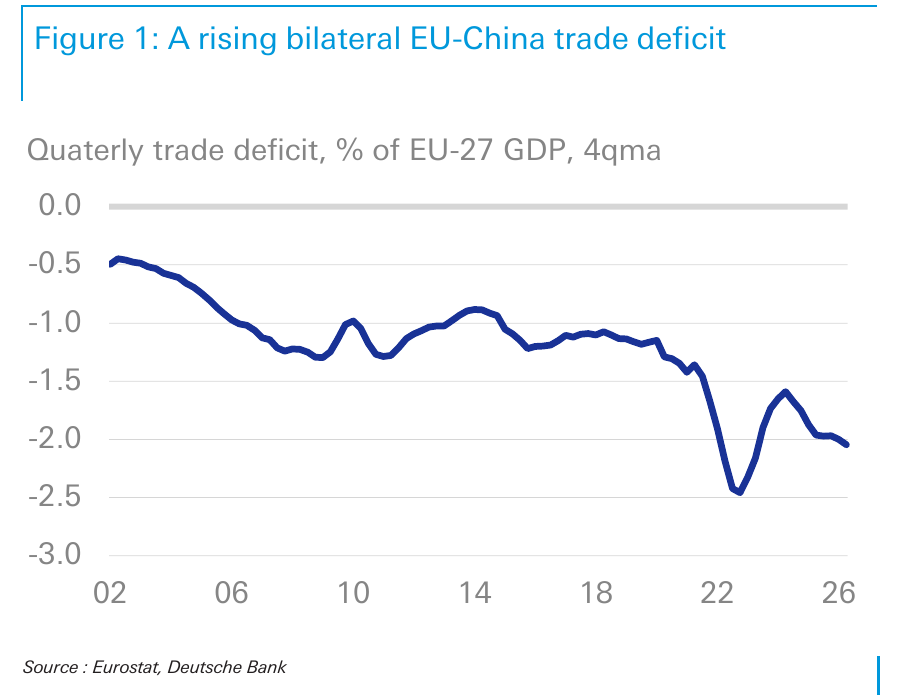
Meanwhile, the bilateral trade deficit with China has blown out again to around 2% of EU GDP. Or, as Bloomberg puts it, more than €1 billion... per day.
That said, DB is far from convinced Brussels will actually follow through on a hard stance. The bank expects this week's Šefčovič-Wang meeting to bring "no major breakthrough," with perhaps some Chinese concessions on market access but "little movement on the EU's demand to restrain exports to Europe." The likely next step after the October 15-16 EU summit is an anti-subsidy probe into Chinese plug-in hybrids, with tariffs taking effect "in early 2027 at the earliest." Overall, DB expects EU leaders "to continue their rather minimalist approach."
Translation: Brussels will do just enough to make a headline, and not enough to make Beijing angry. Indeed, per Bloomberg, a key aim is to "keep the cap on hybrids low enough to avoid a retaliatory response from Beijing", which kinda defeats the purpose. China, for its part, already dismissed earlier talk of voluntary export caps last month as a "serious violation" of WTO rules, which is rich coming from the world's champion of subsidized overcapacity.
Goldman's European trading desk was similarly underwhelmed, noting that the hybrid levy headlines "are not new, repeating what we heard in recent months," and that "the hesitation is the likely backlash from China and the fact that these measures will only briefly limit China's market share gains."
We agree. A temporary, carefully calibrated quota designed not to upset the country flooding your market is certainly not a trade policy - it's just a press release pretending to show Beijing that Brussels can be a tough guy. By the time it takes effect, BYD's Hungarian plant will be churning out "European" cars, and Germany's auto industry, where 140,000 jobs are at risk at VW alone, will have shrunk some more. As we warned a year ago, Germany's industrial core is collapsing; Brussels just noticed.
Better late than never... but only just.
Much more in the full Deutsche Bank "Crunch time for EU-China trade relations" note, available to pro subs.
Tyler Durden Wed, 10/07/2026 - 10:40
Continue reading...
[ H/T ZeroHedge ]
Some ten years after it should have, Europe is finally reaching for the brakes.
According to Bloomberg, the European Commission is preparing so-called safeguard measures to limit imports of Chinese hybrid vehicles, most likely via tariff-rate quotas that slap a levy on anything above a set volume. The cap would be time-limited, and Brussels plans to use hybrids as a "test case" which, if successful, could be replicated in other sectors where the bloc is drowning in Chinese imports.
Our reaction this morning was short and to the point:
The market liked it anyway: Volkswagen jumped as much as 4.6%, Renault 6.1% and Mercedes 2%, while Goldman's European autos basket (GSXEAUTO) was up 90bps mid-morning, helped by a parallel headline that Germany and France want to water down the EU's combustion-engine rules.
The Loophole Was Always The Hybrids
Why hybrids? Because when Brussels slapped tariffs on Chinese EVs in late 2024, Beijing simply did what any exporter would do and drove around the wall. Chinese hybrids don't face the steep levies applied to EVs, and the result is exactly what you would expect: Chinese-made hybrids now account for a quarter of all hybrid sales in Europe, and one in three plug-in hybrids. Monthly imports of Chinese hybrids into the EU have exploded from 3,800 vehicles in October 2024 to 50,000 in July 2026, a roughly 13-fold surge (per FT data cited by Brussels Signal).
Overall, Chinese brands grabbed a record share of Europe's car market in August: 11.7% of all new-car registrations, up from 7.1% a year earlier (Dataforce), with BYD alone selling 26,007 cars, up 128% YoY. In Germany, where the pain is most acute, Chinese registrations jumped around 90% in August, lifting their share to a record 8% from 4.4% (EY analysis of KBA data).
Regular readers know we have been tracking this flood for a while, from "China Floods Europe With Cheap Cars, Grabs Record Market Share As Domestic Brands Buckle" two weeks ago, to "BYD's EU Invasion Deepens Germany's Auto Industry Crisis", and all the way back to June 2024, when Beijing dangled perks to German automakers to kill the EV tariffs (spoiler: Berlin duly voted against them, only to end up destroying its local manufacturing base).
Meanwhile, In Germany...
The timing of Brussels' epiphany is hardly a coincidence. Just yesterday, German factory orders plunged 10.6% MoM in August, ten times worse than the 1.0% drop expected and among the biggest monthly drops on record.
To be fair, much of the drop was a reversal of July's surge in large orders for aircraft, ships, trains and military vehicles, which tumbled 61.5% after more than doubling the prior month. In other words, the only thing that had been propping up German industrial demand was the debt-fueled arms spending boom (which has sent formerly frugal Germany's debt soaring), and when that took a breather, the floor fell out: domestic orders crashed 17.3% and capital goods orders 15.3%. On a less volatile three-month basis, orders ex-large contracts were down 2.6%, which is "underlying weakness" in Destatis-speak.
And while this morning's industrial production print was a pleasant surprise (+2.0% MoM vs +0.5% expected), it was all construction (+9.3%). Auto production fell 5.4%, after a 9.2% plunge in July, and manufacturing output is still down 0.4% YoY. Nothing says "industrial renaissance" like a factory economy where the only thing growing is cement and tanks.
As we put it last month, when the Bundesbank's Nagel blamed the AfD for scaring off investors:
"The Second China Shock"
Even Deutsche Bank, which has rarely been accused of anti-Beijing hysteria, now openly talks of "the second China shock hitting the European manufacturing sector." In a note published this morning ahead of Trade Commissioner Šefčovič's trip to Beijing ("Crunch time for EU-China trade relations", available to pro subs), DB's Marion Muehlberger writes that Germany is the most exposed of the large EU economies:
And cars are actually the good news: in specialised industrial machinery, the crown jewel of the Mittelstand, China overtook Germany back in 2023, and in general industrial machinery China's share of global exports is now well above Germany's.
Meanwhile, the bilateral trade deficit with China has blown out again to around 2% of EU GDP. Or, as Bloomberg puts it, more than €1 billion... per day.
That said, DB is far from convinced Brussels will actually follow through on a hard stance. The bank expects this week's Šefčovič-Wang meeting to bring "no major breakthrough," with perhaps some Chinese concessions on market access but "little movement on the EU's demand to restrain exports to Europe." The likely next step after the October 15-16 EU summit is an anti-subsidy probe into Chinese plug-in hybrids, with tariffs taking effect "in early 2027 at the earliest." Overall, DB expects EU leaders "to continue their rather minimalist approach."
Translation: Brussels will do just enough to make a headline, and not enough to make Beijing angry. Indeed, per Bloomberg, a key aim is to "keep the cap on hybrids low enough to avoid a retaliatory response from Beijing", which kinda defeats the purpose. China, for its part, already dismissed earlier talk of voluntary export caps last month as a "serious violation" of WTO rules, which is rich coming from the world's champion of subsidized overcapacity.
Bottom Line
Goldman's European trading desk was similarly underwhelmed, noting that the hybrid levy headlines "are not new, repeating what we heard in recent months," and that "the hesitation is the likely backlash from China and the fact that these measures will only briefly limit China's market share gains."
We agree. A temporary, carefully calibrated quota designed not to upset the country flooding your market is certainly not a trade policy - it's just a press release pretending to show Beijing that Brussels can be a tough guy. By the time it takes effect, BYD's Hungarian plant will be churning out "European" cars, and Germany's auto industry, where 140,000 jobs are at risk at VW alone, will have shrunk some more. As we warned a year ago, Germany's industrial core is collapsing; Brussels just noticed.
Better late than never... but only just.
Much more in the full Deutsche Bank "Crunch time for EU-China trade relations" note, available to pro subs.
Tyler Durden Wed, 10/07/2026 - 10:40
Continue reading...
[ H/T ZeroHedge ]