


After Iran's Rial, Hormuz Claims Its Second Currency: Iraq Devalues Dinar 13% To Keep Paying Salaries
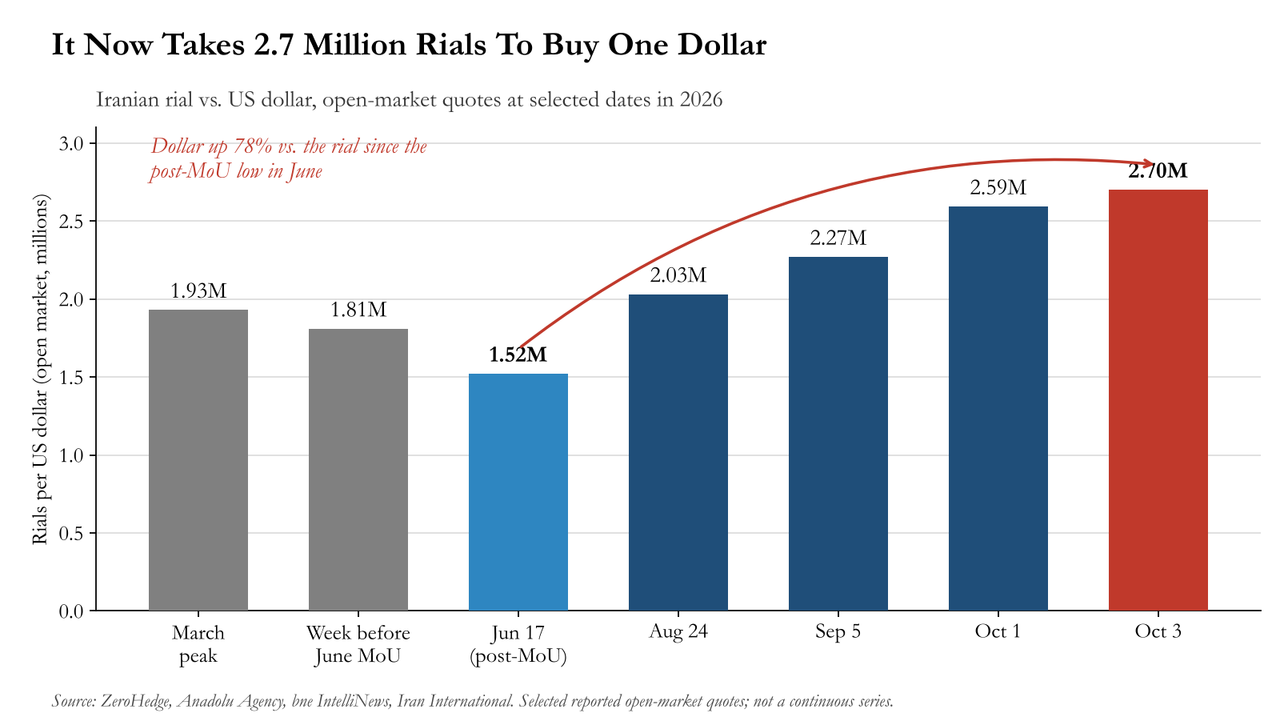
Last weekend, we noted that the clearest scorecard of the US economic war on Iran is the rial, which cratered to a record 2.7 million per dollar (the slide that we first flagged in "Iran's Deadline Expires Today"... Rial Collapses, and which has only accelerated since). Turns out Tehran has company.
On Wednesday, Iraq devalued its currency by 13%, with the central bank raising the dollar-selling price for the public to 1,520 dinars from roughly 1,320. Per Reuters, the cabinet adopted the new structure on Tuesday, effective Wednesday: the Finance Ministry now sells its oil dollars to the CBI at 1,500, banks get them at 1,510 and the public pays 1,520.
That makes Iraq, as Bloomberg notes, the first Gulf Arab state to devalue since the US-Israel war on Iran began in late February. It probably won't be the last thing in the region to break, but it is the first currency peg to do so, which is a different kind of milestone.
The central bank's official explanation was a masterpiece of the genre: the decision was taken "in view of the current economic and financial conditions, and based on the recommendation of the cabinet," and, rest assured, foreign reserves are "sufficient to finance external trade, settle overseas bank-card transactions and provide cash to travelers." Translation: we have enough dollars, which is why we just made each one cost 15% more.
Below we look at why Baghdad blinked, why the street isn't buying it (yet), and why the timing is stranger than it looks given that Goldman says Gulf oil exports are already back to pre-war levels.
Iraq is one of the most oil-dependent economies on the planet: crude sales generate around 90% of government revenue, and those sales go almost entirely out through the Strait of Hormuz. Which is why, from day one of the war, we flagged that Iraq would be the most exposed producer in the Gulf. Back on March 3, as storage filled with nowhere to ship, we tweeted this:
A week later it was this:
Seven months later, the bill has arrived. Bloomberg estimates Iraqi crude exports have averaged only about 1.25 million barrels a day since the start of March, compared with almost 3.5 million last year. SOMO, the state oil marketer, put the country's cumulative oil losses at around $80 billion last month. Even with a recovery, Reuters says exports were just 2.34mb/d in August, versus more than 3.6mb/d before the war.
Meanwhile, the one line item that never shrinks kept on growing. Bloomberg's chief EM economist Ziad Daoud summed it up:
The math behind that choice is not complicated. Iraq had roughly $100 billion in FX reserves when the war began; by August that had dropped to $80 billion. Public-sector salaries alone cost about $5 billion a month, per Daoud.
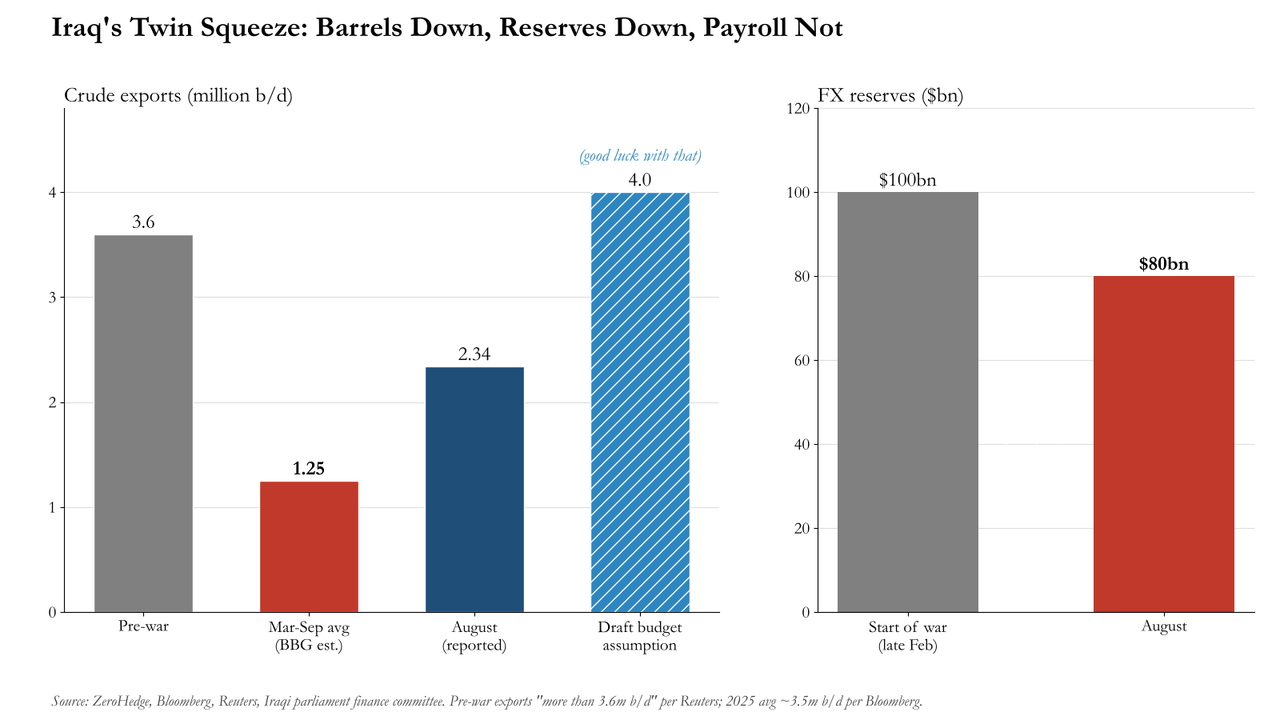
Put differently, $20 billion of reserves went out the door in roughly six months, and what's left covers about 16 months of payroll with nothing else, ever, being imported. Hence the devaluation, which, as Iraqi analyst Mohammed al-Saffar told Reuters, is "essentially a fiscal response to the shock to Iraq's oil revenues": it "gives the government more dinars for each dollar of oil revenue, but raises import costs and reduces households' purchasing power."
Some napkin math (approximate): at 1,320, a 6.6 trillion dinar monthly wage bill eats about $5 billion of oil dollars. At 1,520, the same dinar payroll costs just $4.3 billion, a saving of roughly $650-700 million a month, or ~$8 billion a year. That is a 13% real pay cut for every public-sector worker in Iraq, delivered without anyone having to announce a pay cut. Diversification at its finest.
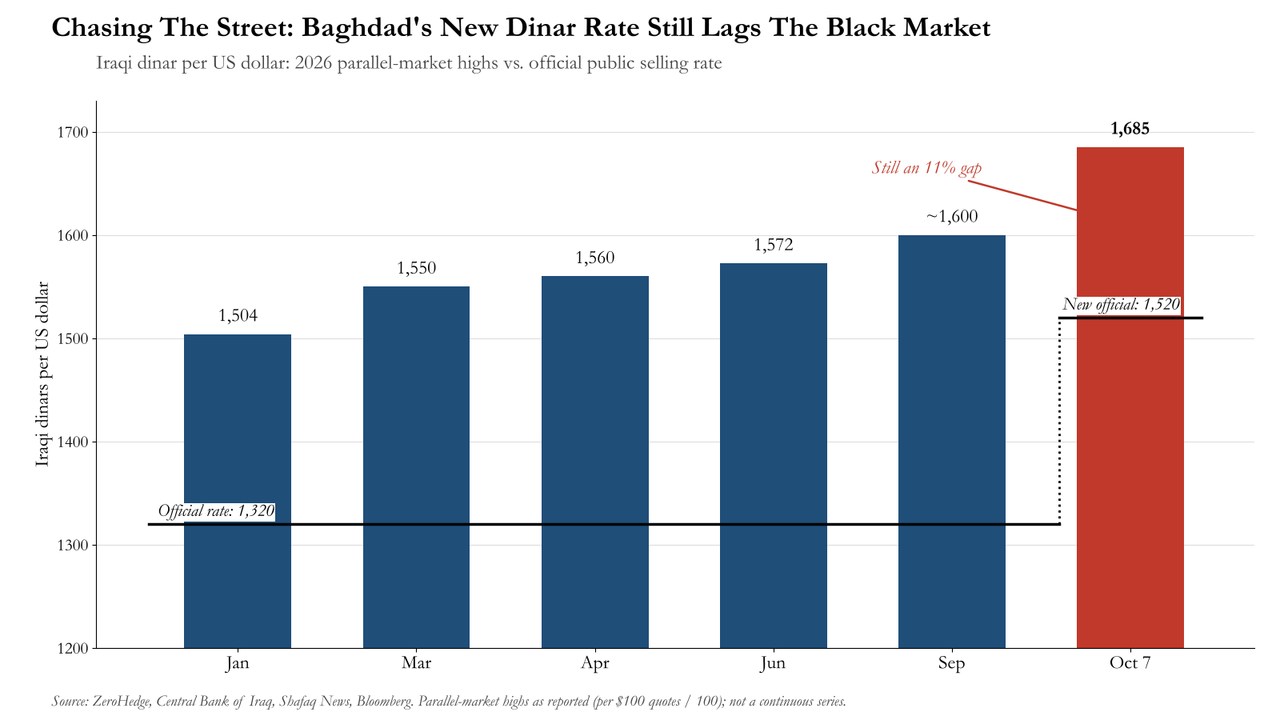
Of course, devaluations rarely happen to the market; they usually happen after it. According to Shafaq News, the dollar set six new parallel-market highs in Baghdad this year, from 150,400 dinars per $100 in January to roughly 160,000 in September, and 168,500 per $100 (1,685 per dollar) after the announcement. In other words, even at the new official rate, the black market still prices the dinar about 11% weaker, and local currency traders are already talking about a test of 180,000.
And the real economy is not taking it gracefully. Iraqi News reports Baghdad's Shorja wholesale market was "completely paralyzed" on Wednesday as merchants shuttered stores, distributors suspended deliveries, and food staples in Saladin jumped about 25% almost overnight. One MP has already demanded an emergency session of parliament to reverse the decision. (We'll take the under on that.)
Readers will also recall that Iraq's dollars aren't entirely Iraq's to begin with. As we discussed in "The Hidden Mechanism Behind Washington's Control Of Iraq's Oil Money" just last week, every barrel Iraq sells settles into a CBI account at the New York Fed, and Washington has not been shy about using that tap: in January it threatened to "starve" Iraq of its oil revenue if pro-Iran parties joined the government, and in April it blocked the regular $500 million cash pallets flown to Baghdad. Add the last US troops leaving Iraq on Sept 30 and Bessent's "frank discussion" with Iraq's foreign minister the very next day on "Iraq's progress in demilitarizing Iranian militias," and one can see why holding dinars has lately lost some of its appeal.
Here is the twist: the devaluation comes just as the physical oil picture is improving dramatically. In their latest Oil Comment, "Adaptation: Persian Gulf Exports Return to 2025 Level" (available to pro subs), Goldman's commodity team led by Daan Struyven writes:
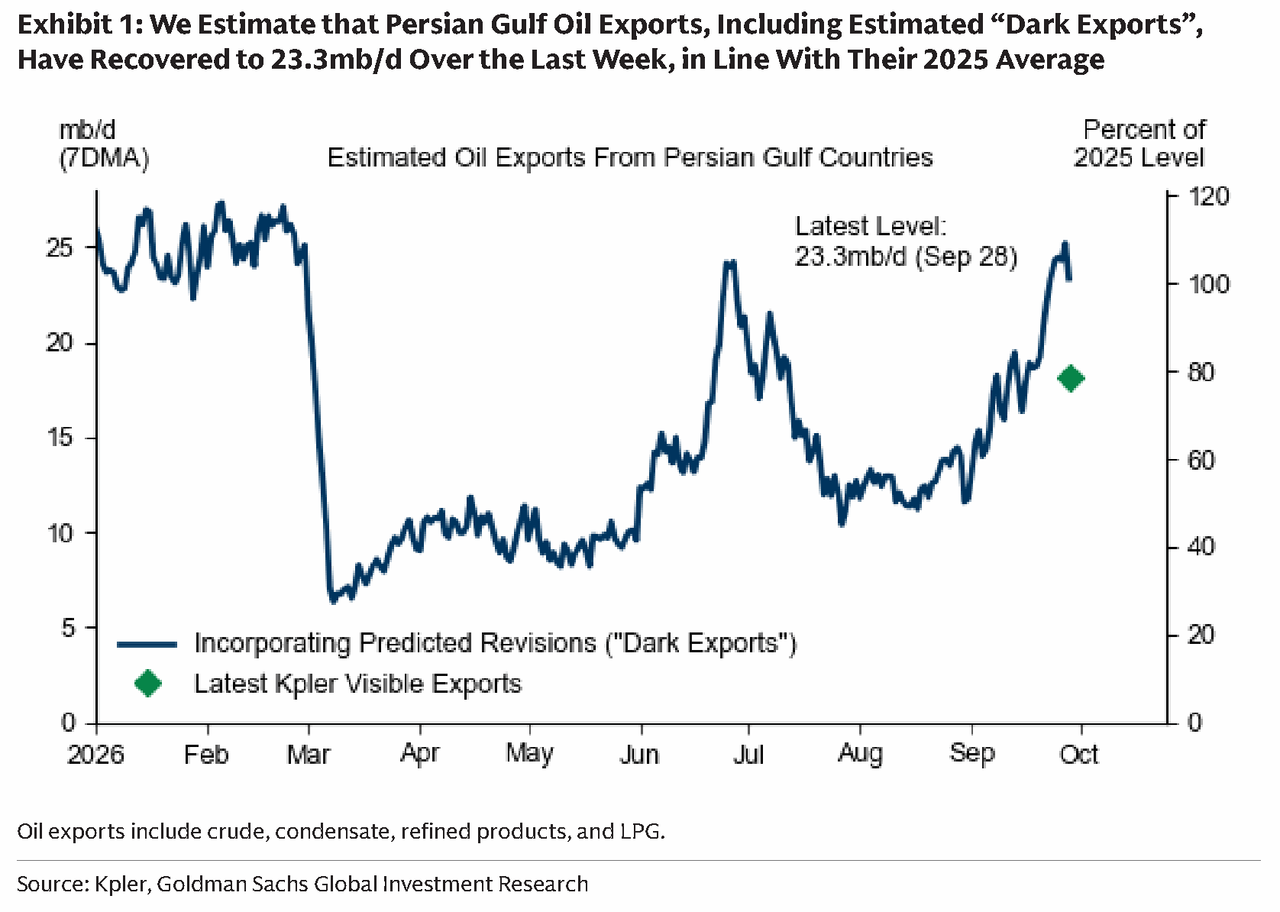
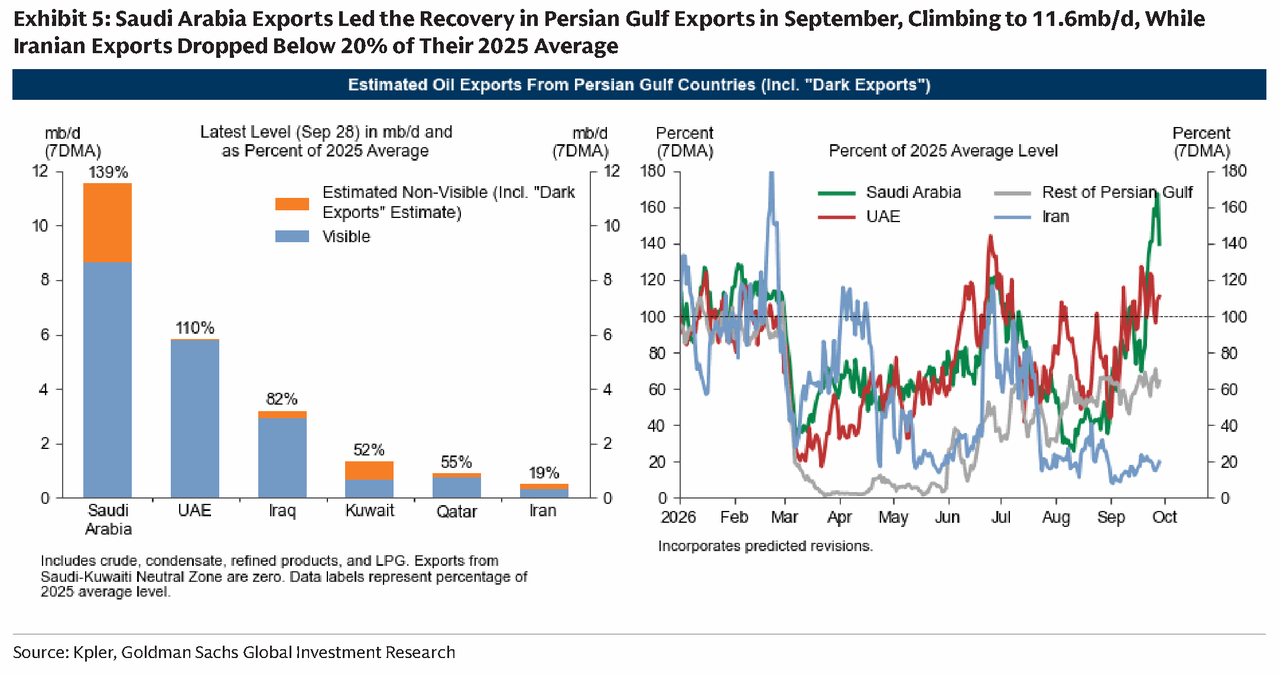
But the recovery is far from evenly shared. Saudi exports "more than doubled in September and rose above their 2025 average, reaching 11.6mb/d," and UAE exports are also above their 2025 levels. Iraq? Just 82% of its 2025 average as of Sep 28, even including Goldman's estimate of dark exports, and that's after a remarkable September. Kuwait and Qatar are stuck around 50%, while Iran shipped essentially nothing by sea.
Struyven repeated the message in the latest edition of Goldman's "Connecting You to GS" desk email (available to pro subs), with Gulf exports now at 23.6mb/d, and a breakdown that shows just how improvised the recovery is: only 7.5mb/d is going through the Strait of Hormuz in the conventional sense, with another 4.5mb/d via the Gulf of Oman, 4.6mb/d out of Saudi Arabia's Yanbu, 2.9mb/d via Fujairah (a bypass hub we said would become the focus back in March) and a token 0.2mb/d through Iraq's own Botas-Ceyhan pipeline to Turkey. The rest is Goldman's 4mb/d estimate of "dark" flows.
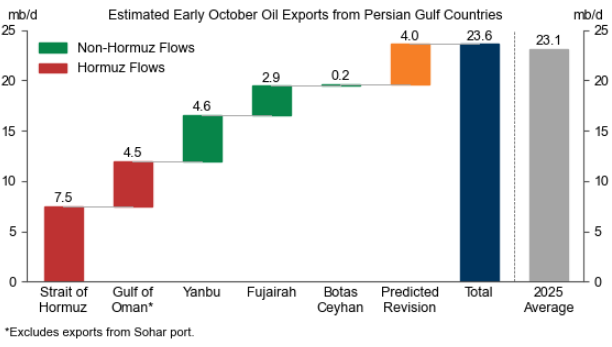
Which brings us to the problem for Baghdad: Saudi Arabia has a Red Sea pipeline and the UAE has Fujairah; Iraq has a 0.2mb/d trickle to Ceyhan and a Syria pipeline that is three to four years away, at best. It is reduced to chasing more tankers to get through Hormuz on Iran's terms. And with dated Brent near $120 and Goldman forecasting Brent "moderates to $85/bbl by year-end and to $80 in 2027," the window in which higher prices offset lower volumes is, according to Goldman at least, closing.
Put another way, the barrels are coming back, but the $80 billion in lost revenue and the $20 billion hole in reserves aren't, and the price of oil the draft budget assumes is $58 per barrel, so nobody in Baghdad is counting on a windfall.
Speaking of the draft budget, the numbers lawmakers shared with Reuters are a work of art. It projects spending of 217 trillion dinars, which Reuters converts to about $166 billion (implying the old ~1,300 rate). At the new 1,520 rate, that same dinar spending is just $143 billion, which is the point. The plan also forecasts a deficit of more than 40 trillion dinars and assumes crude exports of around 4 million barrels per day, including Kurdistan.
For context, that is above pre-war levels, about 70% more than Iraq actually exported in August, and more than three times the average since March. If the Strait doesn't cooperate, the devaluation is simply the plan B that is already in place: when the barrels don't show up, print more dinars per barrel.
And the pain doesn't stop at the Iraqi border. The IMF projects Iraq's $265 billion economy will shrink by almost 7% this year, and Bloomberg notes Saudi Arabia, Kuwait and Qatar are all expected to contract as well. In the bond market, Goldman's EM credit strategist Mikhail Galkin lists Bahrain among his relative dislikes "with a view of protracted Iran conflict" in his latest "EM Credit: The Big Picture... Heading into Q4" note (also available to pro subs), noting that BHRAIN bonds are down roughly 10% YTD, among the worst in EM.
Iran's rial collapsed because Washington wanted it to. Iraq's dinar fell because Baghdad chose to let it, which in some ways is the more telling of the two. The Gulf's dollar pegs were built on an assumption that oil, and therefore dollars, would always flow. For seven months, for the most Hormuz-dependent producer in the region, they haven't.
Daoud's framing is the right one: every oil shock eventually lands on Iraq's currency. The question now is whether 1,520 is the new floor or just the first stop. With the parallel market already at 1,685, traders eyeing 1,800, food prices up a quarter overnight and a budget that only works with 4mb/d of exports, we'd bet on the latter, especially if the Monday de-escalation headlines keep reversing by Friday's close. Iraq picked salaries over the dinar this time. The next time, it may not get to pick.
Much more in the full Goldman "Persian Gulf Exports Return to 2025 Level" and the "EM Credit: The Big Picture... Heading into Q4" notes, both available to pro subs.
Tyler Durden Wed, 10/07/2026 - 10:10
Continue reading...
[ H/T ZeroHedge ]
Last weekend, we noted that the clearest scorecard of the US economic war on Iran is the rial, which cratered to a record 2.7 million per dollar (the slide that we first flagged in "Iran's Deadline Expires Today"... Rial Collapses, and which has only accelerated since). Turns out Tehran has company.
On Wednesday, Iraq devalued its currency by 13%, with the central bank raising the dollar-selling price for the public to 1,520 dinars from roughly 1,320. Per Reuters, the cabinet adopted the new structure on Tuesday, effective Wednesday: the Finance Ministry now sells its oil dollars to the CBI at 1,500, banks get them at 1,510 and the public pays 1,520.
That makes Iraq, as Bloomberg notes, the first Gulf Arab state to devalue since the US-Israel war on Iran began in late February. It probably won't be the last thing in the region to break, but it is the first currency peg to do so, which is a different kind of milestone.
The central bank's official explanation was a masterpiece of the genre: the decision was taken "in view of the current economic and financial conditions, and based on the recommendation of the cabinet," and, rest assured, foreign reserves are "sufficient to finance external trade, settle overseas bank-card transactions and provide cash to travelers." Translation: we have enough dollars, which is why we just made each one cost 15% more.
Below we look at why Baghdad blinked, why the street isn't buying it (yet), and why the timing is stranger than it looks given that Goldman says Gulf oil exports are already back to pre-war levels.
Salaries Or The Dinar: Pick One
Iraq is one of the most oil-dependent economies on the planet: crude sales generate around 90% of government revenue, and those sales go almost entirely out through the Strait of Hormuz. Which is why, from day one of the war, we flagged that Iraq would be the most exposed producer in the Gulf. Back on March 3, as storage filled with nowhere to ship, we tweeted this:
A week later it was this:
Seven months later, the bill has arrived. Bloomberg estimates Iraqi crude exports have averaged only about 1.25 million barrels a day since the start of March, compared with almost 3.5 million last year. SOMO, the state oil marketer, put the country's cumulative oil losses at around $80 billion last month. Even with a recovery, Reuters says exports were just 2.34mb/d in August, versus more than 3.6mb/d before the war.
Meanwhile, the one line item that never shrinks kept on growing. Bloomberg's chief EM economist Ziad Daoud summed it up:
The math behind that choice is not complicated. Iraq had roughly $100 billion in FX reserves when the war began; by August that had dropped to $80 billion. Public-sector salaries alone cost about $5 billion a month, per Daoud.
Put differently, $20 billion of reserves went out the door in roughly six months, and what's left covers about 16 months of payroll with nothing else, ever, being imported. Hence the devaluation, which, as Iraqi analyst Mohammed al-Saffar told Reuters, is "essentially a fiscal response to the shock to Iraq's oil revenues": it "gives the government more dinars for each dollar of oil revenue, but raises import costs and reduces households' purchasing power."
Some napkin math (approximate): at 1,320, a 6.6 trillion dinar monthly wage bill eats about $5 billion of oil dollars. At 1,520, the same dinar payroll costs just $4.3 billion, a saving of roughly $650-700 million a month, or ~$8 billion a year. That is a 13% real pay cut for every public-sector worker in Iraq, delivered without anyone having to announce a pay cut. Diversification at its finest.
The Street Got There First
Of course, devaluations rarely happen to the market; they usually happen after it. According to Shafaq News, the dollar set six new parallel-market highs in Baghdad this year, from 150,400 dinars per $100 in January to roughly 160,000 in September, and 168,500 per $100 (1,685 per dollar) after the announcement. In other words, even at the new official rate, the black market still prices the dinar about 11% weaker, and local currency traders are already talking about a test of 180,000.
And the real economy is not taking it gracefully. Iraqi News reports Baghdad's Shorja wholesale market was "completely paralyzed" on Wednesday as merchants shuttered stores, distributors suspended deliveries, and food staples in Saladin jumped about 25% almost overnight. One MP has already demanded an emergency session of parliament to reverse the decision. (We'll take the under on that.)
Readers will also recall that Iraq's dollars aren't entirely Iraq's to begin with. As we discussed in "The Hidden Mechanism Behind Washington's Control Of Iraq's Oil Money" just last week, every barrel Iraq sells settles into a CBI account at the New York Fed, and Washington has not been shy about using that tap: in January it threatened to "starve" Iraq of its oil revenue if pro-Iran parties joined the government, and in April it blocked the regular $500 million cash pallets flown to Baghdad. Add the last US troops leaving Iraq on Sept 30 and Bessent's "frank discussion" with Iraq's foreign minister the very next day on "Iraq's progress in demilitarizing Iranian militias," and one can see why holding dinars has lately lost some of its appeal.
The Barrels Came Back... The Dollars Didn't
Here is the twist: the devaluation comes just as the physical oil picture is improving dramatically. In their latest Oil Comment, "Adaptation: Persian Gulf Exports Return to 2025 Level" (available to pro subs), Goldman's commodity team led by Daan Struyven writes:
But the recovery is far from evenly shared. Saudi exports "more than doubled in September and rose above their 2025 average, reaching 11.6mb/d," and UAE exports are also above their 2025 levels. Iraq? Just 82% of its 2025 average as of Sep 28, even including Goldman's estimate of dark exports, and that's after a remarkable September. Kuwait and Qatar are stuck around 50%, while Iran shipped essentially nothing by sea.
Struyven repeated the message in the latest edition of Goldman's "Connecting You to GS" desk email (available to pro subs), with Gulf exports now at 23.6mb/d, and a breakdown that shows just how improvised the recovery is: only 7.5mb/d is going through the Strait of Hormuz in the conventional sense, with another 4.5mb/d via the Gulf of Oman, 4.6mb/d out of Saudi Arabia's Yanbu, 2.9mb/d via Fujairah (a bypass hub we said would become the focus back in March) and a token 0.2mb/d through Iraq's own Botas-Ceyhan pipeline to Turkey. The rest is Goldman's 4mb/d estimate of "dark" flows.
Which brings us to the problem for Baghdad: Saudi Arabia has a Red Sea pipeline and the UAE has Fujairah; Iraq has a 0.2mb/d trickle to Ceyhan and a Syria pipeline that is three to four years away, at best. It is reduced to chasing more tankers to get through Hormuz on Iran's terms. And with dated Brent near $120 and Goldman forecasting Brent "moderates to $85/bbl by year-end and to $80 in 2027," the window in which higher prices offset lower volumes is, according to Goldman at least, closing.
Put another way, the barrels are coming back, but the $80 billion in lost revenue and the $20 billion hole in reserves aren't, and the price of oil the draft budget assumes is $58 per barrel, so nobody in Baghdad is counting on a windfall.
A Budget Written In Wishful Thinking
Speaking of the draft budget, the numbers lawmakers shared with Reuters are a work of art. It projects spending of 217 trillion dinars, which Reuters converts to about $166 billion (implying the old ~1,300 rate). At the new 1,520 rate, that same dinar spending is just $143 billion, which is the point. The plan also forecasts a deficit of more than 40 trillion dinars and assumes crude exports of around 4 million barrels per day, including Kurdistan.
For context, that is above pre-war levels, about 70% more than Iraq actually exported in August, and more than three times the average since March. If the Strait doesn't cooperate, the devaluation is simply the plan B that is already in place: when the barrels don't show up, print more dinars per barrel.
And the pain doesn't stop at the Iraqi border. The IMF projects Iraq's $265 billion economy will shrink by almost 7% this year, and Bloomberg notes Saudi Arabia, Kuwait and Qatar are all expected to contract as well. In the bond market, Goldman's EM credit strategist Mikhail Galkin lists Bahrain among his relative dislikes "with a view of protracted Iran conflict" in his latest "EM Credit: The Big Picture... Heading into Q4" note (also available to pro subs), noting that BHRAIN bonds are down roughly 10% YTD, among the worst in EM.
Bottom Line
Iran's rial collapsed because Washington wanted it to. Iraq's dinar fell because Baghdad chose to let it, which in some ways is the more telling of the two. The Gulf's dollar pegs were built on an assumption that oil, and therefore dollars, would always flow. For seven months, for the most Hormuz-dependent producer in the region, they haven't.
Daoud's framing is the right one: every oil shock eventually lands on Iraq's currency. The question now is whether 1,520 is the new floor or just the first stop. With the parallel market already at 1,685, traders eyeing 1,800, food prices up a quarter overnight and a budget that only works with 4mb/d of exports, we'd bet on the latter, especially if the Monday de-escalation headlines keep reversing by Friday's close. Iraq picked salaries over the dinar this time. The next time, it may not get to pick.
Much more in the full Goldman "Persian Gulf Exports Return to 2025 Level" and the "EM Credit: The Big Picture... Heading into Q4" notes, both available to pro subs.
Tyler Durden Wed, 10/07/2026 - 10:10
Continue reading...
[ H/T ZeroHedge ]