






Summary
- Jones Act waivers enabled greater domestic movement of cargo.
- U.S.-flagged shipping remained fully engaged despite months of foreign-vessel competition.
- Reviving American shipbuilding remains essential to economic resiliency and national defense.
Since March 17, 2026, the federal government has implemented a months-long Jones Act waiver. This waiver allows foreign-flagged vessels to transport specified cargo between U.S. ports, easing shipping disruptions caused by the Iran conflict. As such, the waiver offers an opportunity to examine the Jones Act’s effectiveness in safeguarding and growing American shipping using recent shipping data.
Under federal law, two primary pathways exist for obtaining a Jones Act waiver. First, the secretary of war may request a waiver when it is necessary to address an immediate adverse effect on military operations, while certifying to Congress that qualified U.S.-flagged vessels are unavailable to meet the need. Second, the president may determine that a waiver is necessary in the interest of national defense, but only after the maritime administrator finds that sufficient Jones Act-qualified vessels are not available.
Jones Act waivers have been used most often during natural disasters like Hurricane Katrina, which caused significant loss of life and destruction.
Maritime industry groups have argued that the extended waiver has displaced U.S.-flag vessels and harmed American maritime employment. However, the Kirby Corporation, the only publicly traded Jones Act operator to discuss the effect directly with investors, panned the waiver’s impact.
“We haven’t really seen a big impact for Kirby,” explained Kirby CEO David Grzebinski, in the company’s second quarter 2026 earnings call. “We have heard of a couple participants losing some contracts because of non-Jones Act equipment. So far, it’s benign,”
Major petroleum companies, by contrast, have described tangible commercial benefits from the waivers. Phillips 66, an oil refiner and shipper that transports crude oil and petroleum products between U.S. ports, said it received approximately 20% of the Jones Act waivers issued since the program began in March.
On its second quarter 2026 earnings call, executives said the waivers had improved Phillips 66’s ability to optimize the movement of crude oil and petroleum products. PBF Energy similarly reported that the waivers let it process non-traditional crude oils, giving it greater flexibility in markets with limited refining capacity.
If the Kirby and Phillips 66 experience is widespread, then the waivers are enhancing domestic trade without taking business away from the small Jones Act fleet. This appears to be borne out by ship-tracking data.
From the start of the current Jones Act waiver to Oct. 5, 2026, analysis of commercial automatic identification system (AIS) ship-tracking data found no statistically significant downward trend in the U.S. share of flagged vessels present in or crossing the U.S. Exclusive Economic Zone. In fact, activity modestly increased by 0.626%. Despite the waiver, U.S. shipping appears to have remained fully engaged.
The question, then, is this: Had more U.S.-flagged ships been available, would they have been disadvantaged by such a waiver?
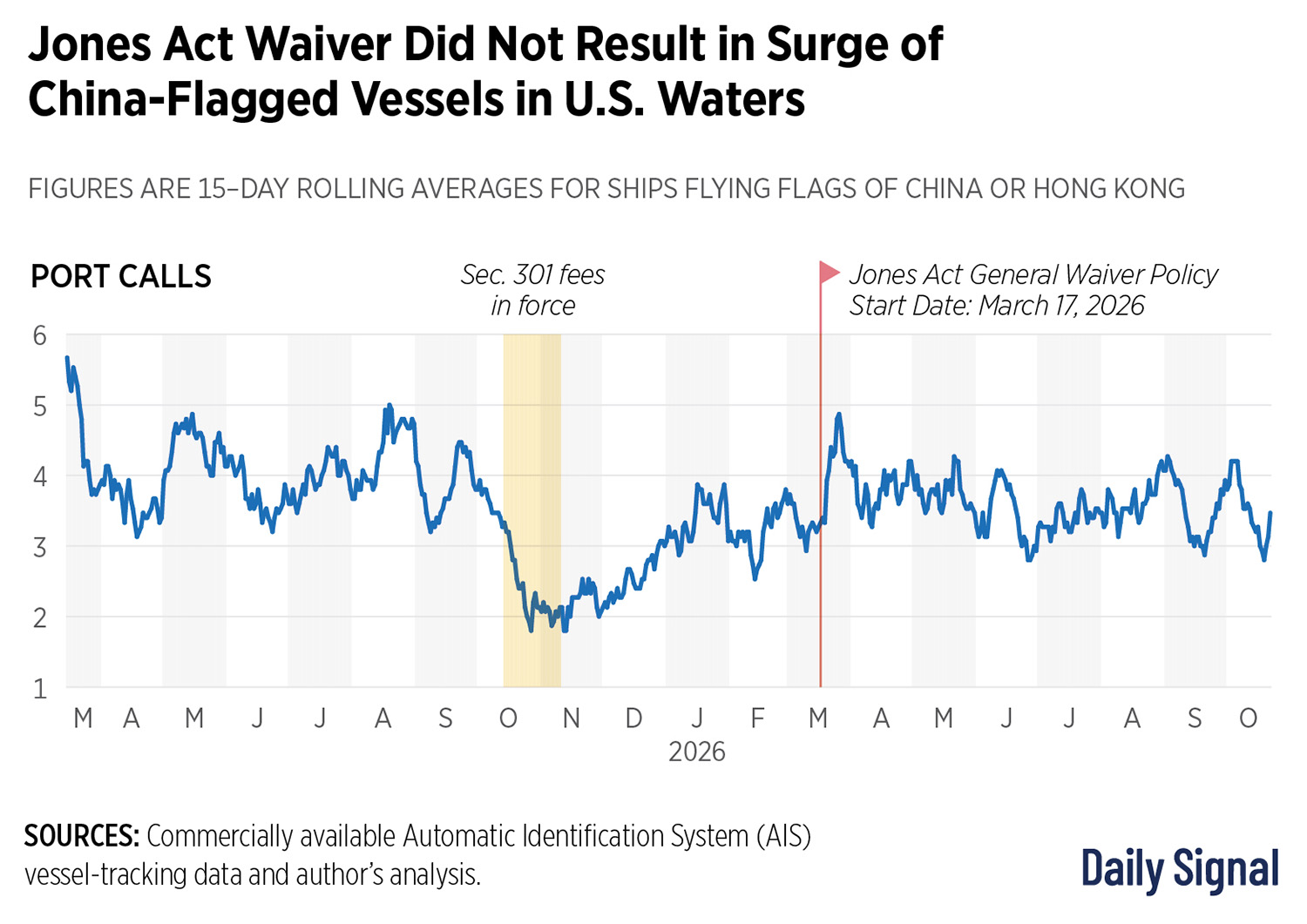
Another concern is that the waiver would invite an influx of hostile Chinese shipping—recently found engaged in espionage—that would drive out the last remaining American shippers. Despite the Jones Act, a significant amount of foreign shipping occurs in American waters and has not prevented Jones Act ships from conducting maintenance in Chinese shipyards.
During the waiver period, no appreciable change in Chinese- and Hong Kong-flagged vessel activity in the U.S. Exclusive Economic Zone appears to have occurred. In fact, average daily counts of Chinese- and Hong Kong-flagged vessels declined slightly during the waiver period (63.35 vessels per day before the waiver versus 62.99 after, a 0.6% decrease).
The Daily Signal.
As such, the months-long waiver is exposing false assumptions and pointing the way to nurture and revive the American maritime industry. Fees authorized by President Donald Trump under a Section 301 trade complaint against China have bolstered U.S. shipping.
The data shows a correlation between the fees and reduced Chinese shipping from Oct. 14, 2025, until its Nov. 10 pause. It does not indicate a marked increase in U.S. shipping, which seemingly is due more to a lack of additional ships available to replace Chinese shipping traffic.
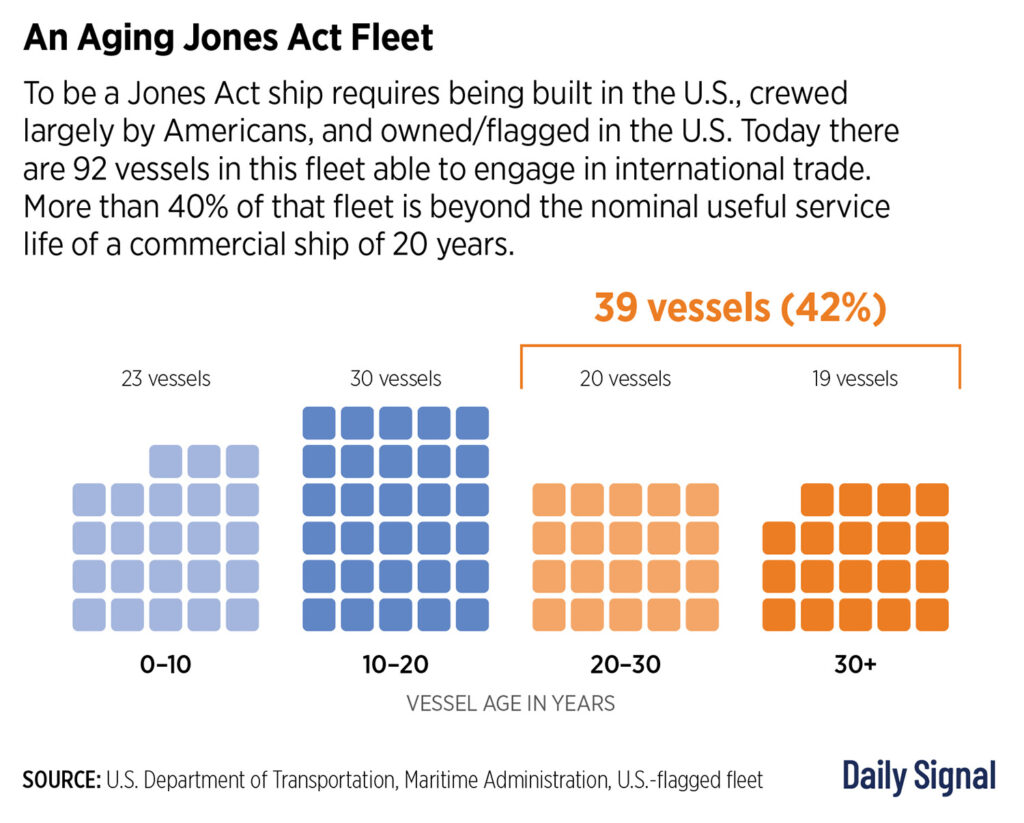
To add more resiliency to America’s economy and bolster its national defense, the nation needs more ships. In the long term, reviving American shipbuilding is needed to ensure more assured shipping in a war or crisis; today American-flagged ships serve only 0.25% of our vital maritime trade. The SHIPS for America Act and the president’s complementary executive orders aim to address the dearth of American shipping, but those ships will not arrive for years.
The Daily Signal.
In the meantime, the Jones Act waiver appears to be enabling more American maritime traffic. During the waiver, roughly 192.8 million barrels of crude oil and petroleum products have moved domestically by tankers and barges, a 33.52% increase from the same period last year. But until the American maritime industry grows, the nation will remain reliant on foreign shipbuilding and shippers. Mitigating the potential of economic coercion in the short term requires action.
In the short term, thoughtful application of Section 301 fees on Chinese shipping in concert with efforts to secure more shipping from friendly nations is required. Key will be striking the right balance in leveling the playing field against state-backed shippers and shipbuilders, without harming our economy or America’s shipbuilding revival that President Trump advocates.
Continue reading...
[ H/T The Daily Signal ]