




Yen Plunges After Two Dissenters Upstage BOJ's Rate Hike: Full Wall Street Reaction
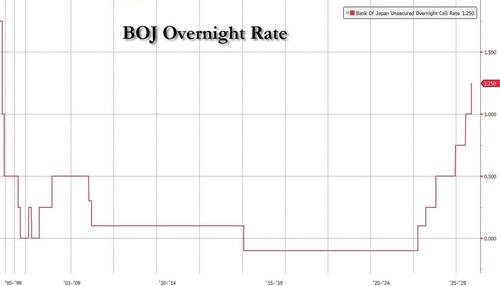
The yen sank to a two-week low against the dollar on Friday after two policy makers at the Bank of Japan dissented from a widely expected decision to raise interest rates, extinguishing expectations for back-to-back hikes. Governor Kazuo Ueda now needs, at a minimum, to preserve expectations for a December move to prevent markets from unwinding most if note all of the tightening path already priced into rates.
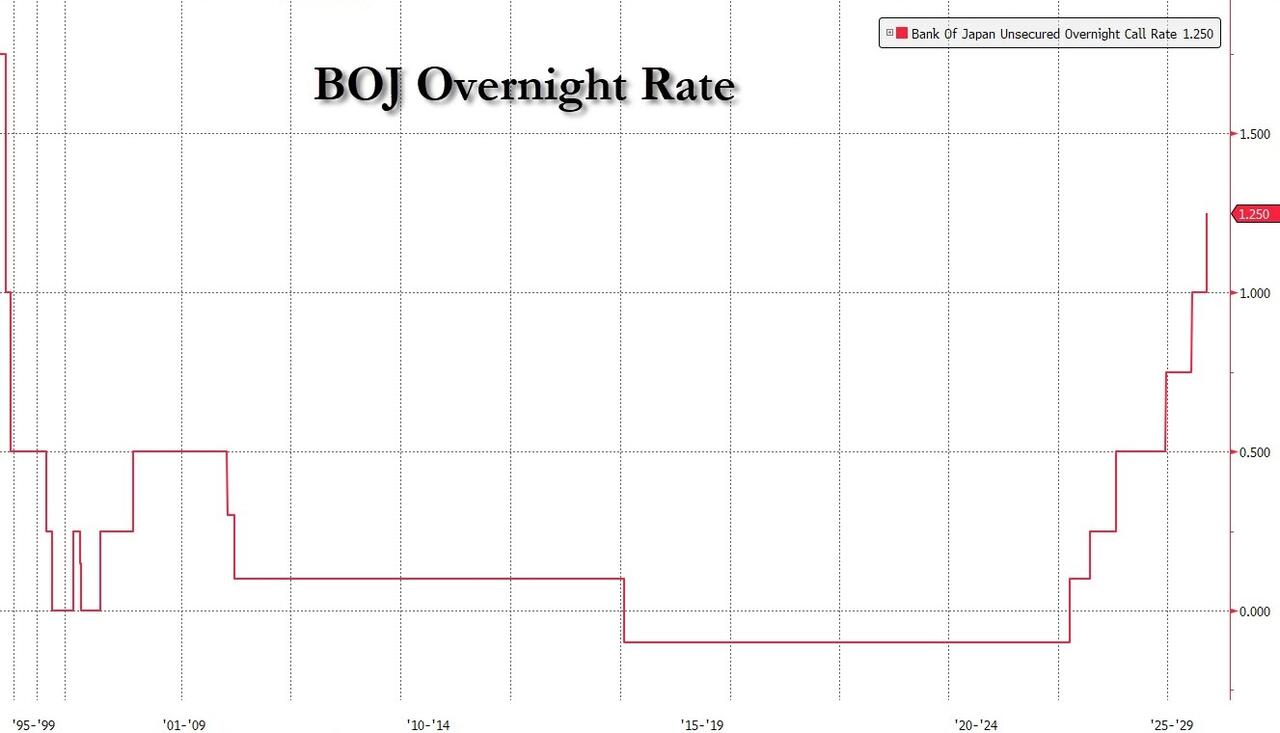
While Japanese policymakers pushed rates to their highest level in 31 years at 1.25%, the move failed to boost the currency as traders felt there was a lack of explicitly hawkish guidance.
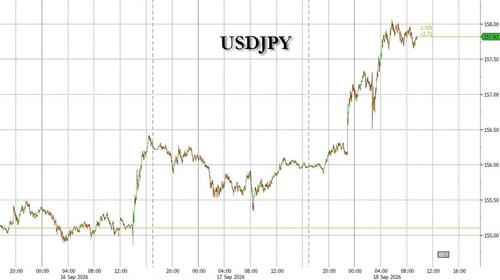
As a result of the dovish split, the yen tumbled and the US dollar rose more than 1.2% against the Japanese currency, hitting a a two-week high of 158.07 yen after wavering during BOJ Governor Kazuo Ueda's press conference. It was set for its biggest daily increase versus the yen since December and the largest weekly rally since September 2024.
Traders had already discounted the equivalent of another hike by year-end before today’s policy meeting, leaving a high bar for any hawkish surprise. The presence of two dissenters signals that support for another rate increase in October is weakening, with OIS assigning around a 20% probability to such an outcome. That leaves Ueda’s press conference carrying the burden of preserving expectations for a December hike and keeping the BOJ on a tightening path that at least matches the Fed’s recent pace.
"They've just clearly underwhelmed versus expectations here," said Ray Attrill, head of FX strategy at National Australia Bank in Sydney. "And I think that one of the more staggering aspects of it was that they couldn't even get the unanimous vote for that," he said. "That really raised eyebrows in the market."
"The statement offered little additional hawkish guidance to support bullish Japanese yen positions," said Frantisek Taborsky, currency strategist at ING. "The dissent from (Toichiro) Asada and (Ayano) Sato points to resistance against the fastest pace of rate increases in more than three decades and suggests they may increasingly act as a brake on further tightening."
According to Mizuho strategists, the dissenters raise concerns that further rate hikes become harder to deliver, potentially steepening the JGB yield curve. Senior strategist Masayuki Nakajima said that Friday’s two dissenters were appointed by Prime Minister Sanae Takaichi. Two more members are due to leave the board next year and could potentially be replaced by more dovish policymakers
“Should their successors come from the reflationist camp, four of the nine Board members would become dovish,” he says; “While that would still fall short of a majority, it could reinforce expectations that sustaining the tightening cycle may become more difficult in the future”
“If so, concerns that the BOJ is falling behind the curve could re-emerge, potentially leading to further curve steepening,” he added.
Commenting on the market reaction, Bloomberg's Ven Ram said that the decision was:
Japan’s benchmark rate still trails the neutral rate by a considerable margin, and without back-to-back interest-rate hikes, the yen will stay weaker for longer. Only the franc carries a lower interest rate in the G-10 economies, with the Swiss central bank due to meet next week. Should that monetary authority reiterate its preference for keeping rates at zero, it will engender low volatility in two of the major exchange rates that represent the preferred funding currencies.
After a slew of central bank meetings and with Brent crude headed for the first weekly decline this month, global bonds that were deeply oversold are finding some respite. Longer-dated gilts received a boost from the Bank of England’s plan to pause bond sales and stop selling securities that mature in 2049 or later. Gilts with a maturity of 30 years stand to benefit considerably, so an immediate follow-through of Thursday’s rally is likely even though the looming autumn budget realities may check the pace of gains.
Here are some other reactions to the split BOJ decision from Wall Street traders:
NAKA MATSUZAWA, CHIEF MACRO STRATEGIST, NOMURA SECURITIES, TOKYO:
RAY ATTRILL, HEAD OF CURRENCY STRATEGY, NATIONAL AUSTRALIA BANK, SYDNEY:
BART WAKABAYASHI, BRANCH MANAGER, STATE STREET, TOKYO:
DAVID CHAO, GLOBAL MARKET STRATEGIST FOR ASIA-PACIFIC, INVESCO, SINGAPORE:
MASAHIKO LOO, SENIOR FIXED INCOME STRATEGIST, STATE STREET INVESTMENT MANAGEMENT, TOKYO:
CAROL KONG, CURRENCY STRATEGIST, COMMONWEALTH BANK OF AUSTRALIA, SYDNEY:
YUGO TSUBOI, CHIEF STRATEGIST, DAIWA SECURITIES, TOKYO:
SHUN HONG LIU, CHIEF INVESTMENT OFFICER, HONG INVESTMENT ADVISORS, HONG KONG:
KANAKO NAKAMURA, ECONOMIST, DAIWA INSTITUTE OF RESEARCH, TOKYO:
PRASHANT NEWNAHA, SENIOR RATES STRATEGIST, TD SECURITIES, SINGAPORE:
TOHRU SASAKI, CHIEF STRATEGIST, FUKUOKA FINANCIAL GROUP AND FORMER BOJ OFFICIAL, TOKYO:
ANTHONY MALOUF, EBURY, SYDNEY:
KENTO MINAMI, SENIOR ECONOMIST AT DAIWA SECURITIES, TOKYO:
MASATO KOIKE, SENIOR ECONOMIST, SOMPO INSTITUTE PLUS, TOKYO:
HIROFUMI SUZUKI, CHIEF FX STRATEGIST, SMBC, TOKYO:
FRED NEUMANN, CHIEF ASIA ECONOMIST, HSBC, HONG KONG:
Sellside reactions aside, Governor Kazuo Ueda said that with the price trend very close to the bank’s 2% target, authorities now need to ensure inflation doesn’t overshoot.
“It has become important to stabilize the rate of price increases at a level of around 2%,” Ueda said in a post-decision briefing. “In that sense, I believe the phase of policy has shifted to a new stage.” The bank should act preemptively to avoid being forced into a situation where rapid hikes might become unavoidable, he added.
Traders also remained alert to the risk of intervention to prop up the currency after Finance Minister Satsuki Katayama said Tokyo won't hesitate to conduct further coordinated action, following a joint US-Japan move to boost the yen in late July.
The yen rallied sharply in early September to its highest since February as traders bet the BOJ would embark on multiple rate hikes, although those wagers came under question on Friday.
The dollar rally against the yen helped the DXY dollar index climb 0.25% to 100.48, as broader currency markets remained focused on energy prices and the U.S. Federal Reserve. The index, which tracks the currency against six major peers, was up 1.4% for the week to around a six-week high after the US Federal Reserve hiked interest rates on Wednesday and signaled more increases could be coming.
Traders now see a roughly 55% chance of a quarter-point hike at the Fed's next two-day meeting next month, up from 27% a week ago, according to the CME Group's FedWatch tool.
Finally, it's worth noting that the BOJ dissenters directly jeopardized the plan of Steve Bessent for a stronger yen (and thus less fears of TSY selling to prop up the yen through intervention). According to Bloomberg, Warsh should "seriously consider a little Friday afternoon intervention to ensure that this bounce in USD/JPY makes a lower high than the prior ascent to just over 160."
Of course, the problem with constant meddling in market prices is the risk that the market tests you, forcing ever-more frequent action to keep things in line. At the very least anyone who stayed with the short-dollar trade has received a painful kick in the shin, which arguably will dissuade some punters from staying in the position the next time that the authorities step in.
Tyler Durden Fri, 09/18/2026 - 10:10
Continue reading...
[ H/T ZeroHedge ]
The yen sank to a two-week low against the dollar on Friday after two policy makers at the Bank of Japan dissented from a widely expected decision to raise interest rates, extinguishing expectations for back-to-back hikes. Governor Kazuo Ueda now needs, at a minimum, to preserve expectations for a December move to prevent markets from unwinding most if note all of the tightening path already priced into rates.
While Japanese policymakers pushed rates to their highest level in 31 years at 1.25%, the move failed to boost the currency as traders felt there was a lack of explicitly hawkish guidance.
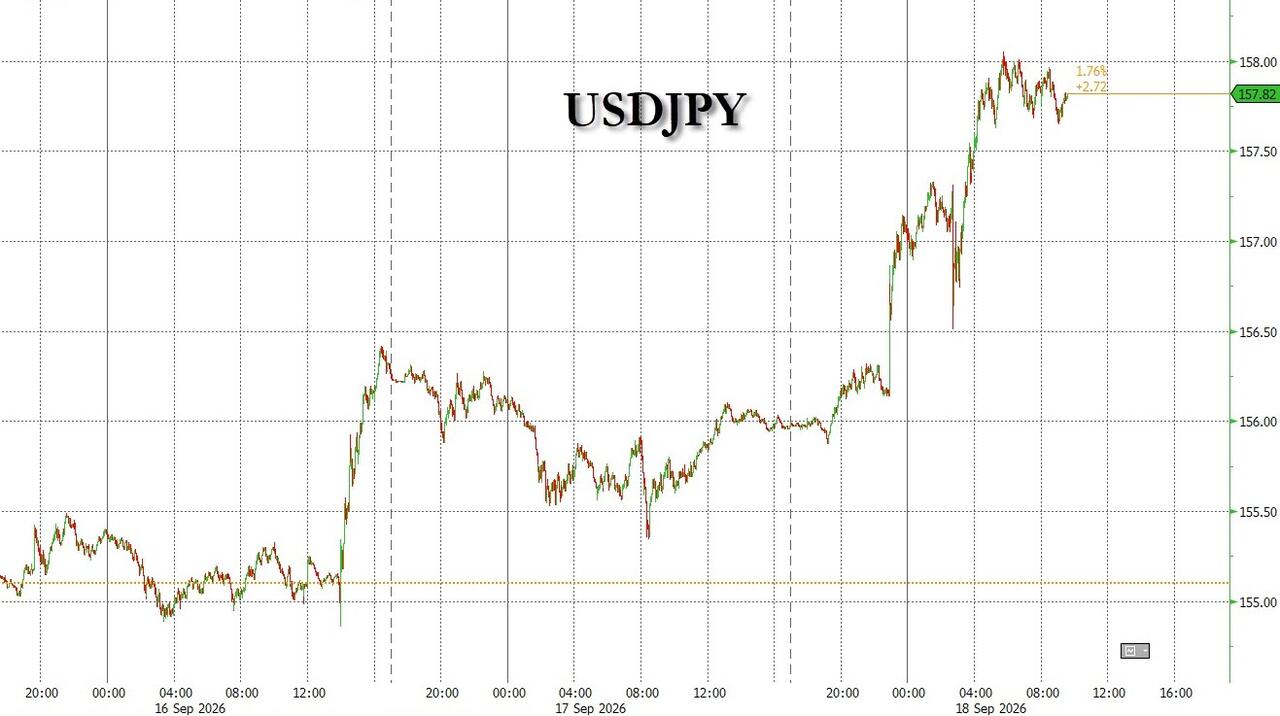
As a result of the dovish split, the yen tumbled and the US dollar rose more than 1.2% against the Japanese currency, hitting a a two-week high of 158.07 yen after wavering during BOJ Governor Kazuo Ueda's press conference. It was set for its biggest daily increase versus the yen since December and the largest weekly rally since September 2024.
Traders had already discounted the equivalent of another hike by year-end before today’s policy meeting, leaving a high bar for any hawkish surprise. The presence of two dissenters signals that support for another rate increase in October is weakening, with OIS assigning around a 20% probability to such an outcome. That leaves Ueda’s press conference carrying the burden of preserving expectations for a December hike and keeping the BOJ on a tightening path that at least matches the Fed’s recent pace.
"They've just clearly underwhelmed versus expectations here," said Ray Attrill, head of FX strategy at National Australia Bank in Sydney. "And I think that one of the more staggering aspects of it was that they couldn't even get the unanimous vote for that," he said. "That really raised eyebrows in the market."
"The statement offered little additional hawkish guidance to support bullish Japanese yen positions," said Frantisek Taborsky, currency strategist at ING. "The dissent from (Toichiro) Asada and (Ayano) Sato points to resistance against the fastest pace of rate increases in more than three decades and suggests they may increasingly act as a brake on further tightening."
According to Mizuho strategists, the dissenters raise concerns that further rate hikes become harder to deliver, potentially steepening the JGB yield curve. Senior strategist Masayuki Nakajima said that Friday’s two dissenters were appointed by Prime Minister Sanae Takaichi. Two more members are due to leave the board next year and could potentially be replaced by more dovish policymakers
“Should their successors come from the reflationist camp, four of the nine Board members would become dovish,” he says; “While that would still fall short of a majority, it could reinforce expectations that sustaining the tightening cycle may become more difficult in the future”
“If so, concerns that the BOJ is falling behind the curve could re-emerge, potentially leading to further curve steepening,” he added.
Commenting on the market reaction, Bloomberg's Ven Ram said that the decision was:
- marred by dissent from two policymakers who voted against the hike;
- there was none who called for a bigger margin of increase;
- and the accompanying statement, while vowing to continue raising rates, failed to signal a sense of urgency by not saying when they will come.
Japan’s benchmark rate still trails the neutral rate by a considerable margin, and without back-to-back interest-rate hikes, the yen will stay weaker for longer. Only the franc carries a lower interest rate in the G-10 economies, with the Swiss central bank due to meet next week. Should that monetary authority reiterate its preference for keeping rates at zero, it will engender low volatility in two of the major exchange rates that represent the preferred funding currencies.
After a slew of central bank meetings and with Brent crude headed for the first weekly decline this month, global bonds that were deeply oversold are finding some respite. Longer-dated gilts received a boost from the Bank of England’s plan to pause bond sales and stop selling securities that mature in 2049 or later. Gilts with a maturity of 30 years stand to benefit considerably, so an immediate follow-through of Thursday’s rally is likely even though the looming autumn budget realities may check the pace of gains.
Here are some other reactions to the split BOJ decision from Wall Street traders:
NAKA MATSUZAWA, CHIEF MACRO STRATEGIST, NOMURA SECURITIES, TOKYO:
RAY ATTRILL, HEAD OF CURRENCY STRATEGY, NATIONAL AUSTRALIA BANK, SYDNEY:
BART WAKABAYASHI, BRANCH MANAGER, STATE STREET, TOKYO:
DAVID CHAO, GLOBAL MARKET STRATEGIST FOR ASIA-PACIFIC, INVESCO, SINGAPORE:
MASAHIKO LOO, SENIOR FIXED INCOME STRATEGIST, STATE STREET INVESTMENT MANAGEMENT, TOKYO:
CAROL KONG, CURRENCY STRATEGIST, COMMONWEALTH BANK OF AUSTRALIA, SYDNEY:
YUGO TSUBOI, CHIEF STRATEGIST, DAIWA SECURITIES, TOKYO:
SHUN HONG LIU, CHIEF INVESTMENT OFFICER, HONG INVESTMENT ADVISORS, HONG KONG:
KANAKO NAKAMURA, ECONOMIST, DAIWA INSTITUTE OF RESEARCH, TOKYO:
PRASHANT NEWNAHA, SENIOR RATES STRATEGIST, TD SECURITIES, SINGAPORE:
TOHRU SASAKI, CHIEF STRATEGIST, FUKUOKA FINANCIAL GROUP AND FORMER BOJ OFFICIAL, TOKYO:
ANTHONY MALOUF, EBURY, SYDNEY:
KENTO MINAMI, SENIOR ECONOMIST AT DAIWA SECURITIES, TOKYO:
MASATO KOIKE, SENIOR ECONOMIST, SOMPO INSTITUTE PLUS, TOKYO:
HIROFUMI SUZUKI, CHIEF FX STRATEGIST, SMBC, TOKYO:
FRED NEUMANN, CHIEF ASIA ECONOMIST, HSBC, HONG KONG:
Sellside reactions aside, Governor Kazuo Ueda said that with the price trend very close to the bank’s 2% target, authorities now need to ensure inflation doesn’t overshoot.
“It has become important to stabilize the rate of price increases at a level of around 2%,” Ueda said in a post-decision briefing. “In that sense, I believe the phase of policy has shifted to a new stage.” The bank should act preemptively to avoid being forced into a situation where rapid hikes might become unavoidable, he added.
Traders also remained alert to the risk of intervention to prop up the currency after Finance Minister Satsuki Katayama said Tokyo won't hesitate to conduct further coordinated action, following a joint US-Japan move to boost the yen in late July.
The yen rallied sharply in early September to its highest since February as traders bet the BOJ would embark on multiple rate hikes, although those wagers came under question on Friday.
The dollar rally against the yen helped the DXY dollar index climb 0.25% to 100.48, as broader currency markets remained focused on energy prices and the U.S. Federal Reserve. The index, which tracks the currency against six major peers, was up 1.4% for the week to around a six-week high after the US Federal Reserve hiked interest rates on Wednesday and signaled more increases could be coming.
Traders now see a roughly 55% chance of a quarter-point hike at the Fed's next two-day meeting next month, up from 27% a week ago, according to the CME Group's FedWatch tool.
Finally, it's worth noting that the BOJ dissenters directly jeopardized the plan of Steve Bessent for a stronger yen (and thus less fears of TSY selling to prop up the yen through intervention). According to Bloomberg, Warsh should "seriously consider a little Friday afternoon intervention to ensure that this bounce in USD/JPY makes a lower high than the prior ascent to just over 160."
Of course, the problem with constant meddling in market prices is the risk that the market tests you, forcing ever-more frequent action to keep things in line. At the very least anyone who stayed with the short-dollar trade has received a painful kick in the shin, which arguably will dissuade some punters from staying in the position the next time that the authorities step in.
Tyler Durden Fri, 09/18/2026 - 10:10
Continue reading...
[ H/T ZeroHedge ]