




Lilly's "Incredible Hulk" Obesity Combo Delivers Record 23% Weight Loss In Diabetics
Eli Lilly's experimental combination of eloralintide and Mounjaro delivered average weight loss of up to 23% in people with diabetes, strengthening the company's competitive edge against Novo Nordisk in the obesity and diabetes treatment market.
Participants who received the highest dose lost an average of 54 pounds over 48 weeks. Their A1C, a measure of average blood sugar, fell 2.9 percentage points from a baseline of 8.1%, with up to three-quarters reaching normal blood sugar levels, according to Bloomberg.
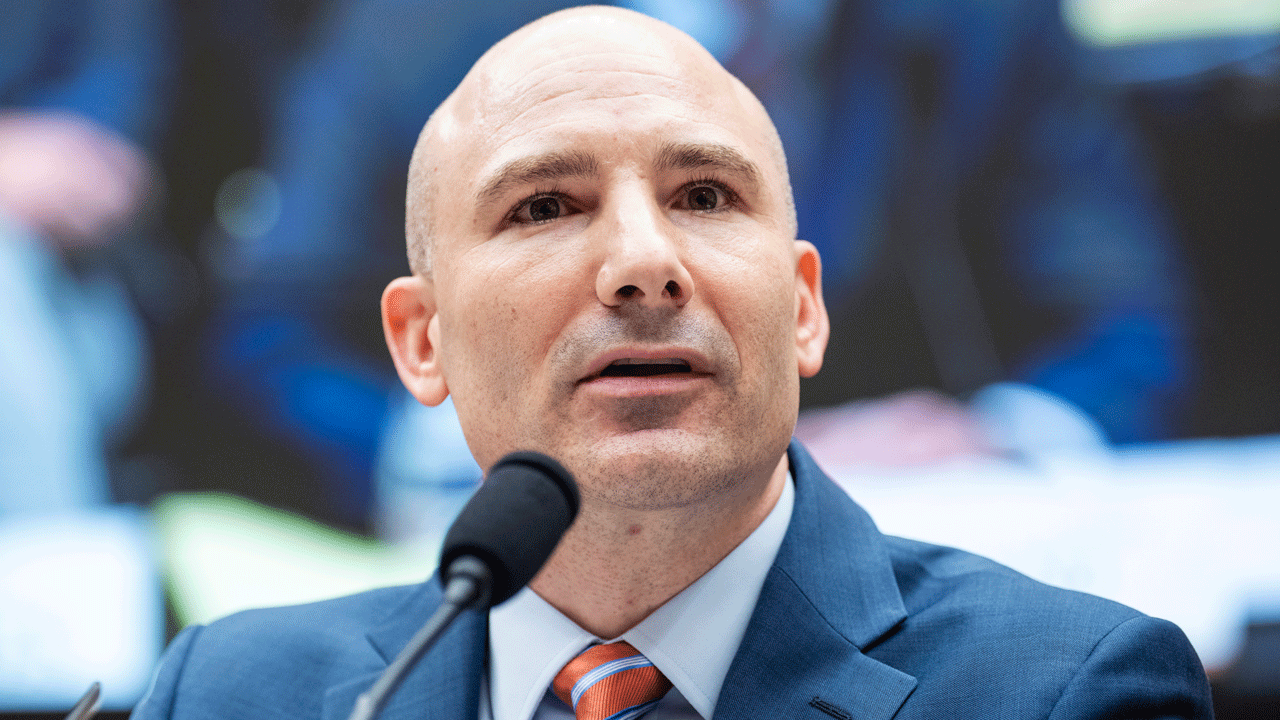
"This could open up even a next frontier in weight loss," Ken Custer, president of Lilly's cardiometabolic unit, stated.
Custer said the study sets a "new, even higher bar" but cautioned against comparing different studies.
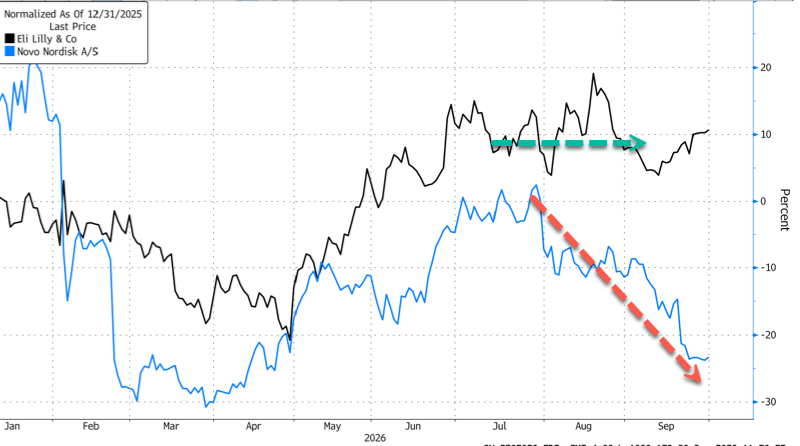
Lilly shares rose as much as 2.6% earlier today before paring gains. Year to date, shares are up a little more than 10%, while competitor Novo Nordisk has slumped more than 20%.
The Phase 2b trial, announced by Lilly Wednesday and presented at the European Association for the Study of Diabetes (EASD) meeting in Milan, randomized 367 adults with obesity or overweight and type 2 diabetes in the US and Argentina to placebo, eloralintide alone, tirzepatide alone, or one of four combinations of the two. Tirzepatide is the active ingredient in both Mounjaro and Lilly's obesity shot Zepbound. Lilly calls the combination EloraTZP.
Eloralintide mimics amylin, a hormone the pancreas releases alongside insulin that slows digestion and signals fullness to the brain. Tirzepatide hits two gut hormone receptors, GIP and GLP-1, so the combination works on three appetite and blood sugar pathways at once.
The results at 48 weeks, from an average starting weight of 232.4 pounds:
Source: Eli Lilly. Efficacy estimand, i.e. assuming all participants stayed on treatment.
In other words, adding eloralintide to the top dose of Mounjaro bought an extra 20 pounds of weight loss. Oddly, the highest dose of eloralintide on its own (9 mg) did worse than the 6 mg dose, at 11.1%.
Weight loss is typically harder to come by in diabetics, which is what makes the number stand out. Analysts at Citi wrote that the 23.3% figure is "comparable to tirzepatide in patients without T2D" and came in "comfortably above our 17% bar." For comparison, Lilly's triple-hormone shot retatrutide produced 20.8% weight loss in diabetics in its Phase 3 TRIUMPH-2 trial, and that took 80 weeks.
Study investigator Julio Rosenstock offered a very colorful description of the new GLP-1 wonder drug. Having nicknamed Mounjaro "King Kong," with retatrutide already claiming "Godzilla," Rosenstock called the new combination the "Incredible Hulk." Rosenstock, a University of Texas diabetes researcher, coined the first two in 2023: "We know that tirzepatide (Mounjaro) is the King Kong of the GLP-1s. And when I look at retatrutide, I think that there is no question that Godzilla is smiling."
Rosenstock cautioned that not all patients need to lose that much weight. At the highest dose, 27% of participants stopped taking the drug because of side effects. More than four-fifths reported a side effect of some kind, with roughly half experiencing nausea.
Across the four combination arms, Lilly reported discontinuation rates due to adverse events of 10.8% to 27%, versus 2.9% for tirzepatide alone. The side effects were mostly gastrointestinal and hit hardest during dose escalation. Citi's analysts blamed starting both drugs at once and said a gentler Phase 3 titration "could preserve efficacy while improving adherence." Custer told CNBC Lilly will adjust the dosing, "and we expect that we'll end up with a very favorable balance of efficacy and tolerability."
The results add competitive pressure on Novo, which pioneered the approach with CagriSema, a combination of its amylin treatment cagrilintide and semaglutide, the active ingredient in its blockbuster Wegovy.
That drug has already been bloodied by Lilly. In February, CagriSema failed to prove it was even as good as Mounjaro in the head-to-head REDEFINE 4 trial, with 23% weight loss after 84 weeks versus 25.5% for tirzepatide. Novo filed CagriSema with the FDA in December 2025 and expects a decision by late 2026.
Novo also lost the fight for the next amylin drug. In November, Pfizer outbid it for Metsera in a roughly $10 billion bidding war over the biotech's monthly amylin candidate. Meanwhile Mounjaro overtook Merck's Keytruda as the world's best-selling drug in the first quarter, with $8.7 billion in sales.
Lilly plans to begin late-stage studies of the new combination by year-end, using a single co-formulated injection rather than the two separate shots used in this trial. Eloralintide is already in Phase 3 on its own, after producing up to 20.1% weight loss in non-diabetics in a 48-week Phase 2 study.
Tyler Durden Thu, 10/01/2026 - 08:00
Continue reading...
[ H/T ZeroHedge ]
Eli Lilly's experimental combination of eloralintide and Mounjaro delivered average weight loss of up to 23% in people with diabetes, strengthening the company's competitive edge against Novo Nordisk in the obesity and diabetes treatment market.
Participants who received the highest dose lost an average of 54 pounds over 48 weeks. Their A1C, a measure of average blood sugar, fell 2.9 percentage points from a baseline of 8.1%, with up to three-quarters reaching normal blood sugar levels, according to Bloomberg.
"This could open up even a next frontier in weight loss," Ken Custer, president of Lilly's cardiometabolic unit, stated.
Custer said the study sets a "new, even higher bar" but cautioned against comparing different studies.
Lilly shares rose as much as 2.6% earlier today before paring gains. Year to date, shares are up a little more than 10%, while competitor Novo Nordisk has slumped more than 20%.
The Study
The Phase 2b trial, announced by Lilly Wednesday and presented at the European Association for the Study of Diabetes (EASD) meeting in Milan, randomized 367 adults with obesity or overweight and type 2 diabetes in the US and Argentina to placebo, eloralintide alone, tirzepatide alone, or one of four combinations of the two. Tirzepatide is the active ingredient in both Mounjaro and Lilly's obesity shot Zepbound. Lilly calls the combination EloraTZP.
Eloralintide mimics amylin, a hormone the pancreas releases alongside insulin that slows digestion and signals fullness to the brain. Tirzepatide hits two gut hormone receptors, GIP and GLP-1, so the combination works on three appetite and blood sugar pathways at once.
The results at 48 weeks, from an average starting weight of 232.4 pounds:
| Arm | Weight change | Pounds | A1C change |
|---|---|---|---|
| Eloralintide 9 mg + tirzepatide 15 mg | -23.3% | -54.1 | -2.9 |
| Eloralintide 6 mg + tirzepatide 10 mg | -19.9% | -46.2 | -2.6 |
| Eloralintide 6 mg + tirzepatide 5 mg | -19.4% | -45.1 | -2.7 |
| Eloralintide 3 mg + tirzepatide 5 mg | -13.2% | -30.7 | -2.2 |
| Tirzepatide 15 mg alone | -14.8% | -34.4 | -2.4 |
| Eloralintide 6 mg alone | -12.3% | -28.6 | -1.4 |
| Placebo | -3.0% | -7.0 | -0.3 |
Source: Eli Lilly. Efficacy estimand, i.e. assuming all participants stayed on treatment.
In other words, adding eloralintide to the top dose of Mounjaro bought an extra 20 pounds of weight loss. Oddly, the highest dose of eloralintide on its own (9 mg) did worse than the 6 mg dose, at 11.1%.
Weight loss is typically harder to come by in diabetics, which is what makes the number stand out. Analysts at Citi wrote that the 23.3% figure is "comparable to tirzepatide in patients without T2D" and came in "comfortably above our 17% bar." For comparison, Lilly's triple-hormone shot retatrutide produced 20.8% weight loss in diabetics in its Phase 3 TRIUMPH-2 trial, and that took 80 weeks.
Study investigator Julio Rosenstock offered a very colorful description of the new GLP-1 wonder drug. Having nicknamed Mounjaro "King Kong," with retatrutide already claiming "Godzilla," Rosenstock called the new combination the "Incredible Hulk." Rosenstock, a University of Texas diabetes researcher, coined the first two in 2023: "We know that tirzepatide (Mounjaro) is the King Kong of the GLP-1s. And when I look at retatrutide, I think that there is no question that Godzilla is smiling."
The Catch
Rosenstock cautioned that not all patients need to lose that much weight. At the highest dose, 27% of participants stopped taking the drug because of side effects. More than four-fifths reported a side effect of some kind, with roughly half experiencing nausea.
Across the four combination arms, Lilly reported discontinuation rates due to adverse events of 10.8% to 27%, versus 2.9% for tirzepatide alone. The side effects were mostly gastrointestinal and hit hardest during dose escalation. Citi's analysts blamed starting both drugs at once and said a gentler Phase 3 titration "could preserve efficacy while improving adherence." Custer told CNBC Lilly will adjust the dosing, "and we expect that we'll end up with a very favorable balance of efficacy and tolerability."
Lilly vs. Novo
The results add competitive pressure on Novo, which pioneered the approach with CagriSema, a combination of its amylin treatment cagrilintide and semaglutide, the active ingredient in its blockbuster Wegovy.
That drug has already been bloodied by Lilly. In February, CagriSema failed to prove it was even as good as Mounjaro in the head-to-head REDEFINE 4 trial, with 23% weight loss after 84 weeks versus 25.5% for tirzepatide. Novo filed CagriSema with the FDA in December 2025 and expects a decision by late 2026.
Novo also lost the fight for the next amylin drug. In November, Pfizer outbid it for Metsera in a roughly $10 billion bidding war over the biotech's monthly amylin candidate. Meanwhile Mounjaro overtook Merck's Keytruda as the world's best-selling drug in the first quarter, with $8.7 billion in sales.
Lilly plans to begin late-stage studies of the new combination by year-end, using a single co-formulated injection rather than the two separate shots used in this trial. Eloralintide is already in Phase 3 on its own, after producing up to 20.1% weight loss in non-diabetics in a 48-week Phase 2 study.
Tyler Durden Thu, 10/01/2026 - 08:00
Continue reading...
[ H/T ZeroHedge ]