



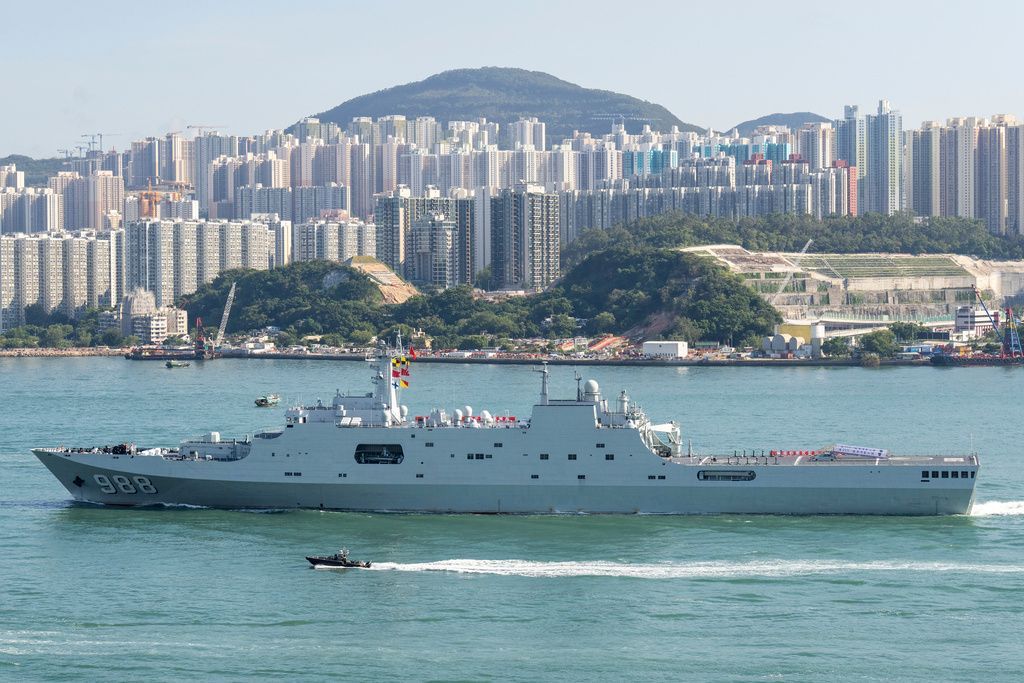
At this week’s APEC summit in Shenzhen, China, President Xi Jinping is offering the mirage of a Chinese Communist Party that seeks only “win-win cooperation” and peaceful coexistence with the world. Chinese military activities testify to a different truth.
In major naval exercises earlier this month, China’s People’s Liberation Army trained to deter and deny U.S. military support for Taiwan in a future war. The PLA would want to delay U.S. policymakers or military forces from assisting Taiwan until it was too late to matter.
As the Institute for the Study of War outlines, these exercises involved task forces from each of the PLA’s three maritime-operations responsible theater commands. The ISW notes that the snap exercises are designed to show that the PLA can surge forces at short readiness and rapidly establish joint offensive and defensive strongholds around Taiwan — offensive against Taiwanese forces, defensive against any intervening U.S. or allied forces.
CHINA LASHES OUT, FEARING FAILED PLAN TO HIDE FISHING ECOCIDE
The question of time is a key concern for U.S. military planners. China has been working hard to shorten the warning time, or intelligence indications, that the United States would have in advance of any attack on or blockade of the island democracy. The shorter that warning time, the more likely that the PLA could deploy forces formidably enough to deter U.S. intervention.
This is not trivial.
Xi views the subjugation of Taiwan under the Communist Party flag as the key test of his and the party’s political destiny. He has told the PLA to be ready to conquer Taiwan by 2027. And while Xi’s purges of the PLA senior leadership have likely diluted his short-term confidence in being able to pull off an attack, these purges increase his medium-term threat. In the interim, the PLA is rapidly developing its ability to operate further out into the Pacific Ocean. It is also training for preemptive strikes on U.S. airfields.
Unfortunately, Taiwan’s progress in boosting its defenses remains unsteady. While President Lai Ching-te has pushed for bold defense boosts, too many in parliament continue to show a casual, peacetime mentality. More positive is Taiwan’s refocusing of defense resources on domestic manufacturers that can offset long delays to U.S. weapons deliveries. The country is also rightly adopting a “porcupine” defense strategy that prioritizes survivability and unmanned systems over a “fight-everywhere” approach. Taipei has recognized that the latter strategy would risk the country being overwhelmed everywhere, at once, by the PLA’s far greater scale.
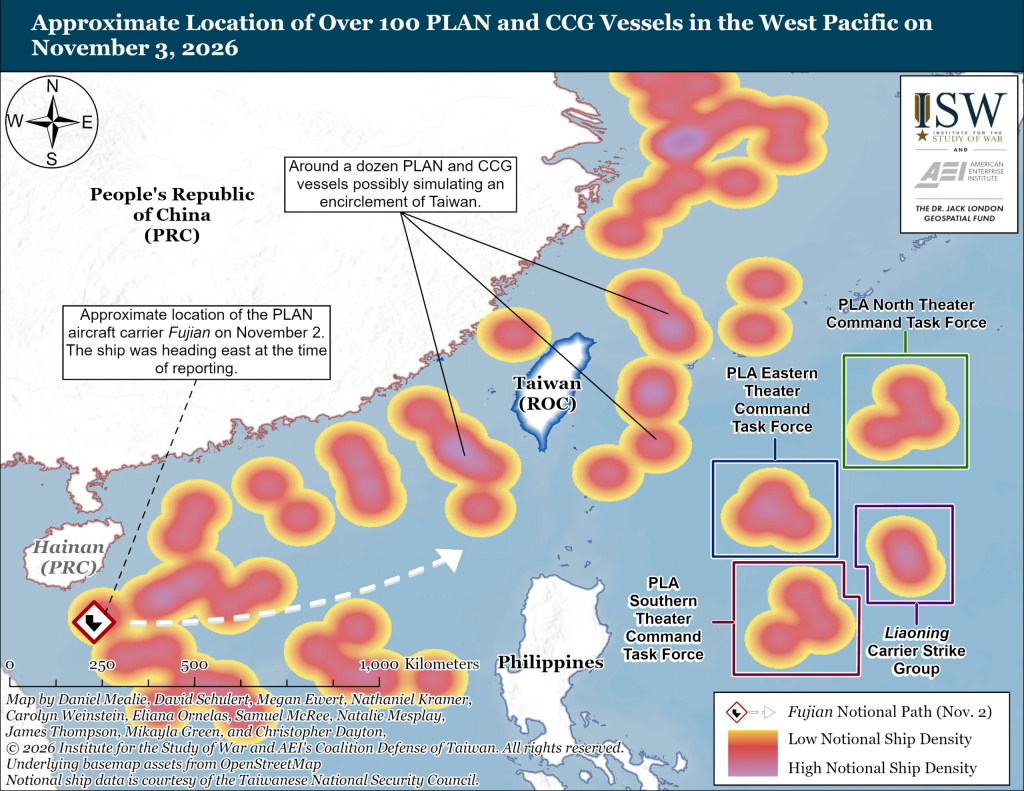
Regardless, these recent exercises reflect Xi’s recognition that his best prospect in seizing Taiwan would be to act with such great force and speed that the result was a fait accompli before the U.S. military even arrived. Consider the ISW’s map below.
(Institute for the Study of War)
Rarely has a picture been more worth a thousand words.
Note the disposition of PLA naval forces. We see the PLA Northern Theater Command Task Force (top right) acting as a blocking force against the U.S. military bastion on Okinawa, and the U.S. 7th Fleet at Yokosuka (near the Japanese capital Tokyo). To the southeast, we see the Liaoning carrier group acting as a blocking force for the 7th Fleet and any responding U.S. forces from Hawaii. Reflecting the Southern Theater Command’s heavy focus on anti-submarine warfare, its task force is positioned to intercept U.S. attack submarines that would be deployed from Guam and Hawaii (the PLA is investing great time, supported by Russia, in boosting its anti-submarine warfare capabilities).
Next up, the PLA Eastern Theater Command Task Force is positioned as a supporting element for the other two task forces. We see numerous other forces encircling Taiwan, and arrayed along the Chinese coast to protect air and land-based forces.
China is sending an unambiguous strategic message here: “We will surge forces with such scale and speed that you will pay dearly even attempting to force your way through to Taiwan.”
The Philippines deserves special attention in this regard. Pay heed to how the PLA is deployed in strength not only to that country’s east, but also to its west and north. At the political level, this encirclement is designed to dissuade the Philippines government from entering any conflict and to prevent the U.S. military from conducting combat operations on their soil. At the military level, it is designed to counter U.S. military land-based drone and missile operations in war.
The U.S. Marine Corps has been particularly focused on basing small units with portable but potent weapons on Japanese islands surrounding Taiwan. Under its courageous prime minister, Sanae Takaichi, Japan has made all but certain that it would join any U.S. defense of Taiwan. But there is little question that both the Marine Corps and the Army would operate forces from the Philippines if Manila allowed it. Some potential operating areas such as the Batanes islands, just 90 miles southeast of Taiwan, would pose big problems for the PLA.
China knows all this.
It knows that if the U.S. could utilize the Philippines for combat operations, it could support other U.S. and Japanese forces in stopping the PLA from quickly flanking and cordoning off Taiwan. The Philippines would also be crucial in allowing U.S. air power to sustain operations around Taiwan. And at a strategic level, it would help Pacific Command to persuade U.S. policymakers that the PLA’s great maritime walls were not as impenetrable as they first appeared.
IN UK ARREST OF US SOLDIER, A REMINDER RUSSIA CAN SPY EFFECTIVELY
For both China and the U.S., then, the key strategic interest here rests on complicating one another’s opening military actions in any crisis. China wants to quickly establish a seemingly impenetrable defensive line around Taiwan before even the tip of the American spear can arrive. The U.S. wants China to know that its spear is a trident with many prongs, American allies and their territories foremost among them. And that these various prongs can immediately start bleeding PLA lines and buy enough time for U.S. reinforcements to arrive en masse.
Ultimately, however, these exercises are an unambiguous signal of intent. Acting at this scale is expensive and politically potent. China wants Taiwan and it wants it badly. And China wants the U.S., Japan, and the Philippines to know it.
Continue reading...
[ H/T Washington Examiner ]