





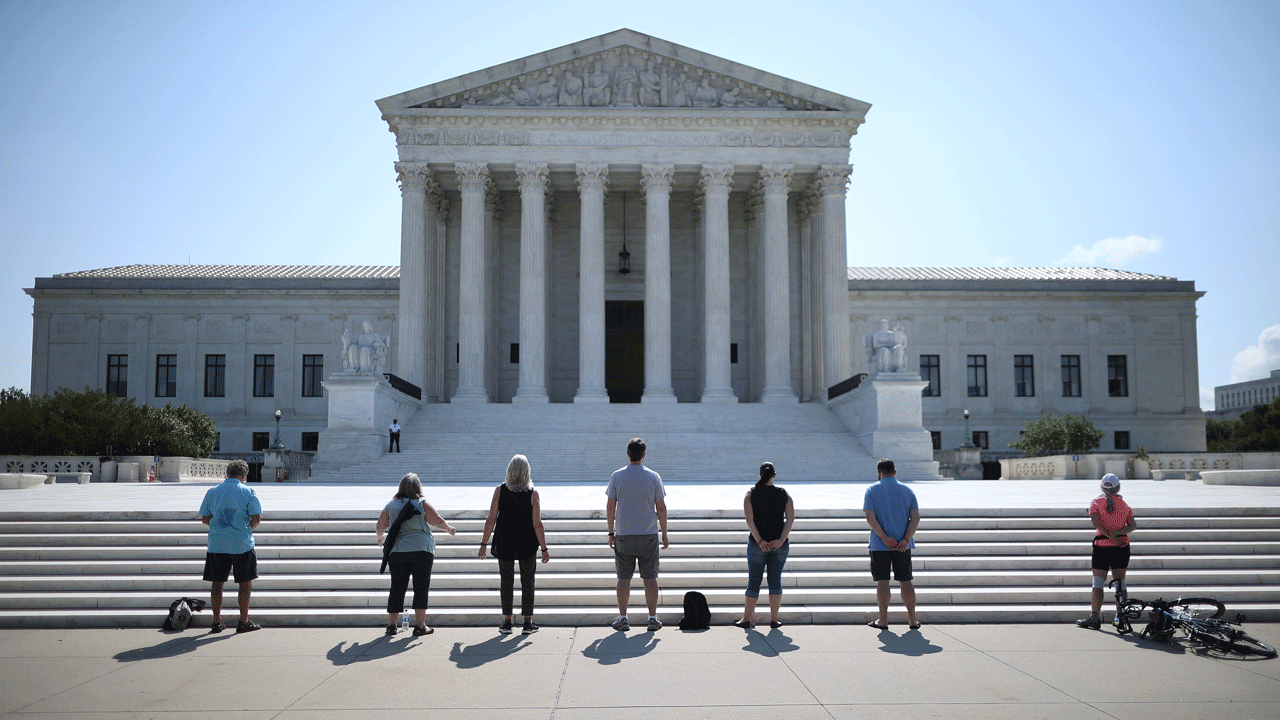
On Oct. 1, 2026, the Supreme Court of the United States agreed to hear Missionaries of Saint John the Baptist, Inc. v. Frederic and answer an important question: Does a regulation prohibiting a church from building a religious structure on its own property violate the Religious Land Use and Institutionalized Persons Act (RLUIPA)?
The answer is yes, and the court should say so without conditions.
RLUIPA, enacted in 2000, addresses a significant threat to the First Amendment’s protection of our free exercise of religion. Zoning codes and discretionary permitting processes could be read to exclude or disfavor houses of worship, particularly smaller or less familiar ones. So, the statute’s Substantial Burden Provision bars any government from implementing a land-use regulation in a way that substantially burdens religious exercise unless the government proves the burden is the least restrictive means of furthering a compelling government interest.
Fortunately, RLUIPA defines “religious exercise” broadly. The statute protects “any exercise of religion, whether or not compelled by, or central to, a system of religious belief,” and “the use, building, or conversion of real property” for religious purposes.
The statute also directs that it “be construed in favor of a broad protection of religious exercise, to the maximum extent permitted” by its terms and the Constitution. While the statute does not define “substantial burden,” lower courts have filled the gap with at least 16 competing factors, including whether adequate alternatives exist, whether the perceived harm is self-imposed, and whether a denial is absolute or conditional.
The Missionaries of Saint John the Baptist, Inc. own Our Lady of Lourdes, a church built in 1930 in a residential neighborhood of Park Hills, Kentucky. The group sought to build a grotto honoring the Virgin Mary on the adjacent lot, roughly 16 by 39 feet—about the size of a backyard pool. The placement reflects the Lourdes tradition, in which Mary asked St. Bernadette to “tell the Priests that a chapel must be built” beside the grotto.
The local Board of Adjustment approved the project and noted the grotto would contribute to the general well-being of the neighborhood. Yet two neighbors disagreed and challenged the Board’s approval in state court. The Kentucky Court of Appeals held the approval unlawful, and the Kentucky Supreme Court affirmed.
Kentucky’s highest court conceded that building the grotto is religious exercise but held the ban was not a substantial burden, saying that the Missionaries could build a smaller shrine on the church lot, making the prohibition “a mere inconvenience.” The court also said that the burden was “self-imposed” because the Missionaries knew the ordinance barred the project.
This case presents three powerful arguments in favor of protecting Americans’ First Amendment right to practice their religion free from regulation. First, RLUIPA makes building a religious structure religious exercise in its own right. So, preventing the building of the grotto presents an outright prohibition on a protected religious activity—the paradigm of substantially burdening First Amendment rights.
Second, the Kentucky Supreme Court’s “build something smaller elsewhere” rationale contradicts the Supreme Court’s decision in Holt v. Hobbs. There, the Court held that RLUIPA’s inquiry asks “whether the government has substantially burdened religious exercise,” and “not whether the RLUIPA claimant is able to engage in other forms of religious exercise.” A court may not tell a church that a lesser shrine elsewhere is close enough.
Third, the “self-imposed burden” rule applied by the Kentucky Supreme Court would gut RLUIPA. The Missionaries did acknowledge in their application that the ordinance did not permit the grotto. That candor proves nothing. Every RLUIPA claimant seeks relief from a rule that already exists. If knowledge of the restriction defeats the claim, a government can immunize any burden simply by enacting it first.
This term, the Supreme Court should prescribe a clear rule: When the government forbids a religious institution from building a religious structure on its own land, that is a substantial burden, and the government must justify it.
We publish a variety of perspectives. Nothing written here is to be construed as representing the views of the Daily Signal.
Continue reading...
[ H/T The Daily Signal ]