




“It’s a fairytale f***ing town, isn’t it? How can a fairytale town not be somebody’s f***ing thing?” So thundered Ralph Fiennes’s Harry in Martin McDonagh’s 2008 black comedy In Bruges, confounded at the thought that someone might be indifferent to the quaint charms of medieval Belgium. McDonagh’s latest work, Wild Horse Nine, dispatches another pair of professional killers to an idyllic holiday destination for a final sendoff. The film is wonderfully funny and unexpectedly moving, a tribute to life, male friendship — and, depending on your sympathies, the CIA.
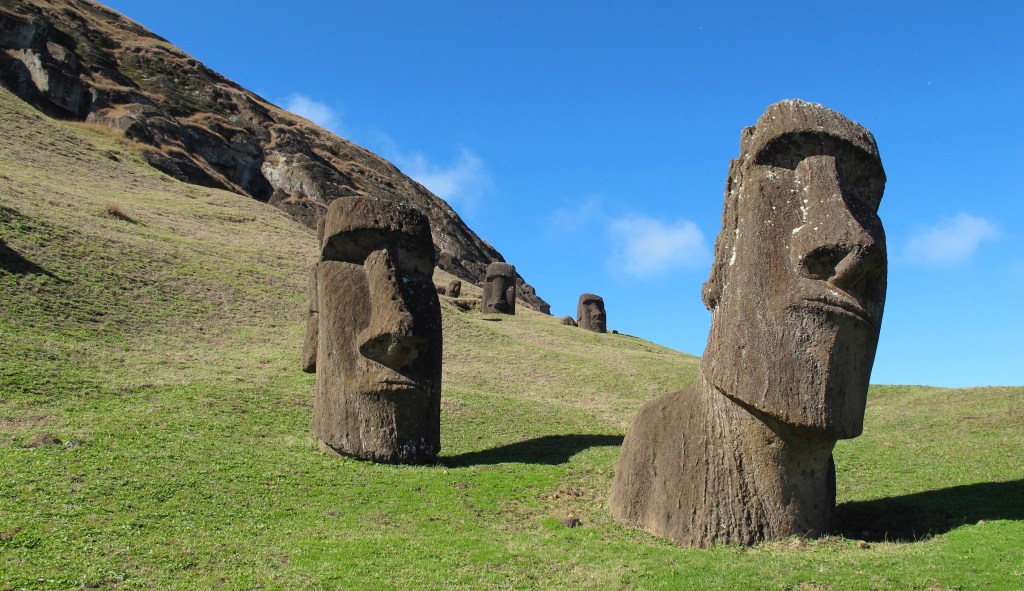
It is 1973, and CIA agents Chris Carlisle (John Malkovich) and Lee Chesterfield (Sam Rockwell) are stationed in Chile, where Salvador Allende’s Marxist government is living on borrowed time. Their bureau chief, MJ (Steve Buscemi), sends them to Easter Island, ostensibly for a respite from toppling socialists. For Chris, who is dying of cancer, the trip offers a chance to see the island’s celebrated stone statues — the “big heads,” as he insists on calling them — before his time runs out.
The premise recalls In Bruges, although McDonagh has exchanged Belgium’s cobblestones and canals for the vast, windswept pastures and volcanic coastline of Rapa Nui. The sweeping cinematography lends the island an otherworldly beauty. Much of the film consists of the two men driving through these lush, verdant landscapes, exchanging the sort of beguilingly mundane banter that only old friends can sustain. Chris needles Lee about his drolly dysfunctional marriage (to an underused Parker Posey), while Lee ripostes with snide remarks about Chris’s reliance on morphine. Their bond also evokes McDonagh’s The Banshees of Inisherin, although here their mutual exasperation seems only to reinforce the friendship.
Cancer, morphine and a failing memory have stripped Chris of whatever social inhibitions a lifetime in espionage might have cultivated. He makes even Larry David look tactful. In a restaurant, upon learning that a couple at the next table is English, he gleefully explains that he was “on Ireland’s side.” He also revels in ribbing tourists who insist upon calling Easter Island “Rapa Nui” — its “indigenous name,” as they self-righteously remind him. Chris can at least take comfort in knowing he won’t live to see how much worse such woke grievances get. His habit of casually divulging, or boasting about, state secrets, including insinuations about the assassination of John F. Kennedy, has begun to worry his superiors.
The political backdrop allows McDonagh to revisit the familiar justification of doing “a terrible thing for the greater good.” Personally, I find the agents’ anti-Marxist enterprise considerably more sympathetic than do the two earnest left-wing Chilean students whom Chris tries to woo. By 1973, Allende’s experiment in nationalization, money-printing and price controls had produced soaring inflation, shortages and flourishing black markets. If this was economic liberation, Chile was overdue for a shipment of America’s finest export: capitalism. Yet McDonagh wisely resists lecturing viewers on U.S. foreign policy, focusing instead on the men tasked with carrying out Washington’s designs. Chris has few regrets about the regimes he helped topple; the innocents caught in the machinery of these grand geopolitical ambitions weigh more heavily on him.
Unlike Ray in In Bruges, whose torment centers on a single unforgivable transgression, Chris is confronting the accumulated weight of an entire life. Among McDonagh’s subtlest triumphs is a scene in which Chris confides that he has always yearned to watch a Western from the perspective of the horse. It is a devastating image, the animal carrying the cowboy into battle with no say in the cause. Chris sees something of himself in that horse, an unlikely Cold War counterpart to Boxer, Orwell’s tireless cart horse in Animal Farm. Both have spent their lives serving the designs of others, although Chris must reckon with the innocents trampled along the way. His Catholicism complicates his wish to hasten death as suicide is forbidden; he has devised a theologically dubious loophole that drives the film’s dark premise.
ANNA PAULINA LUNA SAYS CIA DECLASSIFYING NEWLY DISCOVERED MKULTRA DOCUMENTS
Call them “the boys,” “buds,” “bros,” or whatever else. A man may have siblings, a spouse and children, but his oldest male friendships occupy a peculiar place among these relationships. They often flourish through a vocabulary of barbs and sarcasm that conceals enormous affection. Beneath Chris and Lee’s relentless bickering lies precisely such a bond. With his health deteriorating and his past finally catching up, Chris has little left beyond Lee’s companionship. Malkovich gives an extraordinary performance, at once insufferable, hilarious, and heartbreakingly vulnerable, easily worthy of an Oscar nomination. Rockwell is his ideal foil, displaying the professional discretion of a younger agent who still has plenty of communist leaders left to oust.
The Rolling Stones’ “Out of Time” and Judy Collins’s rendition of Joni Mitchell’s “Both Sides Now” are beautifully worked into the soundtrack, their meditations on time and perspective fitting a man reconsidering his life. I suspect Wild Horse Nine will only improve on subsequent viewings as the subtleties woven into McDonagh’s rich dialogue reveal themselves. Beneath its absurdities and irreverence lies a deeply human story — something we could always use more of, along with the occasional toppled tyrant.
Harry Khachatrian (@Harry1T6) is a film critic for the Washington Examiner. He is a software engineer, holds a master’s degree from the University of Toronto, and writes about wine at BetweenBottles.com.
Continue reading...
[ H/T Washington Examiner ]