


Young progressives are quick to condemn sexism, homophobia, and intolerance. They demand consequences for offensive jokes, misgendering, and speech they consider hateful. Yet many find ways to defend radical Islamist movements that stand against the very rights they champion.
President Donald Trump recently pointed to this contradiction at a rally in Youngstown, Ohio. Mocking the slogan “Gays for Palestine,” he questioned whether its supporters understood how gay people are treated in parts of the Middle East. He raised a question worth asking: How does someone who considers a misgendered pronoun an act of intolerance excuse a movement that persecutes gay people? And how does someone who believes women should control their own lives defend an organization whose ideology denies women basic freedoms?
Advocating Palestinian civilians doesn’t mean endorsing Hamas. Some LGBT activists make that distinction. But those who do celebrate Hamas while championing gay rights at home have a harder contradiction to explain.
As a psychotherapist, I often listen to people justify behavior that contradicts their own values. They rarely see themselves as hypocrites. Instead, they find ways to explain why the rules they insist others follow somehow don’t apply to them.
Consider what happened on college campuses earlier this month, on the third anniversary of Hamas’s Oct. 7, 2023, massacre. According to the Anti-Defamation League, student activists at several universities praised the attack or celebrated those responsible. At Penn State, a student group declared, “Glory to the Palestinian resistance! Long live Al Aqsa Flood!” At SUNY Oswego, a Students for Justice in Palestine chapter praised Hamas leader Yahya Sinwar.
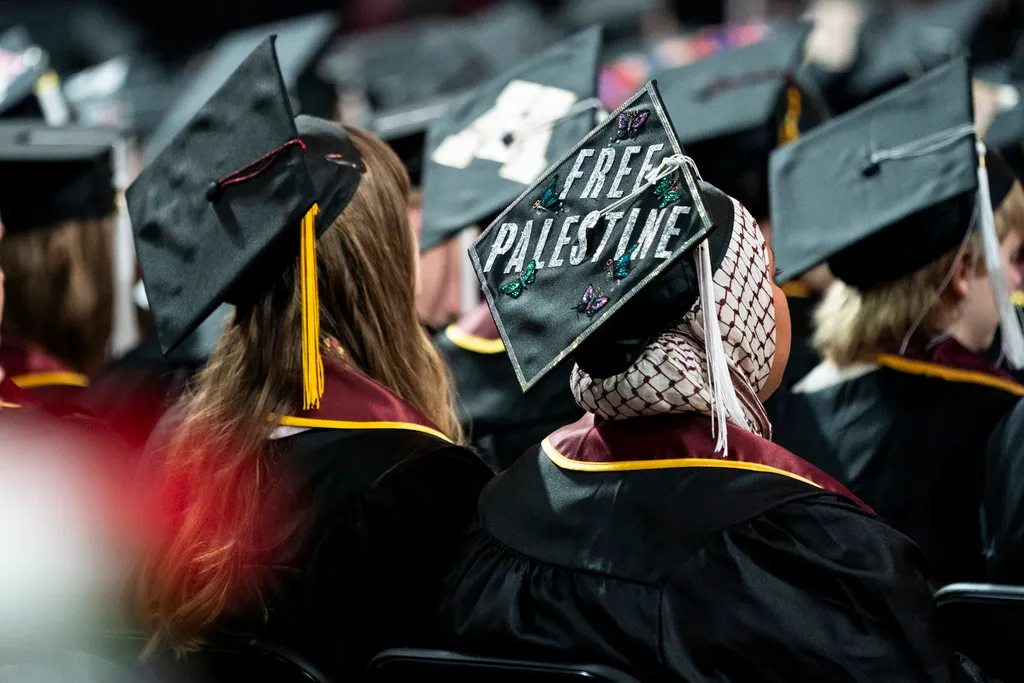
A student sits with her cap decorated to read “Free Palestine” while attending the University of Minnesota’s College of Liberal Arts graduation ceremony, Sunday, May 12, 2024, in Minneapolis, Minn. (Angelina Katsanis /Star Tribune via AP)
" data-large-file="https://www.washingtonexaminer.com/wp-content/uploads/2024/05/AP24134097110913.jpg?w=1024" src="https://www.washingtonexaminer.com/wp-content/uploads/2024/05/AP24134097110913.jpg?w=1024" alt="A student sits with her cap decorated to read "Free Palestine" while attending the University of Minnesota's College of Liberal Arts graduation ceremony, Sunday, May 12, 2024, in Minneapolis, Minn. (Angelina Katsanis /Star Tribune via AP)" class="wp-image-3007481" srcset="https://www.washingtonexaminer.com/wp-content/uploads/2024/05/AP24134097110913.jpg 1024w, https://www.washingtonexaminer.com/wp-content/uploads/2024/05/AP24134097110913.jpg?resize=300,200 300w, https://www.washingtonexaminer.com/wp-content/uploads/2024/05/AP24134097110913.jpg?resize=768,512 768w" sizes="(max-width: 1024px) 100vw, 1024px">
A student sits with her cap decorated to read “Free Palestine” while attending the University of Minnesota’s College of Liberal Arts graduation ceremony, Sunday, May 12, 2024, in Minneapolis, Minn. (Angelina Katsanis /Star Tribune via AP)
Supporting Palestinian rights, criticizing Israel, or opposing the war in Gaza doesn’t make someone a Hamas supporter. Pew Research Center polling published in July found that young Democrats viewed Palestinians considerably more favorably than Hamas. But why would even a minority defend an organization whose beliefs are so incompatible with their own?
The answer could be that some activists have become so focused on who holds power that they’ve stopped paying enough attention to what people actually do. The world gets divided into oppressors and the oppressed. Once a group is identified as oppressed, criticizing it can feel like siding with its oppressor. Its actions become understandable, then defensible, sometimes even admirable. They still believe in their principles. They’re just willing to make exceptions when it’s politically convenient.
I’ve seen similar reasoning in therapy. A patient may insist honesty is essential in a relationship, then spend an entire session explaining why a partner’s repeated lies are understandable. He had a difficult childhood. He’s under stress. He doesn’t mean to hurt anyone. Each explanation may contain some truth, but together they allow the patient to avoid confronting unacceptable behavior.
Political movements encourage similar reasoning: Someone who would never tolerate religious restrictions on women in America may hesitate to criticize those same restrictions when imposed by a group perceived as resisting Western power.
You can understand why people are angry without defending what they do with that anger. Legitimate grievances don’t justify murdering civilians. But once people become emotionally invested in a cause, they may begin making excuses for actions they would condemn under other circumstances. Acknowledging wrongdoing by their own side can feel like handing a victory to their opponents.
There’s also peer pressure. College students want to fit in, and political activism can give them a sense of belonging. But what happens when everyone around you is praising a cause, and you’re the one person who thinks something is wrong? Speaking up might cost you friendships.
There’s another factor: the fear of being accused of disloyalty. In some activist circles, criticizing Hamas can be interpreted as abandoning Palestinians altogether. That creates a false choice between defending Palestinian rights and condemning terrorism. Students who privately recognize the contradiction may remain silent rather than risk being ostracized. Over time, that silence allows the loudest voices to define what the entire movement stands for.
Protesters march passed a police line prior to the start of the Democratic National Convention Sunday, Aug. 18, 2024, in Chicago. (AP Photo/Frank Franklin II)
" data-large-file="https://www.washingtonexaminer.com/wp-content/uploads/2024/08/Free-Palestine-Protest.webp?w=1024" src="https://www.washingtonexaminer.com/wp-content/uploads/2024/08/Free-Palestine-Protest.webp?w=1024" alt="Protesters march past a police line prior to the start of the Democratic National Convention." class="wp-image-3125485" srcset="https://www.washingtonexaminer.com/wp-content/uploads/2024/08/Free-Palestine-Protest.webp 1024w, https://www.washingtonexaminer.com/...08/Free-Palestine-Protest.webp?resize=300,200 300w, https://www.washingtonexaminer.com/...08/Free-Palestine-Protest.webp?resize=768,512 768w" sizes="auto, (max-width: 1024px) 100vw, 1024px">
Protesters march past a police line prior to the start of the Democratic National Convention Sunday, Aug. 18, 2024, in Chicago. (AP Photo/Frank Franklin II)
When your political views become part of your identity and social circle, questioning them can feel like risking your friendships. Social media intensifies that pressure. A complicated conflict becomes a slogan or short video. Outrage attracts attention. There’s little reward for saying Palestinian civilians deserve protection while Hamas deserves condemnation, or that Israeli security concerns are legitimate while particular Israeli policies deserve criticism. Those distinctions don’t fit neatly into an activist chant.
People also dislike ambiguity. It’s reassuring to believe one side is good and the other bad. Once that judgment is made, contradictory information becomes something to dismiss rather than consider.
Radical Islamist movements and progressive activists don’t necessarily share a vision of society. They may simply share an adversary, whether that’s Israel, American foreign policy, or the West.
There’s an irony here. Some activists who demand consequences for offensive speech at home seem willing to overlook far more serious violations of individual rights abroad. A controversial joke can cost someone a job, while the persecution of gay people or restrictions on women get explained away as cultural or political context. Would these same activists be so understanding if a conservative Christian organization held similar beliefs?
Hamas’s founding charter is explicitly Islamist, and its ideology conflicts with progressive commitments to religious pluralism, sexual freedom, and individual autonomy. Supporting Palestinian self-determination is one thing. Endorsing Hamas, with its own religious and political agenda, is another.
There’s nothing inconsistent about defending Muslims against prejudice, supporting Palestinian statehood, and rejecting Islamist extremism. The contradiction arises when activists excuse violence or authoritarian beliefs because they sympathize with the cause.
TRUMP AIDES FIRE BACK AT PRESS OVER ZACHARIA
As a psychotherapist, I encourage people to question whether their explanations help them confront reality or avoid it. The same principle applies to politics. If women’s rights, gay rights, and freedom of expression matter, they should matter regardless of who violates them.
It’s easy to condemn intolerance when it comes from people you dislike. The real test is whether you’re willing to condemn it when it comes from people whose cause you support.
Continue reading...
[ H/T Washington Examiner ]